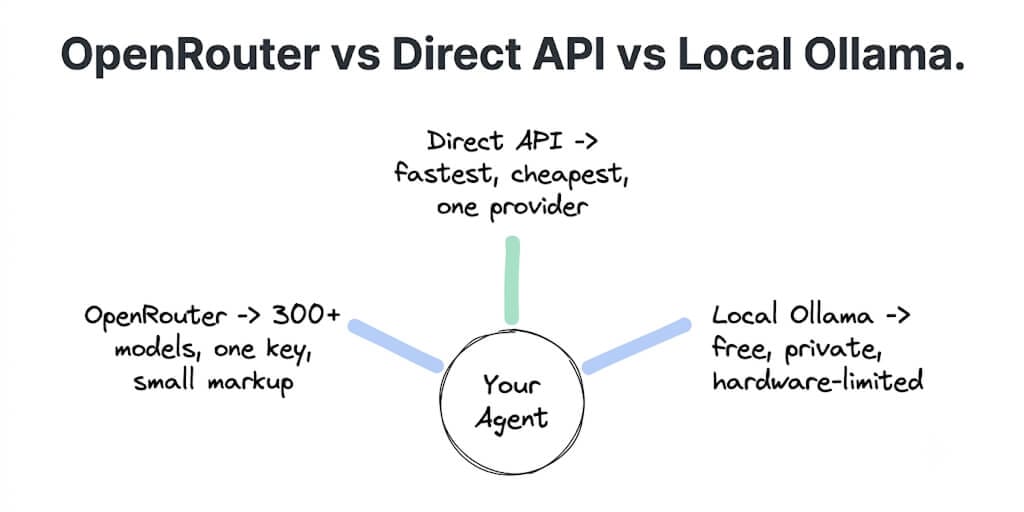
Three ways to connect your agent to an LLM. Each has a different price, a different speed, and a different failure mode. Here's the actual data on all three, so you can stop guessing.
All three paths, one dashboard.
BetterClaw connects OpenRouter, direct APIs, and local endpoints via BYOK — switch in settings, zero inference markup. Free forever, not a trial. Start free → No credit card · 28+ providers · BYOK
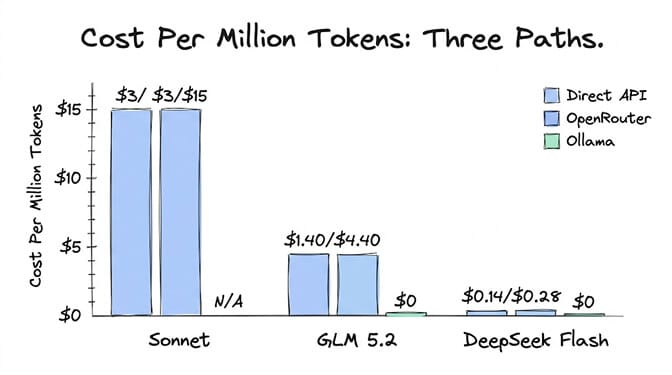
I was paying $3/M for Claude Sonnet through OpenRouter. Then I checked Anthropic's direct pricing. Also $3/M. Why am I routing through a middleman if the price is the same?
Then I checked GLM 5.2. Direct via Z.ai: $1.40/M. OpenRouter: $1.40/M. Same price again.
Then I checked DeepSeek. Direct: $0.14/M. OpenRouter: $0.14/M.
Here's the thing nobody tells you: OpenRouter passes provider token prices through with no markup. What you do pay is a 5.5% fee when you buy credits by card, or, if you bring your own provider keys, nothing up to $25,000 of list-price inference a month and 5% after that. (For the two-way deep dive on just cloud routing, see our OpenRouter vs direct API comparison.) The value proposition isn't cheaper tokens. It's operational flexibility. One API key, 500+ models, automatic fallbacks.
That extra network hop does add latency, though far less than people assume: OpenRouter's own docs put it at roughly 15ms under typical conditions, a little more while edge caches warm up.
And then there's Ollama. Free tokens. Zero latency to a cloud endpoint. But you need the hardware, and the models are smaller.
Here's the real comparison with actual numbers. OpenRouter vs Direct API vs Local Ollama for agent workloads.
Pricing: the table that decides it for most people
| Model | Direct API | OpenRouter | Markup | Ollama (Local) |
|---|---|---|---|---|
| Claude Sonnet 4.6 | $3/$15/M | $3/$15/M | 0% | N/A (proprietary) |
| Claude Opus 4.8 | $5/$25/M | $5/$25/M | 0% | N/A |
| GPT-5.5 | $5/$30/M | $5/$30/M | 0% | N/A |
| GLM 5.2 | $1.40/$4.40/M | $1.40/$4.40/M | 0% | Free (MIT, self-host) |
| MiniMax M3 | $0.60/$2.40/M | $0.60/$2.40/M | 0% | Free (MIT, self-host) |
| DeepSeek V4 Flash | $0.14/$0.28/M | $0.14/$0.28/M | 0% | Free (MIT, GGUF) |
| Qwen 3.6 | $0.40+/M (Alibaba) | $0.40+/M | ~0% | Free (Apache 2.0) |
| Gemma 4 12B | Free tier (Google) | varies | varies | Free (Apache 2.0) |
The pattern: OpenRouter's per-token prices match the direct provider's rates, with no markup. It makes its money on the 5.5% fee when you buy credits (5% with crypto) and the 5% BYOK fee above $25,000/month of list-price inference. Our OpenRouter pricing breakdown has the worked numbers.
Where Ollama wins: Any open-weights model (GLM 5.2, MiniMax M3, DeepSeek, Qwen 3.6, Gemma 4) is completely free to run locally. Zero per-token cost. The cost is hardware and electricity.
OpenRouter's real cost isn't a token markup. It's the 5.5% credit fee, which you can avoid with BYOK. Direct API's real cost isn't the single-provider lock-in. It's the operational complexity of managing 5 different API keys. Ollama's real cost isn't the tokens. It's the hardware and the model quality ceiling.
Speed and latency (where the differences actually matter)
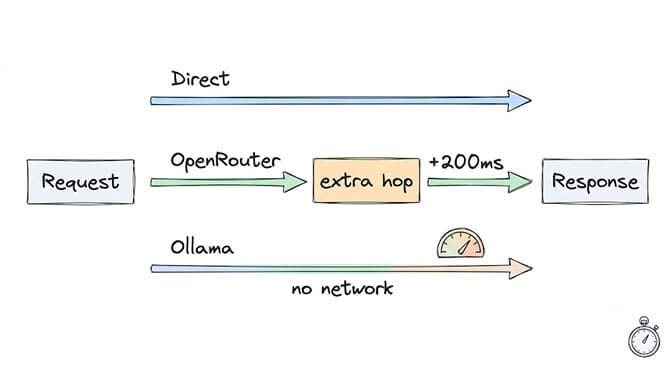
Direct API: Fastest. Your request goes straight to the provider. Time-to-first-token (TTFT) depends on the provider's infrastructure. Claude Sonnet: ~1-2s TTFT. DeepSeek Flash: ~0.5-1s. GLM 5.2: ~2.2s (Artificial Analysis median).
OpenRouter: Adds one network hop. Your request goes to OpenRouter, OpenRouter forwards it to the provider, the response comes back through OpenRouter. OpenRouter's docs put the added latency at roughly 15ms under typical production conditions, higher for the first minute or two in a new region while its edge caches warm. On a single request, negligible. On an agent that chains 5 tool calls per task at 500 tasks per day, it adds up to well under a minute of routing overhead per day.
Local Ollama: No network latency at all. But inference speed is limited by your hardware. Qwen 3.6 on 16 GB Apple Silicon: 25-35 tok/s. Compare to cloud inference at 50-113 tok/s for the same model. Local is zero-latency to start but slower to finish.
The math that matters for agents:
An agent that processes 500 tasks/day with 5 tool calls per task (2,500 API calls/day):
- Direct API total overhead: 0ms routing (just provider latency).
- OpenRouter total overhead: 2,500 × ~15ms = about 38 seconds of added routing per day.
- Ollama: 0ms network, but each call takes 2-3x longer due to slower inference.
For almost every agent, OpenRouter's routing hop is noise next to the provider's own time-to-first-token. It only becomes a real consideration for latency-critical, very high-volume pipelines.
Reliability: the dimension nobody compares
OpenRouter's killer feature: Automatic fallbacks. If Anthropic's API goes down, OpenRouter can route your request to a different provider serving the same model. If one endpoint is slow, OpenRouter can load-balance to a faster one. For production agents that need uptime, this is worth more than the latency cost.
Direct API risk: Single point of failure. If Anthropic is down, your Claude agent is down. If DeepSeek has a regional outage, your Flash agent stops. You need to build your own fallback logic.
Ollama risk: Your hardware is the single point of failure. Laptop sleeps? Agent stops. RAM fills up? Agent hangs. Connection errors are the most common Ollama agent issue. No SLA. No redundancy unless you set up multiple machines.
The Fable 5 lesson: When Anthropic disabled Fable 5 on June 12th, every direct API user lost access immediately. OpenRouter users who had configured model fallbacks switched to Opus 4.8 automatically. The agents that kept running were the ones with multi-model routing already configured.
The decision framework (which path for which use case)
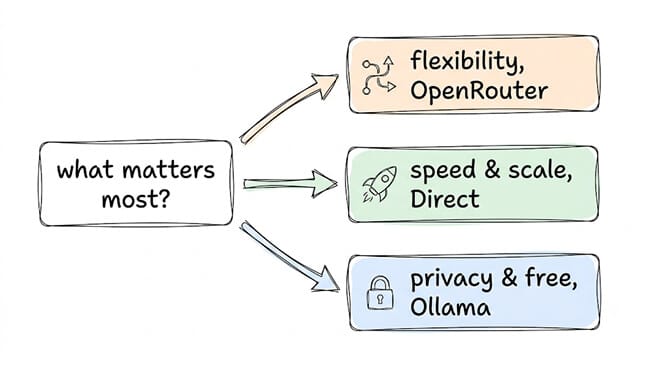
Use OpenRouter when:
- You want model flexibility. One API key, 500+ models. Test Claude, switch to GLM 5.2, try MiniMax M3, compare DeepSeek Flash. All through the same endpoint. No separate accounts, no separate API keys, no separate billing dashboards.
- You want automatic fallbacks. Production agents that need uptime. If one provider goes down, OpenRouter routes to an alternative.
- You're testing and iterating. During development, you switch models constantly. OpenRouter lets you change models without changing keys or endpoints.
Use Direct API when:
- Speed is critical. Real-time chat agents, customer-facing responses, latency-sensitive pipelines. Eliminating the OpenRouter hop removes its routing overhead (roughly 15ms per request, per OpenRouter's docs), which matters only at the latency-critical end.
- You're at scale. 50,000+ API calls per day. The cumulative routing overhead of OpenRouter adds up. Direct connections to 2-3 providers (one for each model tier) is worth the operational complexity.
- You need provider-specific features. Anthropic's prompt caching (90% discount on repeated prefixes). OpenAI's automatic caching (50%). Provider-specific cost optimizations that OpenRouter may not fully support.
Use Local Ollama when:
- Privacy is non-negotiable. Data never leaves your machine. No cloud API sees your inputs. For agents processing sensitive financial, medical, or legal data, this matters.
- Cost must be zero. The model runs on your hardware. No per-token cost. For personal agents and development, this saves $20-100/month in API costs. (To pick the local runner itself, our Ollama vs LM Studio comparison covers both.)
- You're offline or air-gapped. No internet required. The agent runs entirely locally. Useful for on-premises enterprise deployments.
If you want all three options through one dashboard without managing separate configurations, BetterClaw supports OpenRouter, direct APIs, and local endpoints via BYOK. Switch between them in settings. 28+ providers with zero inference markup. Free plan with 1 agent and 100 credits a month. $49/month on Pro.
The hybrid approach (what most production teams actually do)
The best agent setups don't pick one. They use all three.
- Development: Ollama for fast iteration. No API costs while testing prompts and tool configurations.
- Staging: OpenRouter for flexibility. Test against multiple models without managing API keys.
- Production: Direct API for speed and cost optimization. Anthropic direct for Sonnet (prompt caching). DeepSeek direct for Flash tier. OpenRouter as fallback.
This three-layer approach gives you zero cost in development, maximum flexibility in staging, and optimized speed and cost in production. Model routing handles the switching automatically.
The teams shipping the best agents in mid-2026 aren't debating OpenRouter vs Direct vs Ollama. They're using all three for different purposes. The right question isn't "which one." It's "which one for which job."
Give BetterClaw a look if you want all three paths through one dashboard. Free plan with 1 agent and 100 credits a month. $49/month for Pro. BYOK with zero markup across all providers. We handle the provider connections. You handle the agent logic.
Frequently Asked Questions
Is OpenRouter more expensive than using APIs directly?
Per token, no. OpenRouter passes provider pricing through with no markup. The extra cost is a 5.5% fee when you buy credits by card ($0.80 minimum; 5% with crypto). If you bring your own provider keys (BYOK), the first $25,000 of list-price inference each month carries no OpenRouter fee, then 5% applies. So on credits you pay roughly 5.5% more than going direct; on BYOK under $25,000/month you pay the same.
How much latency does OpenRouter add?
OpenRouter's documentation puts it at roughly 15ms per request under typical production conditions, slightly more while edge caches warm up in a new region. For an agent making 2,500 API calls per day (500 tasks with 5 tool calls each), that's well under a minute of cumulative routing per day. The provider's own time-to-first-token matters far more.
Can I use Ollama for production agents?
Yes, with caveats. Ollama runs on your hardware, so uptime depends on your machine staying on and responsive. There's no SLA, no automatic scaling, and no redundancy unless you set up multiple machines. Connection errors (laptop sleep, port conflicts, memory overflow) are common. For personal and development use, Ollama is excellent. For production agents that need 24/7 uptime, cloud APIs (direct or via OpenRouter) are more reliable.
Which is cheapest for running AI agents?
Ollama is cheapest for open-weights models (GLM 5.2, Qwen 3.6, Gemma 4): completely free after hardware cost. For cloud APIs, DeepSeek V4 Flash at $0.14/M is the cheapest capable option. OpenRouter and direct API cost the same per token, but buying OpenRouter credits adds a 5.5% fee (BYOK avoids it up to $25,000/month). Beyond that, the difference is operational: OpenRouter simplifies management (one key for all models), direct API requires managing multiple provider accounts but gives you access to provider-specific discounts like Anthropic's 90% prompt caching.
Should I use OpenRouter or direct API with BetterClaw?
BetterClaw supports both via BYOK. For most users, start with OpenRouter (one key, maximum flexibility, easy model switching). Move to direct API when you need speed optimization (real-time chat agents) or provider-specific features (prompt caching). You can use both simultaneously, routing different agent tasks to different providers. Switch between them in settings without reconfiguring your agent.
One dashboard for OpenRouter, direct, and local.
BYOK across 28+ providers with zero inference markup. Route each task to the path that fits. Free forever, not a trial. Start free →