Updated September 28, 2026. Groq retired Llama 3.3 70B and Llama 3.1 8B from its free and Developer tiers on August 16, and OpenAI replaced GPT-5 with GPT-6 Astra, Sol and Luna in September. Every model, price and speed figure below is re-checked against Groq's model docs, OpenAI's pricing docs and Artificial Analysis.
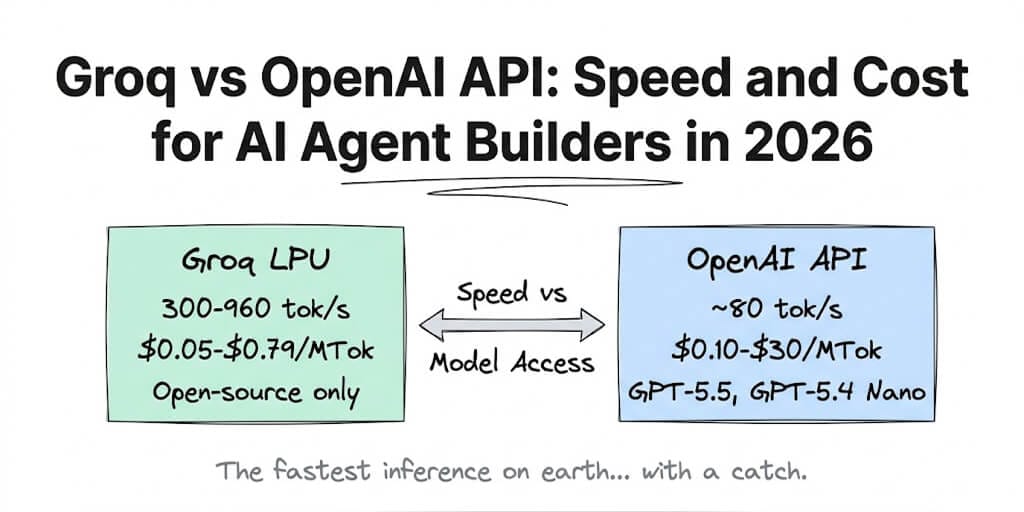
Groq's gpt-oss models run 3-11x faster than OpenAI's GPT-6 Luna and Sol. But Groq only serves open-weight models. Here's when that tradeoff makes sense for agents.
Here's the number that matters. At the output speeds Artificial Analysis measured this month, a 1,000-token response takes about 11 seconds from GPT-6 Sol (91 tokens per second). The same length from gpt-oss-120B on Groq (477 tokens per second) takes about 2 seconds.
For a single API call, the speed difference is nice. For an AI agent that chains 10-15 tool calls per task, each requiring a model inference step, the difference is the gap between a one-minute workflow and a ten-second one. That's not a benchmarking curiosity. That's a fundamentally different user experience.
But here's the part that every Groq vs OpenAI comparison glosses over: Groq only runs open-weight models. No GPT-6. No Claude. No Gemini. And since September, OpenAI's own budget model is both cheaper than Groq's biggest model and scores far higher on quality benchmarks. If your agent needs a proprietary frontier model, Groq isn't an alternative to OpenAI. It's a complement.
Let me break down exactly where Groq wins, where OpenAI wins, and how the math works for real agent workloads.
What Groq actually is (and isn't)
Groq built its name on custom inference chips called LPUs (Language Processing Units), designed specifically to run LLMs fast. On gpt-oss-20B, Artificial Analysis measures Groq at 962 tokens per second, the fastest of the eight providers it tracks for that model.
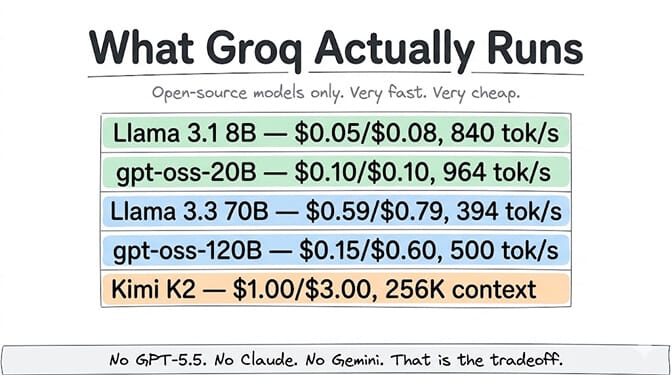
What Groq is not: a model maker. Groq doesn't train frontier models. It runs other people's open-weight models. And that list got much shorter this year. Here's what a free or Developer account can call on September 28, 2026:
| Model on Groq | Status | Price per 1M tokens (input / output) | Groq's listed speed |
|---|---|---|---|
| gpt-oss-120B | Production | $0.15 / $0.60 | 500 tokens/sec |
| gpt-oss-20B | Production | $0.075 / $0.30 | 1,000 tokens/sec |
| Qwen 3.8 27B | Preview | $0.80 / $4.00 | 450 tokens/sec |
| Llama 3.3 70B, Llama 3.1 8B, MiniMax M2.7 | Enterprise contracts only | Contact sales | 280, 560 and 260 tokens/sec |
The retirements are the story. Kimi K2 shut down on April 15. Qwen3 32B and Llama 4 Scout shut down on July 17. Llama 3.3 70B and Llama 3.1 8B were removed from the free and Developer tiers on August 16, and Groq's recommended replacements are gpt-oss-120B and gpt-oss-20B. If an older guide (including an earlier version of this one) told you to run Llama 3.3 70B on Groq, that option is gone unless you sign an enterprise contract.
This means you can't run GPT-6, Claude Opus 5.5, or Gemini on Groq. Those are proprietary models locked to their providers (and cloud partners). If your agent workload requires a specific proprietary model, Groq is out of the conversation for that particular task.
But if your workload runs well on gpt-oss, Groq's speed advantage is large and its pricing is aggressive.
The speed numbers that matter for agents
Here's why Groq's speed is especially relevant for AI agents rather than single API calls.
A typical agent task involves multiple inference steps. The agent receives a request, reasons about it, decides which tool to call, formats the tool parameters, waits for the tool response, reasons about the result, decides the next step, and repeats. Each reasoning step is a model inference call.
Take a 10-step agent workflow with a 500-token response per step. That's 5,000 output tokens. At Artificial Analysis's measured output speeds:
| Model | Output speed | Generation time for 5,000 tokens |
|---|---|---|
| GPT-6 Sol (OpenAI) | 91 tokens/sec | ~55 seconds |
| GPT-6 Luna (OpenAI) | 167 tokens/sec | ~30 seconds |
| gpt-oss-120B on Groq | 477 tokens/sec | ~10.5 seconds |
| gpt-oss-20B on Groq | 962 tokens/sec | ~5 seconds |
Moving that workflow from GPT-6 Sol to gpt-oss-120B on Groq saves about 44 seconds per task. On an agent handling 100 tasks per day, that's about 74 minutes of waiting removed daily. For customer-facing agents where a user is waiting, this is the difference between "this is fast" and "this feels broken."
Two honest caveats. These are output speeds only; they leave out time to first token and the thinking time reasoning models spend before they answer. And Groq isn't the fastest host of every model. For gpt-oss-120B, Artificial Analysis ranks Cerebras (1,768 tokens/sec) and SambaNova (705) ahead of Groq (477).
For the full breakdown of how model routing reduces AI agent costs, the routing principle applies perfectly here: fast, cheap models for speed-sensitive tasks, frontier models for quality-sensitive tasks.
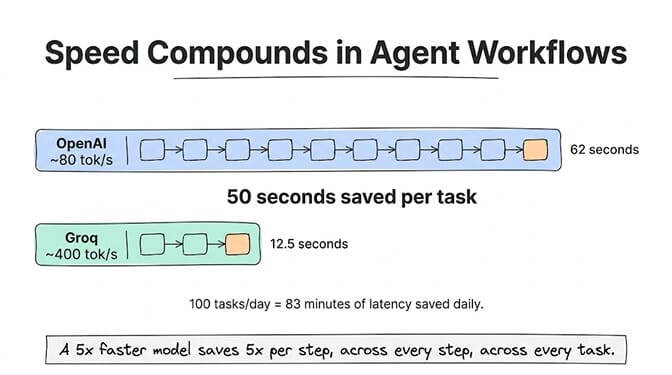
Speed compounds in agent workflows. A 5x faster model doesn't just save time on one call. It saves time on every step, across 10-15 steps per task, across hundreds of tasks per day.
The cost comparison: Groq is cheap, but OpenAI's Luna is cheaper
Let's put real numbers on a month of agent workloads. I'll compare Groq's two production models against OpenAI's three GPT-6 tiers.
Scenario: Support agent processing 3M input + 1M output tokens per day (30 days)
- Groq, gpt-oss-20B ($0.075/$0.30): (3 x $0.075) + (1 x $0.30) = $0.225 + $0.30 = $0.525/day = $15.75/month.
- OpenAI, GPT-6 Luna ($0.10/$0.50): (3 x $0.10) + (1 x $0.50) = $0.30 + $0.50 = $0.80/day = $24/month.
- Groq, gpt-oss-120B ($0.15/$0.60): (3 x $0.15) + (1 x $0.60) = $0.45 + $0.60 = $1.05/day = $31.50/month.
- Groq, Qwen 3.8 27B preview ($0.80/$4.00): $2.40 + $4.00 = $6.40/day = $192/month.
- OpenAI, GPT-6 Sol ($2/$10): $6 + $10 = $16/day = $480/month.
- OpenAI, GPT-6 Astra ($10/$50): $30 + $50 = $80/day = $2,400/month.
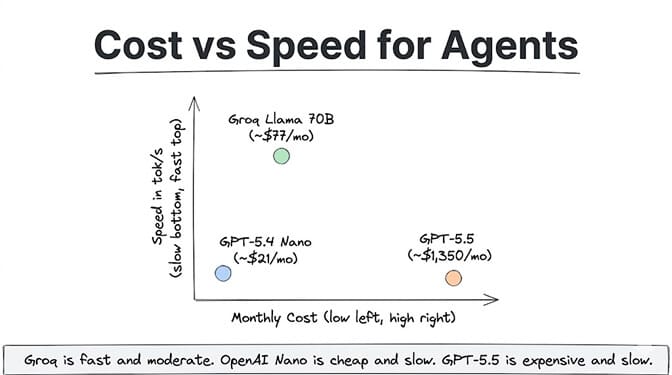
Here's the surprise. GPT-6 Luna costs less than Groq's biggest production model, gpt-oss-120B. And on Artificial Analysis's Intelligence Index, Luna scores 37 against gpt-oss-120B's 12. OpenAI's small model is now both cheaper and much stronger on benchmarks.
So what does Groq still win? Speed. gpt-oss-120B on Groq generates about 2.9x faster than Luna (477 vs 167 tokens per second), and gpt-oss-20B is about 5.8x faster at two-thirds of Luna's price. For a customer-facing agent doing simple, well-defined steps, that speed can be worth more than benchmark points. For anything where the answer needs to be right more than fast, Luna is the better buy.
Against OpenAI's mid tier, the math flips. GPT-6 Sol at $480/month costs about 15x what gpt-oss-120B on Groq costs, and Astra at $2,400 costs about 76x. They're not the same quality class. But for agent steps a small open-weight model handles well, paying frontier rates is waste.
The model quality gap: honest assessment
This is where the comparison gets honest.
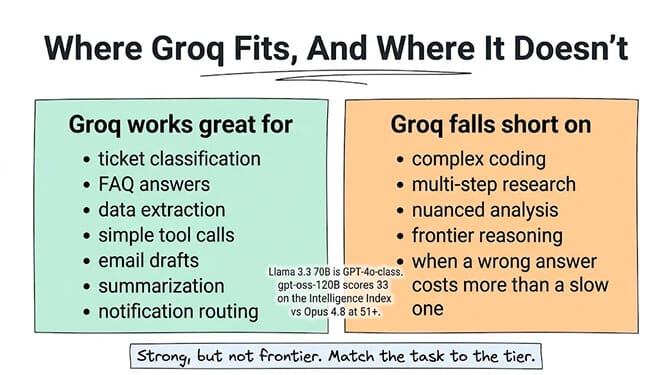
gpt-oss-120B is a capable open-weight model for well-scoped work: classification, extraction, summarization, simple tool calling. For many agent steps it's sufficient.
But it's not a frontier model. On Artificial Analysis's Intelligence Index, gpt-oss-120B scores 12 and gpt-oss-20B scores 9. GPT-6 Luna scores 37 and GPT-6 Sol scores 48. On complex multi-step reasoning, nuanced code generation, and hard analytical tasks, the frontier models pull ahead meaningfully. (For how the frontier options compare on quality and price, see our GPT vs Claude vs DeepSeek breakdown.)
Qwen 3.8 27B, Groq's newest addition, is still in preview, which Groq says means evaluation only and possible discontinuation at short notice. Don't build production on it yet.
Here's the practical framework:
Groq works great for: support ticket classification, FAQ answering, data extraction, simple tool calling, email drafting, content summarization, notification routing, calendar management.
Groq falls short on: complex coding tasks, multi-step research synthesis, nuanced business analysis, tasks requiring frontier-level reasoning, anything where a wrong answer costs more than a slow answer.
Groq's free tier is still a good testing deal
If you haven't tried Groq, the free tier is worth testing. You only add a payment method when you upgrade to the Developer tier. On the gpt-oss models, the free plan allows 30 requests per minute, 1,000 requests per day, 8,000 tokens per minute and 200,000 tokens per day.
For prototyping agent workflows, that's enough to build and test an entire agent pipeline without spending a dollar on inference.
The limits matter for production. The 1,000 requests a day and 8,000 tokens a minute run out quickly with real traffic. The Developer tier raises gpt-oss to 1,000 requests and 250,000 tokens per minute at the same per-token prices, and adds Batch and Flex processing.
This is where a BYOK agent platform makes the testing phase painless. On BetterClaw, you connect a Groq API key for development (free tier, fast iteration). When you're ready for production, you swap in your OpenAI or Anthropic key for the workloads that need frontier quality, and keep Groq for the speed-sensitive tasks. Same agent, same visual builder, different models per task. Free plan with 1 agent and 100 credits a month. $49/month on Pro for 5 agents. Zero inference markup.
The agent architecture that uses both
Here's the setup that actually makes sense for most teams:
Route by task type, not by provider loyalty.
Speed-critical, user-facing tasks: Groq (gpt-oss-120B at ~477 tok/s, or gpt-oss-20B at ~962 tok/s for the simplest steps). Customer chat responses, real-time classification, instant notifications. The user is waiting. Speed matters more than peak quality.
Quality-critical, background tasks: OpenAI (GPT-6 Sol or Astra) or Anthropic (Claude Sonnet 5 or Opus 5.5). Complex analysis, code generation, research synthesis. Nobody's watching the clock. Quality matters more than speed.
High-volume, cost-sensitive tasks: OpenAI's GPT-6 Luna ($0.10/$0.50) or DeepSeek V4.1 Flash ($0.15/$0.60 off-peak, $0.30/$1.20 at peak). Batch processing, data extraction, log analysis. Volume is high. Cost matters most.
This multi-provider routing is exactly what BYOK platforms are built for. You connect keys from Groq, OpenAI, Anthropic, and DeepSeek. An AI agent builder that treats the model as a setting rather than a dependency is what turns that swap into a dropdown. Each agent (or each task within an agent) routes to the optimal provider. (If you'd rather aggregate them behind one key, our OpenRouter vs direct API comparison weighs that tradeoff.) Your support chat agent uses Groq for instant responses. Your coding agent uses Opus 5.5 for accuracy. Your data pipeline uses GPT-6 Luna or DeepSeek for cost.
For a deeper look at how to choose the right model for each task, the decision framework maps well to this multi-provider approach.
The NVIDIA question hanging over everything
I should mention this because it affects Groq's future: in December 2025, Groq signed a non-exclusive licensing agreement with NVIDIA, reported at $20 billion, and NVIDIA hired Groq's founder and CEO Jonathan Ross along with other key staff. It was a licensing deal, not an acquisition.
Then in August 2026, Groq raised a $350 million Series A at a $3.5 billion valuation and repositioned itself as a "neocloud" for inference, building out capacity that includes NVIDIA systems. According to TechCrunch, Groq runs 13 data centers with 54 MW of capacity and plans to exceed 200 MW by 2027.
What this might mean: more capacity and possibly a wider model catalog. What it definitely means: GroqCloud's model list is changing fast, as the retirements above show. Check Groq's deprecations page before you commit a production agent to any model.
For agent builders, the practical implication is simple. Design your agents so the model is a setting, not a dependency. Then a retirement or a faster host is a config change, not a rebuild.
The decision in plain language
If you're building AI agents and evaluating Groq vs OpenAI, here's the honest summary:
Choose Groq when: response speed is your primary concern, your workload runs well on gpt-oss-120B or gpt-oss-20B, you want the free tier for development, or you need open-weight models specifically.
Choose OpenAI when: you need GPT-6 quality specifically, your workload requires frontier-level reasoning, you need the largest ecosystem of tools and integrations built for the OpenAI API format, or you want the best quality per dollar at the budget end (GPT-6 Luna costs less than gpt-oss-120B on Groq and scores far higher).
Choose both when: you're serious about cost and performance optimization. Most production agent systems in 2026 use 2-3 providers. Groq for speed. OpenAI or Anthropic for quality. Luna or DeepSeek for cost. The platforms that make this easy are the ones worth using.
If any of this resonated, give BetterClaw a look. Free plan with 1 agent and 100 credits a month. $49/month for Pro with 5 agents. Connect Groq, OpenAI, Anthropic, DeepSeek, or any of 28+ providers. Zero inference markup. We handle the routing and the infrastructure. You handle building the agent that actually solves the problem.
Frequently Asked Questions
What is Groq and how is it different from OpenAI for AI agents?
Groq is an inference provider that runs open-weight LLMs very fast: Artificial Analysis measures it at about 477 tokens per second on gpt-oss-120B and 962 on gpt-oss-20B, against 91 for OpenAI's GPT-6 Sol and 167 for GPT-6 Luna. The key difference: Groq only runs open-weight models (gpt-oss and Qwen for self-serve accounts). OpenAI runs its proprietary GPT-6 models. For agents, Groq offers speed at the cost of model selection, while OpenAI offers model quality at the cost of latency.
How does Groq speed compare to OpenAI API for agent workloads?
gpt-oss-120B on Groq generates about 477 tokens per second versus about 91 for GPT-6 Sol and 167 for GPT-6 Luna. For a 10-step agent workflow with 500-token responses per step, that's about 10.5 seconds of generation on Groq versus about 55 seconds on Sol. The difference compounds across multi-step workflows, which matters most for customer-facing agents where users are waiting.
Is Groq cheaper than OpenAI for AI agents?
It depends on the models. For an agent processing 3M input + 1M output tokens a day, gpt-oss-20B on Groq costs about $16/month, GPT-6 Luna $24, gpt-oss-120B on Groq $31.50, GPT-6 Sol $480 and GPT-6 Astra $2,400. So Groq is far cheaper than OpenAI's mid and top tiers, but GPT-6 Luna undercuts Groq's biggest model while scoring much higher on quality benchmarks. Groq wins on speed per dollar.
Can I still use Llama 3.3 70B on Groq?
Not on the free or Developer tiers. Groq removed Llama 3.3 70B and Llama 3.1 8B from self-serve accounts on August 16, 2026, and recommends gpt-oss-120B and gpt-oss-20B as replacements. The Llama models are still listed for enterprise customers with a committed-spend contract. Kimi K2 (April 15) and Qwen3 32B (July 17) were retired earlier in 2026.
Does Groq have a free API tier for testing AI agents?
Yes. You only need a payment method to upgrade to the paid Developer tier. On the gpt-oss models, the free tier allows 30 requests per minute, 1,000 requests per day, 8,000 tokens per minute and 200,000 tokens per day. That's useful for prototyping agent workflows. For production traffic, the Developer tier raises gpt-oss to 1,000 requests and 250,000 tokens per minute at the same per-token prices.
Can I use Groq and OpenAI together in the same AI agent?
Yes. BYOK (Bring Your Own Key) agent platforms like BetterClaw let you connect API keys from multiple providers and route different tasks to different models. A common setup: Groq for speed-sensitive, user-facing tasks and OpenAI or Anthropic for quality-sensitive background tasks. This multi-provider approach optimizes both cost and performance without locking you into a single inference provider.