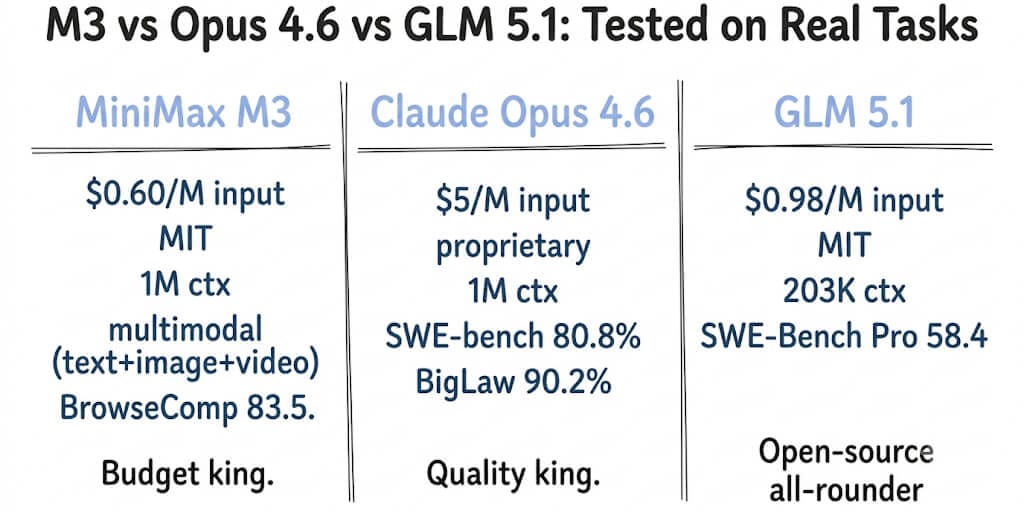
Three models at three wildly different price points. M3 at $0.60/M. GLM 5.1 at $0.98/M. Opus 4.6 at $5/M. We tested all three on the tasks agents actually run. Here's which one justifies its price.
Run all three, route per task.
BetterClaw connects MiniMax M3, Claude Opus 4.6, and GLM 5.1 via BYOK — switch in settings, zero inference markup. Free forever, not a trial. Start free → No credit card · 28+ providers · BYOK
The verdict (top of page)
MiniMax M3 wins on: cost ($0.60/M, cheapest of the three), multimodal breadth (text + image + video), browsing tasks (BrowseComp 83.5, beat Opus 4.7), structured output consistency, and open weights (MIT).
Claude Opus 4.6 wins on: raw intelligence (Intelligence Index 44), complex reasoning depth, agentic coding (SWE-bench Verified 80.8%, Terminal-Bench 65.4%), legal analysis (BigLaw 90.2%), long-context reliability (MRCR v2 76%), and instruction following.
GLM 5.1 wins on: cost-to-coding-quality ratio ($0.98/M with SWE-Bench Pro 58.4), open weights (MIT), and multilingual performance (Chinese native).
Pick M3 if you want the cheapest capable agent. Pick Opus 4.6 if your agent does work where mistakes cost real money. Pick GLM 5.1 if you want open-source with strong coding at under $1/M. (Or pick GLM 5.2 which dropped June 16 with significant improvements.)
I was running three agents last week. Same task. Same prompt. Three models at three very different prices.
The email classification agent? Identical results across all three. 96-98% accuracy. Why am I paying $5 per million tokens when $0.60 does the same job?
Then I tested the complex one. A legal contract review agent that reads a 50-page agreement, flags non-standard clauses, and drafts amendment language. Opus 4.6 produced analysis that our actual lawyer said was "better than most junior associates." M3 caught the major issues but missed two subtle indemnification traps. GLM 5.1 flagged four of six issues but the amendment language was sloppy.
That's the entire MiniMax M3 vs Claude Opus 4.6 vs GLM 5.1 debate in two paragraphs. For simple tasks, the cheapest model wins. For complex tasks, the gap between $0.60 and $5 is the gap between "good enough" and "actually good."
The pricing gap (it's massive)
| MiniMax M3 | GLM 5.1 | Opus 4.6 | |
|---|---|---|---|
| Input per 1M | $0.60 | $0.98 | $5.00 |
| Output per 1M | $2.40 | $3.08 | $25.00 |
| Context window | 1M | 203K | 1M (beta) |
| Multimodal | Text+image+video | Text only | Text+image |
| License | MIT | MIT | Proprietary |
| Open weights | Yes | Yes | No |
| Speed | ~80 tok/s | ~90 tok/s | ~46 tok/s (max) |
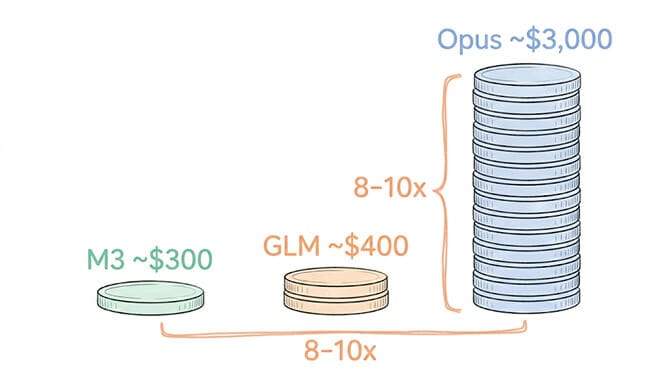
M3 is 8.3x cheaper than Opus 4.6 on input. 10.4x cheaper on output. At 1,000 tasks per day averaging 10K tokens each, monthly costs: M3 ~$300, GLM 5.1 ~$400, Opus 4.6 ~$3,000.
That $2,700/month gap is the question. Does Opus 4.6's quality justify 10x the cost?
For an agent that classifies emails and routes tickets: absolutely not. For an agent that reviews legal contracts or writes production code autonomously: possibly yes. For most agents doing structured work (extraction, summarization, CRM updates): M3 or GLM 5.1 is the smarter choice.
For the detailed M3 cost breakdown, see our M3 pricing analysis.
Head-to-head on 5 agent tasks
Task 1: Email classification (the baseline)
100 customer emails. Five categories. Return category plus confidence score.
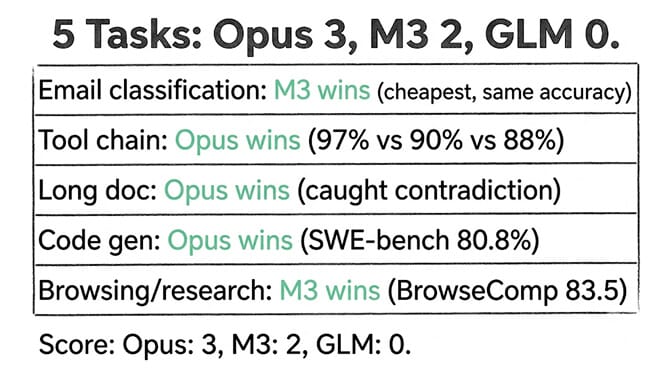
Result: Three-way tie. All three hit 96-98% accuracy. For structured classification, the cheapest model wins because quality is equivalent. Winner: M3 ($0.60/M). (For M3 against Anthropic's mid-tier specifically, see our MiniMax M3 vs Claude Sonnet 4.6 head-to-head.)
Task 2: Multi-step tool chain (4 tools, conditional logic)
Agent reads a support ticket, looks up the customer in CRM, checks subscription tier, searches knowledge base, and drafts a tier-appropriate response.
- Opus 4.6: Completed correctly 97% of the time. Handled ambiguous customer data cleanly. Draft quality was customer-ready.
- M3: Completed correctly 90% of the time. Occasional wrong tool parameter on ambiguous inputs. Drafts needed light editing.
- GLM 5.1: Completed correctly 88% of the time. Struggled more with conditional branching (e.g., different response for expired vs active subscriptions).
Winner: Opus 4.6. The 7-9% accuracy gap matters at 500 daily workflows.
Task 3: Long document analysis (50K+ tokens)
Summarize a technical document. Extract 5 key takeaways. Identify contradictions.
- Opus 4.6: Best summary quality. Caught a subtle contradiction between sections 3 and 7 that the other two missed. 1M context handles any document size.
- M3: Good summary. Missed the contradiction. 1M context works fine for length. MSA (MiniMax Sparse Attention) keeps performance stable on long inputs.
- GLM 5.1: Competent summary at 203K context. For documents over 200K, it physically can't process them.
Winner: Opus 4.6 on quality. M3 on cost if you don't need contradiction detection.
Task 4: Code generation
Write a Python function from a natural language spec. Handle edge cases. Error handling. Clean code.
- Opus 4.6: Most complete implementation. SWE-bench Verified 80.8% and Terminal-Bench 65.4% show up here. The function handled every edge case and included type hints, docstrings, and unit test suggestions.
- M3: Competent code. SWE-Bench Pro 59.0%. Missed two edge cases. No unit tests suggested.
- GLM 5.1: Similar to M3. SWE-Bench Pro 58.4%. Decent but not polished. (Note: GLM 5.2 scores 62.1 on SWE-Bench Pro with significant improvements.)
Winner: Opus 4.6 by a wide margin on code quality.
Task 5: Browsing and research
Agent researches a topic across multiple web pages, synthesizes findings, and produces a structured report.
- M3: Best performance. BrowseComp 83.5 (beat Opus 4.7's 79.3). Strong at navigating multi-page research, extracting relevant information, and producing coherent syntheses.
- Opus 4.6: Good but slower (46 tok/s vs ~80 tok/s). Careful, thorough, but the speed difference makes browsing tasks expensive on Opus.
- GLM 5.1: Text-only. Can't process screenshots or visual elements from web pages.
Winner: M3. Best browsing quality at the lowest price.
Overall: Opus 4.6 wins 3, M3 wins 2, GLM 5.1 wins 0. But GLM 5.1 at $0.98/M is still a strong choice for coding and classification tasks where you want open weights without paying Opus prices.
If you're looking at these three models and thinking "I wish I could use all three for different tasks," that's exactly the right instinct. Model routing sends each task to the model that fits best. M3 for classification and browsing. Opus 4.6 for complex reasoning and code. GLM for budget coding tasks.
On BetterClaw, all three work via BYOK. Switch between them in settings. No reconfiguration. Free plan with 1 agent and 500 credits a month. $49/month on Pro. Zero inference markup.
Which model for which builder
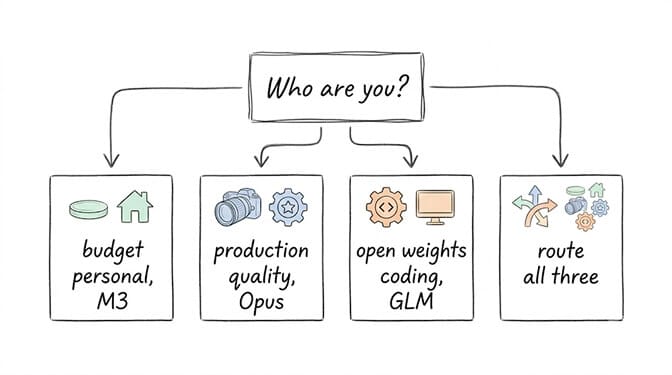
"I'm building personal agents on a budget." MiniMax M3. $0.60/M is the best cost-to-quality ratio. Multimodal for visual tasks. MIT license. Strong enough for 80% of agent workloads. Our best free LLMs guide covers other budget options.
"I'm building production agents where output quality matters." Claude Opus 4.6. $5/M is premium but the SWE-bench 80.8%, BigLaw 90.2%, and 97% tool-chain accuracy justify it. For agents handling legal documents, financial analysis, or customer-facing content, Opus quality is measurably better.
"I want open weights with strong coding." GLM 5.1 at $0.98/M. MIT license. Self-hostable. Or upgrade to GLM 5.2 (released June 16) at $1.40/M with SWE-Bench Pro 62.1 and 1M context.
"I want to route all three." The production setup. M3 handles 65% of tasks (classification, extraction, browsing). GLM handles 25% (coding, structured work). Opus handles 10% (complex reasoning, high-stakes decisions). Monthly cost drops by 60-70% compared to running everything on Opus.
The model that wins isn't the one with the best benchmarks. It's the one that matches the task at a price you can sustain. Three models. Three price points. Three strengths. Use all three.
Give BetterClaw a look if you want all three on one dashboard. Free plan with 1 agent and 500 credits a month. $49/month for Pro. 28+ providers via BYOK. We handle the routing. You handle the agent logic.
Frequently Asked Questions
Is MiniMax M3 good enough to replace Claude Opus 4.6?
For 60-70% of agent tasks (classification, extraction, summarization, browsing, structured output), M3 produces equivalent or near-equivalent results at 8-10x lower cost. For complex reasoning, multi-step tool chains with conditional logic, legal analysis, and autonomous coding, Opus 4.6 is measurably better (97% vs 90% tool-chain accuracy, SWE-bench 80.8% vs 59.0%). The practical approach: use M3 as default and route only complex tasks to Opus.
Can I run GLM 5.1 locally instead of paying for the API?
Yes. GLM 5.1 is released under the MIT license with open weights. At 754B parameters (40B active via MoE), self-hosting requires significant GPU resources. For most users, the API at $0.98/M is more practical. The newer GLM 5.2 (also MIT) is available at $1.40/M with better benchmarks. For local inference alternatives on consumer hardware, see our Qwen 3.6 on Ollama guide.
How much does it cost to run an agent on each model per month?
At 1,000 tasks/day averaging 10K tokens each: MiniMax M3 costs approximately $300/month, GLM 5.1 approximately $400/month, and Opus 4.6 approximately $3,000/month. At 100 tasks/day: M3 ~$30, GLM ~$40, Opus ~$300. With model routing (M3 for simple, Opus for complex), the blended cost is typically $400-600/month for 1,000 daily tasks.
What's the difference between GLM 5.1 and GLM 5.2?
GLM 5.2 (released June 16, 2026) improves SWE-Bench Pro from 58.4 to 62.1, adds IndexShare architecture (2.9x cheaper compute at 1M context), introduces selectable thinking modes (High/Max), and crosses 80% on Terminal-Bench. Context window expanded from 203K to 1M. Pricing increased slightly from $0.98 to $1.40/M input. The upgrade is worth it for most workloads. Both are MIT licensed.
Which model is most reliable for production agent deployment?
Claude Opus 4.6 has the highest tool-chain accuracy (97%) and strongest instruction following in our tests. The tradeoff: it costs 8-10x more than M3, it's proprietary (can't self-host), and it was affected by the Fable 5 suspension (though Opus itself remained available). MiniMax M3 offers MIT open weights at 90% tool-chain accuracy. For maximum reliability with cost control, route critical tasks to Opus and routine tasks to M3.
One dashboard, three models, route per task.
M3, Opus 4.6, and GLM via BYOK with zero markup. Send each task to the model that fits. Free forever, not a trial. Start free →