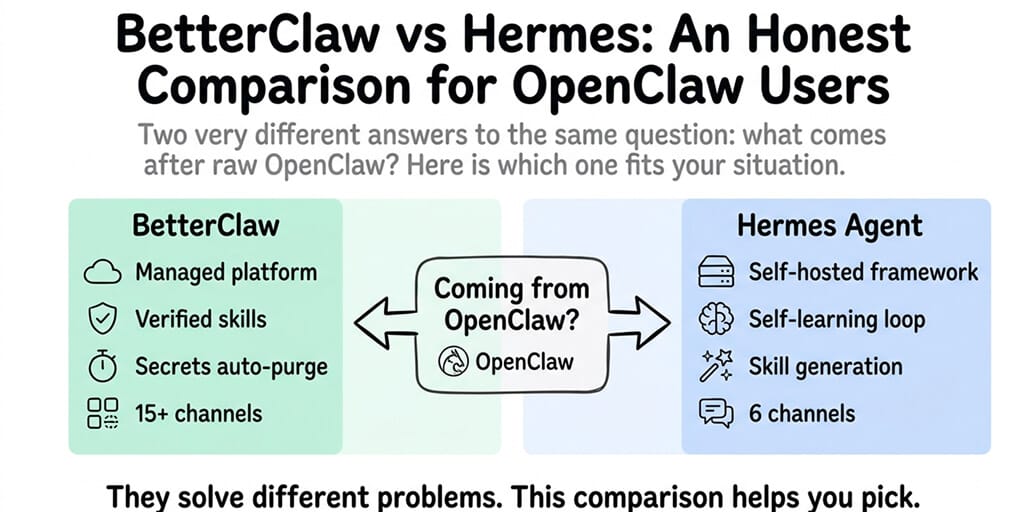
Two very different answers to the same question: "What comes after raw OpenClaw?" Here's which one fits your situation.
Three weeks ago, a developer in our community asked: "Should I switch from OpenClaw to Hermes or BetterClaw?" Forty-seven comments later, the thread concluded with: "They're not really competing with each other."
That answer is correct, but not helpful if you're trying to decide right now.
BetterClaw and Hermes Agent are both responses to OpenClaw's growing pains. The 1,400+ malicious skills in the ClawHavoc campaign. The 500,000+ instances exposed on the public internet. The Anthropic ban on Claude Pro/Max for third-party tools on April 4, 2026, which forced everyone onto API billing overnight. The nine CVEs disclosed in four days in March 2026.
Both saw the same problems. Both built something different.
What Hermes actually is (and isn't)
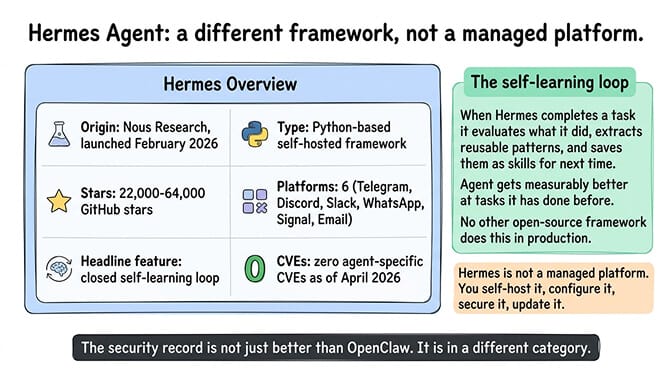
Hermes Agent launched in February 2026 from Nous Research, the lab behind the Hermes model family. It's a Python-based, self-hosted AI agent framework with roughly 22,000–64,000 GitHub stars (numbers vary by source and date). It runs on your own machine or VPS.
Hermes is not a managed platform. It's a different framework. You self-host it, configure it, and maintain it yourself. It supports Telegram, Discord, Slack, WhatsApp, Signal, and Email. Six platforms. Not bad, but narrower than OpenClaw's 24+ or BetterClaw's 15+.
The headline feature is a closed learning loop. When Hermes completes a task, it evaluates what it did, extracts reusable patterns, and saves them as skills for next time. The agent gets measurably better at tasks it has done before. No other open-source framework does this in production.
Here's where it gets interesting. Hermes has zero agent-specific CVEs reported as of April 2026. Zero. Compare that to OpenClaw's nine CVEs in four days. The security record isn't just better. It's in a different category. (We ran both frameworks in parallel in our OpenClaw vs Hermes 30-day comparison if you want the raw experience report.)
But that's not even the real comparison. The comparison is about what kind of user you are.
What BetterClaw actually is (and isn't)
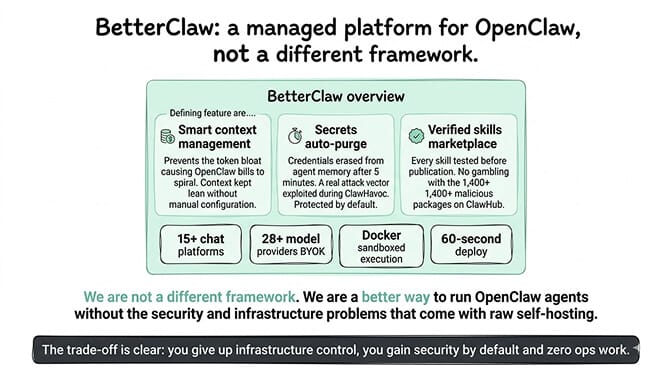
BetterClaw is a managed platform built on top of the OpenClaw ecosystem. We're not a different framework. We're a better way to run OpenClaw agents without the security and infrastructure problems that come with raw self-hosting.
Three things define us:
Smart context management that prevents the token bloat causing OpenClaw bills to spiral. Secrets auto-purge that erases credentials from agent memory after 5 minutes (a real attack vector exploited during ClawHavoc). A verified skills marketplace where every skill is tested before publication (no more gambling with the 1,400+ malicious packages on ClawHub).
We connect to 15+ chat platforms from a single dashboard. 28+ model providers with BYOK and zero inference markup. Docker-sandboxed execution and AES-256 encryption by default. Deploy in under 60 seconds.
For the full breakdown of how BetterClaw differs from raw OpenClaw, our alternative page covers the positioning in detail.
Hermes is a different framework you self-host. BetterClaw is a better way to run OpenClaw without the pain. They solve fundamentally different problems.
The three questions that decide this for you
Instead of a feature matrix, answer these three questions.
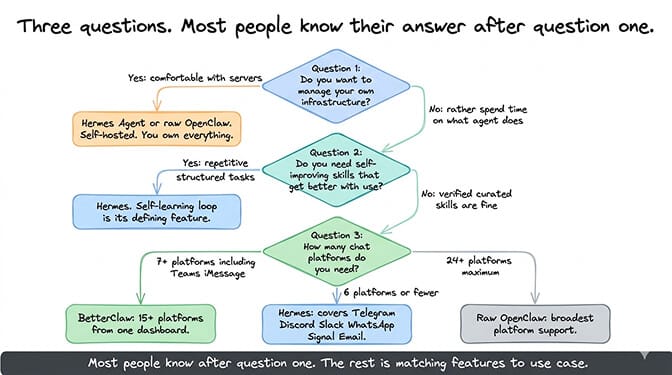
Question 1: Do you want to manage your own infrastructure?
Hermes requires self-hosting. You install it, configure it, secure it, update it. If you enjoy that or already manage servers, Hermes is a genuine option. Its setup is reportedly easier than OpenClaw's, and its stability is better.
BetterClaw eliminates infrastructure entirely. No Docker. No YAML. No server management. If you'd rather spend your time on what the agent does instead of where it runs, that's what we built for.
Question 2: Do you need self-improving skills?
This is Hermes's defining feature. The closed learning loop means the agent creates reusable skills from experience and refines them over time. For repetitive, structured tasks (weekly code reviews, recurring report generation, standard customer support patterns), the agent genuinely gets better with use.
BetterClaw doesn't have a self-learning loop. Our skills come from a verified marketplace where every skill is tested before publication. The trade-off: you don't get autonomous skill generation, but you also don't get the 15–25% token overhead that Hermes's reflection and optimization modules consume.
Question 3: How many platforms do you need?
BetterClaw connects to 15+ platforms (Slack, Discord, Telegram, WhatsApp, Teams, iMessage, and more) from a single dashboard. Hermes supports 6 (Telegram, Discord, Slack, WhatsApp, Signal, Email). OpenClaw supports 24+.
If your use case requires Teams, iMessage, or other platforms beyond Hermes's six, BetterClaw covers more ground. If you only need Telegram and Discord, Hermes handles that fine.
If you're coming from OpenClaw and want to keep the ecosystem (skills, SOUL.md, memory files) while eliminating the infrastructure and security problems, BetterClaw is the natural migration path. Free tier with 1 agent and BYOK. $49/month for Pro. Your first deploy takes about 60 seconds.
Where Hermes genuinely wins
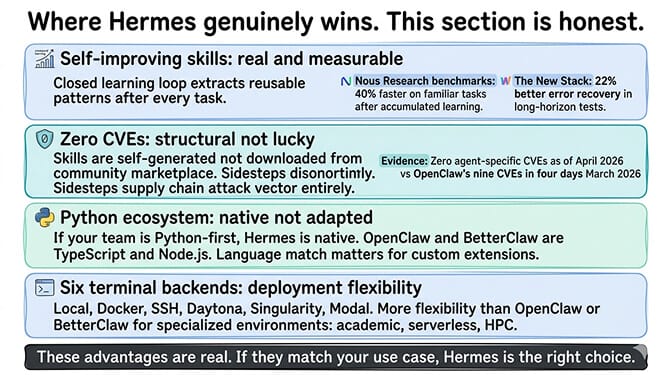
We're a BetterClaw comparison page, but this section is honest.
Self-improving skills are real. Nous Research's benchmarks show agents completing familiar tasks 40% faster after accumulated learning. The New Stack's comparison noted Hermes recovering from errors 22% more effectively than OpenClaw in long-horizon tests. If your workflows are repetitive and structured, this improvement compounds.
Zero CVEs is meaningful. Hermes's architecture sidesteps the supply chain attack vector entirely because skills are self-generated rather than downloaded from a community marketplace. That's a structural advantage, not just good luck.
Python ecosystem. If your team is Python-first, Hermes is native. OpenClaw and BetterClaw are TypeScript/Node.js. The language match matters for custom extensions.
Six terminal backends. Local, Docker, SSH, Daytona, Singularity, Modal. More deployment flexibility than OpenClaw or BetterClaw for specialized environments (academic, serverless, HPC).
Where BetterClaw genuinely wins
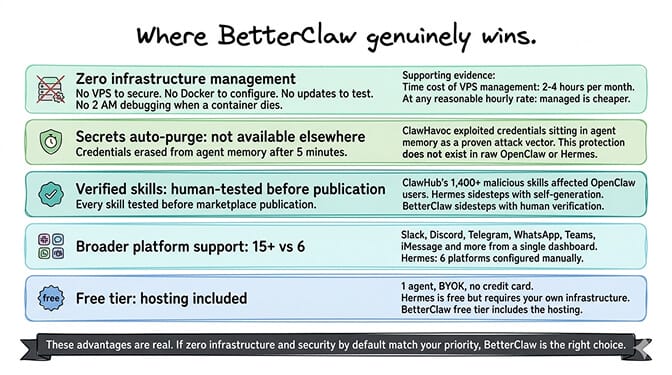
Zero infrastructure management. No VPS to secure. No Docker to configure. No updates to test. No 2 AM debugging when a container dies. For the full comparison of self-hosting costs versus managed, the time cost alone makes managed cheaper for most non-developers.
Secrets auto-purge. After ClawHavoc, credentials sitting in agent memory became a proven attack vector. BetterClaw purges credentials from agent memory after 5 minutes. This protection doesn't exist in raw OpenClaw or Hermes.
Verified skills. Every skill on our marketplace is tested before publication. ClawHub's 1,400+ malicious skills affected OpenClaw users. Hermes sidesteps this with self-generated skills. We sidestep it with human verification.
Broader platform support. 15+ channels from a dashboard versus configuring 6 channels manually. If your agent needs to work across Slack, Telegram, WhatsApp, and Teams simultaneously, the multi-channel setup is handled.
Free tier available. 1 agent, BYOK, no credit card. Hermes is free but requires your own infrastructure. BetterClaw's free tier includes the hosting.
The honest recommendation
For the community's take on running both together, our best practices guide covers multi-agent architectures where people use different frameworks for different tasks.
The Reddit consensus is actually smart: experienced users run both. OpenClaw (or BetterClaw) as the orchestrator for multi-channel, multi-step coordination. Hermes as the execution specialist for repetitive learned tasks. If you're still weighing the broader field, our best OpenClaw alternatives roundup sorts every option into the right category, and our OpenClaw alternative comparison ranks Hermes head-to-head against NanoClaw, ZeroClaw, and n8n.
But if you're choosing one, the decision is simpler than people make it.
Choose Hermes if: You want self-hosted control, self-improving skills matter for your use case, you're comfortable managing infrastructure, and you work primarily in Python.
Choose BetterClaw if: You want zero infrastructure management, security handled by default (verified skills, secrets auto-purge, sandboxed execution), broad platform support, and you value your time over control.
Both are legitimate choices. Neither is wrong. The question is what you want to spend your time doing: managing infrastructure, or using your agent.
If you've decided the infrastructure isn't the interesting part, give BetterClaw a try. Free tier with 1 agent and BYOK. $49/month for Pro (5 agents included) with full skill access. 60-second deploy. We handle the infrastructure, the security, and the updates. You handle the SOUL.md, the skills, and the workflows. That's the split.
Frequently Asked Questions
What is the difference between BetterClaw and Hermes Agent?
BetterClaw is a managed platform for running OpenClaw agents without infrastructure management. It includes verified skills, secrets auto-purge, and 15+ chat platform connections. Hermes Agent is a separate, self-hosted AI agent framework from Nous Research with a self-improving learning loop. BetterClaw eliminates DevOps. Hermes requires self-hosting but offers autonomous skill generation.
Is Hermes Agent better than OpenClaw?
They make different trade-offs. Hermes has zero reported CVEs versus OpenClaw's nine in four days. Hermes's self-learning loop improves agent performance on repetitive tasks by up to 40%. OpenClaw has broader platform support (24+ vs 6), a larger skill ecosystem (13,000+ community skills), and more model provider integrations. Hermes is better for deep, repetitive workflows. OpenClaw is better for broad, multi-platform orchestration.
Can I migrate from OpenClaw to Hermes or BetterClaw?
Yes to both. Hermes includes a built-in migration tool (hermes claw migrate) that imports settings, memories, skills, and API keys from OpenClaw. BetterClaw accepts your existing SOUL.md, memory files, and skill configurations through our migration path. Both preserve your agent's personality and knowledge during the switch.
How much does BetterClaw cost compared to Hermes?
BetterClaw offers a free tier (1 agent, BYOK, hosting included) and Pro at $49/month. Hermes is free and open source but requires your own infrastructure ($5–24/month VPS plus 2–4 hours/month maintenance time). If your time is worth $25+/hour, BetterClaw's managed approach is cheaper in total cost of ownership. If you enjoy server management, Hermes is cheaper on paper.
Is BetterClaw secure enough for business use?
BetterClaw includes Docker-sandboxed skill execution, AES-256 encrypted credentials, secrets auto-purge (credentials erased from agent memory after 5 minutes), and a verified skills marketplace where every skill is tested before publication. These protections address the specific vulnerabilities exploited during ClawHavoc (1,400+ malicious skills) and the 500,000+ exposed instances found by security researchers. CrowdStrike's enterprise advisory specifically flagged unprotected self-hosted deployments as the primary risk.