You don't need to pay $3 per million tokens to run a capable agent. Six models offer free or near-free inference right now. Here's which one to pick for each type of agent work, ranked by what actually matters: tool calling, reliability, and cost.
Last updated: June 2026
Last month I ran five agents for my personal workflow. Morning briefing. Email triage. Expense tracking. Meeting prep. Slack digest. Five agents, seven days a week.
Total API cost: $0.
Not $0 because I wasn't using them. $0 because every agent ran on free-tier models. GLM 5.2 via Z.ai for the complex tasks. Gemma 4 12B locally for classification. Groq free tier for anything speed-sensitive.
The best free LLMs for AI agents in 2026 are genuinely good enough for production personal agents and many business agents. Here's the ranked list, tested on actual agent tasks, updated monthly. If you run agents specifically on OpenClaw, our companion guide to the best free model for OpenClaw covers the same picks with quick-start configs.
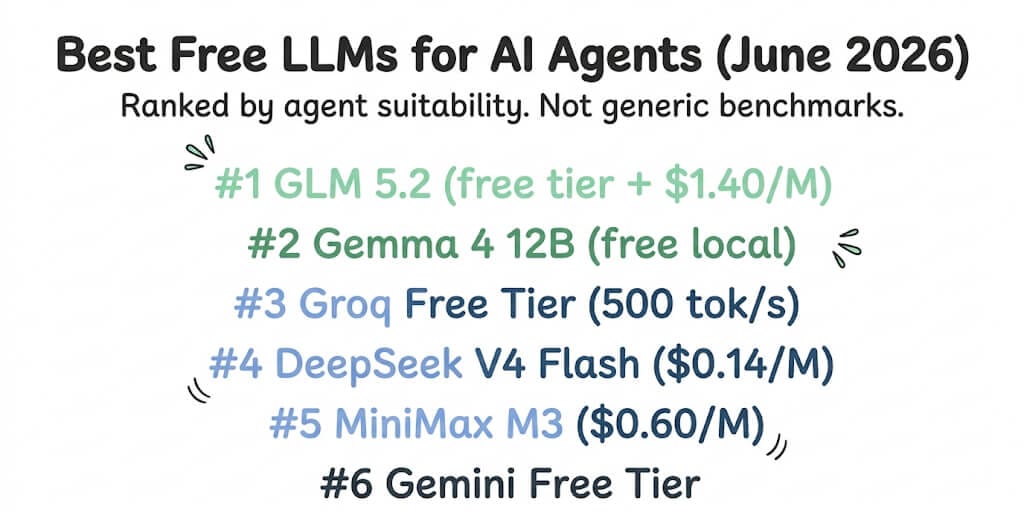
The ranking (June 2026)
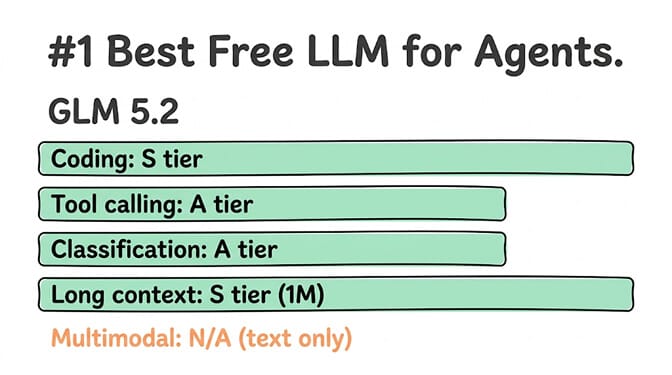
#1: GLM 5.2 (best overall free option for agents)
Free tier: Z.ai offers a free tier for testing and development with generous limits.
Paid fallback: $1.40/M input, $4.40/M output on OpenRouter. GLM Coding Plan from $12.60/month.
Why it's #1: SWE-Bench Pro 62.1 (beats GPT-5.5). First open model past 80% on Terminal-Bench. MCP-Atlas 77.0. 1M context window. MIT license. Selectable thinking modes (High for speed, Max for quality). The strongest open-weights model available in June 2026.
Best for: Coding agents, long-document processing, multi-step reasoning, classification, extraction. Text-only (no image input).
Agent suitability: S tier. If you're picking one free model for your agent, start here. See our GLM 5.2 vs Sonnet 4.6 comparison for the head-to-head.
#2: Gemma 4 12B (best free local model)
Cost: Completely free. Runs on your hardware via Ollama.
Hardware needed: 16 GB RAM (8 GB minimum at Q4). Apple Silicon runs it at 30-50 tok/s. RTX 3060 12 GB works at 15-20 tok/s. For bigger models, see our guide to hardware for local models, from $3,000 mini PCs up to the DGX line.
Why it's #2: The first mid-size model to natively process text, images, audio, AND video without separate encoders. 256K context. Apache 2.0. Strong on creative and conversational tasks where GLM 5.2 is weaker. MMLU Pro 77.2%.
Best for: Multimodal agents (image understanding, audio processing, video analysis), conversational agents, creative content, summarization.
Agent suitability: A tier. The best local option if you need multimodal or can't use cloud APIs. For our full Gemma 4 vs Qwen comparison, see the dedicated head-to-head.
#3: Groq Free Tier (fastest free inference)
Cost: Free. 30,000 tokens per minute. 30 requests per minute. 14,400 requests per day. No credit card.
Models available: Qwen3-32B, Llama 3.3 70B, Llama 3.1 8B, DeepSeek R1 Distill, Gemma. All at 500+ tok/s.
Why it's #3: Nothing else is this fast for free. Sub-second response times. For agents where latency matters (real-time chat, interactive assistants), Groq's LPU delivers 10x the speed of GPU inference.
Best for: Real-time chat agents, high-volume batch classification, latency-sensitive pipelines. The 30 RPM limit constrains heavy tool-calling agents.
Agent suitability: A tier for speed-sensitive tasks. B tier for complex tool chains (rate limits constrain multi-step workflows).
#4: DeepSeek V4 Flash (cheapest paid, practically free)
Cost: $0.14/M input, $0.28/M output. Permanent pricing. Not a promo.
At $0.14/M, processing 1,000 tasks per day costs about $1.40/day or $42/month. For 100 tasks per day: $4.20/month. Practically free for personal and light business use.
Why it's #4: The cheapest capable model for structured agent tasks. 1M context window. Strong on classification, extraction, and routing. The ideal Tier 1 model for routing setups where you send simple tasks to the cheapest option.
Best for: Email classification, data extraction, ticket routing, simple summarization. The budget tier in a multi-model routing setup.
Agent suitability: B+ tier. Excellent for structured tasks. Not strong enough for complex reasoning or creative work.
#5: MiniMax M3 (best value near-free)
Cost: $0.60/M input, $2.40/M output. Open weights (MIT). Promo pricing at $0.30/M available.
Why it's #5: The best cost-to-quality ratio in the market. 1M context. Native multimodal (text + image + video). BrowseComp 83.5 (beat Opus 4.7). SWE-Bench Pro 59.0%. For agents that need both multimodal input and strong reasoning, M3 is the sweet spot. Our M3 cost breakdown covers the pricing in detail.
Best for: Multimodal agents at scale, browsing/research agents, structured output, long-context work.
Agent suitability: A tier. Slightly more expensive than Flash but significantly more capable.
#6: Gemini Free Tier (Google AI Studio)
Cost: Free tier with generous limits via Google AI Studio. Paid: Gemini 3.5 Flash at $1.50/$9/M.
Why it's #6: Google AI Studio's free tier lets you test Gemini models at no cost. Gemini 3.5 Flash scores well on agentic benchmarks (MCP Atlas 83.6%, Terminal-Bench 76.2%). The free tier has rate limits that constrain production use, but it's excellent for development and personal agents.
Best for: Development, testing, personal agents, Google Workspace integrations.
Agent suitability: B+ tier on free tier (rate limits). A tier on paid.
The quick comparison table (screenshot this)
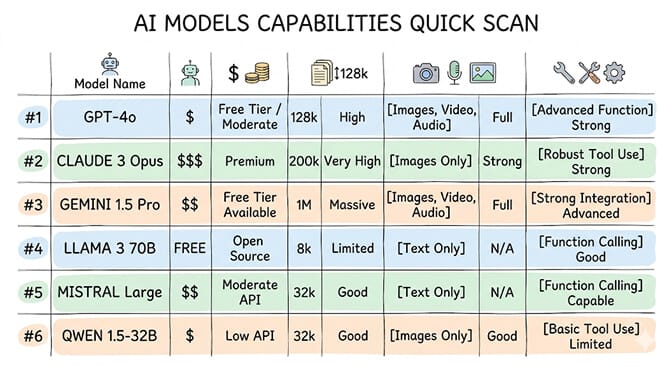
| Model | Cost | Context | Multimodal | Best Agent Task | Tool Calling |
|---|---|---|---|---|---|
| GLM 5.2 | Free tier / $1.40/M | 1M | Text only | Coding, reasoning | Strong (MCP-Atlas 77.0) |
| Gemma 4 12B | Free (local) | 256K | Text+image+audio+video | Multimodal, creative | Good |
| Groq (Qwen3-32B) | Free (30K TPM) | 131K | Text only | Speed-sensitive tasks | Good (rate limited) |
| DeepSeek Flash | $0.14/M | 1M | Text only | Classification, extraction | Adequate |
| MiniMax M3 | $0.60/M | 1M | Text+image+video | Browsing, research | Good (BrowseComp 83.5) |
| Gemini Free | Free (limited) | 1M | Text+image | Development, testing | Strong (MCP Atlas 83.6) |
The question isn't "which free model is best." It's "which free model is best for THIS task." Use GLM 5.2 for coding. Gemma 4 for multimodal. Groq for speed. Flash for volume. M3 for browsing. Gemini for development.
How to actually use these models for free
The $0/month personal agent stack
Email triage: Groq free tier (Qwen3-32B). Fast classification. 30 RPM is enough for personal email volume.
Morning briefing: GLM 5.2 free tier. Read calendar, summarize, generate digest.
Expense tracking: DeepSeek Flash ($0.14/M). Extract receipt data from Gmail. Under $1/month at personal volume.
Meeting prep: GLM 5.2 free tier. Look up attendees, pull email threads, generate brief.
Content research: MiniMax M3 ($0.60/M). Browsing and summarization. Under $2/month.
Total: $0-3/month for five working agents. Compare to Claude Sonnet for everything: $30-80/month.
For the full build guide on each, see our 5 personal agents you can build this weekend.
If you want all five agents running through one dashboard without managing API keys across six providers, BetterClaw connects to all of these via BYOK with zero inference markup. Switch models with a dropdown. Free plan with 1 agent and 100 credits a month. $49/month on Pro.
What free models CAN'T do (the honest part)
Complex multi-step tool chains. When your agent needs to chain 4+ tools with conditional logic, free-tier models make more mistakes than Claude Sonnet (3% hallucination rate). For production agents where wrong tool calls cost money, Sonnet's premium is justified.
Customer-facing tone quality. Free models produce competent but generic text. Sonnet and Opus produce text with nuance, empathy, and brand voice consistency. If your agent writes customer emails, the paid model is worth it for tone.
Guaranteed uptime. Free tiers have rate limits, occasional outages, and no SLA. For agents that must run 24/7 without interruption, a paid provider with an SLA is the safer choice.
The best approach: start free, identify where quality gaps cost you, and upgrade only those specific tasks. Most builders who start on Sonnet for everything discover that 60-70% of their tasks run identically on free models. The paid model is only needed for the remaining 30-40%.
When this ranking changes (and how we update it)
This ranking is updated monthly. The June 2026 update reflects GLM 5.2 (launched June 16), Gemini 3.5 Flash (launched May 19), and current pricing across all providers.
The next update will check for: Qwen 3.7 open weights (if released), Gemini 3.5 Pro launch, GLM 5.2 pricing changes, and any new free-tier announcements. Gartner projects 40% of enterprise applications will embed AI agents by end of 2026. The free model tier keeps improving. What required $3/M twelve months ago requires $0.14/M today. That trend doesn't stop.
Give BetterClaw a look if you want these models running as agents without managing six different API configurations. Free plan with 1 agent and 100 credits a month. $49/month for Pro. 28+ providers via BYOK with zero markup. We handle the connections. You handle the agent logic.
Frequently Asked Questions
What is the best free LLM for AI agents in 2026?
GLM 5.2 is the best overall free LLM for AI agents as of June 2026. It offers a free tier via Z.ai, scores 62.1 on SWE-Bench Pro (beating GPT-5.5), has a 1M context window, and supports native tool calling. For local inference, Gemma 4 12B (completely free, runs on 16 GB hardware) is the best option with multimodal support (text, image, audio, video).
Can I run AI agents for free?
Yes. A personal agent stack using free-tier models (GLM 5.2, Groq, Gemini) costs $0/month for light use. Adding DeepSeek Flash ($0.14/M) for high-volume classification adds $1-5/month. The platform layer is also free on BetterClaw (1 agent, 100 credits a month, no credit card). Total cost for a working personal agent: $0-5/month.
Which free LLM is best for tool calling in agents?
GLM 5.2 scores 77.0 on MCP-Atlas (tool usage benchmark), making it the strongest free option for tool calling. Gemini 3.5 Flash scores 83.6 on MCP-Atlas but requires a paid plan for heavy use. For free local tool calling, Qwen 3.6 35B-A3B on Ollama is reliable with thinking-mode disabled. Claude Sonnet ($3/M, not free) still has the lowest tool-call hallucination rate at 3%.
How do free LLMs compare to Claude Sonnet for agents?
Free models (GLM 5.2, Gemma 4, Groq) handle 60-70% of typical agent tasks (classification, extraction, summarization, coding) at comparable quality to Sonnet. Sonnet is measurably better on complex multi-step tool chains (96% vs 88-92% accuracy), customer-facing output quality, and nuanced instruction following. The practical approach: use free models for structured tasks and Sonnet for precision tasks.
Is it safe to use free LLMs for business agents?
Free models themselves are as safe as paid ones. The difference is in reliability and support. Free tiers have rate limits, no SLAs, and occasional outages. For business-critical agents, use a paid tier (even $0.14/M on DeepSeek Flash) for guaranteed availability. On BetterClaw, secrets auto-purge after 5 minutes, agents run in isolated Docker containers, and trust levels control what actions agents can take, regardless of which model powers them.