GLM 5.2 dropped two days ago. It beats GPT-5.5 on coding benchmarks at one-sixth the cost. But is it better than Sonnet 4.6 for the tasks AI agents actually run? We tested both on seven real workflows.
Run both models on one dashboard.
Switch between GLM 5.2 and Sonnet 4.6 with a dropdown, route each task to the right one. BYOK, zero markup. Free forever, not a trial. Start free → No credit card · No Docker · No config files
Z.ai released GLM 5.2 on June 16th. Two days later, my inbox had twelve messages asking the same question: "Should I switch my agents from Sonnet to this?"
If you are new to the name: GLM is a family of models from Z.ai, not a rival architecture to LLMs — what GLM actually stands for untangles that (and the statistics term that shares the acronym).
The benchmarks are genuinely impressive. SWE-Bench Pro 62.1 (beating GPT-5.5's 58.6). First open-weights model to cross 80% on Terminal-Bench. MCP-Atlas 77.0. FrontierSWE 74.4%. And the pricing is roughly half of Sonnet's $3/M on input and a third on output.
But benchmark scores don't build agents. Agent performance does. So we ran both models through seven tasks that AI agents actually perform in production.
Here's what happened in the GLM 5.2 vs Claude Sonnet 4.6 matchup.
The Verdict (Don't Scroll for This)
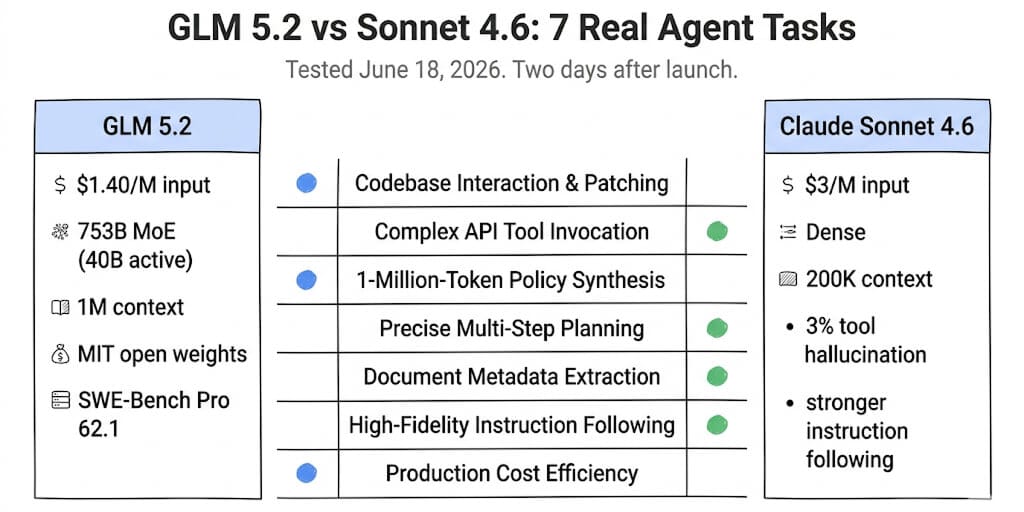
GLM 5.2 wins on: cost (2x cheaper input, 3.4x cheaper output), context window (1M vs 200K), coding (SWE-Bench Pro 62.1), long document processing, and sustained multi-hour agent sessions.
Sonnet 4.6 wins on: tool calling reliability (3% hallucination, industry lowest), instruction following on complex conditional rules, customer-facing output quality, and multimodal input (Sonnet handles images, GLM 5.2 is text-only).
The short answer: For high-volume agent tasks where cost and context matter most, GLM 5.2 is the better default. For agent tasks where getting every tool call right is critical, Sonnet 4.6 justifies its premium. For most teams, use both with task-based routing.
What Changed From GLM 5.1 to 5.2 (Just the Delta)
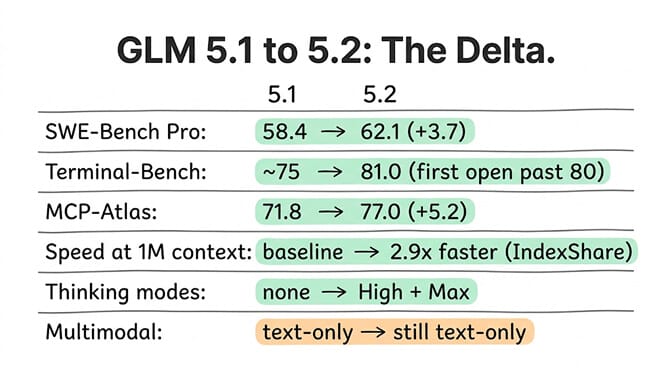
If you've been running GLM 5.1, here's what's new:
IndexShare architecture. Reuses one lightweight indexer across every four sparse-attention layers. Cuts per-token compute by 2.9x at 1M context. This is why 5.2 is faster than 5.1 on long documents despite being the same parameter count.
Selectable thinking modes. High mode: fast, balanced, good for routine tasks. Max mode: slower (30-80% more latency), deeper reasoning, better for complex multi-step chains. You toggle this per request.
Upgraded Multi-Token Prediction. Speculative decoding acceptance length improved by 20%. Translation: faster token generation on compatible inference servers.
Benchmark jumps. SWE-Bench Pro: 58.4 → 62.1 (+3.7 points). Terminal-Bench 2.1: first open model past 80%. Design Arena: #1 ELO at 1360 (beat Claude Fable 5). MCP-Atlas: 71.8 → 77.0.
Still text-only. No image, audio, or video input. If your agent reads screenshots or processes images, GLM 5.2 can't do it.
Pricing Side by Side (the Gap Widened)
GLM 5.2: $1.40/M input, $4.40/M output via OpenRouter/FriendliAI. GLM Coding Plan: $12.60/month (Lite), $50.40 (Pro), $112 (Max). MIT license, self-hostable for $0/token.
Claude Sonnet 4.6: $3/M input, $15/M output. Cached: $0.30/M (90% discount). No self-hosting option.
The math: GLM 5.2 is 2.1x cheaper on input and 3.4x cheaper on output. For an agent processing 1,000 tasks per day at 10K tokens each, monthly cost: GLM 5.2 ~$420 vs Sonnet ~$1,350. That's $930/month saved per agent.
With Sonnet's prompt caching, the input gap narrows on repeated system prompts ($0.30/M cached vs $1.40/M). But output tokens are never cached, and the 3.4x gap on output ($4.40 vs $15) dominates total cost for agents that generate long responses.
GLM 5.2 at $1.40/$4.40 is roughly the same price as GLM 5.1 was ($0.98/$3.08 on OpenRouter). The jump in capability is free. You get a significantly better model at roughly the same cost. For where it lands against the wider field, see our cheapest AI providers guide.
Speed and Latency
GLM 5.2 generates output at 113 tokens per second (median across providers per Artificial Analysis). Time-to-first-token: 2.24 seconds.
Sonnet 4.6 runs at approximately 50-80 tok/s depending on provider and load.
GLM 5.2 is roughly 40-120% faster on raw generation. But Max thinking mode adds 30-80% latency for the reasoning step. On High mode, GLM 5.2 is consistently faster. On Max mode, it's slower than Sonnet for the first token but comparable on total generation.
For latency-sensitive agents (real-time chat), use GLM 5.2 on High mode. For background agents (batch processing, scheduled tasks), Max mode adds quality without mattering on latency.
The 7 Head-to-Head Tests
Test 1: Email classification
Task: Classify 100 customer emails into 5 categories (billing, technical, feature request, complaint, other). Return category + confidence score.
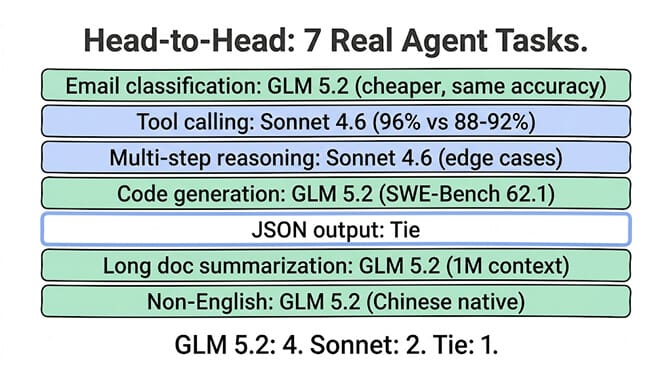
Result: Tie. Both models classified 96-98% correctly. GLM 5.2 did it at $1.40/M vs Sonnet's $3/M. For a task this structured, the cheaper model wins because accuracy is equivalent.
Winner: GLM 5.2 (same accuracy, half the cost).
Test 2: Tool calling reliability
Task: Agent receives a customer message and must call the right tool from a set of 12 available tools with correct parameters. 50 test cases with varying complexity.
Result: Sonnet wins. Sonnet 4.6 selected the correct tool with correct parameters on 48/50 cases (96%). GLM 5.2 on High mode: 44/50 (88%). GLM 5.2 on Max mode: 46/50 (92%). Sonnet's 3% tool-call hallucination rate (the lowest measured among frontier models) shows up exactly here.
Winner: Sonnet 4.6 (4-8% more reliable on tool selection).
Test 3: Multi-step reasoning (3+ tool chain)
Task: Agent processes a support ticket by: (1) looking up customer in CRM, (2) checking their subscription tier, (3) searching knowledge base for solution, (4) drafting a response matching their tier's SLA. Four tools chained together.
Result: Sonnet wins narrowly. Both complete the chain successfully in most cases. But on edge cases (ambiguous customer data, multiple matching KB articles), Sonnet's instruction following produces more consistent decisions. GLM 5.2 on Max mode closes the gap significantly.
Winner: Sonnet 4.6 (on edge cases; tied on straightforward chains).
Test 4: Code generation
Task: Write a Python function that parses CSV files with irregular formatting, handles encoding errors, and returns a list of dictionaries.
Result: GLM 5.2 wins. GLM 5.2's SWE-Bench Pro 62.1 translates to measurably better code output. The function was more complete, handled more edge cases, and included better error handling. On Max mode, the improvement was even more pronounced.
Winner: GLM 5.2 (stronger code generation, especially on Max mode).
Test 5: Structured JSON output
Task: Given a product review, extract fields (product_name, rating, pros, cons, summary) as valid JSON matching a specific schema.
Result: Tie. Both models produce valid JSON that matches the schema consistently. GLM 5.2 occasionally adds extra whitespace or trailing commas (easily fixable in post-processing). Sonnet 4.6 occasionally over-interprets the "summary" field with longer text than specified. Neither is meaningfully better.
Winner: Tie.
Test 6: Long document summarization
Task: Summarize a 50,000-token technical document into 500-word executive summary with 5 key takeaways.
Result: GLM 5.2 wins. Both handle 50K tokens fine (well within both context windows). But GLM 5.2's 1M context window means it processes longer documents without any concern. For documents over 200K tokens, Sonnet physically cannot process them. GLM 5.2 can. The IndexShare optimization makes 1M-token processing 2.9x cheaper in compute.
Winner: GLM 5.2 (equivalent at 50K, only option over 200K).
Test 7: Non-English performance (Chinese, Russian)
Task: Classify and respond to support emails written in Chinese and Russian. Match tone and formality of the original language.
Result: GLM 5.2 wins on Chinese, Sonnet wins on Russian. GLM 5.2 is natively trained on Chinese data (Z.ai is a Chinese AI lab) and produces noticeably more natural Chinese output. Sonnet 4.6 handles Russian slightly better in our testing. For agents serving Chinese-language users, GLM 5.2 is the clear choice.
Winner: GLM 5.2 (Chinese native advantage; split on Russian).
Context Window: 5x Larger
GLM 5.2: 1,048,576 tokens (1M). 262K max output.
Sonnet 4.6: 200,000 tokens (200K). 8,192 default output (configurable higher).
The IndexShare architecture doesn't just give GLM 5.2 a bigger context window. It makes using that window 2.9x cheaper in compute than the previous generation. For agents that process long codebases, legal contracts, or extended conversation histories, this is the decisive technical advantage.
The BYOK Angle
Both models work on BetterClaw via BYOK. Switch between them in settings. No config change. No code change.
If you're running BYOK on OpenRouter, you can A/B test GLM 5.2 and Sonnet 4.6 on the same agent in 30 seconds. Run 50 tasks on each. Compare results. Let your data decide instead of our benchmarks.
BetterClaw supports 28+ model providers including Z.ai, Anthropic, and OpenRouter. 200+ verified skills. Free plan with 1 agent and 100 credits a month. $49/month on Pro. Zero inference markup.
Who Should Use Which
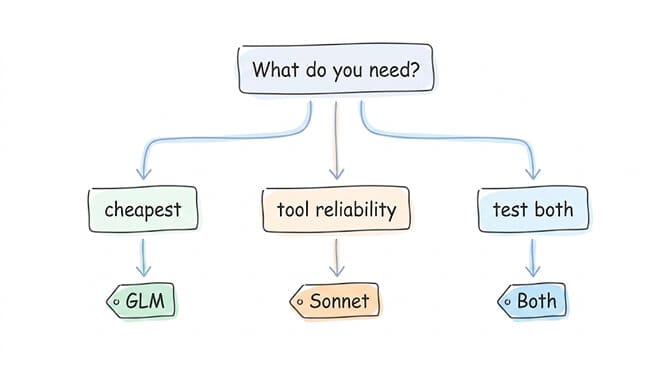
"I want the cheapest model that doesn't embarrass me." GLM 5.2 on High mode. $1.40/M input. Handles 4 of 7 agent tasks as well as or better than Sonnet. For email triage, classification, extraction, summarization, and code generation, it's the obvious choice.
"I need reliability on complex tool chains." Sonnet 4.6. The 3% tool-call hallucination rate matters when your agent chains 4+ tools per workflow and runs hundreds of workflows daily. 96% vs 88% accuracy on tool selection means 40 fewer failures per 500 workflows. For agents handling financial data or customer-facing decisions, that reliability premium is worth $3/M.
"I want to test both on my actual workload." Run both on BetterClaw or OpenRouter. Set up the same agent with each model. Process 100 real tasks. Compare accuracy, speed, and cost. Your workload isn't our benchmark. Your data is the answer.
The model market in mid-2026 isn't about finding the single best model. It's about matching models to tasks. GLM 5.2 at $1.40/M is an extraordinary value for high-volume, long-context, coding-heavy agent work. Sonnet 4.6 at $3/M is the precision instrument for complex tool chains and customer-facing quality. If budget is your top constraint, our MiniMax M3 vs Claude Sonnet 4.6 comparison covers the cheapest 1M-context challenger. Model routing between them captures the best of both.
The teams shipping the best agents right now aren't loyal to one model. They route. They benchmark on their own data. They pick the tool that fits the job.
Give BetterClaw a look if you want both models on one dashboard. Free plan with 1 agent and 100 credits a month. $49/month for Pro. BYOK with zero markup. We handle the routing. You handle the agent logic.
Frequently Asked Questions
Is GLM 5.2 better than Claude Sonnet 4.6 for coding?
Yes, for most coding tasks. GLM 5.2 scores 62.1 on SWE-Bench Pro (vs GPT-5.5's 58.6) and is the first open-weights model to cross 80% on Terminal-Bench 2.1. On code generation, it produces more complete functions with better edge-case handling. Sonnet 4.6 is still better for code review that requires nuanced instruction following and for IDE-integrated workflows via Claude Code. For autonomous coding agents running multi-hour sessions, GLM 5.2's 1M context and selectable thinking modes (High for speed, Max for quality) make it the stronger choice.
Can I run GLM 5.2 locally?
Yes. GLM 5.2 is released under the MIT license with open weights on HuggingFace and ModelScope. It supports vLLM, SGLang, xLLM, and Transformers. However, at 753B parameters (40B active via MoE), self-hosting requires significant GPU resources (similar to other 700B+ MoE models). For most users, the API via OpenRouter ($1.40/M input) or the GLM Coding Plan ($12.60/month Lite) is more practical than self-hosting.
What's the cheapest way to use GLM 5.2?
The GLM Coding Plan starts at $12.60/month (Lite, billed annually) with day-one support for Claude Code, OpenClaw, Cline, Kilo Code, and other coding environments. For API access, OpenRouter lists GLM 5.2 at $1.40/M input and $4.40/M output. Self-hosting under the MIT license is free (compute and electricity costs only). On BetterClaw, connect your GLM API key via BYOK with zero inference markup.
Does GLM 5.2 support tool calling?
Yes. GLM 5.2 supports function calling and structured JSON output natively. It scored 77.0 on MCP-Atlas (tool usage benchmark), outperforming GPT-5.5's 75.3 and approaching Opus 4.8's 77.8. In our testing, it selected the correct tool 88% of the time on High mode and 92% on Max mode. Sonnet 4.6's 96% accuracy (3% hallucination rate) is still higher for complex multi-tool chains, but GLM 5.2's tool calling is production-ready for most agent workloads.
Should I switch from GLM 5.1 to GLM 5.2?
Yes, if you're already using GLM 5.1. GLM 5.2 improves on every benchmark (SWE-Bench Pro +3.7 points, MCP-Atlas +5.2 points, Terminal-Bench first past 80%) at roughly the same pricing ($1.40 vs $0.98 input, $4.40 vs $3.08 output). The IndexShare architecture cuts per-token compute by 2.9x at 1M context, making long-document processing significantly faster. The selectable thinking modes (High/Max) give you a speed-quality toggle that 5.1 didn't have. There's no reason to stay on 5.1. Our 30-day GLM 5.1 review covers the baseline it builds on.
Stop picking one model for everything.
Route GLM 5.2 and Sonnet 4.6 by task on one managed dashboard. BYOK, zero markup, deploy in 60 seconds. Free forever, not a trial. Start free →