Your Max or Team plan now comes with monthly API credits. Here is how to claim them and run an agent on them, the legitimate way.
For six months, the question in every agent community was the same: can I run my agent on my Claude subscription without getting cut off?
On April 4, Anthropic cut Pro and Max logins off OpenClaw. On May 13 it said subscriptions could power third-party agents again through a separate Agent SDK credit, then paused that change on June 15. Some people spent that summer routing subscriptions through proxies and hoping.
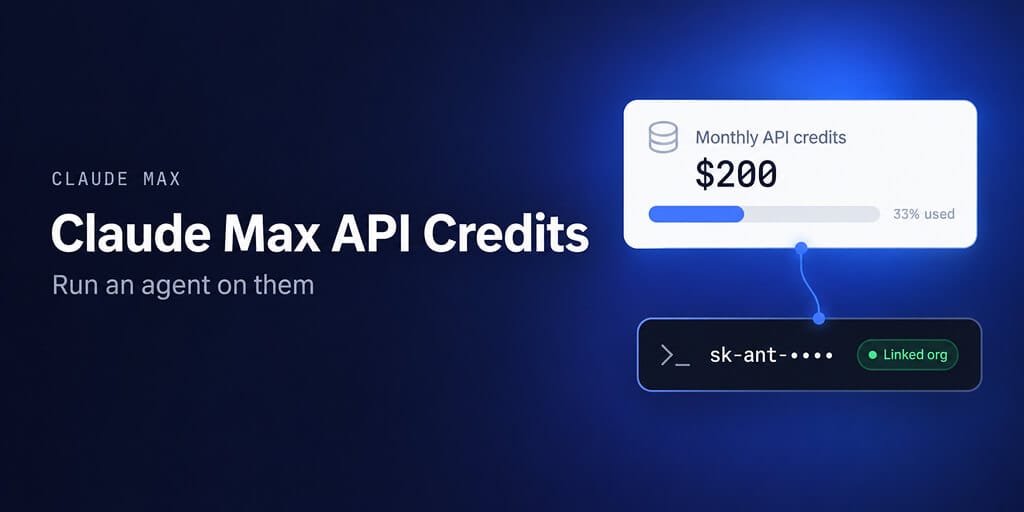
On October 7, Anthropic gave a much cleaner answer. Claude Max and Team plans now include monthly API credits. They work with an ordinary API key, so they work with any agent that accepts one.
Here's how much you get, how to claim it, and how far it actually goes.
How much Claude Max API credit you get
| Plan | Monthly API credits | Notes |
|---|---|---|
| Max 5x ($100/month) | $100 | |
| Max 20x ($200/month) | $200 | |
| Team, Standard seat | $20 per seat | Pooled across the team, capped at $500 a month |
| Team, Premium seat | $100 per seat | Pooled across the team, capped at $500 a month |
| Free, Pro, Enterprise | None | Not eligible |
A few rules from Anthropic's docs that matter:
- Unused credits expire every billing cycle. No rollover.
- New subscribers can claim after seven days on an eligible plan.
- Team credits are worked out from the seats you have at the start of each billing month. Three Standard and two Premium seats get $260 a month.
- Discounted Team plans (Nonprofit, Scientists) get the same per-seat amounts.
Here's the weird part. Max 5x costs $100 and comes with $100 of credit. Max 20x costs $200 and comes with $200. If your agent would spend that much on the API anyway, the subscription itself now costs you nothing extra.
How to claim your Claude Max API credits in five minutes
The rollout runs over a few days, so if you don't see the option yet, check back.
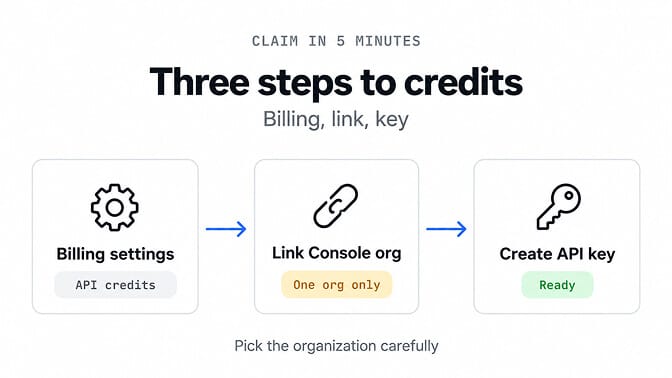
- On claude.ai, open Settings > Billing (Max), or Organization settings > Billing (Team; Owner or Primary Owner only).
- Find the API credits section and choose Link organization.
- Pick an existing Console organization, or create a new one. You need the Owner, Admin or Billing role in it.
- Review the credit terms and link.
- In that same Console organization, create an API key. This is the key your agent will use.
Choose the organization carefully. You can only link one Console organization, each organization can take credits from only one plan, and changing the link later means contacting support. If you already have a messy shared Console org, a fresh one just for your agents is cleaner.
One bonus: linked organizations move up to at least Anthropic's Start usage tier, or at least the Build tier if your monthly credits are over $200 (so Max 20x, at exactly $200, gets Start; Build is for larger Team pools). That means higher rate limits from day one.
What the credits cover, and what they don't
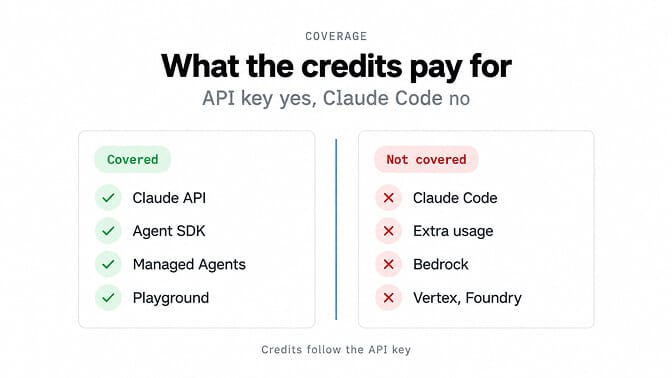
Covered:
- The Claude API (Messages and Message Batches).
- Claude Managed Agents.
- The Claude Agent SDK.
- The Console Playground.
Not covered:
- Claude Code: the terminal, IDE, desktop and web, and runs from the GitHub Action. One exception:
claude -pthat you run yourself with an API key from the linked org. Runs started by the GitHub Action, an IDE extension or the desktop app still count as Claude Code, even with-p. - Extra usage in Claude, Claude Code or Claude Cowork.
- Claude on Amazon Bedrock, Google Cloud Vertex AI, Microsoft Foundry, and Claude Platform on AWS.
This is where most people get it wrong. The credits don't change your Claude Code limits at all. Claude Code keeps drawing on your plan's usage allowance, as before. The credits are a separate pot, for things that call the API with a key.
What happens when they run out? If the organization has purchased credits or auto-reload, requests keep going on those. If it doesn't, API requests stop until the next monthly credit lands. Anthropic says usage is never charged to your Claude plan.
Using Claude Max API credits with an AI agent
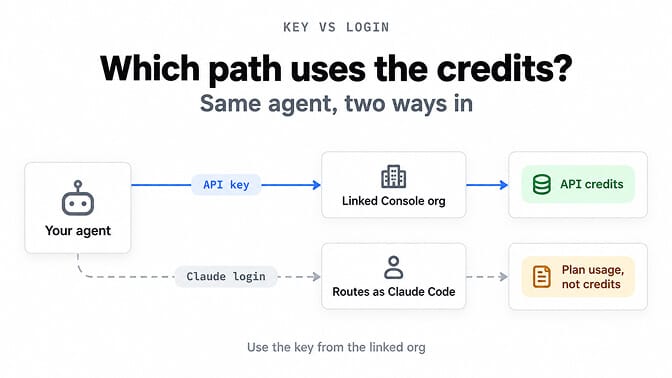
Anthropic's docs say every API key and workspace in the linked organization draws from the same credit balance. So the rule is simple: give your agent an API key from the linked organization, not your Claude login.
That distinction matters more than it sounds. Some agent tools offer to sign in with your Claude account instead of a key. Hermes's own docs say its Anthropic OAuth path "routes as Claude Code" and bills Max extra usage. Since Claude Code is excluded, that route won't touch your API credits.
OpenClaw
Pass the key during onboarding, then confirm the models are visible:
openclaw onboard --anthropic-api-key "$ANTHROPIC_API_KEY"
openclaw models list --provider anthropic
Use the API key, not openclaw models auth login --provider anthropic --method cli, which signs in through the Claude CLI instead. If the key is rejected, our OpenClaw API key troubleshooting guide covers the usual causes.
Hermes
Set the key and pick the Anthropic provider:
export ANTHROPIC_API_KEY=your-key-from-the-linked-org
hermes chat --provider anthropic
Make sure the key is actually set. Without it, Hermes falls back to reading Claude Code's login, which is the route the credits don't cover.
BetterClaw
Paste the key on your agent's Model tab under the Anthropic provider. BetterClaw is bring-your-own-key with no inference markup, so every token is billed by Anthropic straight to your credit balance. Setup is in our BYOK guide.
Wherever the key lives, treat it like money, because now it literally is. Don't paste it into plain-text config files you sync or commit. Our guide to keeping API keys out of plain text covers the safer options.
The credits follow the key, not the app. Get the right key into the right tool and the rest takes care of itself.
If you'd rather not run the agent's infrastructure yourself, that's the part BetterClaw handles. Paste the credited key once, and your agent runs in the cloud on your Max credits, with no gateway to babysit.
How far $100 or $200 goes (worked example)
Here's the formula, so you can plug in your own numbers:
cost per run = (input tokens × input price + output tokens × output price) ÷ 1,000,000
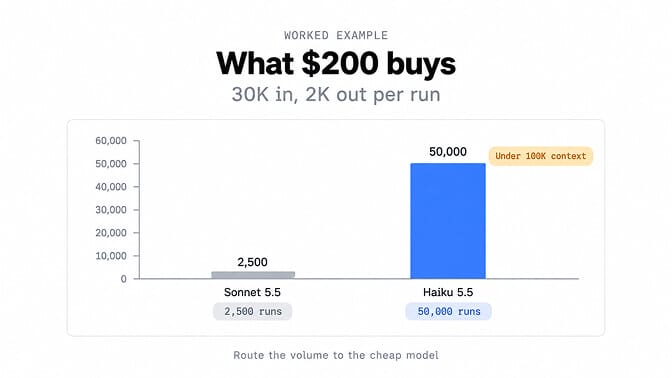
Take a typical agent run: 30K tokens in, 2K tokens out.
| Model | Price per 1M (in / out) | Cost per run | Runs per $100 | Runs per $200 |
|---|---|---|---|---|
| Claude Sonnet 5.5 | $2 / $10 | about $0.08 | about 1,250 | about 2,500 |
| Claude Haiku 5.5 | $0.10 / $0.50 | about $0.004 | about 25,000 | about 50,000 |
That's before caching. If most of your 30K input is a stable system prompt and tool list, cache reads cost a fraction of normal input: $0.10 per 1M on Sonnet 5.5 and $0.01 on Haiku 5.5. With caching, the same $200 stretches further.
Two cautions:
- Haiku 5.5's price steps up once a prompt goes over 100,000 tokens, to $0.50 in and $2.50 out for the whole request. Keep agent context lean, or the 50,000-run figure falls fast.
- The credits expire monthly. A $200 balance that your agent only uses $60 of is $140 you didn't get.
In practice, the strongest pattern is routing. Sonnet 5.5 plans the task, and Haiku 5.5 does the many small steps, so most of your runs happen at the cheap price.
Why not a Claude Max API proxy?
Because that's what got people cut off. Routing a subscription login through a proxy so an agent could use it is exactly the pattern Anthropic shut down for OpenClaw users on April 4. Our OpenClaw subscription ban explainer has the full timeline.
The credits remove the reason to do it. You get API-priced access, through the front door, with a normal key and higher rate limits. There's no longer a good argument for the back door.
Claude Max vs pay-as-you-go API: which is cheaper for agents now?
It depends on how much your agent would spend on the API in a month anyway.
| Your monthly API spend | Pay-as-you-go | Max 5x ($100) | Max 20x ($200) |
|---|---|---|---|
| $50 | $50 | $100 (half the credit expires) | $200 |
| $150 | $150 | $150 ($100 plan plus $50 bought) | $200 ($50 of credit expires) |
| $300 | $300 | $300 ($100 plan plus $200 bought) | $300 ($200 plan plus $100 bought) |
If you'd spend at least the plan price on the API every month, Max costs you nothing extra. You get the Claude apps and Claude Code on top at no extra cost. If your agent spends well under the plan price, pay-as-you-go is cheaper. The unused credit just expires.
The honest takeaway: these credits don't make Claude cheaper per token. They make the subscription and the API the same money, so you stop choosing between them. That's a better deal than the workarounds people were running in the spring, and it's one you never have to hide.
If any of this resonated, give BetterClaw a try. Paste your credited Anthropic key and your agent runs on your Max credits, with no inference markup. The free plan gives you one agent and 100 credits a month, with no card. Basic is $19 a month, and Pro is $49 a month for five agents. Start free or see full pricing.
Frequently Asked Questions
Does Claude Max include API credits?
Yes, since October 7, 2026. Max 5x includes $100 a month and Max 20x includes $200 a month in Claude API credits, claimed from Settings > Billing on claude.ai. They expire at the end of each billing cycle.
Do Claude Pro users get API credits?
No. Free, Pro and Enterprise plans aren't eligible. Only Max and Team plans (including discounted Team plans) get monthly API credits.
Can I use Claude Max credits with OpenClaw?
Yes, through an API key. Create a key in the Console organization linked to your Max plan, and give it to OpenClaw with openclaw onboard --anthropic-api-key. Don't use the Claude login route: it counts as Claude Code usage, which the credits don't cover.
Do the credits roll over?
No. Unused credits expire at the end of each billing cycle, or monthly on annual plans. They're also spent before any credits you've bought, so purchased credits only kick in once the monthly balance is gone.
Do the credits work with Claude Code?
Mostly no. Interactive Claude Code in the terminal, IDE, desktop and web isn't covered, and keeps using your plan's usage limits. The one exception is claude -p that you run yourself with an API key from the linked organization, which does draw on the credits. Runs from the GitHub Action, an IDE extension or the desktop app don't count, even with -p.
How do I get an API key from my Claude Max plan?
The plan itself doesn't issue a key. Link your plan to a Console organization from Settings > Billing on claude.ai, then create an API key inside that organization in the Console. Every key in that organization draws from the same monthly credit.
Do Team plans get credits per seat?
Yes. Team plans get $20 per Standard seat and $100 per Premium seat, pooled into one monthly balance capped at $500. It's based on the seats at the start of each billing month. For example, three Standard and two Premium seats receive $260.