You don't need 8 separate AI tools. You need one agent that actually does things.
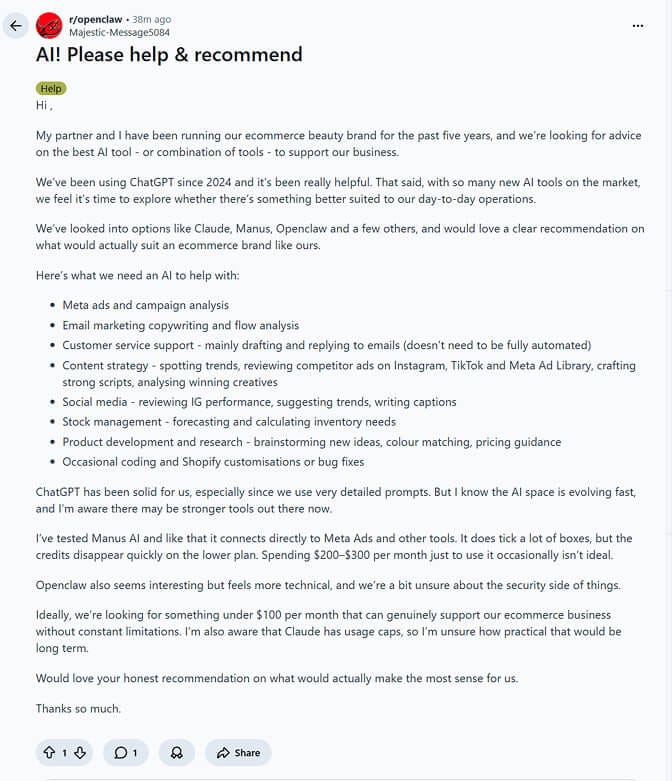
Last Tuesday at 11 PM, I was scrolling r/openclaw and saw a post that stopped me cold.
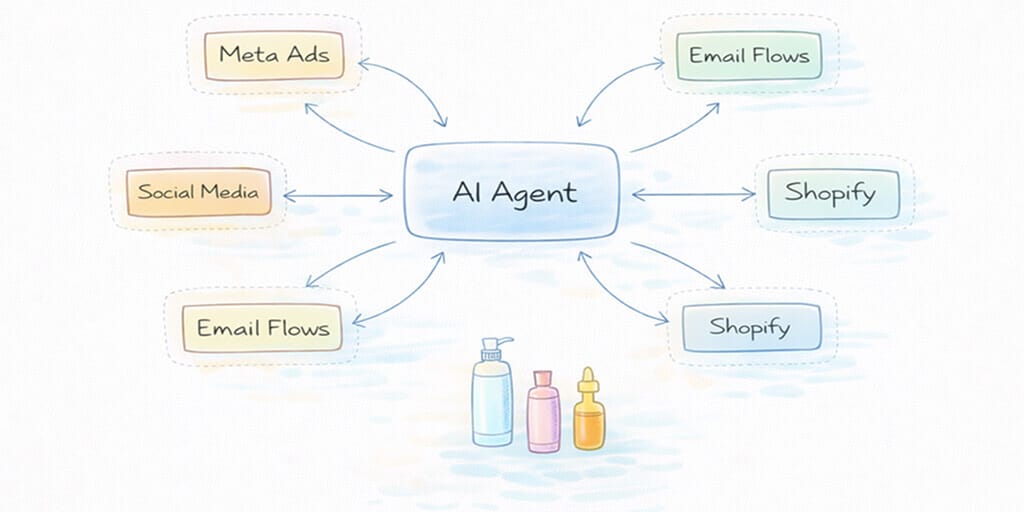
An ecommerce beauty brand owner - five years in business, two co-founders - was drowning. Meta ads analysis. Email marketing flows. Customer service emails. Content strategy across Instagram and TikTok. Social media captions. Stock management. Product development research. Shopify bug fixes. Eight separate workflows, all needing AI help.
Their solution? ChatGPT in one tab. Maybe Claude in another. Manus AI burning through $200–$300/month in credits. And still - they were copy-pasting between tools like it was 2023.
Here's the thing nobody tells you about using AI for ecommerce: the bottleneck isn't the AI model. It's the integration.
ChatGPT is brilliant at generating ad copy. Claude writes beautiful email sequences. But neither of them can wake up at 7 AM, check your Meta Ads Manager, pull yesterday's campaign performance, draft a Slack summary for your co-founder, flag the underperforming ad sets, and suggest copy variations - all before you've finished your coffee.
That's not a chatbot. That's an AI agent. And for ecommerce brands spending more time switching between tools than actually growing their business, it changes everything.
What an AI Agent Actually Does (And Why It Matters for Ecommerce)
Let's clear something up first.
ChatGPT, Claude, Gemini - these are conversational AI models. You ask a question. They answer. You copy the answer. You paste it somewhere. Repeat 47 times a day.
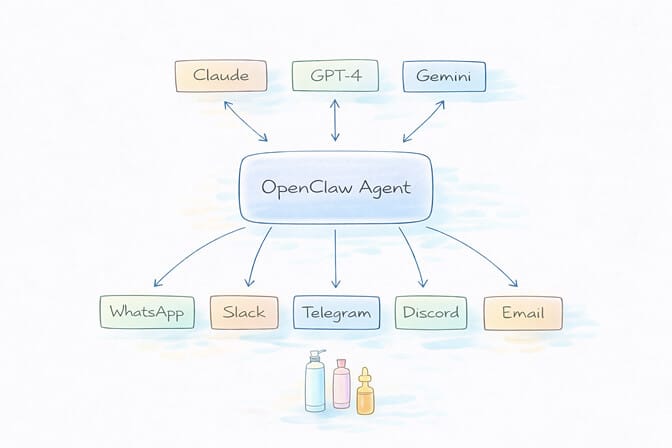
An AI agent is different. It connects to your actual tools - your email, your Shopify store, your ad accounts, your project management system - and takes action on your behalf. Not hypothetical action. Real, measurable, "this task is done" action.
OpenClaw is the open-source framework that made this possible for regular people. With 230,000+ GitHub stars and over 1.27 million weekly npm downloads, it's become the default way to deploy a personal AI agent that connects to platforms like WhatsApp, Slack, Telegram, and Discord.
But here's where it gets messy.
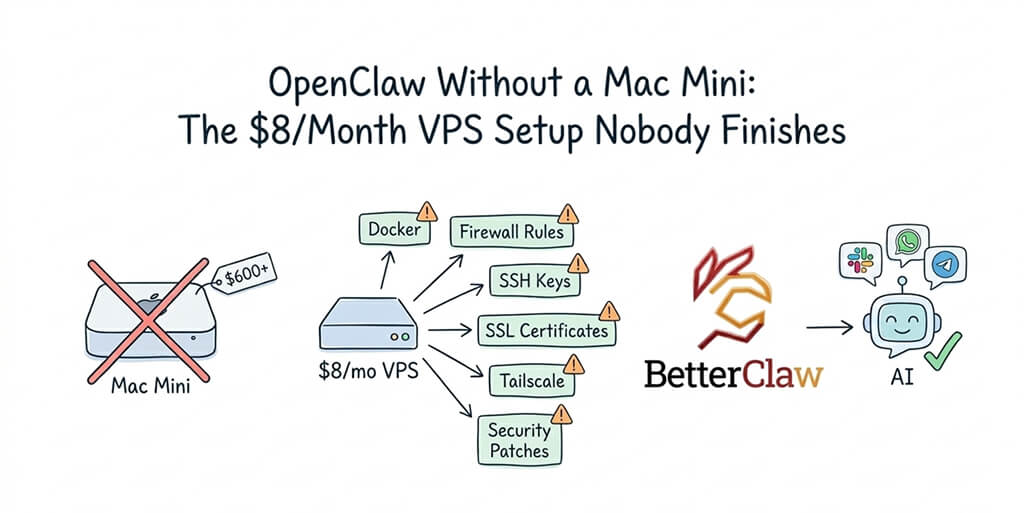
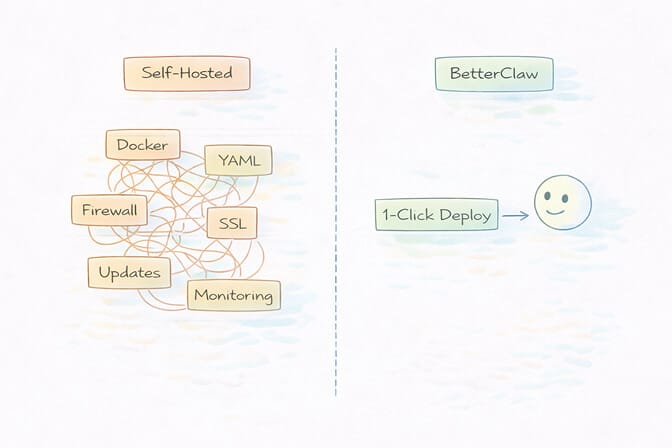
If you're running an ecommerce beauty brand and someone tells you to "just set up OpenClaw," they're glossing over about 6 hours of Docker configuration, YAML file editing, server provisioning, and security hardening that you absolutely do not have time for.
One of OpenClaw's own maintainers literally warned: "If you can't understand how to run a command line, this is far too dangerous of a project for you to use safely."
That's not gatekeeping. It's honesty. OpenClaw has real security risks that ecommerce brands need to understand - including a critical one-click remote code execution vulnerability (CVE-2026-25253) and over 30,000 internet-exposed instances found running without any authentication.
The question isn't whether AI agents are useful for ecommerce. It's whether you can deploy one without creating a bigger problem than the one you're solving.
The 8 Things Your Beauty Brand Actually Needs AI to Do
That Reddit post perfectly captured what most ecommerce founders are dealing with. Let me break down each workflow and explain what's realistic with today's AI agents - and what's still fantasy.
1. Meta Ads and Campaign Analysis
An OpenClaw agent can connect to Meta's Marketing API, pull campaign performance data daily, and send you a structured briefing. Not a raw data dump - a briefing. "Your retargeting campaign for the new serum collection spent $340 yesterday with a 2.1x ROAS. The broad audience creative with the before/after shots outperformed the lifestyle creative by 38%. Recommendation: shift $150 from the lifestyle ad set."
This is where agents crush chatbots. You're not pasting screenshots into ChatGPT and asking "what do you think?" The agent has the actual numbers, in context, every morning.
2. Email Marketing Copywriting and Flow Analysis
Feed your agent your brand voice guidelines, your top-performing email subject lines, and your product catalog. It drafts welcome sequences, abandoned cart emails, and promotional campaigns in your tone. But more importantly - it can analyze your Klaviyo or Mailchimp data to tell you which flows are underperforming and why.
3. Customer Service Drafting
This is the easiest win. Your agent monitors your support inbox, categorizes incoming emails (returns, product questions, shipping issues), and drafts responses for your review. You're not fully automating - you're eliminating the blank-page problem. Instead of writing 30 emails from scratch, you're editing 30 pre-drafted responses.
4. Content Strategy and Competitor Analysis
An agent running on a scheduled heartbeat can check competitor Instagram accounts, scan the Meta Ad Library for new creatives in your category, and monitor TikTok trending sounds relevant to beauty content. It compiles a weekly brief: "Three competitors launched new moisturizer campaigns this week. Two are using UGC-style before/after videos. One is running a limited-time bundle. Here's what's working in their comment sections."
5. Social Media Management
Your agent writes caption drafts, suggests posting schedules based on your historical engagement data, and flags trending hashtags in the beauty space. It's not replacing your creative direction - it's doing the research grunt work so you can focus on the creative decisions that actually matter.
6. Stock Management and Forecasting
Connect your agent to Shopify's inventory API and your sales history. It runs basic demand forecasting: "Based on last year's seasonal pattern and your current sell-through rate, you'll run out of the Rose Hip Oil in 18 days. Current reorder lead time is 21 days. Recommend placing a reorder this week."
7. Product Development Research
Your agent browses competitor websites, monitors beauty industry publications, tracks ingredient trends, and compiles research briefs. "Bakuchiol continues gaining traction as a retinol alternative. Three new DTC brands launched bakuchiol serums this month. Average price point: $38–$52."
8. Shopify Customizations and Bug Fixes
This is where understanding how OpenClaw actually works matters. The agent can execute code, interact with Shopify's APIs, and even control a browser to test changes. Minor theme tweaks, SEO fixes on product pages, redirect management - all doable through natural language commands.
Why ChatGPT Alone Can't Do This (And Where Claude and Manus Fall Short)
Let's be direct about the tools that Reddit poster was evaluating.
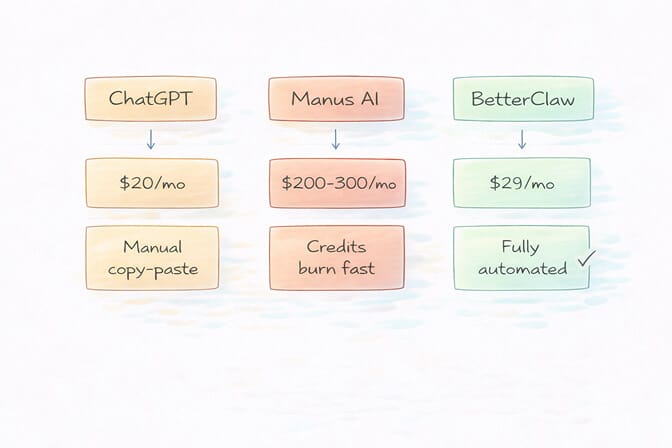
ChatGPT is the Swiss Army knife of AI. It's good at almost everything and great at nothing specific to your business. You can't connect it to your Shopify store, your Meta Ads account, or your email platform in any meaningful automated way. Every interaction is manual. Every insight requires you to provide the context. It doesn't remember that you launched a new product last week unless you tell it again.
Claude (full disclosure - this blog post was likely written with help from an AI model, and we use Claude's API for agent reasoning in BetterClaw) is excellent for deep analysis and long-form content. But it has usage caps on the consumer plan that make it impractical as a daily business tool. The person on Reddit was right to flag this concern.
Manus AI connects to some external tools, which is a step in the right direction. But at $200–$300/month for moderate use, you're paying enterprise prices for a tool that burns through credits fast. For an ecommerce brand targeting under $100/month, it's a non-starter.
The real answer isn't choosing between ChatGPT, Claude, or Manus. It's deploying an AI agent that uses whichever model is best for each task - and connects directly to your business tools.
This is exactly what OpenClaw does. It supports 28+ AI model providers. You can use Claude for complex analysis, GPT-4 for creative writing, and a lighter model for routine tasks - all through one agent, one conversation, one interface.
The problem, as we've established, is the setup.
The Self-Hosting Trap (Or: How I Lost a Weekend to Docker)
I'll be honest about our origin story.
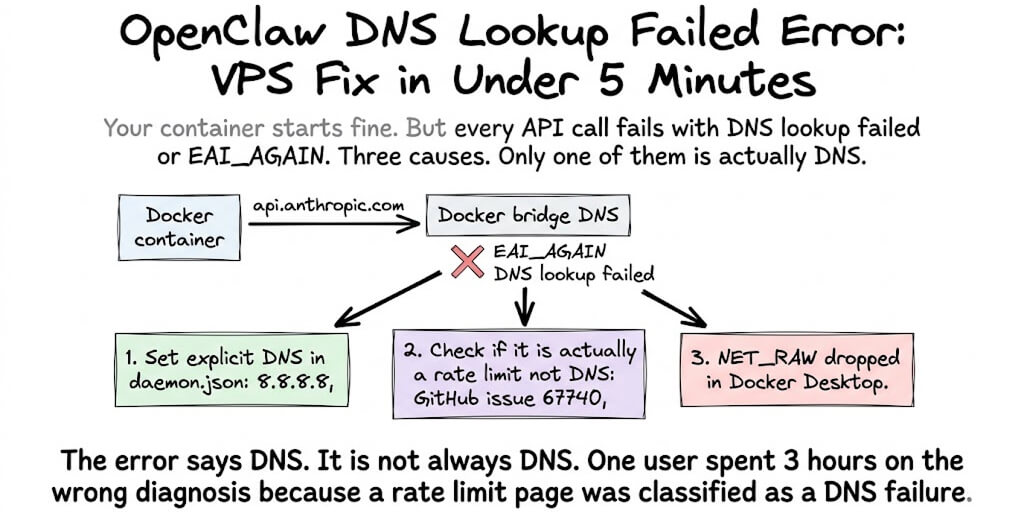
We tried self-hosting OpenClaw. Twice. The first time, we followed the official docs and got stuck on a Docker networking issue that took three hours to debug. The second time, we tried DigitalOcean's 1-Click deploy - which community members have reported has broken self-update scripts and fragile Docker interaction issues.
Both times, we got a working agent eventually. Both times, we spent more time on infrastructure than on actually building useful agent workflows.
And we're technical people. We know our way around a terminal.
For the beauty brand founder on Reddit - someone who explicitly said OpenClaw "feels more technical" and they're "a bit unsure about the security side" - self-hosting isn't just inconvenient. It's risky.
Consider this: CrowdStrike published a full security advisory on OpenClaw enterprise risks. Cisco found a third-party skill performing data exfiltration without user awareness. The ClawHavoc campaign discovered 824+ malicious skills on ClawHub - roughly 20% of the entire registry.
When you self-host, you are responsible for all of that. Firewalls. SSL certificates. Docker sandboxing. Credential encryption. Monitoring for anomalies. Keeping up with security patches.
If you're thinking about deploying an AI agent for your ecommerce business use cases and you're not a DevOps engineer, you need a managed solution. Period.
If you're tired of debugging infrastructure and want your agent running in 60 seconds - connected to Telegram, Slack, or whatever channel your team already uses - BetterClaw's no-code AI agent platform handles all of this for $49/month for Pro. AI model access included. No Docker. No YAML. No 2 AM debugging sessions.
What a Realistic AI Stack Looks Like for a Beauty Brand at $49/month
Here's what I'd actually recommend to that Reddit poster - and to any ecommerce brand in a similar position.
The Agent Layer: BetterClaw Pro - $49/month
One agent deployed through BetterClaw, connected to Telegram or Slack. Pro includes 5 agents and 12,000 credits a month, so there's room to add more agents as the brand grows. This becomes your command center. You talk to it like a team member. It handles email triage, content drafts, competitor monitoring, inventory alerts, and Shopify management.
AI model access is included in the price - no separate API keys to manage, no surprise token bills at the end of the month.
Docker-sandboxed execution means your agent can't accidentally wreck your server. AES-256 encryption protects your credentials. Real-time health monitoring auto-pauses the agent if something looks wrong. Workspace scoping ensures the agent only accesses what you've explicitly permitted.
Optional: Specialized Tools - $0–$30/month
Depending on your needs, you might add Klaviyo (free tier for small lists), Canva (free tier for basic design), or a social scheduling tool. But the agent handles the thinking - these tools just handle the execution that requires proprietary interfaces.
Total: $49–$79/month
Compare that to $200–$300/month on Manus AI alone, or $20/month on ChatGPT Plus that still requires you to manually copy-paste everything.
The Part Nobody Talks About: Your Agent Gets Smarter Over Time
Here's what makes an AI agent fundamentally different from switching between chatbot tabs.
OpenClaw has persistent memory. It remembers your brand voice. It knows your product catalog. It learns which Meta ad formats perform best for your audience. It understands that your co-founder handles product development while you handle marketing.
Every interaction makes it more useful. After a month, your agent knows things about your business that would take a new employee weeks to learn.
BetterClaw enhances this with hybrid vector + keyword search across your agent's memory. Ask it "what was our best-performing email subject line last quarter?" and it actually finds the answer from past conversations and analyses.
An AI chatbot gives you a fresh start every time. An AI agent gives you compound returns.
This is the core difference between managed and self-hosted OpenClaw - managed deployments handle the persistent storage, backup, and search infrastructure that makes memory actually reliable. Self-hosted setups often lose context when Docker containers restart or updates break the memory system.
Setting Up Your First Ecommerce Agent (The Honest Version)
If you're sold on the agent approach, here's what the first week actually looks like:
Day 1: Deploy and connect. Sign up for BetterClaw. Connect your primary chat channel (Telegram is great for founders who live on their phone; Slack if you're more desktop-oriented. WhatsApp isn't available on BetterClaw yet). AI model access is already included, so there's nothing else to configure. Total time: about 10 minutes.
Day 2–3: Teach it your business. This is the important part. Write a clear briefing document: your brand voice, your product lines, your target customer, your current challenges. Feed it your best-performing content as examples. The more context you give, the more useful every future interaction becomes.
Day 4–5: Start with one workflow. Don't try to automate everything at once. Pick your biggest time sink - for most beauty brands, it's content creation or customer service drafting - and get that working well before adding more.
Day 6–7: Expand gradually. Add a second workflow. Set up a daily morning briefing. Connect your Shopify data. Let the agent start monitoring your competitors.
The beauty brand on Reddit listed eight workflows they needed help with. That's a month-long rollout, not a weekend project. And that's okay. The point isn't to automate everything immediately. It's to stop doing $15/hour work when you should be doing $150/hour thinking.
This Is Just the Beginning
Peter Steinberger - the creator of OpenClaw - recently joined OpenAI, and the project is moving to an open-source foundation. That means more contributors, more skills, more integrations, and (critically for ecommerce brands) more pre-built workflows for common business tasks.
The ecosystem is exploding. Over 850 contributors are building new skills and integrations every week. Six months ago, setting up an ecommerce-specific agent required deep technical knowledge. Today, it requires an afternoon and the willingness to talk to your computer like it's a new hire. If you're deciding which automation to build first, our guide to the 5 ecommerce AI agent automations that pay for themselves in week one ranks them by return.
The ecommerce brands that figure this out early won't just save time. They'll operate with a level of intelligence and responsiveness that their competitors - still copy-pasting between ChatGPT tabs - simply can't match.
And it doesn't have to cost $200/month. It doesn't require a developer. It just requires you to stop thinking about AI as a tool you use and start thinking about it as a team member you deploy.
If any of this resonated - if you've been toggling between three AI tabs, burning through subscription credits, and still feeling like you're doing everything manually - give BetterClaw a try. It's $49/month for Pro, AI models included, and your first deploy takes about 60 seconds. We handle the infrastructure, the security, the updates. You handle the part that actually grows your business.
Frequently Asked Questions
What is an AI agent for ecommerce and how is it different from ChatGPT?
An AI agent for ecommerce is an autonomous assistant that connects directly to your business tools - Shopify, email platforms, ad accounts, messaging apps - and takes action on your behalf. Unlike ChatGPT, which only responds when you ask it something in a browser tab, an agent can monitor your business 24/7, send alerts, draft responses, and execute tasks without you initiating each interaction. Think of ChatGPT as a consultant you call. An AI agent is an employee that shows up every morning.
How does BetterClaw compare to self-hosting OpenClaw for an ecommerce business?
Self-hosting OpenClaw requires Docker setup, YAML configuration, server management, and ongoing security maintenance. BetterClaw eliminates all of that with 1-click deployment, Docker-sandboxed execution, AES-256 encryption, and real-time health monitoring. For ecommerce founders without DevOps experience, BetterClaw reduces setup time from hours (or days) to under 60 seconds - and you don't risk exposing your business data through misconfigured security.
How long does it take to set up an AI agent for my Shopify store?
With BetterClaw, the technical deployment takes about 60 seconds. The meaningful setup - teaching your agent about your brand, products, and workflows - takes 2–3 days of initial context building. Most ecommerce brands see real productivity gains within the first week, starting with customer service drafting and content creation before expanding to ad analysis and inventory management.
Is an OpenClaw agent worth it for a small ecommerce brand under $100/month?
Yes. BetterClaw Pro costs $49/month with managed model access included - no separate API keys or surprise token bills. Add a few optional specialized tools and you're still under $80/month. Compare that to Manus AI at $200–300/month or hiring a virtual assistant at $500+/month. If your agent saves you even 5 hours per week on content creation, email drafting, and competitor research, the ROI is immediate.
Is it safe to connect an AI agent to my Shopify store and business data?
Security is a legitimate concern - CrowdStrike and Cisco have both published advisories about OpenClaw risks in unmanaged deployments. BetterClaw addresses this with Docker-sandboxed execution (your agent can't access anything outside its container), AES-256 encryption for all stored credentials, workspace scoping for granular permissions, and real-time anomaly detection that auto-pauses agents if something looks wrong. Your data never touches shared infrastructure.