Every major gateway now passes provider token rates through at zero markup. So the price war is over and the real question changed. Here is what nine of them actually charge, verified on their own pages, and the four things that break agents specifically.
I went looking for a cheaper gateway than OpenRouter and came back with a different conclusion: there almost isn't one, because the thing I was shopping for stopped being the differentiator.
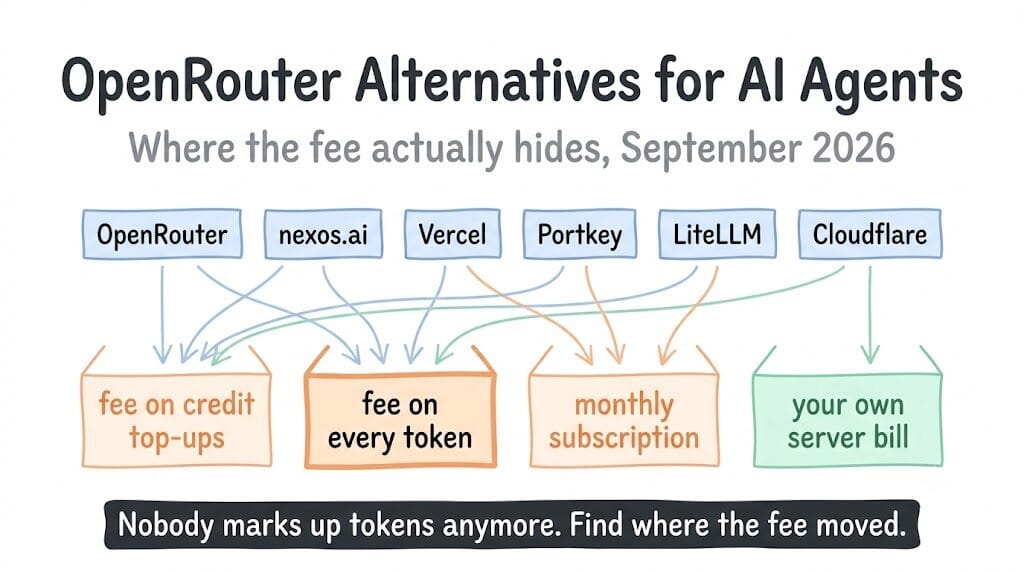
Vercel put it bluntly in their own comparison, and they have every commercial reason to say otherwise: every major gateway dropped its per-token markup to zero. OpenRouter, Vercel AI Gateway, Portkey, LiteLLM, Cloudflare, Eden AI, LLM Gateway, all of them pass the provider's published rate straight through.
So comparing token prices across gateways is comparing identical numbers. What actually differs is where each one takes its cut, and for agents specifically, four behaviours that no pricing page mentions.
What each one charges, verified
Checked against each gateway's own pricing or docs pages in September 2026.
| Gateway | Token markup | Where the fee sits | Self-host | Catalogue |
|---|---|---|---|---|
| OpenRouter | 0% | 5.5% on card credit top-ups ($0.80 min, 5% crypto). BYOK free to $25,000/mo of list-price inference, then 5%. Business tier at 8% on credits for EU-only or US-only routing | No | 500+ models, 80+ providers |
| nexos.ai | 5% on the Gateway | On the inference itself for the Gateway product, with no BYOK escape. The Workspace product is a subscription plus a monthly credit pool instead | No | 200+ models |
| Vercel AI Gateway | 0% | Nothing beyond provider list prices, including on BYOK. Free tier includes $5/mo of credits | No | 200+ models, 40+ providers |
| Cloudflare AI Gateway | 0% | Free when you use your own keys. 5% only if you opt into Unified Billing. Log storage billed via Workers | No | Multi-provider |
| Portkey | 0% | Subscription from $49/mo, plus about $9 per 100k logs. Free tier at 10,000 logs/mo. OSS gateway is MIT | Yes | 1,600+ models, 45+ providers |
| LiteLLM | 0% | Nothing on tokens. You pay your own infra (proxy, Postgres, Redis). Enterprise tier from roughly $250/mo | Yes, required | 100+ providers |
| Helicone | 0% | Plan-based, around $79/mo. Free tier at 10,000 requests/mo | Yes | 100+ models (vendor-stated) |
| Requesty | ~5% | Flat markup on the model price, no seat fee | No | Multi-provider |
| Eden AI | 0% | 5.5% on credit top-ups | No | Multi-provider |
| LLM Gateway | 0% | 5% on credits, 0% with your own keys | Yes, AGPLv3 | 200+ models, 40+ providers |
Two notes before anyone quotes this at me. Portkey was acquired by Palo Alto Networks in May 2026, and Helicone's gateway repository went into maintenance mode in March 2026, so neither is the safe default it was a year ago. And Kong AI Gateway 2.0 and Envoy AI Gateway exist in this category but are Kubernetes-shaped infrastructure rather than something you point an agent at in an afternoon.
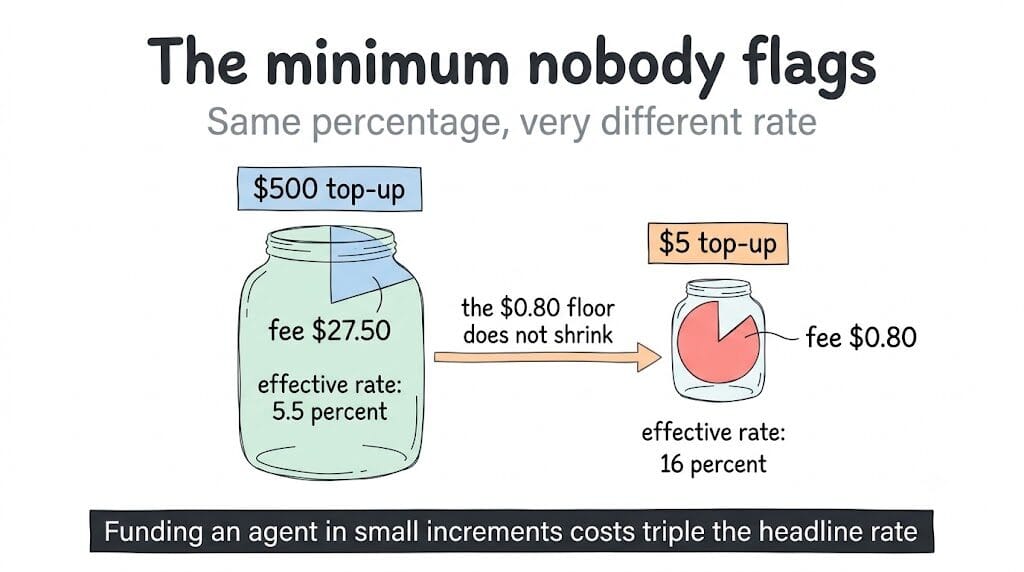
One line item that hits small teams hardest and appears in no comparison: OpenRouter's credit fee carries a $0.80 minimum. On a $500 top-up that 5.5% is $27.50, which is what everyone quotes. On a $5 top-up it is $0.80, or 16 percent. If you have been funding an agent in small increments to keep spend visible, you have been paying triple the headline rate.
The OpenRouter BYOK number everyone is still quoting is wrong
Here's the thing I'd most want to know if I were reading someone else's comparison.
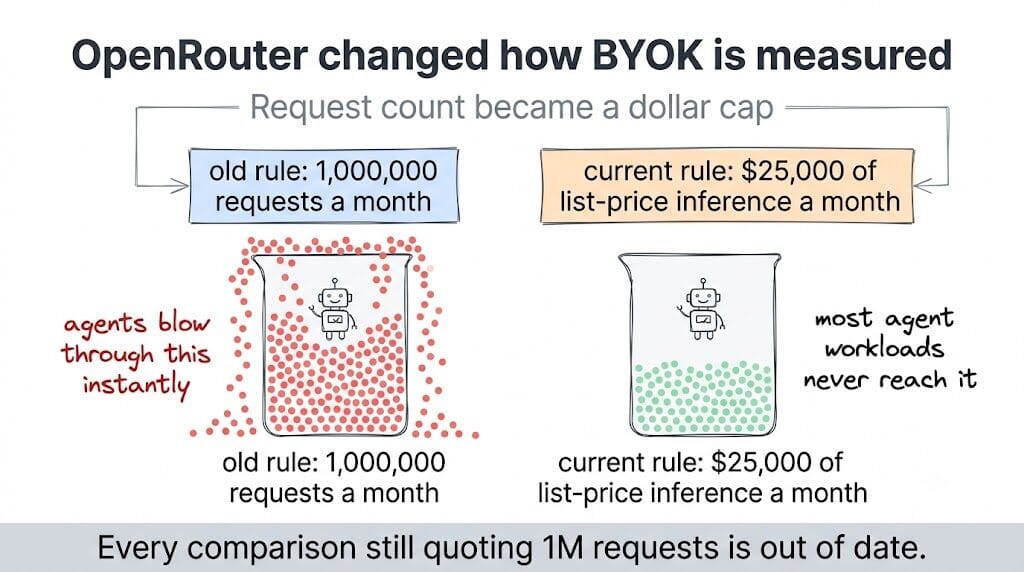
Almost every "OpenRouter alternatives" page on the web, including Vercel's own, says OpenRouter's BYOK is free for the first 1 million requests per month and then charges 5%. That was true. It isn't now, and OpenRouter's current FAQ goes out of its way to say so.
The allowance is a dollar cap, not a request count: BYOK is free up to $25,000 per month of list-price inference on pay-as-you-go, $200,000 on Enterprise, then 5% of what the same model would have cost on OpenRouter.
That reframes the entire cost comparison. A request-count allowance punished agents, which make enormous numbers of small calls. A dollar allowance does the opposite: your agent can make two million tiny classification calls a month and pay OpenRouter nothing, as long as the list-price value stays under $25,000.
On BYOK, OpenRouter's fee is zero for the overwhelming majority of agent workloads. If you're comparing gateways on fees alone and you're willing to hold your own provider keys, the honest answer is that OpenRouter, Vercel and Cloudflare all land at zero and the comparison has to be made on something else.
Which is why this post is mostly about something else.
The four things that actually break agents
A chatbot sends one message and reads one reply. An agent sends a large repeated prefix, calls tools, and runs unattended. Those differences make four gateway behaviours matter far more than a percentage.
Does it pass through provider-specific parameters?
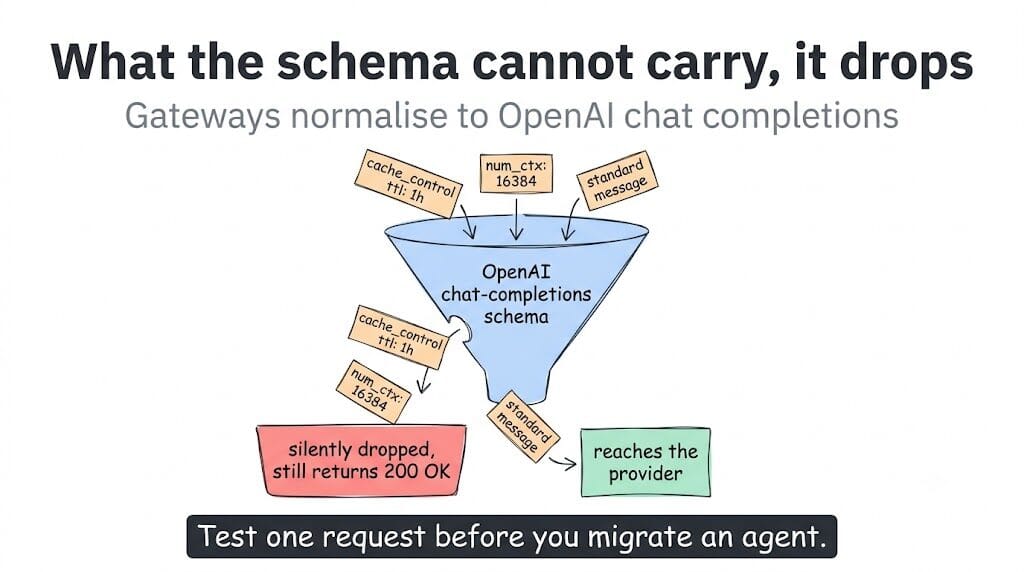
This is the one that costs people days. Gateways normalise everything to the OpenAI chat-completions schema, because that's what every SDK speaks. Anything that isn't in that schema has nowhere to go.
So a provider-specific parameter gets silently dropped. Not rejected, not warned about. Dropped, with a 200 OK. We wrote up the local-model version of this in the Ollama context window decoder, where num_ctx sent to an OpenAI-compatible endpoint does nothing at all and your agent quietly runs at the default window.
The same class of problem shows up with cache controls. OpenRouter documents that block-level cache markers translate between providers but TTLs are not translated: an Anthropic cache_control TTL gets dropped when routed toward OpenAI, and request-level cache options stay OpenAI-only. If your agent economics depend on a one-hour cache and your gateway silently gives you five minutes, your bill changes and nothing tells you.
Test this before you commit. Send one request with the provider-specific parameter your agent depends on, then check the response usage fields to confirm it took effect.
What does failover actually do?
Automatic failover is sold as a feature and it is one, right up until it isn't.
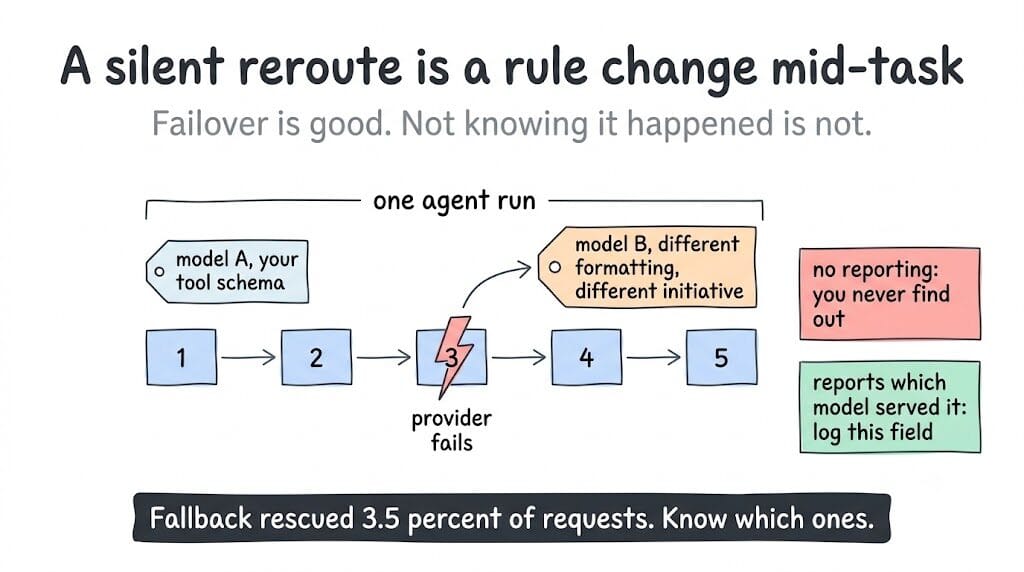
For a chatbot, falling back from one model to another is a small quality wobble. For an agent, it can be a behaviour change: a different model may not honour your tool schema as strictly, may format structured output differently, or may take different initiative when a step fails. A silent reroute mid-task is an agent that started following different rules halfway through.
Vercel reports that across seven months of production traffic their fallback routing rescued 3.5 percent of requests, which is a real reliability gain worth having. The question isn't whether failover is good, it's whether you know it happened. Prefer a gateway that reports which provider and model actually served each request, and log that field.
Are the rate limits per minute or per day?
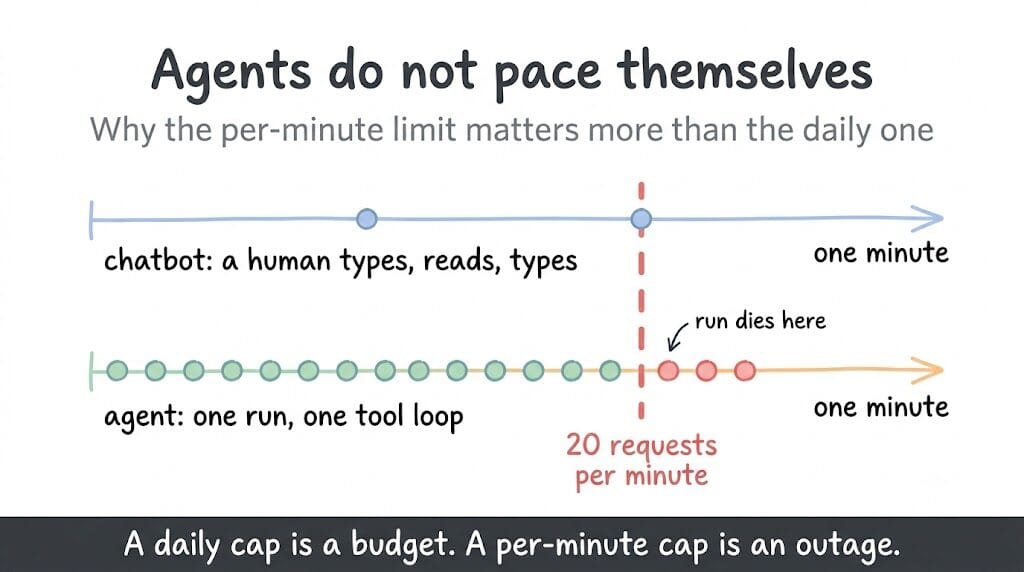
A daily cap is a budget. A per-minute cap is an outage.
Agents don't pace themselves. A single agent run can fire a dozen calls in a few seconds as it reads a tool result, decides, calls again. OpenRouter's free tier allows roughly 20 requests a minute and 50 a day, rising to 1,000 a day once you have bought at least $10 of credits. The daily number is what people read; the per-minute number is what kills an agent mid-task, and a paid balance is what removes it. Whatever gateway you pick, find the per-minute figure before you test with anything more complex than a chat.
Whose privacy policy applies, and does it stack?
A gateway adds a layer. Now two policies govern your agent's traffic: the gateway's and the downstream provider's.
OpenRouter handles this better than most: it tracks each endpoint's data policy, and where it can't establish one it assumes that endpoint retains and trains, and labels it. You can enforce zero retention globally, per model group, or per request, and zero data retention is included on the Business tier. Self-hosted options like LiteLLM sidestep the question entirely, since the only added layer is yours.
If your agent touches customer data, this deserves more attention than the fee. We went through the whole set in which AI providers train on your agent's data, including what zero-retention agreements exclude.
So which one, actually
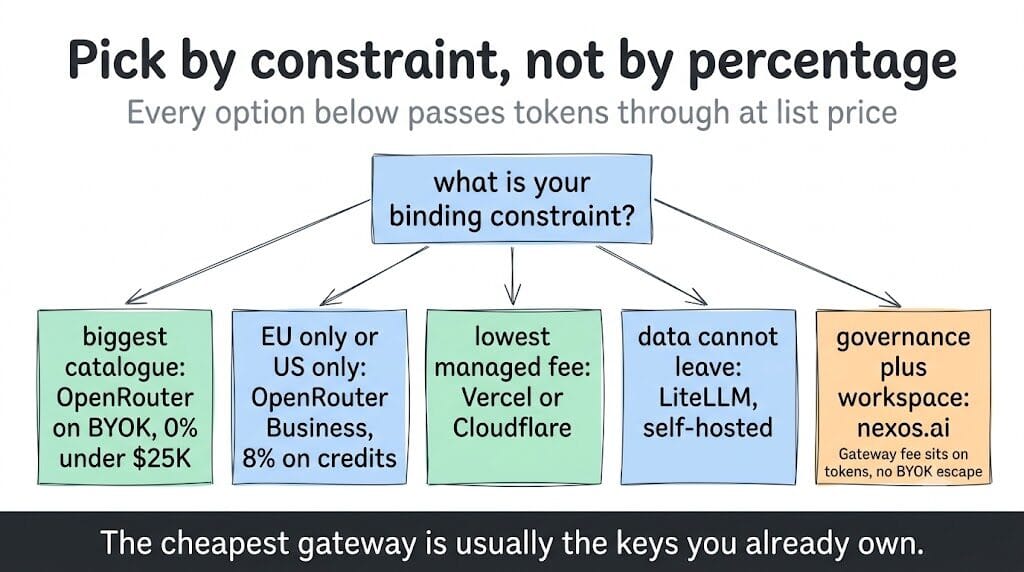
Broadest catalogue and you want to stop thinking about it: OpenRouter, on BYOK. The 5.5% credit fee is the thing people flee, and BYOK removes it entirely below $25,000 a month of list-price inference. You keep the largest model catalogue in the category and a genuinely good data-policy layer.
Hard EU-only or US-only routing: OpenRouter Business. This is newer than most comparisons and worth knowing about. 8% on credit purchases instead of 5.5%, no monthly minimum and no contract, and you point requests at a regional endpoint that will not fall back outside the region you picked. Zero data retention and a DPA are included. For a team that needs residency without a procurement cycle, self-serve at 8% is a genuinely different offer from "talk to sales."
Cheapest managed path: Vercel AI Gateway or Cloudflare. Vercel charges nothing beyond provider list prices, including on BYOK, and includes $5 a month of credits on the free tier. Cloudflare is free with your own keys and only takes 5% if you opt into Unified Billing. Neither matches OpenRouter's catalogue, and both suit you better if you already live in that ecosystem.
Data residency or air-gapped: LiteLLM. Zero fee on tokens, you pay infra, and nothing leaves your network that you didn't send. The cost is real operational work: a proxy, Postgres, Redis, and you on call for it.
European governance and a workspace in one: nexos.ai. Backed by Nord Security's founders out of Vilnius, with a €30M Series A. Be careful which product you are pricing, because they are two different things. The AI Gateway takes 5% on the inference itself, so a $10 per million model becomes $10.50 with no BYOK escape hatch, which at agent volumes is the most expensive structure in this table. The Workspace is a subscription with a monthly credit pool, listed at $39 a month and frequently discounted, which is a seat-and-usage purchase rather than a gateway fee. Buy the second one because you want the governance and the workspace, not because you are shopping for a cheaper router.
Already have Kong, or need guardrails in the gateway: Kong AI Gateway or Portkey. Portkey's 1,600-model catalogue and built-in guardrails are the strongest in the group; factor in the Palo Alto acquisition when you think about roadmap risk.
If you'd rather not run a gateway at all, that's more or less what we built. BetterClaw takes your provider keys directly, lets each agent use a different model, and adds no markup on inference, so there's no fee layer to shop for in the first place. You can try it on the free plan and see the per-agent cost before you commit to any of this.
The uncomfortable conclusion
I started this expecting to find OpenRouter overcharging and a scrappier alternative underpricing it. What I found is a category that competed itself into commodity pricing, where the headline number is zero almost everywhere and the remaining fee is avoidable by holding your own keys.
Which means the honest answer to "what's a cheaper OpenRouter alternative" is usually: your own provider keys, through whichever gateway you already trust. The fee was never the expensive part. The expensive part is a model you didn't need for a task that didn't require it, and no gateway fixes that for you. Our model routing guide is where that money actually is, and the OpenRouter fee calculator will tell you in thirty seconds whether switching gateways is worth the migration at your volume. My guess is it usually isn't.
If any of this resonated, give BetterClaw a try. Bring your own keys across 28-plus providers with no inference markup, set a different model per agent, and cap spend per agent so a routing mistake costs dollars rather than a weekend. Start free or see full pricing.
Frequently Asked Questions
What are the best OpenRouter alternatives for AI agents?
For the lowest managed fee, Vercel AI Gateway (nothing beyond provider list prices, including on BYOK) and Cloudflare AI Gateway (free with your own keys, 5% only on Unified Billing). For data residency, self-hosted LiteLLM. For guardrails and the biggest catalogue, Portkey at 1,600-plus models from $49 a month. For European governance plus a workspace, nexos.ai, though its Gateway fee sits on tokens rather than top-ups.
How does nexos.ai compare to OpenRouter on price?
The fee structures differ in kind, not just size, and nexos.ai sells two things. OpenRouter charges 5.5% when you buy credits and nothing on BYOK below $25,000 a month of list-price inference, so a team holding its own keys often pays zero. The nexos.ai AI Gateway adds 5% to the inference itself, so a $10 per million model bills at $10.50, with no BYOK route around it. Its Workspace is a separate subscription-plus-credits product listed at $39 a month. At agent volumes the Gateway is the more expensive structure; the case for nexos.ai rests on governance and the bundled workspace, not on price.
How do I test whether a gateway will break my agent?
Run four checks before migrating. Send one request carrying the provider-specific parameter your agent depends on (a cache TTL, a context length) and confirm from the response usage fields that it took effect rather than being silently dropped. Force a provider failure and check whether the response tells you which model actually served it. Find the per-minute rate limit, not just the daily one. Then read the gateway's data policy alongside the downstream provider's, because both now apply.
Is OpenRouter's 5.5% fee worth paying, or should I switch?
Usually neither: switch to BYOK on OpenRouter rather than switching gateways. The 5.5% applies to credit top-ups, and bringing your own provider keys drops it to zero below $25,000 a month of list-price inference ($200,000 on Enterprise), which covers nearly every agent workload. Two things to check first: the widely quoted "free for 1 million requests" figure is outdated, and the $0.80 minimum per top-up means small increments cost far more than 5.5%.
Is a self-hosted gateway like LiteLLM actually safer than a managed one?
On data exposure, yes, because the only added layer is one you run, and nothing reaches a third party you haven't vetted. On reliability it's a trade: you inherit the proxy, Postgres and Redis, and you are the on-call rotation when routing breaks at 2am. Choose it when residency or air-gapping is a hard requirement, not because managed gateways are careless. If you want residency without running infrastructure, OpenRouter's Business tier is the self-serve middle option.