MiniMax M3 is nearly free. Opus 4.6 costs serious money. Tested side by side on real agent tasks. When the price gap is justified and when it isn't.
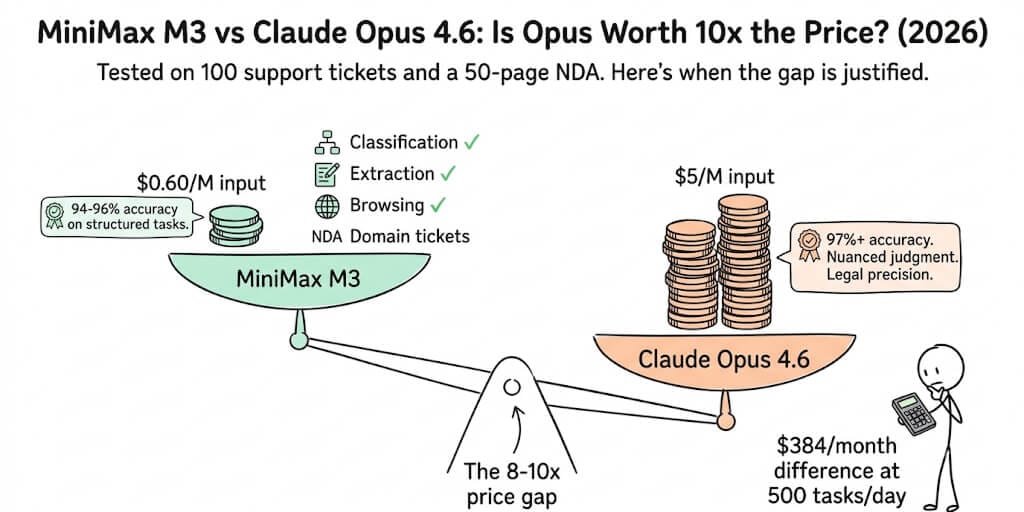
We ran both models on the same 100 support tickets from our own help desk. M3 classified 94 correctly. Opus 4.6 classified 97 correctly. Three extra correct classifications. The misclassified tickets (ambiguous "billing vs technical" cases) ended up in human review either way.
Then we ran both on a 50-page NDA from an actual partnership deal (redacted, obviously). M3 caught 4 out of 6 non-standard clauses. Opus caught all 6, including a subtle carve-out in the indemnification section that would have limited our liability cap. Our lawyer's review: "The Opus output was better than what most junior associates produce."
That's the MiniMax M3 vs Claude Opus 4.6 question reduced to two data points. For structured tasks with clear categories, the cheap model matches the expensive one. For nuanced judgment calls with real consequences, the gap is the difference between "caught most of it" and "caught all of it." (If your workload is reasoning-heavy rather than judgment-heavy, our DeepSeek R1 vs Claude Opus 4.6 breakdown is the more relevant read.)
The price gap in real numbers
| MiniMax M3 | Claude Opus 4.6 | Difference | |
|---|---|---|---|
| Input per 1M | $0.60 | $5.00 | 8.3x |
| Output per 1M | $2.40 | $25.00 | 10.4x |
| 100 tasks/day (monthly) | $11 | $88 | $77/month |
| 500 tasks/day (monthly) | $56 | $440 | $384/month |
| 2,000 tasks/day (monthly) | $223 | $1,760 | $1,537/month |
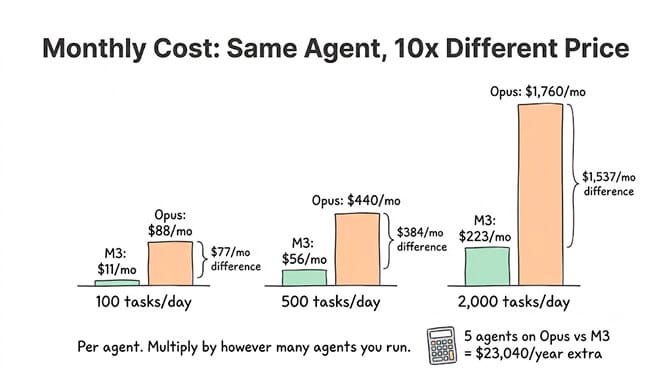
At 500 tasks per day, choosing Opus over M3 costs an extra $384/month. That's $4,608/year. Per agent. If you run 5 agents on Opus instead of M3, the gap is $23,040/year.
The question isn't "which model is better." It's "which tasks justify the $384/month premium?"
Where M3 matches Opus (and the premium is wasted)
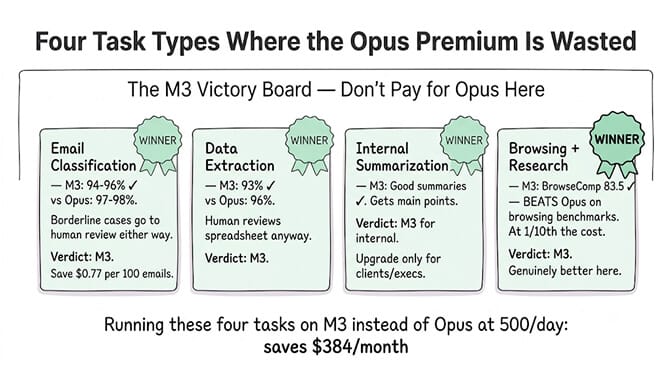
Email classification
100 emails. Five categories. Both models produce structured JSON output.
- M3: 94-96% accuracy. $0.11 per 100 emails. 80 tok/s.
- Opus 4.6: 97-98% accuracy. $0.88 per 100 emails. 46 tok/s.
The 2-3% accuracy gap rarely matters for classification. A human reviews the borderline cases either way. Verdict: M3. Save the $0.77 per 100 emails.
Data extraction
Extract vendor name, amount, date, and category from 50 receipt emails.
- M3: 93% field-level accuracy. Occasional wrong dates (MM/DD vs DD/MM confusion).
- Opus 4.6: 96% field-level accuracy. Better on ambiguous date formats.
For internal expense tracking where a human reviews the spreadsheet, 93% vs 96% doesn't justify 10x cost. Verdict: M3.
Summarization
Summarize a 5,000-word document into 3 key takeaways.
- M3: Good summaries. Captures main points. Occasionally includes a minor detail as a "key" takeaway.
- Opus 4.6: Better summaries. More precise about what's actually important vs merely mentioned.
For internal use (team briefings, meeting summaries, research digests), M3's summaries are perfectly usable. Verdict: M3 for internal. Opus if the summary goes to a client or executive.
Browsing and research
Research a topic across multiple sources. Synthesize into a structured report.
- M3: BrowseComp 83.5 (actually beat Opus 4.7 on browsing tasks). Strong at navigating multi-page research and extracting relevant information.
- Opus 4.6: Good but slower (46 tok/s vs ~80 tok/s). More careful and thorough, but the browsing benchmark says M3 is better here.
Verdict: M3. Genuinely better on browsing tasks at 1/10th the cost.
For structured tasks with clear inputs and expected outputs (classification, extraction, summarization, browsing), M3 matches or nearly matches Opus at 8-10x less cost. The premium is wasted here.
For the full daily cost breakdown at multiple volumes (with a third model in the mix), see our MiniMax M3 vs GLM vs Claude cost comparison. If you'd rather stay in the Anthropic family for the cheaper tier, M3 vs Claude Sonnet 4.6 covers the middle option.
Where Opus justifies the premium (and M3 falls short)
Complex multi-step tool chains
Agent reads a ticket, looks up the customer in CRM, checks subscription tier, searches knowledge base, and drafts a tier-appropriate response.
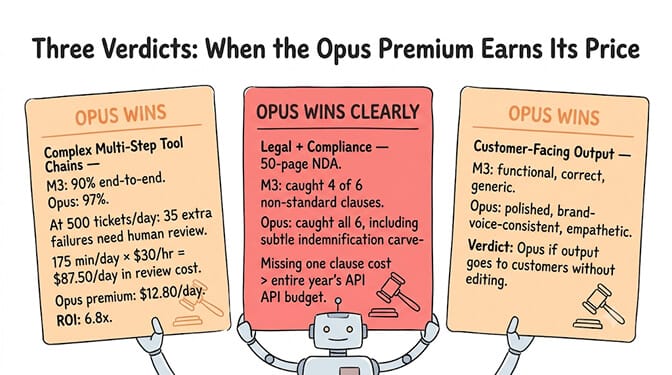
- M3: 90% correct end-to-end. Occasional wrong tool parameter on ambiguous inputs. Drafts need light editing.
- Opus 4.6: 97% correct end-to-end. Handles ambiguity cleanly. Draft quality is customer-ready.
The math: at 500 daily tickets, M3 produces ~50 failures. Opus produces ~15 failures. Those 35 extra failures per day need human review at ~5 minutes each. That's 175 minutes (nearly 3 hours) of human time per day. If the reviewer costs $30/hour, that's $87.50/day in human review cost. The Opus premium for 500 tasks is $12.80/day.
Verdict: Opus. The premium pays for itself 6.8x over in saved human review time.
Legal and compliance work
Read a 50-page contract. Identify non-standard clauses. Cross-reference with company policy. Draft amendment language.
- M3: Caught 4 of 6 issues. Missed two subtle indemnification traps. Amendment language was functional but generic.
- Opus 4.6: Caught all 6 issues. SWE-bench Verified 80.8%. BigLaw Bench 90.2%. Amendment language was specific and professional.
Verdict: Opus. Missing an indemnification clause costs more than the entire year's API budget.
Customer-facing output quality
Agent drafts customer emails, reports, or content that humans read without editing.
- M3: Functional, correct, generic. Gets the facts right. Tone is adequate.
- Opus 4.6: Polished, brand-voice-consistent, nuanced. Tone matches the customer's energy. Empathy where needed.
Verdict: Opus if the output goes to customers without human editing. M3 if a human reviews and polishes before sending.
Long-context reasoning (50K+ tokens)
Both have 1M context windows. But Opus maintains higher attention quality across long contexts. The lost-in-the-middle effect impacts both, but Opus degrades more gracefully. MRCR v2 at 1M context: 76% (Opus) vs estimated 60-65% (M3).
Verdict: Opus for documents over 50K tokens where precision matters.
If you want both models available through one dashboard, BetterClaw supports MiniMax and Anthropic (plus 26 other providers) via BYOK with zero inference markup. Route classification to M3 and complex tasks to Opus. Free plan with 1 agent and 500 credits a month. $49/month on Pro.
The decision framework (one question)
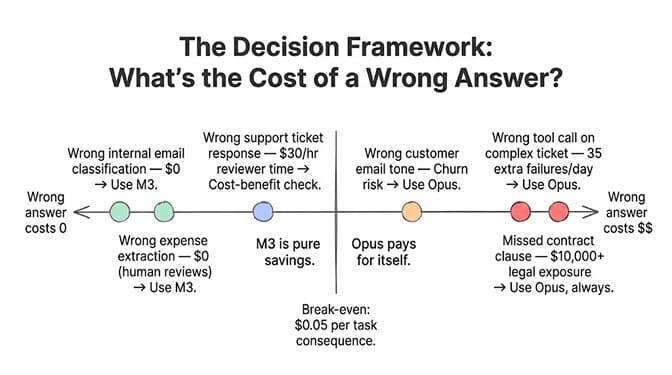
Ask yourself: what's the cost of a wrong answer on this task?
- Wrong classification on an internal email? $0. Use M3.
- Wrong extraction on an expense receipt? $0 (human reviews anyway). Use M3.
- Wrong tool call on a customer support ticket? $30/hour reviewer time × 5 minutes. Use Opus.
- Wrong clause missed in a legal contract? $10,000+ legal exposure. Use Opus.
- Wrong tone in a customer email? Churn risk. Use Opus.
The break-even threshold: if a wrong answer on this task costs more than $0.05 in downstream consequences, Opus pays for itself. If a wrong answer costs $0, M3 is pure savings.
The builders getting the best results aren't choosing one model for everything. They're using M3 for the 65% of tasks where wrong answers are cheap, and Opus for the 35% where wrong answers are expensive. Model routing handles this automatically — here's how to set it up on your own agent.
Blended cost at 500 tasks/day (65% M3, 35% Opus): $36 + $154 = $190/month. Compare to all-M3 ($56, some failures) or all-Opus ($440, overpaying on simple tasks). The blend gives you Opus quality where it matters and M3 savings where it doesn't.
On BetterClaw, you can connect both MiniMax and Anthropic keys in the same agent. Set a per-agent monthly cap (say, $50). The agent uses M3 by default and escalates to Opus when the task complexity warrants it. If the cap is reached, the agent pauses and alerts you instead of running up the bill. Free plan to test the routing. $49/month for Pro for production.
Frequently Asked Questions
Is MiniMax M3 good enough to replace Opus 4.6 for agents?
For 60-65% of agent tasks (classification, extraction, summarization, browsing), yes. M3 achieves 90-96% accuracy on structured tasks at 8-10x less cost. For complex multi-step tool chains (Opus 97% vs M3 90%), customer-facing output quality, legal analysis, and long-context reasoning, Opus is measurably better. The practical approach: use M3 as the default and route only complex/high-stakes tasks to Opus.
How much cheaper is M3 than Opus 4.6?
M3 costs $0.60/M input and $2.40/M output vs Opus at $5/$25/M. That's 8.3x cheaper on input and 10.4x cheaper on output. At 500 tasks/day: M3 costs $56/month, Opus costs $440/month. The gap is $384/month ($4,608/year). With model routing (65% M3, 35% Opus): $190/month, saving $250/month vs all-Opus.
Does M3 support multimodal like Opus 4.6?
M3 supports text, image, AND video input (MIT license). Opus 4.6 supports text and image only (proprietary). For agents processing video content, screenshots, or image-based data, M3 actually has broader multimodal coverage. Both have 1M context windows.
When is Opus 4.6 worth 10x the price?
When the cost of a wrong answer exceeds $0.05 per task. Specifically: complex multi-step tool chains (35 fewer failures per day at 500 tasks saves $87.50/day in reviewer time), legal and compliance work (missing a clause costs thousands), customer-facing drafts (tone and quality affect retention), and high-stakes decisions where precision matters more than cost.
Can I use both M3 and Opus on the same agent?
Yes. On BetterClaw, connect both MiniMax and Anthropic API keys via BYOK. Configure model routing to send simple tasks to M3 and complex tasks to Opus. Both providers work simultaneously with zero markup. Free plan supports 1 agent. Pro ($49/month) supports 5 agents with 12,000 credits a month.