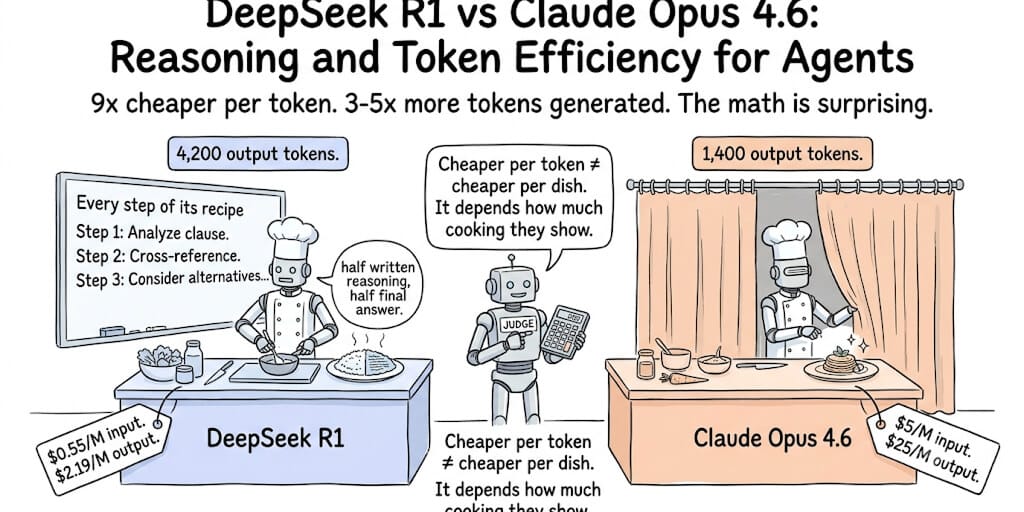
DeepSeek R1 reasons out loud at $0.55/M. Opus 4.6 reasons internally at $5/M. Both solve hard problems. But the token economics are completely different, and that changes which one actually costs less on real agent workloads.
The verdict (top of page)
DeepSeek R1 wins on: raw price per token (9x cheaper input, 11x cheaper output), open weights (MIT, self-hostable), transparency (reasoning chain visible and inspectable), and math/logic tasks where chain-of-thought is the entire point.
Claude Opus 4.6 wins on: reasoning quality on complex agent tasks, context window (1M vs 164K), token efficiency (reasoning is hidden, not billed as output), multimodal input (text + image), tool calling reliability, and long-running agent sessions.
R1 is cheaper per token. Opus 4.6 is often cheaper per correct answer. The difference is that R1 generates 3-5x more output tokens on reasoning tasks (visible chain-of-thought billed at $2.19/M). Opus 4.6 thinks internally (adaptive, not billed as standard output). On a complex reasoning task, R1's total cost can exceed Opus despite the lower per-token rate.
I ran the same prompt through both models last week. A multi-step agent task: read a contract, identify non-standard clauses, cross-reference with company policy, and draft an amendment.
DeepSeek R1 generated 4,200 output tokens. About 3,000 of those were visible chain-of-thought reasoning. The final answer was 1,200 tokens. Cost: $0.55 input + ($2.19 x 4.2) = $9.75 per million equivalent. But wait. Those 3,000 reasoning tokens are billed as regular output at $2.19/M.
Claude Opus 4.6 generated 1,400 output tokens. The reasoning happened internally via adaptive thinking. I couldn't see the chain-of-thought. The final answer was roughly the same quality. Cost: $5 input + ($25 x 1.4) = $40 per million equivalent.
R1 was 4x cheaper on this task. But when I tested on a simpler task (email classification), R1 still generated 800 tokens of reasoning for a 50-token answer. Opus 4.6 on "low" effort mode answered in 60 tokens with no reasoning overhead.
The cost comparison between DeepSeek R1 and Claude Opus 4.6 isn't about per-token pricing. It's about how many tokens each model generates to reach the right answer.
How reasoning tokens change the cost math
Here's the insight most comparison articles miss.
DeepSeek R1 uses visible chain-of-thought. The model "thinks out loud." You see every reasoning step. Those reasoning tokens are counted as output tokens and billed at the output rate ($2.19/M). A typical R1 response on a reasoning task generates 3-5x more tokens than the final answer.
Claude Opus 4.6 uses adaptive thinking with four effort levels (low, medium, high, max). The model reasons internally. You see only the final answer. The thinking tokens are generated but Anthropic handles the billing differently. On simpler tasks, Opus uses less thinking. On complex tasks, more.
DeepSeek R1 shows its work. You pay for seeing it. Opus 4.6 does its work behind the curtain. You pay a higher per-token rate but generate fewer output tokens on average.
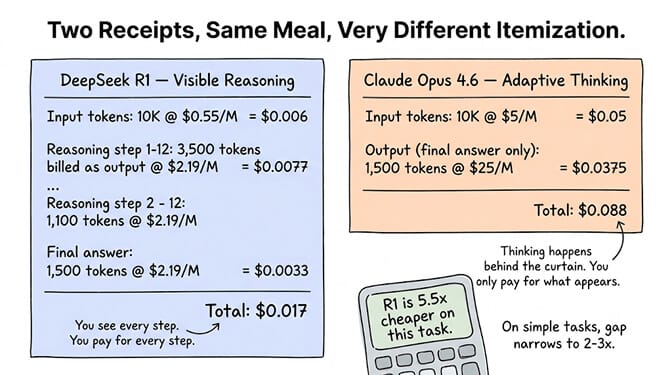
The math on a complex reasoning task (10K input, reasoning-heavy):
R1: 10K input ($0.0055) + 5K output including reasoning ($0.011) = $0.016 per task.
Opus 4.6: 10K input ($0.05) + 1.5K output ($0.0375) = $0.088 per task.
R1 is 5.5x cheaper on this task. The per-token rate advantage overwhelms the extra reasoning tokens.
The math on a simple task (2K input, classification):
R1: 2K input ($0.0011) + 800 output including unnecessary reasoning ($0.00175) = $0.0029.
Opus 4.6 (low effort): 2K input ($0.01) + 60 output ($0.0015) = $0.0115.
R1 is still cheaper, but the gap narrows because R1 generates 800 tokens of reasoning for a task that needs 60 tokens. On simple tasks, DeepSeek V4 Flash at $0.14/M is the better choice than R1.
Specs side by side
| DeepSeek R1 | Claude Opus 4.6 | |
|---|---|---|
| Input per 1M | $0.55 | $5.00 |
| Output per 1M | $2.19 | $25.00 |
| Context window | 164K | 1M (beta) |
| Max output | 16K-66K | 128K |
| Multimodal | Text only | Text + image |
| License | MIT (open weights) | Proprietary |
| Architecture | 671B MoE (37B active) | Dense (proprietary) |
| Reasoning style | Visible chain-of-thought | Adaptive thinking (4 effort levels) |
| Speed | ~34 tok/s (DeepSeek API) | ~46 tok/s (max effort) |
| Cache discount | 90% (automatic) | 90% (prompt caching) |
The pricing gap: R1 is 9x cheaper on input and 11.4x cheaper on output at published rates. With DeepSeek's automatic cache (90% discount at 70% hit rate), the effective input rate drops to ~$0.17/M. With Anthropic's prompt caching, input drops to $0.50/M.
Where R1 wins (and it's not close)
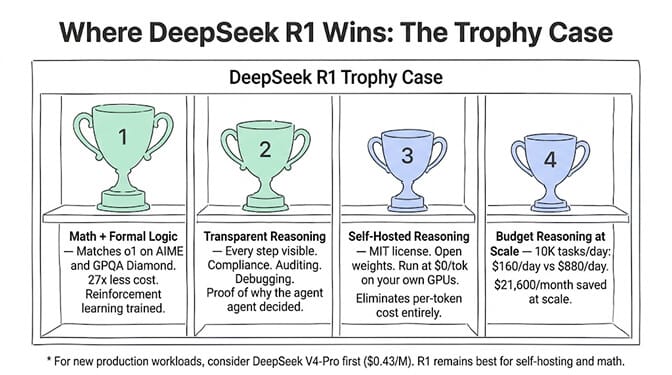
Math and formal logic. R1 was specifically trained with reinforcement learning on verifiable math and logic tasks. It matches OpenAI o1 on AIME and GPQA Diamond at 27x less cost. If your agent does math (financial calculations, statistical analysis, optimization), R1 is the obvious choice.
Transparent reasoning. You can inspect every step R1 takes. For compliance, auditing, or debugging, this visibility is invaluable. Opus 4.6's adaptive thinking is a black box. You see the answer but not the reasoning path. If you need to prove why the agent made a decision, R1's chain-of-thought is the evidence.
Self-hosted reasoning. MIT license. Open weights on HuggingFace. Run R1 on your own GPUs for $0/token. For high-volume reasoning workloads, self-hosting eliminates per-token costs entirely.
Budget reasoning at scale. 10,000 complex reasoning tasks per day: R1 ~$160/day. Opus 4.6 ~$880/day. At scale, the 5.5x gap compounds to $21,600/month saved. If your agents do heavy reasoning work, R1's pricing is hard to argue against.
Where Opus 4.6 wins (and it matters for agents)
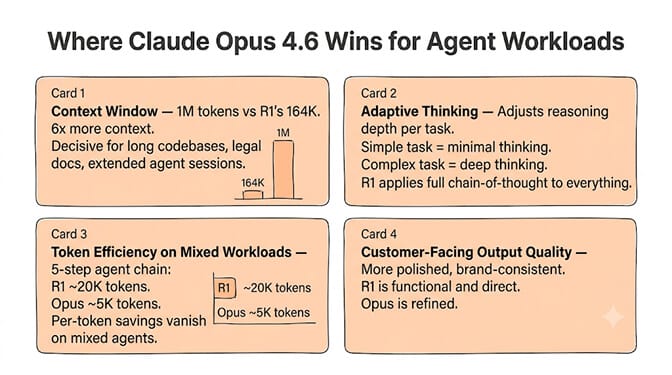
Context window. 1M tokens vs 164K. If your agent processes long codebases, legal documents, or extended conversation histories, Opus 4.6 can handle 6x more context. For long-running agents, this is the decisive technical advantage.
Tool calling and agent tasks. Opus 4.6 was designed for agentic workflows. SWE-bench Verified 80.8%. Terminal-Bench 65.4%. The adaptive thinking system adjusts reasoning depth per task automatically. R1 applies full chain-of-thought to everything, including tasks that don't need it.
Token efficiency on mixed workloads. Agents don't do one type of task. They classify, then reason, then draft, then call tools. Opus 4.6's adaptive thinking uses minimal reasoning on simple steps and deep reasoning on complex steps. R1 generates full chain-of-thought on every step. For a 5-step agent chain, R1 produces ~20K tokens. Opus produces ~5K tokens. The per-token savings vanish.
Output quality on customer-facing text. Opus 4.6 produces more polished, brand-voice-consistent output. R1's output tends toward functional and direct. For agents drafting customer emails or reports, Opus quality is measurably better.
If you want both models available on one dashboard, BetterClaw supports DeepSeek and Anthropic (plus 26 other providers) via BYOK with zero markup. Route reasoning-heavy tasks to R1 and everything else to Opus or Sonnet. Free plan with 1 agent and 100 credits a month. $49/month on Pro.
The token efficiency analysis (this is the section that matters)
Here's why "cheaper per token" doesn't always mean "cheaper per task."
Scenario: Support agent processing 500 tickets per day. Each ticket requires reading the email (2K tokens), reasoning about the category and response (variable), and drafting a response (500 tokens).
R1: Input: 2K x $0.55/M = $0.0011. Output: 2,500 avg (including reasoning) x $2.19/M = $0.0055. Per ticket: $0.0066. Daily: $3.30. Monthly: $99.
Opus 4.6 (medium effort): Input: 2K x $5/M = $0.01. Output: 600 avg x $25/M = $0.015. Per ticket: $0.025. Daily: $12.50. Monthly: $375.
R1 is 3.8x cheaper for support tickets. But here's the catch: R1's reasoning is visible to the end user unless you strip it. You need post-processing to extract only the final answer. Opus delivers only the final answer by default.
Scenario: Code review agent analyzing PRs. Each PR is 15K tokens of code. Deep analysis required.
R1: Input: 15K x $0.55/M = $0.0083. Output: 8K (heavy reasoning) x $2.19/M = $0.0175. Per PR: $0.026.
Opus 4.6 (high effort): Input: 15K x $5/M = $0.075. Output: 2K x $25/M = $0.05. Per PR: $0.125.
R1 is 4.8x cheaper on code review. And the reasoning chain is genuinely useful here (you want to see the analysis steps).
The pattern: R1 wins on cost for every task type. The gap ranges from 3-8x. But the gap shrinks on simple tasks where R1's unnecessary reasoning tokens reduce the advantage. For mixed agent workloads, the practical saving is 3-5x, not the 9-11x the per-token rates suggest.
Which one for which agent
"I need the cheapest reasoning model for high-volume workloads." DeepSeek R1. 3-5x cheaper than Opus 4.6 on reasoning tasks. MIT license for self-hosting. Best for: math agents, code review, analytical reasoning, anything where you want to see the reasoning chain.
"I need the most capable agent model that handles everything." Claude Opus 4.6. Adaptive thinking adjusts to task complexity. 1M context for long sessions. Tool calling designed for agentic workflows. Best for: multi-step agents, customer-facing output, legal analysis, long-running autonomous sessions.
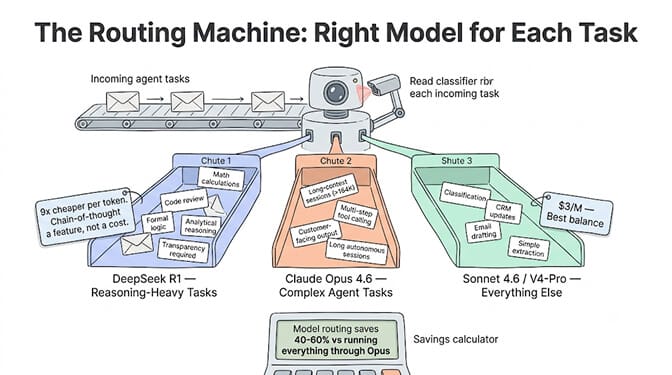
"I want both and I want to route between them." The production setup. Route reasoning-heavy tasks (math, code analysis, formal logic) to R1. Route everything else (classification, drafting, tool calling, customer-facing) to Opus 4.6 or Sonnet 4.6 at $3/M. Model routing captures the best of both.
The model that wins isn't the cheapest per token. It's the one that delivers the right answer at the lowest total cost for your specific workload. R1 generates more tokens but charges less per token. Opus generates fewer tokens but charges more. The math depends on what your agents actually do.
Give BetterClaw a look if you want both DeepSeek and Anthropic on one dashboard. Free plan with 1 agent and 100 credits a month. $49/month for Pro. BYOK with zero markup. We handle the routing. You handle the agent logic.
Frequently Asked Questions
Is DeepSeek R1 cheaper than Claude Opus 4.6?
Per token, yes. R1 costs $0.55/M input and $2.19/M output vs Opus 4.6 at $5/$25/M. That's 9x cheaper on input and 11x cheaper on output. But R1 generates 3-5x more output tokens per task (visible chain-of-thought reasoning billed as output). The effective per-task savings are typically 3-5x, not the 9-11x the per-token rates suggest. R1 is still significantly cheaper for most workloads.
Can DeepSeek R1 replace Claude Opus 4.6 for agent tasks?
For reasoning-heavy tasks (math, code analysis, formal logic), yes. For multi-step agent workflows with tool calling, customer-facing output quality, and long-context sessions (over 164K tokens), Opus 4.6 is the better choice. R1's 164K context limit and full chain-of-thought on every task make it less efficient for mixed agent workloads where 70% of steps are simple.
What are "reasoning tokens" and why do they matter for cost?
Reasoning tokens are the chain-of-thought steps a model generates while solving a problem. DeepSeek R1 makes these visible and bills them as output tokens ($2.19/M). A 500-token answer might generate 2,000 tokens of reasoning (total 2,500 output tokens billed). Opus 4.6 reasons internally via adaptive thinking and only charges for the visible output. This means R1's total output token count is 3-5x higher per task.
Should I use DeepSeek R1 or V4-Pro for new agent projects in 2026?
For new projects, DeepSeek V4-Pro with Thinking Max mode ($0.43/$0.87/M) is generally the stronger choice. V4-Pro has a 1M context window, better benchmarks than R1, and more flexible thinking control. R1 remains relevant for self-hosting (MIT, open weights), fine-tuning, and existing deployments. Both work on BetterClaw via BYOK.
Can I run DeepSeek R1 locally to avoid per-token costs?
Yes. R1 has MIT-licensed open weights on HuggingFace. At 671B parameters (37B active via MoE), it requires significant GPU resources for full-quality inference. Distilled variants (7B, 14B, 32B, 70B) run on consumer hardware with quality trade-offs. On Groq's free tier, R1 Distill runs at 500+ tok/s. For self-hosting guidance, see our Ollama setup guide.