Updated June 2026. Fresh pricing. GLM 5.2 added. Real cost breakdowns for agents processing 100, 500, and 2,000 tasks per day.
Last month this page showed GLM 5.1 at $0.98/M. That model is already outdated. GLM 5.2 dropped June 16, 2026 with better benchmarks, a 1M context window, and $1.40/M pricing. This page now reflects the June 2026 reality.
Here's what your agent actually costs per day on each model. Not per-token hypotheticals. Daily cost at real workload volumes.
The pricing table (June 2026, verified)
| MiniMax M3 | GLM 5.2 | Claude Sonnet 4.6 | |
|---|---|---|---|
| Input per 1M | $0.60 | $1.40 | $3.00 |
| Output per 1M | $2.40 | $4.40 | $15.00 |
| Cached input | varies | varies | $0.30 (90% off) |
| Context window | 1M | 1M | 200K |
| Multimodal | Text+image+video | Text only | Text+image |
| License | MIT | MIT | Proprietary |
| Speed | ~80 tok/s | ~113 tok/s | ~65 tok/s |
| SWE-Bench Pro | 59.0% | 62.1% | ~58% |
| Tool hallucination | ~10% | ~8-12% | 3% |
What changed from the last update: GLM 5.1 ($0.98/$3.08) replaced by GLM 5.2 ($1.40/$4.40). Context window jumped from 203K to 1M. SWE-Bench Pro improved from 58.4 to 62.1. IndexShare architecture cuts compute by 2.9x at full context. Selectable thinking modes (High/Max) added.
For the full head-to-head test results, see our GLM 5.2 vs Sonnet 4.6 vs M3 comparison.
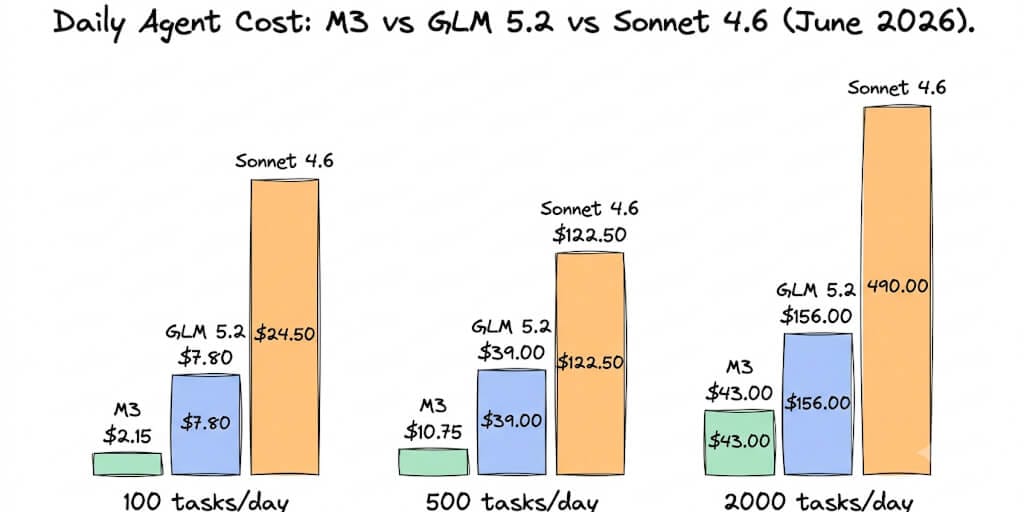
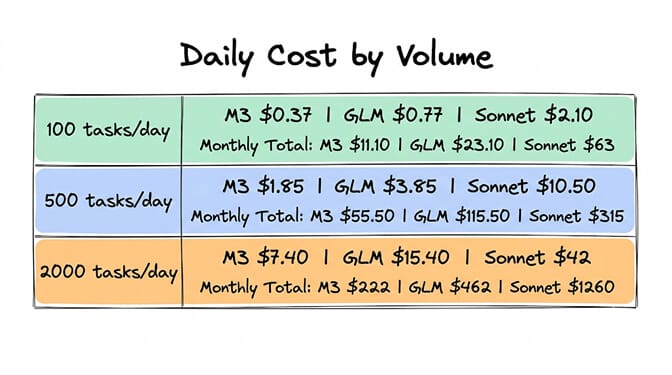
Daily cost at 100 tasks (personal agents)
A personal agent running 100 tasks per day. Each task averages 3K input tokens (system prompt + user message + tool definitions) and 800 output tokens (response).
| M3 | GLM 5.2 | Sonnet 4.6 | |
|---|---|---|---|
| Daily input cost | $0.18 | $0.42 | $0.90 |
| Daily output cost | $0.19 | $0.35 | $1.20 |
| Daily total | $0.37 | $0.77 | $2.10 |
| Monthly total | $11 | $23 | $63 |
At 100 tasks/day, all three are affordable. M3 is 5.7x cheaper than Sonnet. GLM 5.2 is 2.7x cheaper. For personal agents doing email triage, morning briefings, and expense tracking, M3 at $11/month is the obvious choice.
Daily cost at 500 tasks (business agents)
A business agent handling 500 customer support tickets, lead qualifications, or CRM updates per day. Same token profile.
| M3 | GLM 5.2 | Sonnet 4.6 | |
|---|---|---|---|
| Daily input cost | $0.90 | $2.10 | $4.50 |
| Daily output cost | $0.96 | $1.76 | $6.00 |
| Daily total | $1.86 | $3.86 | $10.50 |
| Monthly total | $56 | $116 | $315 |
At 500 tasks/day, the gap becomes meaningful. Sonnet costs $259/month more than M3. On an annual basis, that's $3,108 per agent. If you run 5 agents, the choice between M3 and Sonnet is a $15,540/year decision.
But here's the nuance: Sonnet's 3% tool-call hallucination rate means fewer failed workflows. On 500 daily tasks with 5 tool calls each, Sonnet produces approximately 75 failures. M3 produces approximately 250 failures. Those extra 175 failures per day have a cost too, in human review time and customer impact.
The honest cost comparison isn't just per-token pricing. It's per-token pricing plus failure cost. Sonnet's premium pays for itself when the cost of a wrong answer exceeds $0.05 per task.
Daily cost at 2,000 tasks (production agents)
A production agent processing 2,000 tasks daily. High-volume support, lead scoring, or data extraction.
| M3 | GLM 5.2 | Sonnet 4.6 | |
|---|---|---|---|
| Daily input cost | $3.60 | $8.40 | $18.00 |
| Daily output cost | $3.84 | $7.04 | $24.00 |
| Daily total | $7.44 | $15.44 | $42.00 |
| Monthly total | $223 | $463 | $1,260 |
At 2,000 tasks/day, Sonnet costs $1,037/month more than M3. This is where model routing becomes essential. Route 65% of tasks (classification, extraction) to M3. Route 25% (drafting, analysis) to GLM 5.2. Route 10% (complex reasoning, customer-facing) to Sonnet.
Routed cost at 2,000 tasks/day: M3 (1,300 tasks): $4.84/day. GLM 5.2 (500 tasks): $3.86/day. Sonnet (200 tasks): $2.10/day.
Routed daily total: $10.80. Monthly: $324. That's 74% less than all-Sonnet ($1,260) and 45% more than all-M3 ($223), but with Sonnet-quality output on the tasks that need it.
The routing sweet spot
If debugging API configurations, managing provider keys, and optimizing routing rules is more infrastructure work than you want to maintain, BetterClaw handles model routing through a visual builder. Connect your M3, GLM 5.2, and Sonnet API keys via BYOK. Per-agent cost caps ensure you never exceed your budget. Free plan with 1 agent and 500 credits a month. $49/month on Pro. Zero inference markup.
When each model wins (the decision matrix)
Pick M3 ($0.60/M) when: The task is structured (classification, extraction, JSON output, summarization). The output doesn't face customers directly. You need multimodal input (images, video). You're optimizing for cost above all else. Monthly budget: $11-223.
Pick GLM 5.2 ($1.40/M) when: The task involves coding (SWE-Bench Pro 62.1). You need 1M context for long documents or codebases. You want open weights (MIT) with the option to self-host. Speed matters (113 tok/s, fastest of the three). Monthly budget: $23-463. Full GLM 5.2 review here.
Pick Sonnet 4.6 ($3/M) when: The task requires complex multi-step tool chains (3% hallucination rate). The output faces customers (tone, quality, brand voice). Instruction following must be precise. You can't afford wrong answers. Monthly budget: $63-1,260.
Pick all three with routing when: You process 500+ tasks/day and want Sonnet quality on the 10% that need it without paying Sonnet prices on the 90% that don't. Monthly budget: $324 (74% less than all-Sonnet).
Gartner projects 40% of enterprise applications will embed AI agents by end of 2026. The teams that scale won't be the ones who picked the best model. They'll be the ones who matched the right model to each task and kept their cost curve sustainable.
Give BetterClaw a look if you want all three models on one dashboard with per-agent cost caps. Free plan with 1 agent and 500 credits a month. $49/month for Pro. BYOK with zero markup. We handle the cost controls. You handle the agent logic.
Frequently Asked Questions
How much does it cost to run an AI agent per day?
At 500 tasks/day (typical business agent), costs range from $1.86/day on MiniMax M3 ($0.60/M) to $10.50/day on Claude Sonnet 4.6 ($3/M). GLM 5.2 falls in between at $3.86/day. With model routing (sending simple tasks to cheap models), the blended cost is approximately $3.60/day ($108/month) for the same 500 tasks. Platform costs are separate: BetterClaw is $0 (free plan) or $49/month (Pro).
Which is cheaper for agents, MiniMax M3 or GLM 5.2?
M3 is cheaper on input ($0.60/M vs $1.40/M) and output ($2.40/M vs $4.40/M). At 500 daily tasks, M3 costs $56/month vs GLM 5.2's $116/month. However, GLM 5.2 has stronger coding benchmarks (SWE-Bench Pro 62.1 vs 59.0), 1M context window (same as M3), and faster inference (113 tok/s vs ~80 tok/s). For coding agents, GLM 5.2's quality advantage may justify the higher price.
Is Claude Sonnet 4.6 worth 5x the price of MiniMax M3?
For customer-facing agents and complex multi-step tool chains, yes. Sonnet's 3% tool-call hallucination rate means significantly fewer failures on complex workflows compared to M3's ~10%. At 500 daily tasks with 5 tool calls each, Sonnet produces ~75 failures vs M3's ~250. If each failure costs $0.10 in human review time, Sonnet's quality saves $17.50/day ($525/month), offsetting most of the pricing premium.
What changed from GLM 5.1 to GLM 5.2 in this comparison?
GLM 5.2 (released June 16, 2026) replaced GLM 5.1 in this comparison. Key changes: pricing increased slightly ($0.98 to $1.40/M input), context window expanded from 203K to 1M, SWE-Bench Pro improved from 58.4 to 62.1, speed improved to 113 tok/s (IndexShare architecture), and selectable thinking modes (High/Max) were added. The upgrade makes GLM 5.2 a stronger competitor to M3 and Sonnet.
How do I route tasks between M3, GLM 5.2, and Sonnet?
Use a classifier prompt that categorizes each incoming task as "simple" (classification, extraction, formatting), "moderate" (coding, analysis, summarization), or "complex" (multi-step reasoning, customer-facing, judgment calls). Route simple to M3, moderate to GLM 5.2, complex to Sonnet. On BetterClaw, connect all three provider keys via BYOK and configure routing in the visual builder. See the model routing setup guide for the full implementation.