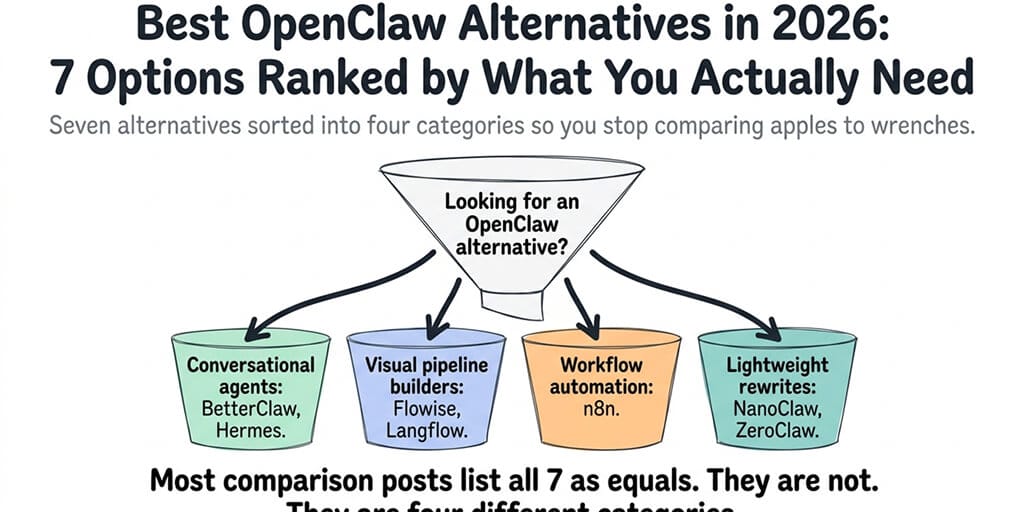
Conversational agents, visual pipelines, workflow automation, or lightweight rewrites. Seven alternatives sorted into four categories so you stop comparing apples to wrenches.
I counted 15 "OpenClaw alternatives" roundup articles ranking on page 1. Every single one lists the alternatives in a flat list, as if Flowise and ZeroClaw solve the same problem. They don't. Flowise builds visual LangChain pipelines. ZeroClaw is a 3.4MB Rust rewrite of the OpenClaw runtime. Comparing them is like comparing Figma to VS Code because both run in a browser.
The reason people can't choose an OpenClaw alternative isn't lack of options. It's lack of categories. Here are all seven alternatives sorted by what they actually do.
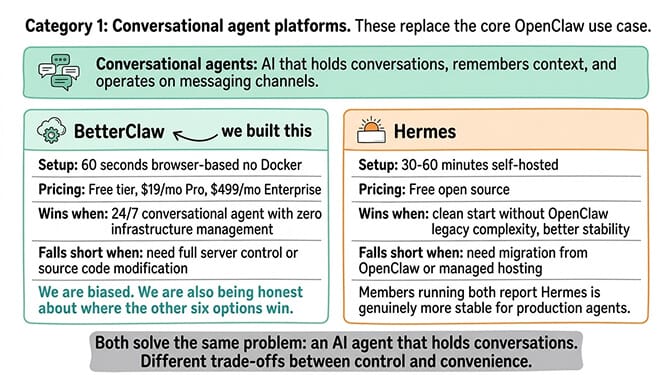
Category 1: Conversational agent platforms (talk to users on messaging channels)
These replace the core OpenClaw use case: an AI agent that holds conversations, remembers context, and operates on Slack, WhatsApp, Telegram, and other messaging platforms.
BetterClaw
What it is: A managed platform that runs OpenClaw-compatible agents with three added layers: smart context management (fewer tokens per request), verified skills (tested before publication), and secrets auto-purge (credentials erased after 5 minutes).
Setup: 60 seconds from a browser. No Docker. No VPS.
Pricing: Free tier (1 agent, BYOK). $49/month for Pro. $149/month for Business. Enterprise is custom.
Wins when: You want a conversational agent running 24/7 on messaging channels without managing infrastructure. Token cost optimization matters. Skill security matters. You don't want to think about Docker, YAML, or gateway configuration.
Falls short when: You need full server control, custom Docker configurations, or want to modify the framework's source code. No self-hosting option.
Honest note: We built this. We're biased. But we're also being transparent about where the other six options win.
For the detailed feature comparison, our comparison hub covers BetterClaw versus each alternative individually.
Hermes
What it is: A completely different agent framework. Not a fork of OpenClaw. Different architecture, reportedly easier setup, better stability for production use.
Setup: 30-60 minutes (self-hosted).
Pricing: Free and open source.
Wins when: You want to start fresh without OpenClaw's legacy complexity. You value stability over ecosystem size. You're comfortable self-hosting but frustrated with OpenClaw's 7,900+ open issues and frequent breaking changes.
Falls short when: You need to migrate existing OpenClaw configurations (no direct migration path). You want the largest skill ecosystem (OpenClaw's is bigger). You need a managed hosting option.
Honest note: Community members running both report that Hermes is genuinely more stable for production agents. The trade-off is a smaller ecosystem and fewer community resources. See our BetterClaw vs Hermes deep-dive for the head-to-head, and our OpenClaw vs Hermes 30-day test for the side-by-side experience report.
Category 2: Visual pipeline builders (design AI flows with drag-and-drop)
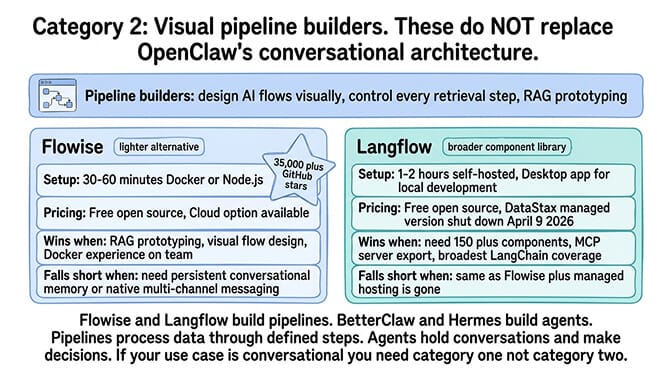
These don't replace OpenClaw's conversational agent architecture. They replace the need to write code for LangChain-based AI pipelines. Different problem, different solution.
Flowise
What it is: Open-source visual LangChain builder. Drag-and-drop canvas for designing RAG pipelines, chatbot flows, and agent chains. 35,000+ GitHub stars.
Setup: 30-60 minutes (self-hosted with Docker or Node.js).
Pricing: Free and open source. Cloud option available (check flowise.ai for current pricing).
Wins when: You're prototyping RAG pipelines. You want to see data flow visually. You need precise control over every retrieval step. Your team has Docker experience.
Falls short when: You need persistent conversational memory across sessions. You want native multi-channel messaging (WhatsApp, Telegram). You don't have someone who can manage Docker and a VPS. See our Flowise alternative breakdown for the no-Docker comparison.
Langflow
What it is: Open-source visual canvas for LangChain workflows, agents, and RAG pipelines. 150+ components. MCP server export. Version 1.9 shipped April 2026 with desktop support.
Setup: 1-2 hours (self-hosted). Langflow Desktop available for local development.
Pricing: Free and open source. DataStax hosted version shut down April 9, 2026. IBM watsonx integration coming (timeline uncertain).
Wins when: You need the broadest component library for LangChain flows. You want MCP server export for integration with other tools. You need more components than Flowise offers.
Falls short when: Same as Flowise: no native conversational memory, no multi-channel messaging, requires self-hosting since DataStax killed the managed version. For the full migration story, see our Langflow alternative post.
The category distinction that matters: Flowise and Langflow build pipelines. BetterClaw and Hermes build agents. Pipelines process data through defined steps. Agents hold conversations and make decisions. If you're searching for an "OpenClaw alternative" and your use case is conversational, you need category 1, not category 2.
Category 3: Workflow automation (connect SaaS tools with AI steps)
n8n
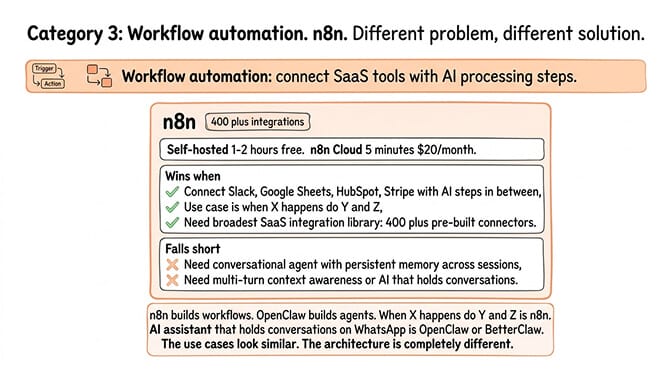
What it is: Open-source workflow automation with 400+ integrations and a visual editor. Not specifically an AI agent tool. A general automation platform that includes AI nodes.
Setup: 1-2 hours self-hosted. 5 minutes on n8n Cloud ($20/month).
Pricing: Free self-hosted. Cloud from $20/month.
Wins when: You need to connect Slack, Google Sheets, Hubspot, Stripe, and email with AI processing steps in between. Your use case is "when X happens, do Y and Z." You want the broadest SaaS integration library.
Falls short when: You need a conversational agent with persistent memory. You want multi-turn context awareness. You need an AI that holds conversations, not one that processes triggers. See our n8n alternative breakdown for the workflow-vs-agent distinction.
Category 4: Lightweight OpenClaw rewrites (same idea, better implementation)
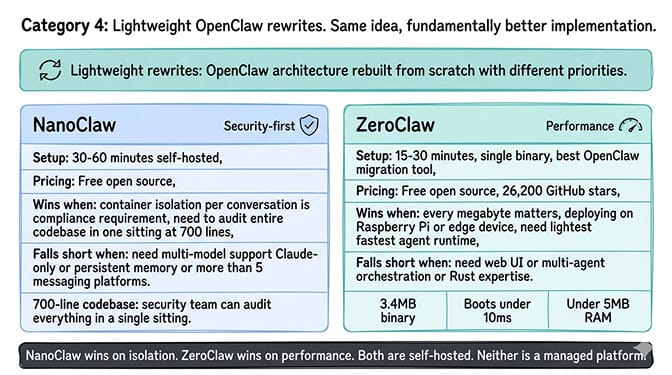
These aim to be "OpenClaw but better" at the framework level. Same general architecture, fundamentally different implementation.
NanoClaw
What it is: 700-line TypeScript agent framework built specifically to fix OpenClaw's security model. Every chat group gets its own sandboxed Docker container.
Setup: 30-60 minutes (self-hosted).
Pricing: Free and open source.
Wins when: Container isolation per conversation is a compliance requirement. Your security team needs to audit the entire codebase (700 lines versus OpenClaw's thousands). You handle sensitive data in regulated environments.
Falls short when: You need multi-model support (Claude-only). You need persistent memory. You need more than 5 messaging platforms.
ZeroClaw
What it is: Ground-up Rust rewrite of the AI agent concept. 3.4MB static binary. Boots in under 10 milliseconds. Uses less than 5MB of RAM. 26,200+ GitHub stars.
Setup: 15-30 minutes.
Pricing: Free and open source. Best OpenClaw migration tool available (imports config, memory, channel settings).
Wins when: Every megabyte matters. You're deploying on a Raspberry Pi, edge device, or resource-constrained server. You want the fastest, lightest agent runtime available. You need a clean migration path from OpenClaw.
Falls short when: You need a web UI (use Open WebUI). You need multi-agent orchestration. You need Rust expertise for customization.
PicoClaw
What it is: The extreme end of this category. A Go agent built by embedded-hardware company Sipeed — reportedly in a single day, on 9 February 2026 — that targets microcontrollers with under 1 MB of RAM and roughly $10 of hardware.
Setup: Flashing a board, not installing a daemon. Assume embedded tooling.
Pricing: Free and open source.
Wins when: The agent needs to live on a device rather than a server — sensors, kiosks, a board on your desk. It proves how little the core loop actually needs.
Falls short when: You want anything resembling OpenClaw's feature set. This is a demonstration of a lower bound, not a replacement for a multi-channel assistant.
A note on GoBot. Earlier versions of this guide listed GoBot here — a Go rewrite with SQLite-backed sessions and a compiled-only plugin policy. Do not plan a migration around it. The localrivet/gobot repository has returned 404 since September 2026; the maintainer's account is still live, the project is not. If the compiled-plugin security model was the draw, NanoClaw's container isolation above is the closest surviving equivalent. It is also a fair reminder to check a repo's pulse before betting an agent stack on a single-maintainer project.
Category 5: Hosted commercial agents (someone else runs everything)
The newest arrivals are not open source at all. They are cloud products competing for the same users, and they are increasingly what people mean when they ask what to use instead of OpenClaw.
Grok Bot
What it is: xAI's hosted agent, launched 11 August 2026 as a direct answer to OpenClaw and Hermes. The agent's "computer" lives in xAI's cloud, and memory, routines and third-party credentials are managed there rather than on your machine.
Setup: Minutes. There is nothing to host.
Pricing: A paid xAI subscription. Reported entry pricing varies between sources and usage is billed on top, so check xAI's current pricing page rather than any figure quoted second-hand.
Wins when: You want an agent today with zero infrastructure, and you are comfortable inside xAI's ecosystem.
Falls short when: You need model choice — it is Grok-locked, where OpenClaw is model-agnostic and can point at local models through Ollama. You need your conversations, memory and skills as inspectable files on disk. You need OpenClaw's channel breadth.
If your evaluation has led you to category 1 (conversational agents) and you don't want to manage infrastructure, BetterClaw is purpose-built for exactly that. Free tier with 1 agent and BYOK. $49/month for Pro. 60-second deploy. Smart context management, verified skills, secrets auto-purge. 15+ channels. 28+ model providers.
The decision in 30 seconds
Need a conversational agent on messaging channels? Managed: BetterClaw. Self-hosted: Hermes.
eed a visual AI pipeline builder? Flowise (simpler) or Langflow (more components). Both self-hosted.
Need SaaS workflow automation with AI? n8n. Cloud or self-hosted.
Need a lightweight, secure OpenClaw replacement? NanoClaw (security-focused) or ZeroClaw (performance-focused). Both self-hosted.
The answer isn't "which is best." It's "which category is your problem in." Once you know the category, the choice within it is usually obvious.
For the specific use cases where conversational agents deliver measurable ROI, our use cases page covers support triage, lead qualification, HR screening, ops reporting, and competitor monitoring with specific dollar savings.
For an even more detailed competitor-by-competitor breakdown, our OpenClaw alternative comparison ranks NanoClaw, ZeroClaw, Hermes, and n8n against BetterClaw on the dimensions that actually differ.
The AI agent space is splitting into these four categories faster than the roundup articles can keep up. The tools that try to be everything (OpenClaw's 230,000+ stars came from being the "do everything" framework) are losing ground to focused alternatives that do one thing well. Pick your category. Pick the best tool in it. Stop comparing pipeline builders to agent platforms.
If you picked conversational agents and want to skip the infrastructure, give BetterClaw a try. Free tier. $49/month Pro. 60-second deploy. We handle the servers. You handle the conversations.
Frequently Asked Questions
What are the best OpenClaw alternatives in 2026?
Seven alternatives across four categories: conversational agents (BetterClaw managed, Hermes self-hosted), visual pipeline builders (Flowise, Langflow), workflow automation (n8n), lightweight rewrites (NanoClaw for security, ZeroClaw for performance). The best alternative depends on your category: most roundup articles compare them as equals, but they solve fundamentally different problems.
How does n8n compare to OpenClaw?
n8n is a workflow automation platform (trigger-based, sequential, 400+ SaaS integrations). OpenClaw is a conversational agent framework (persistent memory, multi-turn conversations, messaging channels). n8n builds pipelines. OpenClaw builds agents. If your need is "connect Slack to Google Sheets with AI processing," n8n. If your need is "AI assistant that holds conversations on WhatsApp," OpenClaw or BetterClaw.
Which OpenClaw alternative is easiest to set up?
BetterClaw: 60 seconds (managed, browser-based, no Docker). n8n Cloud: 5 minutes ($20/month). ZeroClaw: 15-30 minutes (single binary, best migration tool). Flowise: 30-60 minutes (Docker). Hermes: 30-60 minutes. Langflow: 1-2 hours. NanoClaw: 30-60 minutes. Setup time correlates with self-hosting complexity. Managed platforms are faster because they eliminate infrastructure setup.
Is BetterClaw free?
Free tier: 1 agent, 100 credits/month, BYOK required, hosting included, no credit card. Pro: $49/month (5 agents, 12,000 credits/month, all integrations). Business: $149/month (25 agents, 40,000 credits/month). Enterprise: custom pricing (SAML SSO, audit logs, dedicated account manager). All plans use BYOK with zero inference markup. You pay your model provider directly at their rates.
Is OpenClaw still safe to use in 2026?
With full hardening (latest patches, gateway bound to loopback, skills audited, credentials rotated), cautiously yes. Without hardening, demonstrably unsafe: 540+ CVEs, 500K+ exposed instances, 1,400+ malicious skills. Microsoft, Kaspersky, and CrowdStrike all recommend against deploying on machines with sensitive data. Alternatives like NanoClaw (container isolation) and BetterClaw (managed security with secrets auto-purge) address these risks architecturally.