Our sales team was drowning in prospecting. Three reps spending four hours a day researching leads, writing first-touch emails, and scheduling follow-ups. By the time they got to actual conversations with qualified prospects, it was 3 PM and their energy was shot. If your lead lists live in a spreadsheet, you can connect Google Sheets to an AI agent.
We deployed an AI agent for sales outreach on a Monday. By Thursday, it had contacted 2,400 prospects, personalized every email based on LinkedIn and company data, and scheduled follow-ups automatically for non-responders.
Here's the part nobody talks about in the AI sales pitch: the response rate on those first 2,400 emails was terrible. 1.8%. Way below our human-written average of 4.5%.
The AI was fast. It was tireless. And it was obviously AI-generated. Prospects could tell.
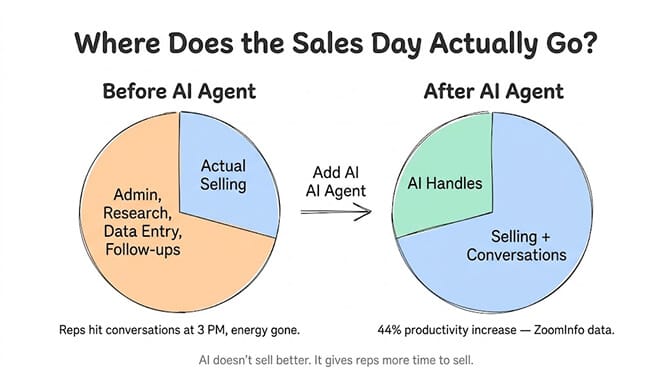
That's when we learned the real lesson about AI agents for sales: the value isn't in replacing your reps. It's in replacing the 70% of their day that has nothing to do with selling.
The 70% problem (why your sales team is wasting most of their time)
Research from multiple sources converges on the same uncomfortable number: SDRs spend only about 30% of their workday actually selling. The other 70% goes to researching prospects, updating CRM records, writing initial outreach, scheduling follow-ups, and doing administrative work.
ZoomInfo data shows teams using AI for sales activities see a 44% productivity increase. Not because the AI is a better salesperson. Because it eliminates the non-selling work so humans can focus on what they're actually good at: conversations, relationships, and judgment.
Forrester's Q1 2026 B2B Sales Automation report found that pipeline velocity improves by about 27% when AI handles lead prioritization. Leads move faster because the right people are being contacted first, not because the AI is making better pitches.
The pattern is consistent: AI makes sales teams faster at the parts of sales that aren't actually sales.
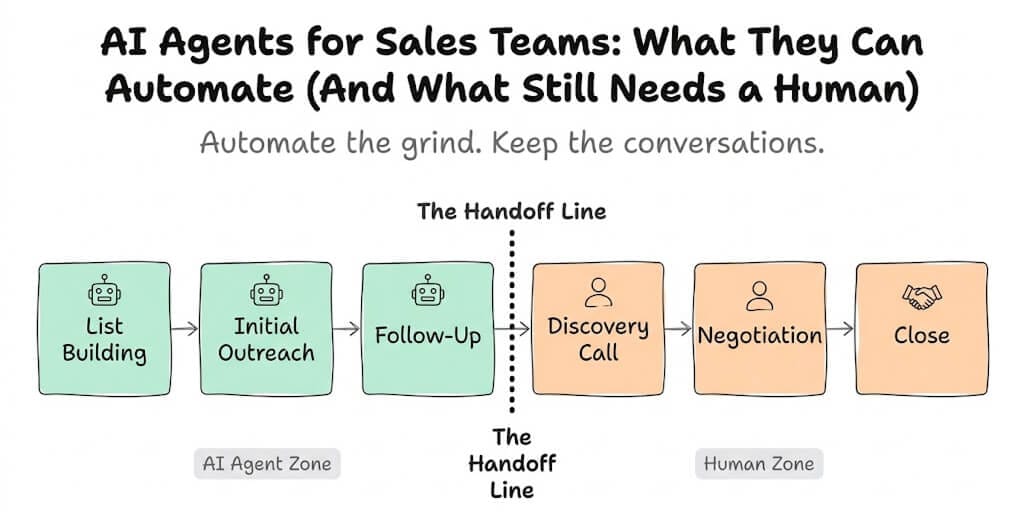
What AI agents can automate right now (the green zone)
These are the sales tasks where AI agents genuinely outperform humans, not because they're smarter but because they're faster, more consistent, and never get tired.
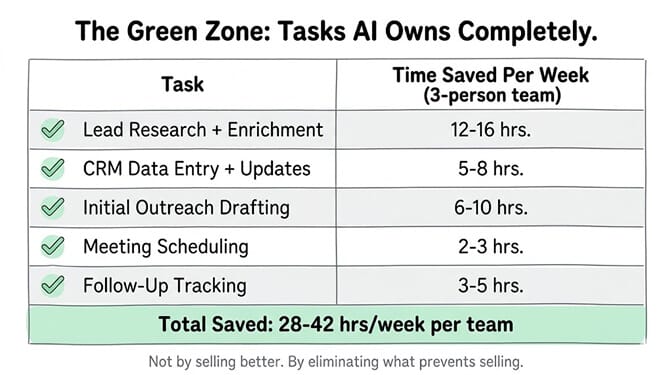
Lead research and enrichment
An AI agent can take a list of company names and, within minutes, pull firmographic data (revenue, employee count, industry, tech stack), identify likely decision-makers, find their contact information, check for recent news or funding rounds, and compile it into a structured brief.
A human rep doing this manually spends 15-20 minutes per lead. An AI agent does it in seconds. For a team processing 50 new leads per day, that's 12-16 hours of research time eliminated. This is pure labor savings with near-zero quality tradeoff.
CRM data entry and hygiene
After every call, reps are supposed to update the CRM. Log the call. Update the status. Add notes. Schedule next steps. Most don't, or they do it poorly, because it's boring and they'd rather move to the next call.
An AI agent that listens to call recordings, extracts key information, and updates HubSpot or Salesforce automatically eliminates the data entry entirely. The CRM stays accurate without relying on human discipline. This is one of the highest-ROI agent use cases because it fixes a problem everyone complains about but nobody solves.
Initial outreach sequencing
First-touch emails, LinkedIn connection requests, and follow-up sequences for non-responders. An AI agent can write personalized first emails based on the research data it gathered, send them at optimal times, track opens and replies, and automatically schedule follow-ups for leads that don't respond.
The catch (and I'll be honest here): AI-written outreach converts at lower rates than great human-written outreach. Buyers in 2026 are sophisticated. Many can detect AI-generated emails. The Amplemarket 2026 evaluation found that the highest-scoring AI sales platforms use a "human-in-the-loop" approach where AI drafts the email and a human approves it in one click. Fully autonomous AI outreach scored dramatically lower.
Meeting scheduling and coordination
"When are you available this week?" is a question that generates 4-6 back-and-forth emails. An AI agent connected to your calendar checks availability, proposes times, sends the invite, adds the Zoom link, and confirms. This eliminates calendar coordination overhead entirely.
Follow-up reminders and pipeline nudging
Leads go cold because reps forget to follow up. An AI agent never forgets. It tracks every open opportunity, identifies leads that haven't been contacted in X days, drafts a follow-up message, and either sends it automatically or queues it for approval.
An AI agent for sales saves 28-42 hours per week across a typical 3-person team. Not by making better sales calls, but by eliminating the work that prevents reps from making calls in the first place.
What still needs a human (the orange zone)
Here's where the honest part of the article begins. And where most AI sales content loses credibility by pretending these don't exist.
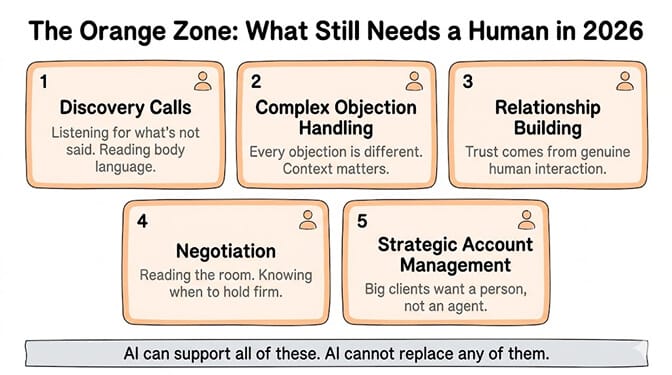
Discovery calls and qualification conversations
The discovery call is where a rep figures out whether the prospect has a real problem, real budget, real timeline, and real authority to buy. This requires listening for what's not being said. Reading body language on video calls. Asking follow-up questions that the prospect didn't expect. Adjusting tone based on emotional cues.
AI can transcribe the call, summarize it, and extract key data points. AI cannot conduct the conversation. Not yet. For the drafting and research half that AI does handle well, you can build the agent in a browser rather than commissioning an engineering project. The gap between "AI can generate a response" and "AI can build rapport" is still enormous.
Complex objection handling
"Your competitor offered us the same thing for 40% less." "We tried something similar last year and it failed." "I need to run this by my CFO who hates subscription pricing."
Every objection is different. Every objection requires understanding the specific prospect's context, history, and emotional state. An AI can draft template responses to common objections. A human can read the situation and know whether to push back, empathize, or offer a creative alternative.
Relationship building and trust
Deals close because the prospect trusts the rep. Trust comes from genuine human interaction: remembering personal details, following through on promises, being available when things go sideways. An AI can remind you about the prospect's daughter's soccer tournament that they mentioned on the last call. An AI cannot genuinely care about it.
McKinsey's research on AI in sales consistently emphasizes that the highest-performing sales organizations use AI to augment human relationships, not replace them. The $2.6-4.4 trillion addressable value from AI comes from freeing humans to do more of the relationship work, not less.
Negotiation and pricing flexibility
Negotiation requires reading the room. Knowing when to hold firm. Knowing when a 5% discount saves a six-figure deal. Understanding power dynamics, urgency signals, and competitive pressure. AI can model pricing scenarios and suggest ranges. The actual negotiation needs a human who understands that "let me think about it" means three different things depending on who says it and how.
Strategic account management
Your biggest clients don't want an AI managing their relationship. They want a person who understands their business, anticipates their needs, and picks up the phone when something goes wrong. AI can surface data, flag churn risk signals, and draft quarterly business reviews. The relationship itself is human.
The handoff: where AI ends and humans begin
The best sales teams in 2026 don't run "AI sales" or "human sales." They run a hybrid where the handoff point is clearly defined.
AI handles everything up to the first qualified conversation. Research. Enrichment. Initial outreach. Sequencing. Follow-ups. Scheduling. CRM updates. All of it automated.
Humans take over at first meaningful contact. The discovery call. The demo. The negotiation. The close. The relationship.
The handoff point is the meeting booking. Before the meeting is booked, the AI agent runs the process. After the meeting is booked, a human rep owns the relationship.
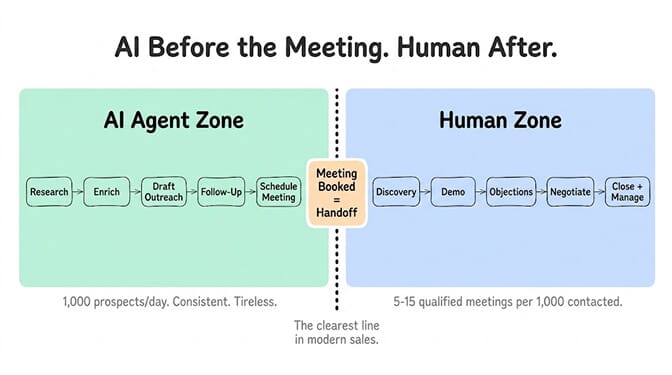
This is how the most effective AI SDR deployments work. Industry data shows 5-15 qualified meetings per 1,000 prospects contacted through AI outreach. The volume game is where AI excels. The conversion game is where humans win.
We built BetterClaw to sit in that "before the handoff" zone. An AI agent connected to your CRM, email, calendar, and Slack handles the prospecting and coordination work. Your reps handle the conversations. Free plan with 1 agent and 100 credits a month. $49/month on Pro. BYOK with zero markup. Connect your HubSpot, Gmail, and calendar with one-click OAuth. Deploy in 60 seconds.
The three setups that work (ranked by complexity)
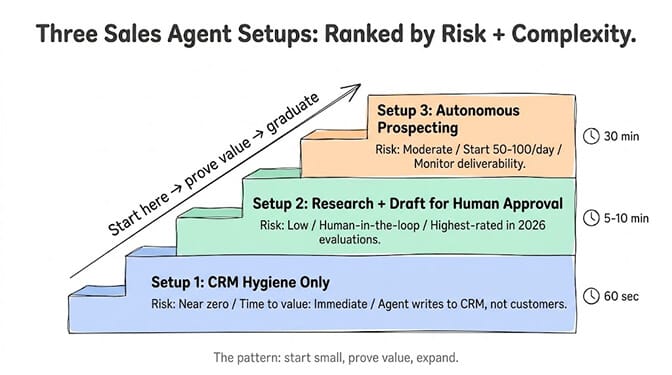
Setup 1: AI agent for CRM hygiene only (lowest risk)
Start here if your team is skeptical or you want a quick win. The agent listens to call recordings, extracts data, and updates your CRM automatically. No outreach. No customer contact. Just clean data.
Time to value: Immediate. Every rep saves 1-2 hours per day on data entry. Risk: Near zero. The agent writes to your CRM, not to your customers. Setup time: About 60 seconds on a no-code platform.
Setup 2: AI agent for research + drafts (medium trust)
The agent researches new leads, enriches CRM records, and drafts personalized outreach emails. But it doesn't send them. It queues them for human review and one-click approval. This is the human-in-the-loop model that scored highest in the Amplemarket 2026 AI SDR evaluation.
Time to value: Week one for research savings, week two for outreach velocity. Risk: Low. Humans approve every customer-facing message. Setup time: 5-10 minutes to connect integrations and set approval workflows.
Setup 3: AI agent for autonomous prospecting (high trust)
The agent handles the full pre-meeting workflow: research, enrich, draft, send, follow up, schedule. Human approval only for edge cases. This is the "AI SDR" model.
Time to value: 2-3 weeks to calibrate quality and monitor deliverability. Risk: Moderate. AI-generated outreach at scale can trigger spam filters, damage sender reputation, or produce messages that prospects recognize as automated. Start with small batches (50-100/day) and expand only after monitoring response rates. Setup time: 30 minutes including deliverability configuration.
The pattern: start at Setup 1, prove value, graduate to Setup 2, then decide if Setup 3 makes sense for your volume and risk tolerance. The same start-small approach works outside sales: an AI operations agent can begin with a weekly status report and take on expense routing or vendor emails once it has proved itself.
What the next 12 months look like
Three predictions based on what we're seeing:
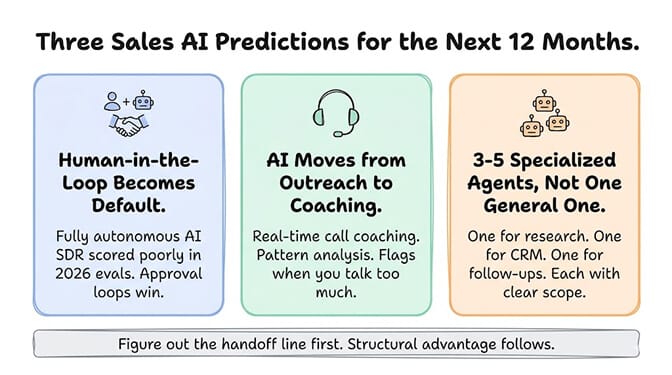
Human-in-the-loop becomes the default, not the exception. The fully autonomous AI SDR concept (Artisan, 11x) scored poorly in independent evaluations in 2026. The highest-rated platforms keep humans in the approval loop. This trend will accelerate as buyers get better at detecting AI outreach.
AI agents move from outreach to coaching. The next wave isn't "AI that sends emails." It's "AI that listens to your discovery calls and gives you real-time coaching." Analyzing conversation patterns, suggesting questions, flagging when you're talking too much. This is where agentic AI gets genuinely interesting for sales.
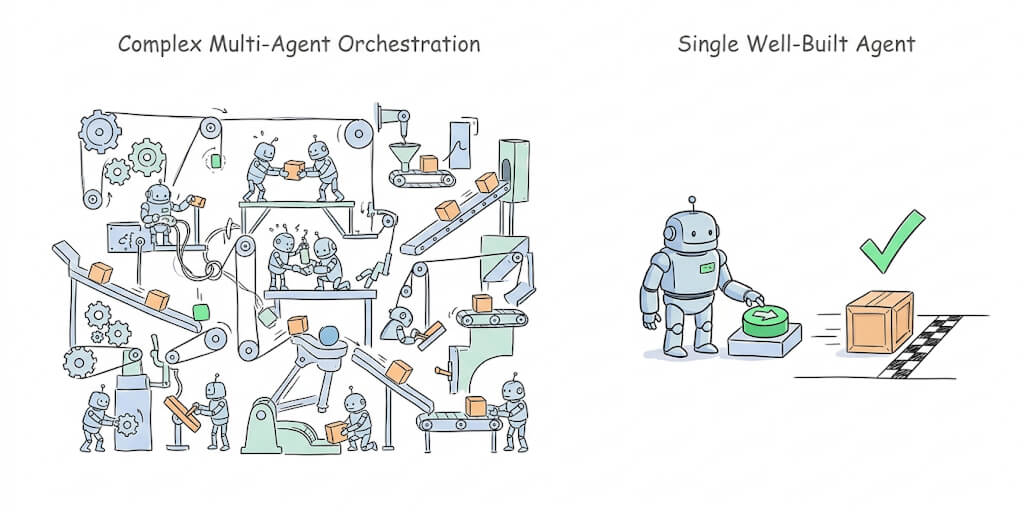
The best sales teams will deploy 3-5 specialized agents, not one general one. One agent for research. One for CRM hygiene. One for follow-up sequencing. One for meeting prep. Each agent does one thing well, with clear boundaries and specific permissions.
The sales teams that figure out the handoff line first will have a structural advantage over the teams still debating whether AI replaces reps or not. It doesn't replace them. It gives them their time back.
If your sales team is spending more time on admin than on selling, give BetterClaw a look. Free plan with 1 agent and 100 credits a month. $49/month for Pro. Connect HubSpot, Gmail, Calendar, Slack, and LinkedIn with one-click OAuth. Your agent handles the pre-meeting grind. Your reps handle the conversations that close deals.
Frequently Asked Questions
What is an AI agent for sales?
An AI agent for sales is an autonomous tool that handles repetitive sales tasks without constant human supervision: researching prospects, enriching CRM data, writing personalized outreach, managing follow-up sequences, and scheduling meetings. Unlike traditional sales automation that follows rigid rules, an AI agent reasons about each prospect and adapts its approach. The best implementations keep humans in the loop for approval on customer-facing communications.
How does an AI SDR agent compare to a human SDR?
An AI SDR can process 1,000+ contacts per day versus 30-50 for a human rep. However, human SDRs consistently outperform AI on response rates for personalized outreach, discovery conversations, objection handling, and relationship building. The most effective approach is hybrid: AI handles research, data entry, and initial outreach sequences while humans handle qualified conversations and closing.
How long does it take to set up an AI sales agent?
On a no-code platform like BetterClaw, about 60 seconds for basic CRM integration and outreach drafting. Full autonomous prospecting workflows take 30 minutes to configure including email deliverability settings. Code-first frameworks (CrewAI, LangGraph) require 8-20 hours of development for comparable sales automation. Most teams see ROI within the first week from CRM data entry savings alone.
How much does AI sales automation cost?
BetterClaw's free plan includes 1 agent, 100 credits per month, and 3 connectors at $0. Pro is $49/month with 5 agents, 12,000 credits a month, and unlimited connectors including HubSpot, Gmail, Calendar, and Slack. Dedicated AI SDR platforms (11x, Artisan, Amplemarket) charge $1,000-5,000/month. Building custom sales agents with a development team costs $15,000-50,000 upfront plus $500-2,000/month for maintenance. BetterClaw's BYOK model means zero inference markup on LLM costs.
Can an AI sales agent safely access my CRM and email?
Yes, with proper controls. BetterClaw uses one-click OAuth with narrow permission scopes for each integration (read-only CRM access, compose-only email access). Trust levels let you require human approval before the agent sends any email or modifies CRM records. Credentials are encrypted with AES-256 and auto-purged from agent memory after 5 minutes. Each agent runs in an isolated container. You choose what the agent can and cannot do.