Cheaper than Haiku 4.5 by up to 90%, with a price cliff at 100K tokens and a tokenizer that quietly adds 25 to 30%. Here is the math for agent workloads.
Picture a research subagent that runs 1,000 times a day. Claude Haiku 5.5 lands on October 7, you swap the model ID, and the daily bill drops by close to 90%. Then one run drags in a fat 150K-token context, and that single call costs more than ten normal ones.
That's Haiku 5.5 in one scenario, and the numbers below are real. It's the cheapest capable Claude model Anthropic has shipped, and for most agent runs it really does cut the bill by close to 90%. But two details change the math: the price jumps 5x once a prompt passes 100K tokens, and the new tokenizer counts 25 to 30% more tokens for the same text.
This post shows when Haiku 5.5 is the right model for an agent, and when it isn't.
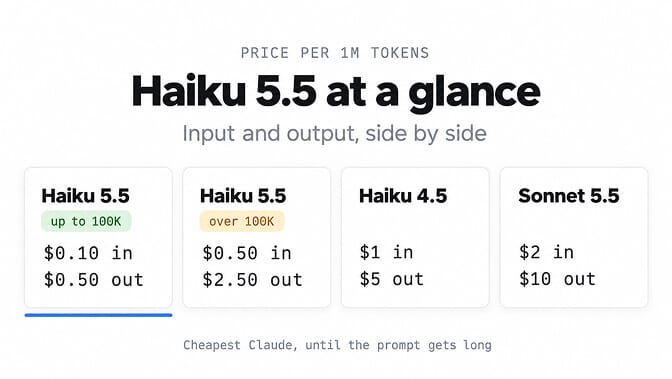
Claude Haiku 5.5 in one table
Here's what you're actually buying, next to the models you'd compare it with. Prices are per 1M tokens, from Anthropic's pricing docs.
| Haiku 5.5 (prompt up to 100K) | Haiku 5.5 (prompt over 100K) | Haiku 4.5 | Sonnet 5.5 | |
|---|---|---|---|---|
| Input | $0.10 | $0.50 | $1 | $2 |
| Output | $0.50 | $2.50 | $5 | $10 |
| Cache reads | $0.01 | $0.05 | $0.10 | $0.10 |
| Cache writes (5 min) | $0.125 | $0.625 | $1.25 | $2.50 |
| Context window | 1M | 1M | 200K | 1M |
| Effort levels | Yes | Yes | No | Yes |
The basics:
- Released October 7, 2026. Model ID
claude-haiku-5-5. - Available on the Claude API, Amazon Bedrock (
anthropic.claude-haiku-5-5), Google Cloud and Microsoft Foundry. - 1M-token context window and up to 128K output tokens.
- Adaptive thinking is on by default, with effort set to
medium.
Anthropic's own summary is that Haiku 5.5 is priced 90% lower than Haiku 4.5 for requests up to 100,000 tokens, and 50% lower above that.
The Haiku 5.5 100K price cliff (the part most posts skip)
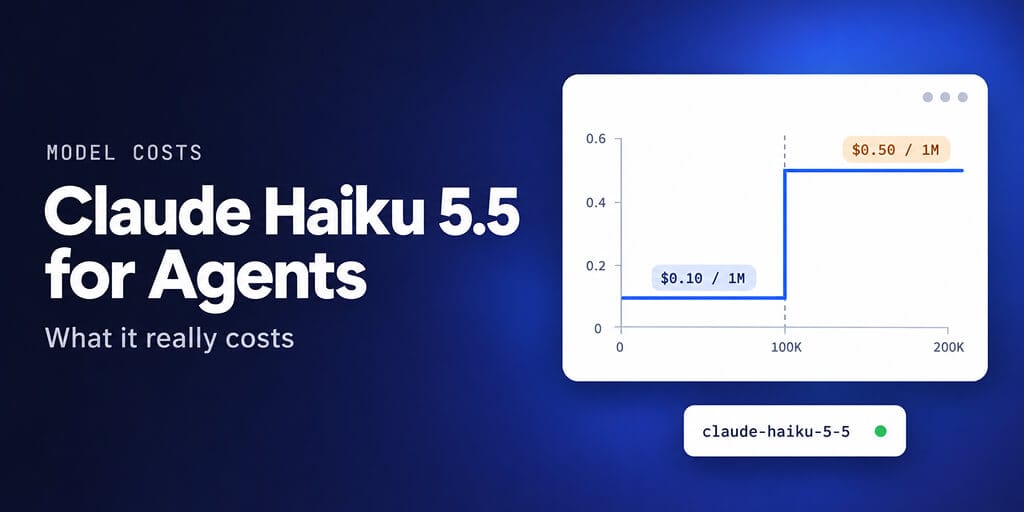
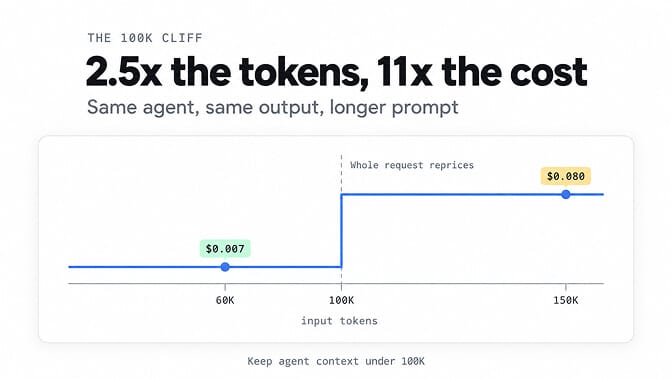
Here's the line from Anthropic's pricing docs that matters most: "a request whose prompt is over 100,000 tokens pays higher prices." And it's the whole request, not just the tokens past 100K.
So 99K tokens of input is billed at $0.10 per million. 101K tokens is billed at $0.50 per million. For every single token.
Here's a typical agent run with 2K tokens of output:
| Agent run | Haiku 5.5 | Haiku 4.5 (same text) |
|---|---|---|
| 60K input, 2K output | about $0.007 | about $0.056 |
| 150K input, 2K output | about $0.080 | about $0.128 |
The 150K run costs 11x the 60K run for 2.5x the tokens.
The Haiku 4.5 column converts the same text to Haiku 4.5's token counts (about 48K and 120K input), using the 1.25x tokenizer ratio Simon Willison measured. So the saving is 87.5% on the short run and only 37.5% on the long one.
Haiku 5.5 is a 90% discount on short prompts and a 37% discount on long ones. Your context length decides which product you bought.
Here's the weird part: caching doesn't save you from the cliff. Anthropic counts cache reads and cache writes toward the 100K threshold. A 120K prompt that's 110K cached still pays the over-100K rates on every token.
Two more things push agents over the line faster than you'd expect. Thinking blocks from earlier turns now stay in context and count as input, where Haiku 4.5 kept only the latest turn's. And images use a higher-resolution tier: a 2,000 by 1,500 image costs about 2.5x the visual tokens it did on Haiku 4.5.
The lesson is simple. Keep agent context under 100K. Compact long histories, cache the stable prefix, and clear old thinking blocks. Our prompt caching guide covers the caching half. Once a 50K prefix is cached, a 60K run drops to about $0.0025.
The tokenizer tax
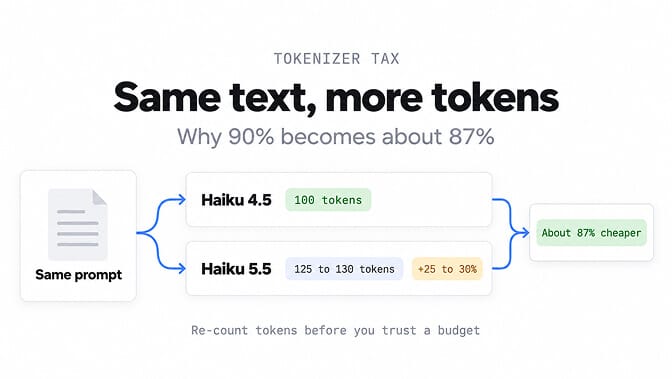
Haiku 5.5 uses the same newer tokenizer as Claude 4.7 and later models. Anthropic says the same text produces about 30% more tokens than on Haiku 4.5, depending on content. Simon Willison measured one long prompt at about 1.25x.
So the 90% headline saving is really closer to 87 to 88% in practice. The math is short. You pay 10% of the old price per token, but you send 1.25x to 1.3x the tokens, so you pay 12.5% to 13% of the old bill.
That's still a huge cut. It just means any cost estimate built from Haiku 4.5 token counts is wrong by a quarter before you start. Re-count with Anthropic's token counting endpoint on your own prompts, not ours.
Where Haiku 5.5 is the right agent model
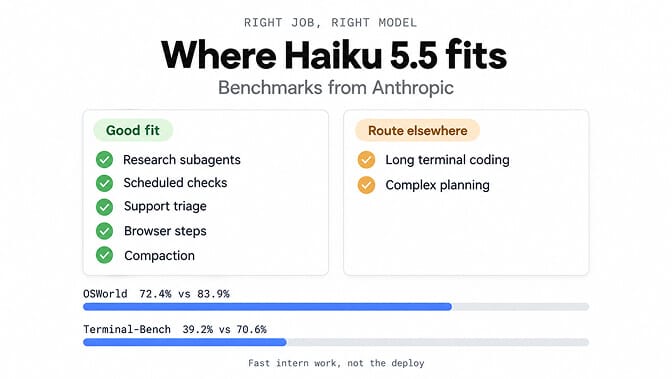
Anthropic pitches Haiku 5.5 at high-volume, cost-sensitive work, subagents, and speed-sensitive jobs like live support and browser use. That matches what we'd put it on:
- Subagents for research, summarising and classification.
- Heartbeat and scheduled checks that run hundreds of times a day.
- Email and support triage.
- Browser steps inside a larger task.
- Compaction, where one model summarises another's long history.
It's genuinely good at the computer-use side. On OSWorld 2.1 (offline subset) it scores 72.4%, against 15.7% for Haiku 4.5 and 83.9% for Sonnet 5.5.
Where it falls short is long, multi-step coding in a terminal. Terminal-Bench 4.0 has Haiku 5.5 at 39.2% against 70.6% for Sonnet 5.5. Anthropic says it plainly: "Sonnet 5.5 and Opus 5.5 remain better choices for complex agentic coding tasks."
Give Haiku 5.5 the jobs you'd give a fast, sharp intern. Don't hand it the production deploy.
Haiku 5.5 vs Sonnet 5.5 vs Opus 5.5 for agents
Same text, same tokenizer family, same 60K-input, 2K-output run:
| Haiku 5.5 | Sonnet 5.5 | Opus 5.5 | |
|---|---|---|---|
| Cost per typical run | about $0.007 | about $0.14 | about $0.28 |
| Cost at 150K input | about $0.080 | about $0.32 | about $0.64 |
| Terminal-Bench 4.0 | 39.2% | 70.6% | not in Haiku 5.5's published table |
| Best use | Execute, summarise, classify | Plan and code | Hardest planning and review |
At 1,000 short runs a day, that's roughly $210 a month on Haiku 5.5, against $4,200 on Sonnet 5.5.
The pattern we recommend is routing, not choosing. Opus or Sonnet plans the task, and Haiku executes the steps. Your planner runs a few times per task, and your executor runs dozens of times. Put the cheap model where the volume is. We walk through the planner side in how we rerouted Opus 5.5 agents to cut cost.
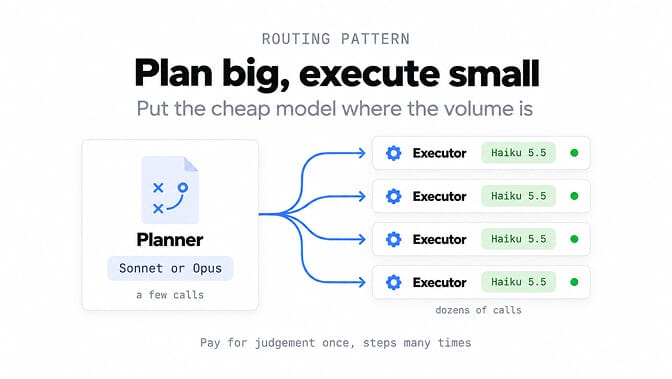
If wiring up a planner, executors and per-agent model choices sounds like a weekend of YAML, that's the part BetterClaw handles for you. Pick a model per agent, bring your own key, and pay the provider directly with no markup.
Haiku 5.5 vs GPT-6 Luna
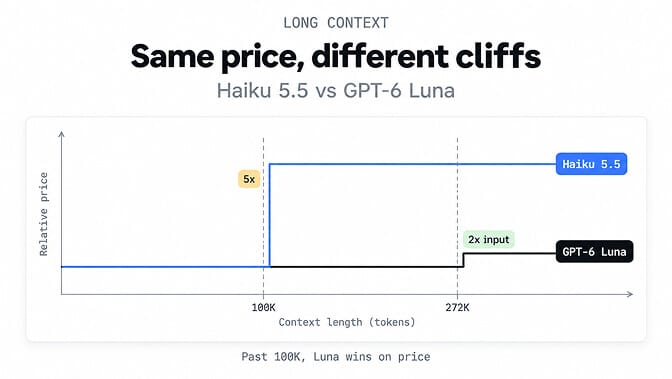
This is the comparison most people are actually making. OpenAI's GPT-6 Luna has the same base price, $0.10 in and $0.50 out. The difference is where the price changes.
- Haiku 5.5 jumps 5x above 100K tokens, to $0.50 and $2.50.
- GPT-6 Luna only reprices above 272K tokens, and only to $0.20 in and $0.75 out. Like Haiku, the higher rate applies to the whole request.
So at 150K input and 2K output, Haiku 5.5 is about $0.080, while Luna is about $0.016. At 300K, it's about $0.155 against $0.062.
One caveat: the two models use different tokenizers, so the same text won't produce identical counts. The gap is still far too large for that to close it.
The plain answer:
- Under 100K tokens: pick on quality, since they cost the same. On Anthropic's published numbers, Haiku 5.5 leads Luna on OSWorld (72.4% vs 48.9%) and Terminal-Bench (39.2% vs 16.4%).
- Long-context agents that routinely run past 100K: Luna is the better deal.
Our OpenAI vs Anthropic pricing breakdown covers the rest of both lineups.
Effort levels: which one for which agent job
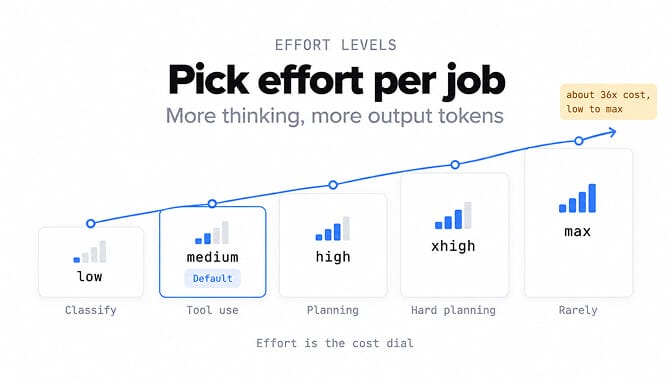
Haiku 5.5 is the first Haiku with an adjustable effort setting: low, medium, high, xhigh and max. Default is medium.
You can turn thinking off with thinking: {"type": "disabled"}, but only at high effort or below. At xhigh or max that setting returns a 400 error. For most agent jobs, effort is the better lever anyway. At low effort the model thinks less, and it can skip thinking entirely on simple requests.
- Low for classification, routing and tagging.
- Medium (the default) for most tool use.
- High or above only for planning steps that genuinely need it.
Higher effort means more output tokens, and output is the expensive side. Simon Willison's test makes the point: the same drawing task cost 0.0936 cents at low effort and 3.3826 cents at max. That's about 36x, and it took 5 minutes instead of 7 seconds.
One practical gotcha: thinking tokens count toward max_tokens. Set it too tight and a response can stop after the thinking block, before any answer.
Using Haiku 5.5 in your agent
There are three common ways to run it.
OpenClaw. Haiku 5.5 support landed in stable 2026.10.1, so you don't need a beta. Set it as the default model, or give it to subagents only:
openclaw models set anthropic/claude-haiku-5-5
For the routing pattern above, keep Sonnet or Opus as the primary model and set agents.defaults.subagents.model to anthropic/claude-haiku-5-5.
Claude Code. Since version 2.1.293 (October 7), Haiku 5.5 is the default Haiku model on the Anthropic API. If you use Haiku for subagents there, you're probably already on it.
BetterClaw. Bring your own Anthropic key and pick the model on the agent's Model tab. If Haiku 5.5 isn't in the list yet, choose Custom and enter claude-haiku-5-5. You pay Anthropic directly at their price, with no markup.
A cheaper model doesn't fix an agent that drags 140K tokens of history into every call. It just makes the bill arrive more slowly. The real win with Haiku 5.5 is discipline: short contexts, cached prefixes, the right effort for the job, and the expensive model kept for the few calls that need it.
If any of this resonated, give BetterClaw a try. The free plan gives you one agent and 100 credits a month, with no card. Basic is $19 a month, and Pro is $49 a month for five agents. Every plan is bring-your-own-key with zero inference markup, so Haiku 5.5's low price reaches your bill intact. Start free or see full pricing.
Frequently Asked Questions
How much does Claude Haiku 5.5 cost?
For prompts up to 100K tokens, Haiku 5.5 costs $0.10 per million input tokens and $0.50 per million output tokens, with cache reads at $0.01. For prompts over 100K tokens, the whole request is billed at $0.50 input and $2.50 output. A typical agent run with 60K input and 2K output costs about $0.007.
Is Haiku 5.5 better than Sonnet 5.5?
No, but it's much cheaper. Sonnet 5.5 leads on every benchmark Anthropic published, including Terminal-Bench 4.0 (70.6% vs 39.2%) and OSWorld 2.1 (83.9% vs 72.4%). Use Sonnet to plan and code, and Haiku 5.5 for high-volume steps like research, triage and summaries.
What is the cheapest Claude model for OpenClaw?
Claude Haiku 5.5, supported since OpenClaw 2026.10.1. Set it with openclaw models set anthropic/claude-haiku-5-5, or use it only for subagents. Keep prompts under 100K tokens, or the price per token rises 5x.
Can I turn off reasoning in Haiku 5.5?
Yes, at high effort or below. Send thinking: {"type": "disabled"}. At xhigh or max that returns a 400 error, and so does the old budget_tokens form. Setting effort to low is often enough: the model thinks less, and it can skip thinking entirely on simple requests.
Why is my Haiku 5.5 bill higher than expected?
Usually it's one of four things:
- Prompts crossing 100K tokens, which reprices the whole request, cached tokens included.
- The new tokenizer, which counts 25 to 30% more tokens than Haiku 4.5.
- Thinking blocks from earlier turns, which now stay in context.
- An effort level set higher than the job needs.
Check your input token counts per request first.
Is Haiku 5.5 good for subagents?
Yes, it's the job it's best at. Anthropic recommends it for subagents alongside Opus 5.5 or Sonnet 5.5, and at about $0.007 per typical run it's cheap enough to fan out widely. Keep each subagent's context lean, so it stays under the 100K line.