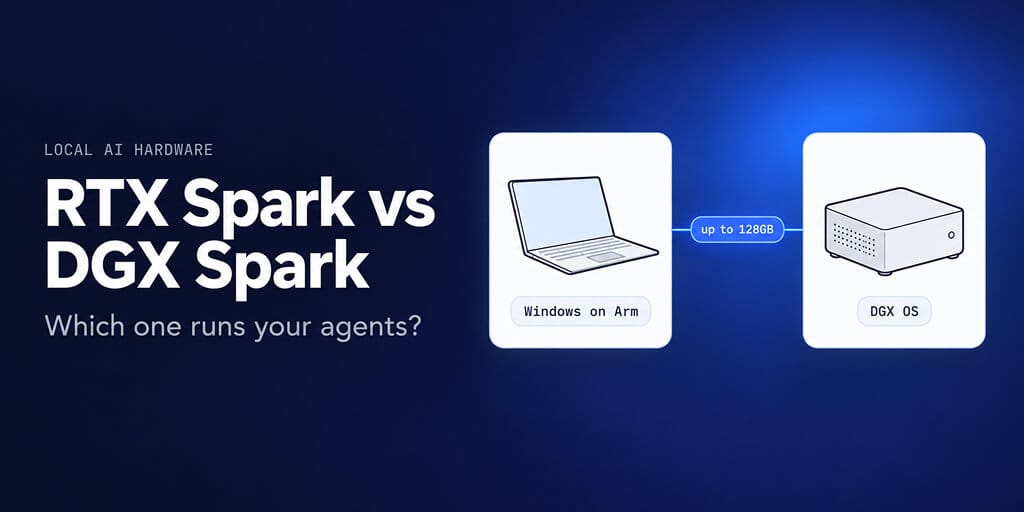
Very similar silicon, different machines. One is a Windows laptop, the other a Linux box that clusters. Here is what that means for local models and agents.
You've got a 120-billion-parameter model you want running locally, an agent that calls it all day, and a credit card hovering over two very different NVIDIA machines. One is a thin Windows laptop that ships on October 16. The other is a 1.2 kg Linux box that has been on desks since last year.
The RTX Spark vs DGX Spark question sounds like a chip shootout. It mostly isn't. The silicon is close cousins. What actually decides it for local agents is memory, the operating system, and whether you'll ever need two machines working as one.
RTX Spark vs DGX Spark: the short answer
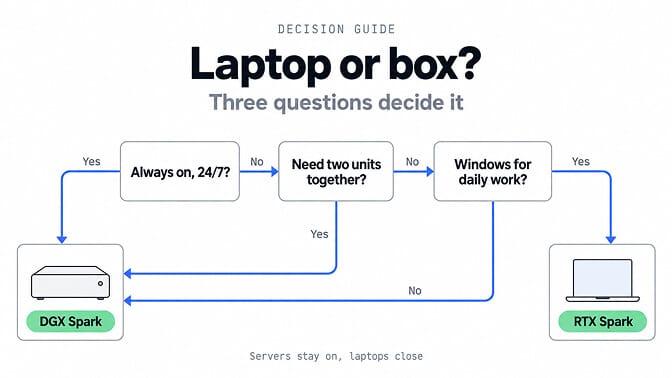
- Pick RTX Spark if you want one Windows machine that runs local models while you work on it, and you're happy to be early on Windows on Arm.
- Pick DGX Spark if you want an always-on Linux server, need to cluster two units, or want NVIDIA's DGX software stack working today.
If your agent needs to answer at 3am while your laptop lid is closed, that's a server job. Don't make a laptop do it.
RTX Spark vs DGX Spark specs, side by side
Everything below comes from NVIDIA's own spec pages, unless it's marked as not published.
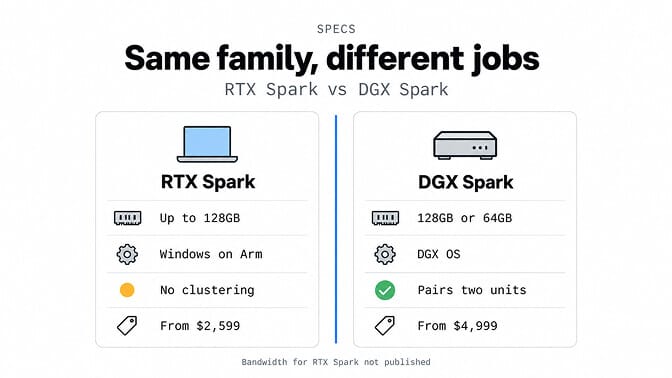
| RTX Spark (OEMs list it as N1X) | DGX Spark (GB10) | |
|---|---|---|
| Announced / available | Announced 31 May 2026, launched 7 Oct. Laptops ship 16 Oct, compact desktops in November | Shipping since 2025. 64GB partner models ship 23 Oct 2026 |
| OS | Windows 11 (on Arm) | DGX OS (Linux) |
| CPU | Up to 20-core Grace (18-core on the smaller config) | 20-core Grace (10 Cortex-X925 + 10 Cortex-A725) |
| GPU | Blackwell RTX, 6,144 or 5,120 CUDA cores | Blackwell, 6,144 CUDA cores |
| Memory | Up to 128GB unified LPDDR5X (up to 64GB on the 5,120-core config) | 128GB or 64GB unified LPDDR5X |
| Memory bandwidth | Not published by NVIDIA | 273 GB/s |
| AI compute | Up to 1 petaflop FP4 | Up to 1 petaflop FP4 |
| Power | 45 to 80W in laptops, 140W listed for the desktop config | 140W chip TDP, 240W power supply |
| Clustering | No ConnectX-7 or clustering listed | ConnectX-7, pairs two units |
| Price | Laptops from $2,599.99 | 64GB $4,999, 128GB $6,950 (reported 2 Oct) |
Two things to notice:
- NVIDIA hasn't published RTX Spark's memory bandwidth anywhere.
- Both product pages give the same "up to 1 petaflop" FP4 figure without saying how it was measured. Treat it as a marketing number, not a measured result.
Is RTX Spark the same chip as DGX Spark?
Very close, and NVIDIA has said as much. In September 2025, Jensen Huang said the GB10 superchip inside DGX Spark is the same chip as its N1 PC processor. The top RTX Spark config matches GB10 on the headline numbers: a 20-core Grace CPU, 6,144 CUDA cores, up to 128GB of unified memory, and up to 1 petaflop of FP4.
Here's where they split:
- Power. RTX Spark laptops run at 45 to 80W. DGX Spark's chip runs at 140W. Same silicon at roughly half the power won't sustain the same speed under a long agent workload.
- Networking. DGX Spark has a ConnectX-7 NIC and two QSFP ports for linking a second unit. NVIDIA lists nothing like that for RTX Spark.
- A cut-down config. RTX Spark also comes as an 18-core, 5,120-core version capped at 64GB.
- Memory bandwidth. Unconfirmed. Press reports put it around 300 GB/s, but NVIDIA hasn't published it. The 600 GB/s figure NVIDIA does give is the CPU-to-GPU NVLink-C2C link, not memory bandwidth. Assume it's similar to DGX Spark's 273 GB/s until reviews say otherwise.
If you landed here searching for an RTX Spark "GPU equivalent": 6,144 CUDA cores is the same count as a desktop RTX 5070. But a 5070 has its own fast GDDR7 memory and a much bigger power budget. Core count alone won't tell you how fast tokens come out. Bandwidth does, which is why our DGX Spark memory bandwidth breakdown matters more than any core count.
Same family of silicon, different jobs. One is built to sit on your lap for eight hours. The other is built to never turn off.
What fits in 128GB (and in 64GB)
Unified memory is the whole point of both machines. A 128GB box holds models that would need several consumer GPUs. Here's what that means with real open models.
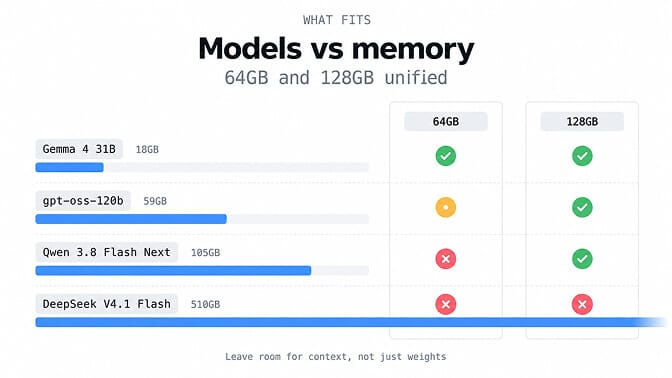
| Model | Size at the precision people run it | 64GB | 128GB |
|---|---|---|---|
| gpt-oss-120b (MXFP4) | about 59 GiB | Not in practice, the weights alone fill it | Yes |
| Qwen 3.8 Flash Next (4-bit) | about 95 to 110GB | No | Yes, with modest context |
| Gemma 4 31B (4-bit) | well under 32GB | Yes | Yes |
| DeepSeek V4.1 Flash | 510GB official checkpoint | No | No |
A few notes on that table:
- Qwen 3.8 Flash Next is the model NVIDIA used to show off RTX Spark. It's about 180B parameters in total: a 125B model plus a 51B n-gram embedding. Only about 6B are active per token, which is why it runs at all.
- gpt-oss-120b has published DGX Spark numbers. Community llama.cpp runs show up to about 60 tokens per second on a tuned setup, and about 46 on stock DGX OS. Ollama's own test measured about 41 tokens per second.
- DeepSeek V4.1 Flash has 763B parameters on its Hugging Face card, counting the vision encoder. No 4-bit build fits in one machine, and it won't fit in two linked DGX Sparks either. That's 256GB in total.
And remember, an agent doesn't just load the model. It also needs room for context. A 100GB-plus model in a 128GB machine leaves little headroom for long agent histories.
Windows on Arm vs DGX OS for agents
This is the section that should actually decide your purchase.
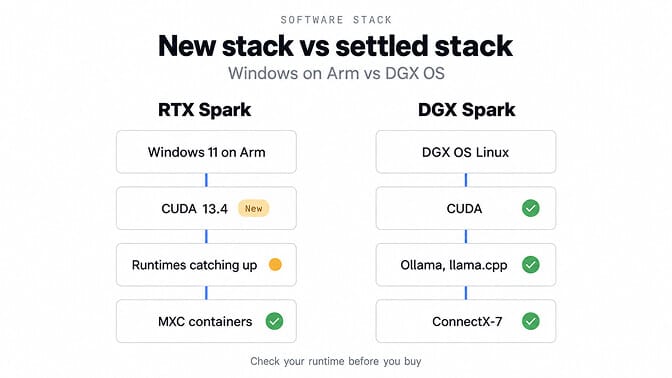
DGX Spark runs DGX OS, NVIDIA's Linux, and the software has had a year to settle. Ollama's hardware docs list the GB10 by name, Ollama has published DGX Spark benchmarks, and the llama.cpp community has too. If you want to run a model server tonight, it works.
RTX Spark is Windows 11 on an Arm CPU, and the stack is brand new:
- CUDA only gained native Windows on Arm64 support with CUDA Toolkit 13.4 in September.
- Ollama's hardware docs don't list RTX Spark yet.
- NVIDIA hasn't announced Linux support for RTX Spark laptops.
None of that means it won't work on day one. It means you should check that your exact runtime supports CUDA on Windows Arm64 before you buy.
Here's the weird part: Windows is ahead on agent containment. On October 7, Microsoft made MXC (Microsoft Execution Containers) generally available. It's a sandbox layer for running agent tools and model output in isolated containers, with policies for which files and network destinations an agent can touch. If you run agents that execute code locally, that matters as much as tokens per second.
For a deeper look at splitting work between a local box and the cloud, see our hybrid local GPU and cloud agents guide.
If babysitting drivers, runtimes and a model server sounds like the wrong use of your week, that's the part we built BetterClaw to take off your plate. Your agents run in the cloud, and they can still use your local models when you want them to.
RTX Spark vs DGX Spark price, per GB of usable memory
Price matters most when you divide it by memory, because memory decides which models fit. These are list prices we could verify as of October 13, 2026.
| Machine | Memory | Price | Per GB |
|---|---|---|---|
| Surface Laptop Ultra (RTX Spark, 6,144-core) | 128GB | $5,899.99 (listed out of stock) | about $46 |
| Surface Laptop Ultra (RTX Spark, 6,144-core) | 64GB | $4,299.99 | about $67 |
| DGX Spark (Founders Edition) | 128GB | $6,950 | about $54 |
| DGX Spark (partner models) | 64GB | $4,999 | about $78 |
The cheapest RTX Spark laptops start at $2,599.99, from the Surface Laptop Ultra and the ASUS ProArt P14. But that Surface config has 24GB of memory, and 24GB doesn't run the models this post is about.
DGX Spark's price has also moved a lot. The 128GB Founders Edition launched at $3,999, rose to $4,699 in February, and was reported at $6,950 on October 2, with memory costs as the cause.
Per gigabyte, the 128GB RTX Spark laptop is cheaper than the 128GB DGX Spark right now. You pay for that with no clustering, a newer software stack and a laptop power budget.
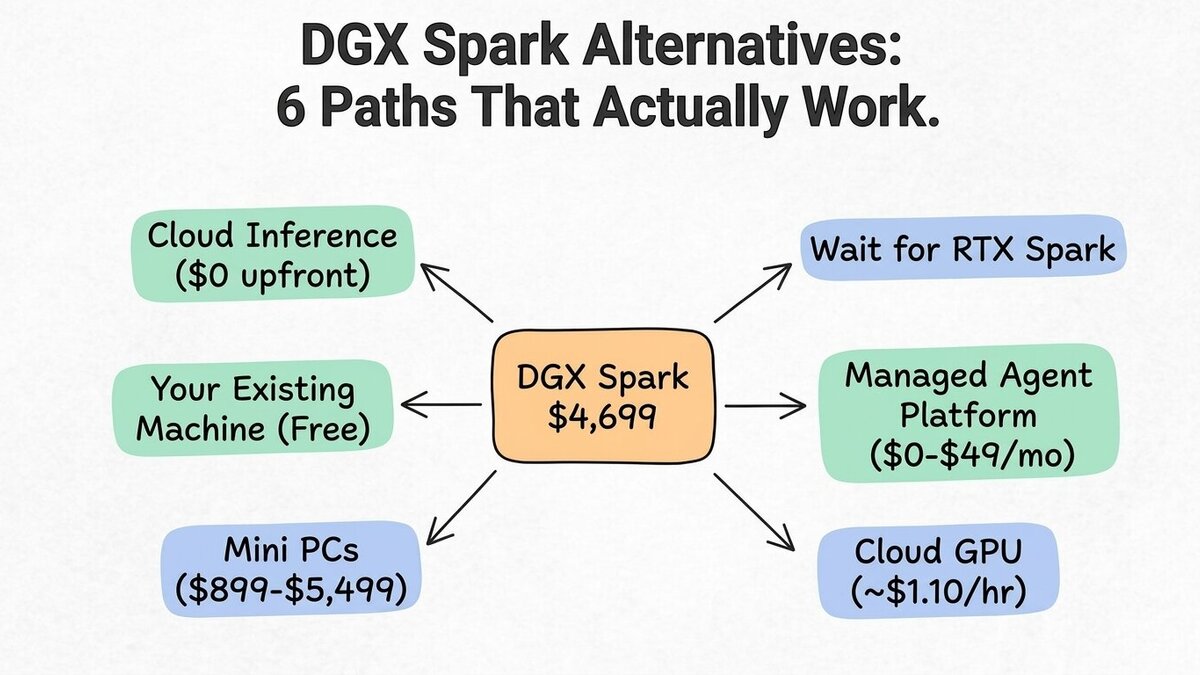
Our DGX Spark alternatives guide covers the non-NVIDIA options in more depth.
RTX Spark vs Mac Studio, M5 Max and Strix Halo
RTX Spark vs Mac Studio
The M5 Max Mac Studio tops out at 128GB, with up to 614GB/s of memory bandwidth, more than twice DGX Spark's 273GB/s. The M5 Ultra goes to 512GB and up to 1.2TB/s. For pure local inference speed and capacity, a Mac Studio is the stronger box. RTX Spark's edge is CUDA, and running Windows.
RTX Spark vs M5 Max
The M5 Max MacBook Pro also offers up to 128GB with up to 614GB/s. That's the laptop to beat for local models. RTX Spark wins only if you specifically need CUDA tooling on a laptop.
RTX Spark vs Strix Halo
AMD's Ryzen AI Max+ 395 reaches 128GB at 256GB/s, close to DGX Spark's bandwidth. The Framework Desktop launched at $1,999 for 128GB, though memory prices have risen since. It's the budget pick, with ROCm and Vulkan instead of CUDA.
RTX Spark vs RTX 5090
A desktop RTX 5090 has far more bandwidth, but only 32GB of memory. It's faster on models that fit, and useless for the 100GB-plus models a Spark is built for.
Run local models on a Spark without exposing it
Here's the setup we'd actually use with either machine. Keep your agents in the cloud, where they're always on and connected to Slack, Gmail and the rest. Then let them call the model running on your Spark.
That's what BetterClaw Desktop does. It connects models running in Ollama, LM Studio or llama.cpp to your BetterClaw agents with no open ports, no tunnels and no API key. Your agents keep their schedules and channels, and your tokens cost nothing.
One honest caveat. BetterClaw Desktop doesn't run natively on either Spark yet:
- Version 0.1.0 supports Windows on Intel or AMD only, with no Windows on Arm.
- Its Linux build is x86_64, while DGX Spark is Arm.
The workaround is supported today. Run the model server on the Spark, and run Desktop on a Mac or an Intel/AMD PC on the same network. Desktop connects to any OpenAI-compatible address on your local network. Get it from the BetterClaw downloads page.
If any of this resonated, give BetterClaw a try. The free plan gives you one agent and 100 credits a month, with no card. Basic is $19 a month, and Pro is $49 a month for five agents. It's all bring-your-own-key with no inference markup, and your local models are free tokens. Start free or see full pricing.
The Spark machines are a real moment. A year ago, 128GB of GPU-addressable memory meant a server rack. Now it fits in a laptop bag. Just don't buy the hardware before you've decided where your agents live.
Frequently Asked Questions
Is RTX Spark out yet?
Not quite. NVIDIA first announced RTX Spark at Computex on May 31, 2026, and launched it with Microsoft on October 7, when laptop preorders opened. The first laptops are available on October 16, some HP models ship in early November, and compact RTX Spark desktops follow in November.
Is RTX Spark ARM based?
Yes. RTX Spark pairs an NVIDIA Grace CPU, which uses Arm cores, with a Blackwell RTX GPU, and runs Windows 11 on Arm. CUDA gained native Windows on Arm64 support in CUDA Toolkit 13.4 in September 2026, so check that your local AI tools support it.
How much does RTX Spark cost?
RTX Spark laptops start at $2,599.99, for example the Surface Laptop Ultra with 24GB and the ASUS ProArt P14. A Surface Laptop Ultra with the full 6,144-core chip and 128GB is listed at $5,899.99. NVIDIA hasn't announced a price for the chip itself, so laptop makers set the prices.
Is RTX Spark the same chip as DGX Spark?
It's very close. Jensen Huang said in 2025 that DGX Spark's GB10 is the same chip as NVIDIA's N1 PC chip, and the top RTX Spark config matches GB10's 20 CPU cores, 6,144 CUDA cores and 128GB. The differences are power (45 to 80W in laptops vs 140W), no ConnectX-7 networking on RTX Spark, and memory bandwidth that NVIDIA hasn't published.
Can two RTX Sparks be clustered?
Not in the way DGX Spark can. DGX Spark has a ConnectX-7 NIC with two QSFP ports, and NVIDIA supports a two-Spark setup for models up to 400B parameters. NVIDIA lists no ConnectX-7 or clustering for RTX Spark.
Which is better for local LLMs?
For an always-on model server, DGX Spark, because its Linux software stack is mature and it can pair with a second unit. For one machine you also work on every day, RTX Spark, once your runtime supports Windows on Arm. If raw local inference speed is the priority and you don't need CUDA, a 128GB Mac has more memory bandwidth than either.