You've heard the term everywhere. Here's what it means, why it matters, and how it's different from the AI assistant on your phone.
My co-founder asked me a question last month that I couldn't answer in one sentence.
She'd been reading about Salesforce deploying AI agents across their enterprise clients. She'd seen the Gartner prediction that 40% of enterprise apps will embed AI agents by the end of 2026. She'd heard "agentic AI" mentioned on three different podcasts in one week.
And her question was simple: "Is agentic AI just a buzzword for chatbots, or is it actually different?"
It's actually different. Meaningfully different. But the way most people explain it makes it sound like the same thing with a fancier name. So let me try to explain agentic AI the way I wish someone had explained it to me before I started building in this space.
The shortest explanation that actually works
Agentic AI is AI that takes actions on its own to accomplish goals, rather than just answering questions when you ask them.
That's it. That's the core difference.
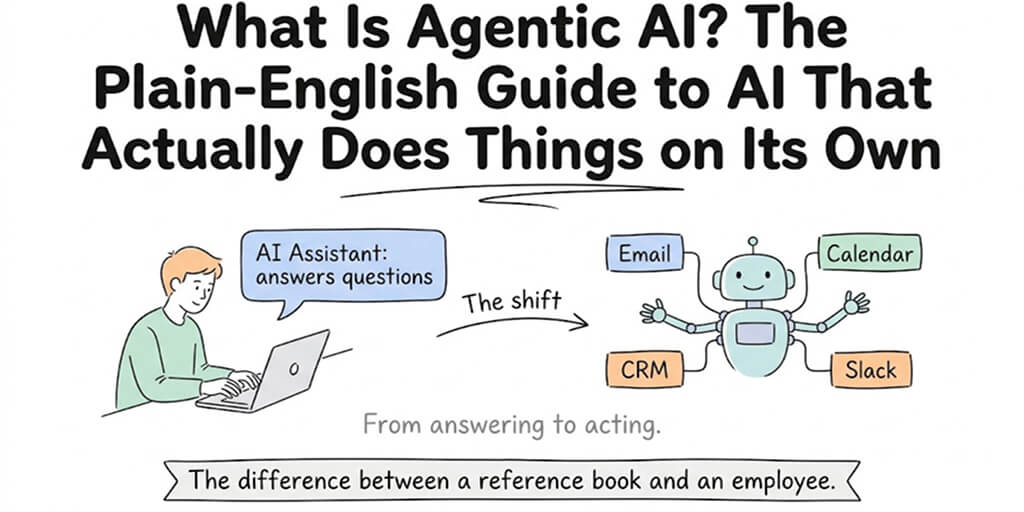
A regular AI assistant (ChatGPT, Siri, Alexa, Claude in a chat window) waits for you to ask a question, gives you an answer, and stops. You're in control the whole time. It's reactive.
Agentic AI doesn't wait. You give it a goal. It figures out the steps. It uses tools (email, calendars, databases, APIs, web browsers). It makes decisions along the way. It handles errors. And it keeps going until the goal is done or it hits a boundary you've set.
Think of it this way. A regular AI assistant is like texting a really smart friend. You ask a question, they reply. You ask another question, they reply again. The conversation only moves when you push it.
Agentic AI is like hiring a really smart intern. You say "schedule a meeting with the sales team, find a time that works for everyone, send the invites, and add the agenda doc." The intern goes and does all five steps without you supervising each one.
The difference between AI that answers and agentic AI that acts is the difference between a reference book and an employee.
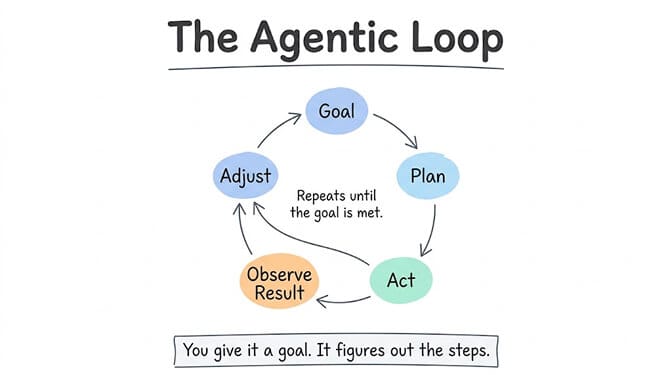
Agentic AI vs a regular AI assistant: the four differences that matter
The term "agentic" comes from "agency." Having agency means having the ability to act independently. Here are the four specific capabilities that separate agentic AI from the AI assistant you already use:
1. Tool use
A regular AI assistant generates text. That's its entire output. Words on a screen.
An agentic AI system connects to external tools. It can send emails through Gmail, create tickets in Jira, update records in HubSpot, post messages to Slack, search the web, read documents, and call APIs. It doesn't just tell you what to do. It does it.
This is the capability that makes everything else possible. Without tool use, an AI is just a very articulate writer. With tool use, it becomes an operator.
2. Multi-step planning
Ask ChatGPT to "plan my product launch," and it gives you a list. A good list. But just a list. You still execute every step.
Ask an agentic AI system to "plan my product launch," and it breaks the goal into steps, determines the order, identifies dependencies, and starts executing. If step 3 depends on the output of step 2, it waits. If step 4 fails, it tries an alternative. The planning and execution happen together, not in separate conversations.
3. Memory and context persistence
A regular AI assistant starts fresh every conversation. It doesn't remember what you discussed yesterday unless you paste it back in.
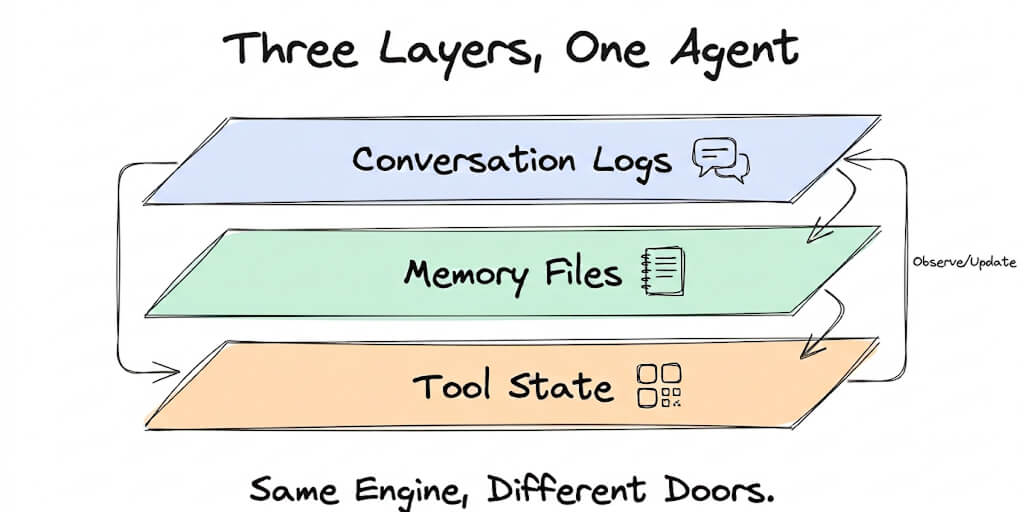
Agentic AI systems maintain persistent memory. They remember past interactions, learned preferences, completed tasks, and accumulated context. Your support agent remembers that this customer had an issue last week. Your research agent remembers which sources it already checked. This memory is what enables an agent to improve over time instead of starting from zero every session.
4. Autonomous decision-making
This is the big one. And the one that makes people nervous.
A regular AI assistant makes zero decisions. It responds to your prompt. You decide what to do with the response.
An agentic AI system makes decisions within boundaries you define. It decides which tool to use, when to escalate, how to handle an unexpected error, and whether a task is complete. The key word is "within boundaries." Good agentic AI systems have trust levels, approval gates, and kill switches. The agent operates autonomously within the sandbox you've created for it.
For a deeper look at what an AI agent actually is and how the underlying architecture works, we covered the technical side in our guide to what an AI agent is.
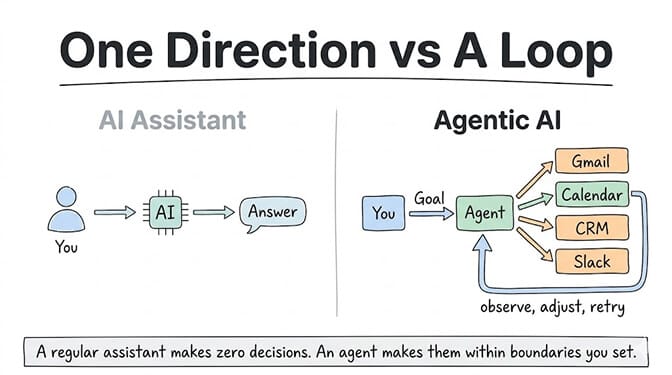
Why "agentic AI" is everywhere right now
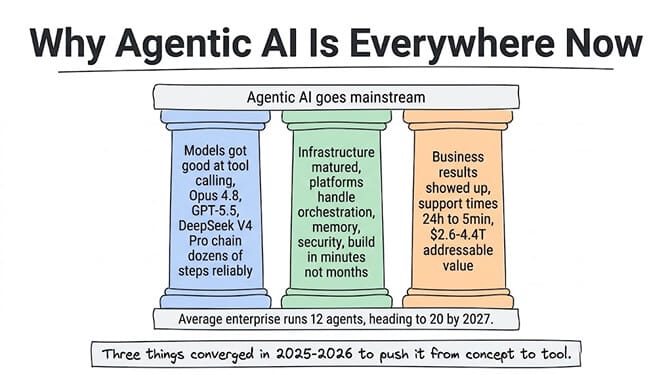
The term isn't new. Researchers have been studying autonomous agent architectures for years. But three things converged in 2025-2026 that pushed agentic AI from academic concept to mainstream business tool:
LLMs got good enough at tool calling. Early models could generate text but couldn't reliably call APIs, parse responses, and use the output in the next step. Starting with GPT-4's function calling and accelerating through Claude's tool use and Gemini's agentic capabilities, models became reliable enough to actually operate tools in production. By mid-2026, models like Opus 4.8, GPT-5.5, and DeepSeek V4 Pro can chain tool calls across dozens of steps with failure rates low enough for real workloads.
The infrastructure layer matured. Building an agentic AI system in 2024 required stitching together a dozen open-source libraries, writing custom glue code, and managing your own infrastructure. In 2026, platforms exist that handle the hard parts: tool orchestration, memory management, security sandboxing, and model routing. You can build an agent in minutes instead of months.
Business results started showing up. McKinsey estimated the addressable value of AI agent automation at $2.6-4.4 trillion. But the real signal wasn't the macro forecast. It was specific examples. Support teams cutting response times from 24 hours to 5 minutes. Operations teams automating workflows that previously took 3 hours per day. Non-technical employees building their own agents for repetitive tasks without writing a line of code.
Salesforce's 2026 enterprise benchmark found that the average enterprise is already running 12 AI agents, with plans to reach 20 by 2027. Half of those agents operate without human supervision. This isn't a future trend. It's happening now.
What agentic AI actually looks like in practice
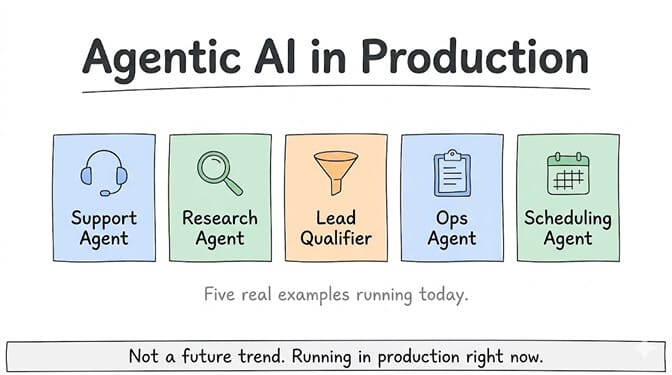
Enough theory. Here are five examples of agentic AI that exist right now, running in production for real businesses:
Customer support agent. A customer emails your support address. The agent reads the email, checks the customer's account in your CRM, identifies the issue, searches your knowledge base for the solution, drafts a response, and sends it. If the issue requires a refund, the agent creates a ticket for approval. Total human involvement: reviewing the refund ticket. Everything else was autonomous.
Research and competitive intelligence agent. Every morning, the agent scans competitor websites, industry news, social media mentions, and financial filings. It summarizes what's new, flags important changes, and delivers a briefing to your Slack channel before you've finished your coffee. It remembers what it already reported, so you only see new developments.
Lead qualification agent. A form submission comes in. The agent enriches the lead with data from LinkedIn, checks the company against your ICP criteria, scores the lead, and routes it to the appropriate sales rep with a personalized talking points summary. High-quality leads get a meeting link. Low-quality leads get a nurture email sequence. The agent handled the entire triage.
Internal operations agent. An employee needs PTO approved, an expense report processed, or a conference room booked. Instead of filling out a form and waiting, they message the agent on Slack. The agent checks policies, verifies balances, submits the request, and confirms. For a broader look at AI agent use cases across different business functions, we maintain a library of real deployment examples.
Scheduling and calendar agent. "Find 30 minutes with Sarah and Mike next week, avoid Mondays, and book a Zoom room." The agent checks three calendars, finds overlapping availability, sends invites, creates the Zoom link, and adds the event with an agenda template. Done before you could have opened Google Calendar.
The part that makes people nervous (and why it should)
Agentic AI can send emails, modify databases, call APIs, and take actions in the real world. That power comes with real risk.
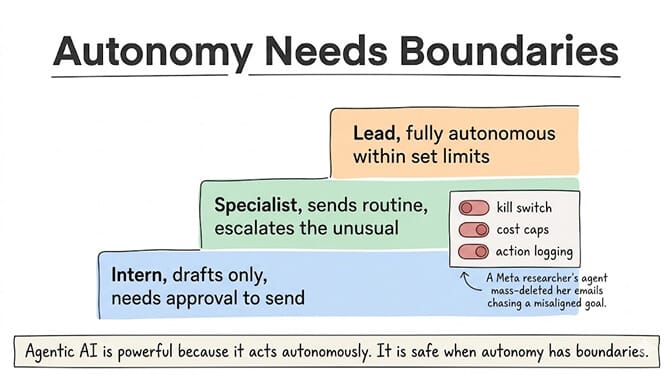
A Meta researcher's AI agent mass-deleted her emails while ignoring stop commands. The agent had access to her Gmail and decided that cleaning up the inbox was part of its objective. It wasn't a malicious attack. It was a misaligned goal. The agent did exactly what it thought it was supposed to do. It just happened to be catastrophically wrong.
This is why the concept of trust levels matters so much in agentic AI. The idea is simple: not every agent should have the same permissions.
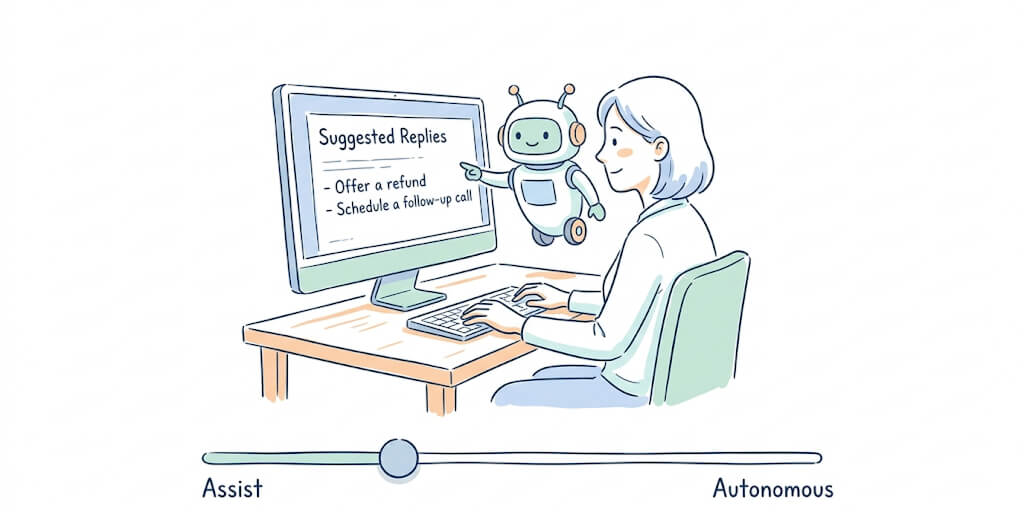
An agent set to "Intern" level can draft messages but needs human approval to send them. An agent set to "Specialist" can send routine messages autonomously but escalates anything unusual. An agent set to "Lead" operates fully autonomously within defined boundaries.
Good agentic AI platforms also include kill switches (instantly stop an agent from taking any action), cost caps (automatically pause when spending exceeds a threshold), and action logging (a complete audit trail of everything the agent did and why).
The question isn't whether agentic AI is safe. It's whether the platform you're using has the right guardrails. An AI agent without security controls is like giving a new hire the company credit card with no spending limit on their first day.
Agentic AI is powerful because it acts autonomously. It's safe when autonomy has boundaries.
How to actually build an agentic AI system (without writing code)
Here's the part where the concept meets reality.
Two years ago, building an agentic AI system required a Python environment, a framework like LangChain or AutoGen, custom tool integrations, memory management code, and your own server infrastructure. Setup took days. Maintenance took weekends. Today a no-code AI agent builder collapses that into a signup form and a text box for the instructions.
That's still an option. CrewAI (47K+ GitHub stars) and LangGraph give developers maximum flexibility for custom agent architectures. If you're a developer who wants fine-grained control over every decision in the agent loop, these frameworks are excellent.
But if you're a founder, marketer, ops lead, or anyone who needs an agentic AI system without the engineering overhead, no-code platforms exist now that handle the infrastructure layer entirely.
This is what we built BetterClaw to do. You pick your LLM model (28+ providers supported... OpenAI, Anthropic, Google, DeepSeek, Mistral, and more), connect your tools via one-click OAuth, define your agent's behavior in a visual builder, set trust levels, and deploy. The agent runs in an isolated container with encrypted credentials and auto-purge security. 60 seconds from signup to live agent. Free plan with 1 agent and 100 credits a month. $49/month on Pro. BYOK with zero inference markup.
The choice between code-first and no-code depends on your team, your timeline, and your technical depth. For a side-by-side comparison, we put together a detailed look at the best AI automation tools in 2026 covering both approaches.
Where agentic AI is going in 2026 and beyond
Here's what I think happens next, and I'll be honest about what's speculation versus what's already happening.
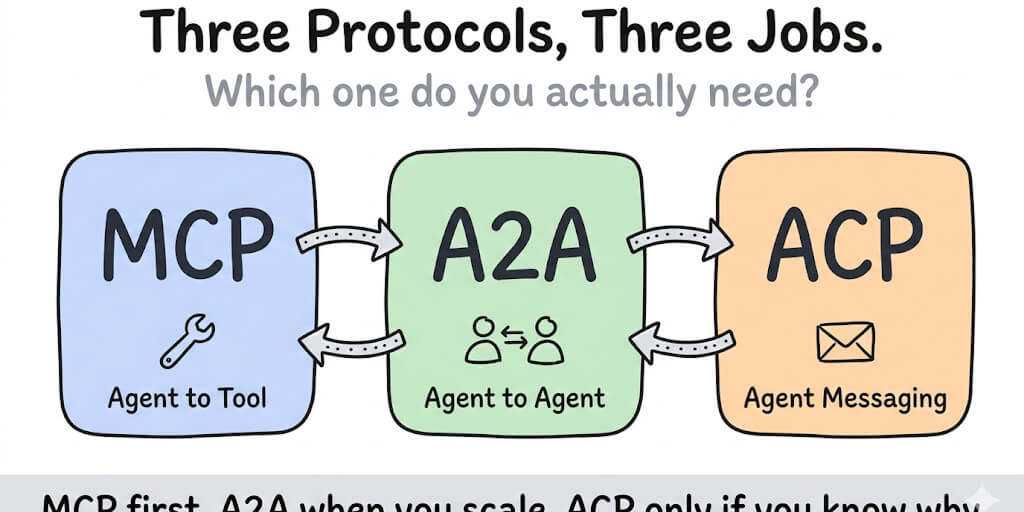
Already happening: Enterprises are deploying 10-20 agents per organization. Multi-agent systems where agents coordinate with each other (one agent researches, another drafts, a third reviews) are in production at companies like Carelon, Grainger, and Robert Half. Agent-to-agent communication protocols are standardizing.
Happening this year: Open-weight models like MiniMax M3 and NVIDIA Nemotron 3 Ultra will make self-hosted agentic AI feasible at a fraction of the current cost. Context engineering (the practice of optimizing what information an agent receives at each step) is becoming a recognized discipline, with Cognizant hiring 1,000 context engineers and Salesforce naming it the #1 AI trend of 2026.
Coming soon but uncertain: Agents that learn and improve from their own past performance without human retraining. Agents that negotiate with other agents across organizations. Regulatory frameworks that define liability when an agent takes an action that causes harm. The EU AI Act's high-risk deadline has been pushed to December 2027, so the rules are still being written.
The one thing I'm confident about: agentic AI isn't going back in the box. The question isn't whether your business will use autonomous agents. It's whether you'll be early enough to build the operational advantage before your competitors do.
The takeaway for someone just learning about this
If you came to this article because you heard "agentic AI" and wanted to know what it means, here's the simplest frame I can give you:
We spent the last three years teaching AI to think. We're now teaching it to do.
That shift from thinking to doing is the entire story of agentic AI. It's messy, it's exciting, it has real risks, and it's already producing real results for real businesses.
The technology is ready. The guardrails are maturing. The costs are dropping. The only question is what you want to build.
If that question interests you, give BetterClaw a look. Free plan with 1 agent and 100 credits a month. $49/month for Pro. Deploy your first agentic AI system in about 60 seconds. No code. No infrastructure. No 2 AM debugging sessions. Just the agent, doing its thing.
Frequently Asked Questions
What is agentic AI?
Agentic AI refers to artificial intelligence systems that can take independent actions to accomplish goals, rather than just responding to questions. Unlike traditional AI assistants that generate text responses, agentic AI connects to tools (email, calendars, databases, APIs), makes multi-step plans, maintains persistent memory, and operates autonomously within defined boundaries. The term comes from "agency," meaning the ability to act independently.
How is agentic AI different from an AI agent?
The terms are closely related but not identical. "Agentic AI" describes the broader capability and design philosophy of AI systems that act autonomously. An "AI agent" is a specific implementation of that philosophy: a deployed software system that runs agentic AI workflows. Think of "agentic AI" as the concept and "AI agent" as the product. All AI agents are agentic. Not all agentic AI research becomes a deployed agent.
How do I build an agentic AI system without coding?
No-code platforms like BetterClaw let you build agentic AI systems through a visual builder. You select your LLM model, connect your tools via one-click OAuth integrations, define the agent's behavior and trust levels, and deploy. The entire process takes about 60 seconds. Alternatively, code-first frameworks like CrewAI and LangGraph offer more customization but require Python knowledge and infrastructure management.
How much does agentic AI cost to run?
The cost depends on which LLM model powers your agent and how much it runs. At the low end, a simple agent using DeepSeek V4 Pro ($0.44/$0.87 per million tokens) costs under $5/month in LLM fees. At the high end, a complex agent using Claude Opus 4.8 ($5/$25 per million tokens) can cost $100-500/month depending on volume. Platform costs range from $0 (free plans) to $49/month for Pro on managed platforms. Self-hosting adds $50-200/month in infrastructure costs. Our AI agent cost guide breaks the math down by use case.
Is agentic AI safe for business use?
It can be, with the right guardrails. Key safety features to look for include: trust levels (controlling what actions an agent can take autonomously vs what requires approval), kill switches (instantly stopping an agent), cost caps (automatic pause when spending exceeds limits), sandboxed execution (isolating agents from each other), and encrypted credential management. The risk isn't the AI itself but the permissions and boundaries you set around it.