LangChain has 700+ integrations and an ecosystem the size of a small country. Pydantic AI has type safety and the radical idea that your agent code should look like normal Python. Here's why developers are switching, when they shouldn't, and what both miss.
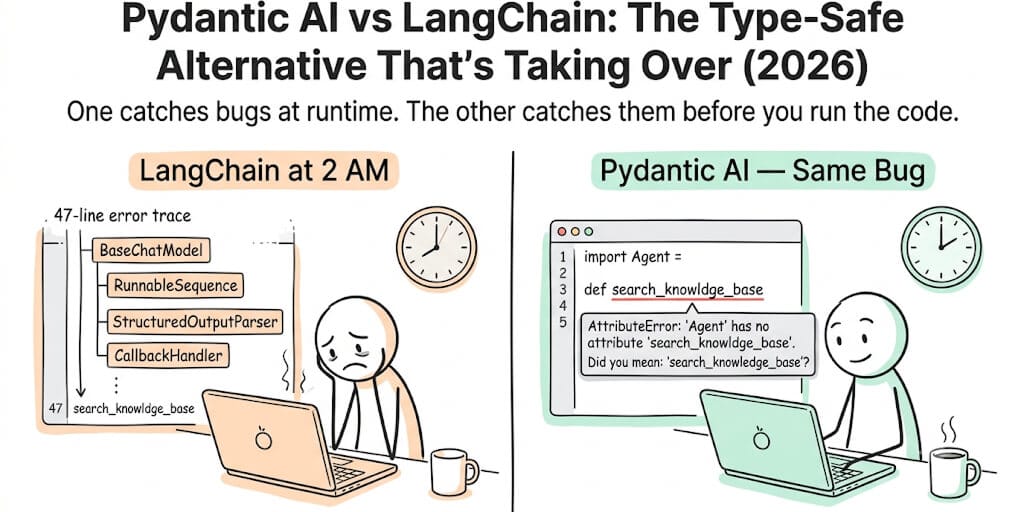
Last month I spent 45 minutes debugging a LangChain agent. The error trace was 47 lines long, winding through BaseChatModel, RunnableSequence, StructuredOutputParser, and three callback handlers. The agent was calling a tool that didn't exist. The actual bug: "search_knowldge_base" instead of "search_knowledge_base". A typo in a string that Python had no way to catch, because LangChain passes tool names as untyped strings.
This exact class of bug (string-based tool names, untyped parameters, runtime-only validation) shows up weekly on the LangChain Discord and in GitHub issues. The Pydantic AI team built their framework specifically to eliminate it.
Pydantic AI launched from the team behind Pydantic (the validation library powering FastAPI, used in 90%+ of production Python APIs). V2 shipped June 23, 2026 with a "harness-first" redesign. Tools are typed functions. Outputs are Pydantic models. Your IDE catches "search_knowldge_base" before you run the code.
Here's the honest Pydantic AI vs LangChain comparison. Not a feature matrix. A builder's experience with both.
The core difference (why developers care)
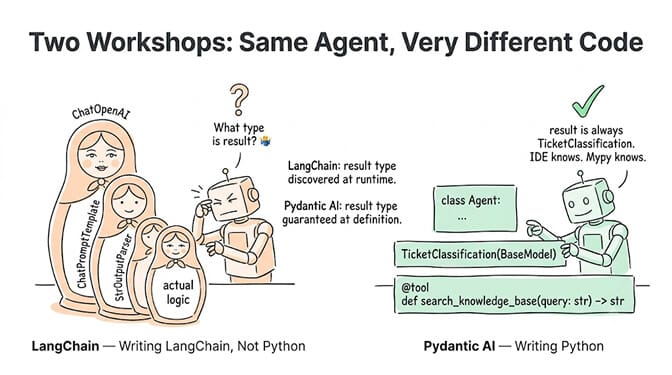
LangChain wraps everything. Models get wrapped in ChatOpenAI. Prompts get wrapped in ChatPromptTemplate. Outputs get wrapped in StrOutputParser. Tools get wrapped in @tool. Chains connect wrappers to other wrappers. It works. But you're writing LangChain, not Python.
Pydantic AI uses native Python patterns. Tools are typed functions. Outputs are Pydantic models. The agent is a class with methods you can test, type-check, and refactor with standard Python tools. Your IDE's autocomplete works. Mypy catches bugs before runtime. Refactoring is safe.
# LangChain style (simplified)
chain = prompt | model | output_parser
result = chain.invoke({"query": ticket_text})  # What type is result? 🤷

# Pydantic AI style
class TicketClassification(BaseModel):
    category: Literal["billing", "technical", "sales"]
    priority: int
    summary: str

agent = Agent(model, result_type=TicketClassification)
result = await agent.run(ticket_text)  # result is TicketClassification. Always.
In the Pydantic AI version, result is always a TicketClassification object. Your IDE knows it. Mypy knows it. If you access result.categori (typo), your editor underlines it in red before you run the code. In LangChain, you discover the typo at runtime. Possibly in production. Possibly at 2 AM.
The pitch for Pydantic AI isn't "we're better than LangChain." It's "your agent code should be as type-safe as the rest of your Python codebase." If you already use Pydantic models, FastAPI, and mypy, Pydantic AI fits your workflow. LangChain requires you to learn a new abstraction layer.
Where LangChain still wins (and it's not close)
The ecosystem
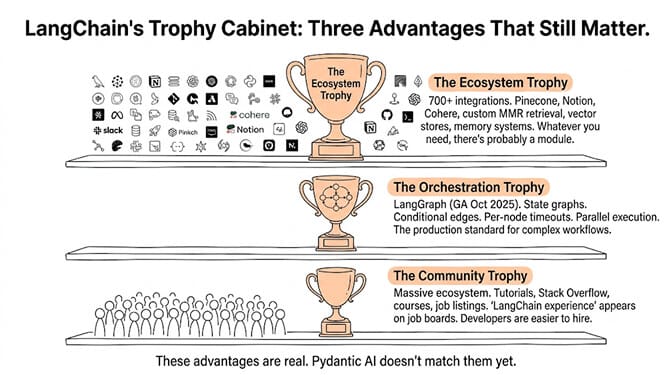
700+ pre-built integrations. Vector stores, document loaders, memory systems, output parsers, embedding models, retrieval chains. Whatever you need to connect to, LangChain probably has a module for it. Pydantic AI has a fraction of this.
If your agent needs to connect to Pinecone for vector search, pull documents from Notion, embed them with Cohere, and retrieve via a custom MMR algorithm... LangChain has modules for all of that. Pydantic AI has the agent loop. You build the integrations yourself. (For the retrieval-heavy end of that spectrum specifically, our LangChain vs LlamaIndex comparison breaks down which framework owns the RAG layer.)
LangGraph for complex orchestration
LangChain's agent story isn't just chains anymore. LangGraph (GA since Oct 2025) adds state graph orchestration with conditional edges, checkpoints, and per-node timeouts. For complex multi-step agents, LangGraph is the production standard.
Pydantic AI V2 focuses on the harness (the agent loop, tool definitions, structured output). It doesn't have LangGraph's orchestration layer. For simple tool-loop agents, you don't need it. For conditional workflows with parallel execution paths, you do. We break down how LangGraph stacks up against a leaner Claude-native approach in Claude Agent SDK vs LangGraph, and against the other orchestrators in LangGraph vs CrewAI vs AutoGen.
Community and jobs
LangChain has a massive community. Tutorials, courses, Stack Overflow answers, hiring demand. "LangChain experience" appears on job listings. "Pydantic AI experience" doesn't. Yet.
If you're building a team that needs to hire, LangChain developers are easier to find. Pydantic AI developers are Python developers who read the docs in an afternoon. Different hiring calculus.
Where Pydantic AI wins (and it matters more than you think)
Type safety catches bugs before production
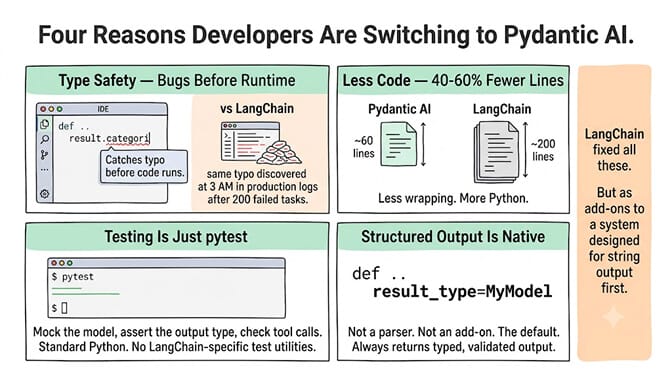
Every tool parameter, every output field, every dependency is type-checked. Mypy, Pyright, or your IDE catches mismatches before you run the code. On LangChain, these become runtime errors. On Pydantic AI, they're red squiggles in your editor.
For a weekend project, this doesn't matter. For a production agent processing 500 tasks per day, catching a field-name typo in development vs catching it after 200 failed tasks at 3 AM... type safety pays for itself.
Less code, fewer abstractions
A comparable agent in Pydantic AI is 40-60% fewer lines than LangChain. Not because Pydantic AI does more magic. Because it does less wrapping. You write Python functions, not LangChain wrapper classes. Less code means fewer bugs, faster onboarding, and easier maintenance.
Testing is just... testing
Pydantic AI agents are Python classes with methods. You test them with pytest. Mock the model, assert the output type, check the tool calls. No special testing framework. No LangChain-specific test utilities.
On LangChain, testing means mocking chains, faking callbacks, and dealing with the abstraction layers between your test and the actual logic. It works, but it's more friction than it should be.
Structured output is native, not bolted on
LangChain added structured output through StructuredOutputParser, PydanticOutputParser, .with_structured_output(). It works, but it's an add-on to a system originally designed for string outputs.
Pydantic AI starts from structured output. result_type=MyModel is the default, not the exception. The entire framework assumes you want typed, validated output. Because in 2026, you do.
If you're evaluating frameworks and thinking do I really need to learn either of these just to build an agent?, the honest answer is: not always. BetterClaw builds agents through a visual interface with no framework at all. Unlimited skills. 28+ model providers via BYOK. Free plan with 1 agent and 100 credits a month. $49/month on Pro.
The comparison table
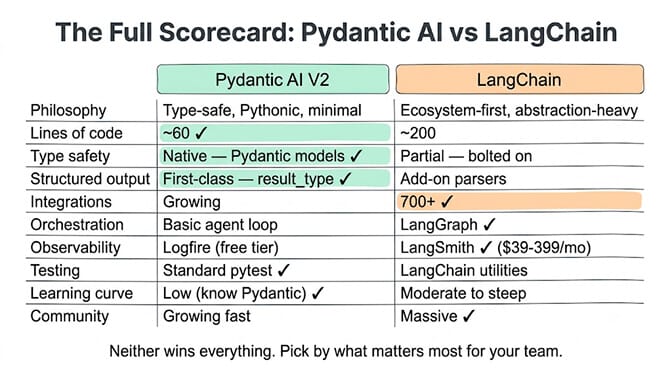
| Pydantic AI V2 | LangChain | |
|---|---|---|
| Philosophy | Type-safe, Pythonic, minimal | Ecosystem-first, abstraction-heavy |
| Lines of code (triage agent) | ~60 | ~200 |
| Type safety | Native (Pydantic models) | Partial (bolted on) |
| Structured output | First-class (result_type) | Add-on parsers |
| Integrations | Growing | 700+ |
| Orchestration | Basic agent loop | LangGraph (state graphs) |
| Multi-agent | Manual | LangGraph, CrewAI ecosystem |
| Observability | Logfire (from Pydantic team) | LangSmith ($39-399/mo) |
| Testing | Standard pytest | LangChain test utilities |
| Model support | Model-agnostic | Model-agnostic |
| Learning curve | Low (if you know Pydantic) | Moderate to steep |
| Community size | Growing fast | Massive |
| Pricing | Free (open-source) | Free + LangSmith paid |
| Shipped | V2 June 23, 2026 | LangGraph GA Oct 2025 |
The decision framework
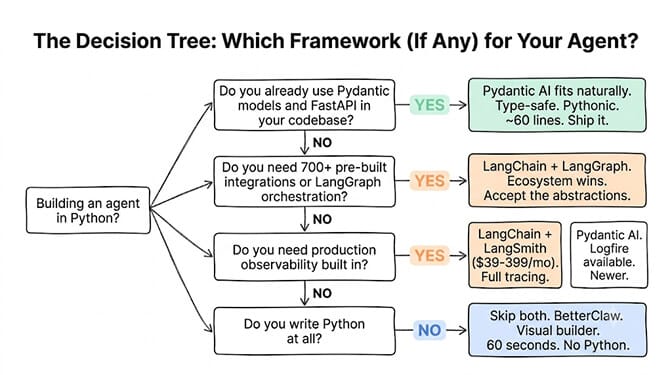
Use Pydantic AI when: your team already uses Pydantic models and FastAPI. You want type-safe agent code. Your agents are primarily tool-loop workflows (read data, process it, return structured output). You value code simplicity and testability over ecosystem breadth. You're building agents that integrate into an existing typed Python codebase.
Use LangChain (+ LangGraph) when: you need 700+ pre-built integrations out of the box. Your workflow requires complex conditional orchestration (LangGraph). You want LangSmith for production observability. You need to hire developers with framework experience. Your agent architecture involves multiple interconnected chains, retrievers, and memory systems. If you're still mapping the wider landscape, our rundown of AI agent frameworks covers CrewAI, AutoGen, and Semantic Kernel alongside these two.
Use neither when: you don't write Python. You want an agent running in production without managing infrastructure. You need guardrails, trust levels, and cost caps built in. You need your agent deployed across Telegram, Slack, Discord and Gmail. For these cases, a managed no-code platform is the better fit.
The honest take
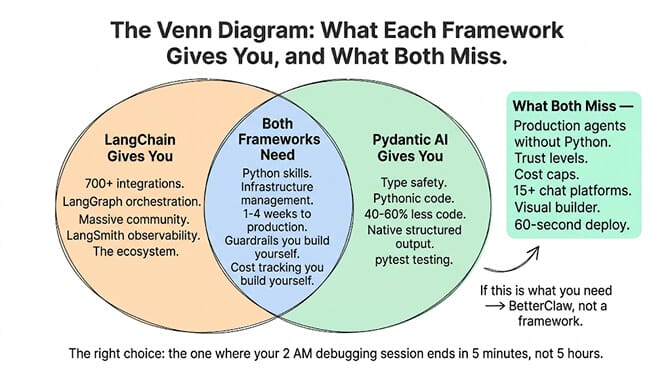
Pydantic AI isn't "taking over" LangChain. Not yet. LangChain's ecosystem is enormous and growing. Gartner projects 40% of enterprise applications will embed AI agents by end of 2026. Most of those will use LangChain because it's the established standard with the most integrations and the most tutorials.
But Pydantic AI represents a real shift in how Python developers think about agent code. The question it asks is important: should your agent code be as sloppy as a Jupyter notebook, or as clean as a production API?
If you've ever spent an hour debugging a LangChain chain where the error was a string mismatch that mypy would have caught instantly... you understand why Pydantic AI exists. If you've never had that experience because LangChain works fine for you... keep using LangChain.
The right framework is the one that makes your specific agent reliable and maintainable. Not the one with the most GitHub stars. Not the one with the best conference talks. The one where your 2 AM debugging session ends in 5 minutes instead of 5 hours.
If the Pydantic AI vs LangChain debate feels like choosing between two different flavors of complexity, there's a third path: skip the framework entirely. BetterClaw builds agents through a visual interface. No type annotations to write. No chains to compose. No framework to learn. Your agent deploys in 60 seconds with unlimited skills, and a curated set that is already tested and typed for you. Free to try. $49/month for Pro.
Frequently Asked Questions
What is Pydantic AI?
Pydantic AI is an agent framework built by the Pydantic team (creators of the Pydantic validation library used by FastAPI). It uses native Python type hints and Pydantic models for type-safe agent development. V2 shipped June 23, 2026 with a "harness-first" redesign. Agents return typed Pydantic models, tools are typed functions, and the entire codebase is IDE and mypy compatible. Model-agnostic (works with OpenAI, Claude, Gemini, local models).
How does Pydantic AI compare to LangChain for agents?
Pydantic AI is simpler (~60 lines vs ~200 for a comparable agent), type-safe (IDE catches bugs before runtime), and more Pythonic (standard functions instead of wrapper classes). LangChain has a much larger ecosystem (700+ integrations), LangGraph for complex orchestration, LangSmith for observability, and a bigger community. Choose Pydantic AI for type safety and simplicity. Choose LangChain for ecosystem breadth and complex multi-step workflows.
Is Pydantic AI production-ready in 2026?
V2 (shipped June 23, 2026) is designed for production. The harness-first redesign focuses on testability, type safety, and structured output as first-class features. Observability is handled through Logfire (from the Pydantic team). The framework is newer and has fewer integrations than LangChain, but the core agent loop is solid and well-tested. Alice Labs ranked it #7 for production-readiness, noting "best for type-safe Python."
Can I use Pydantic AI with LangGraph?
Not directly. They're separate frameworks with different philosophies. However, you can use Pydantic AI for individual agent steps (typed tool functions, structured output) and wrap them in LangGraph nodes for orchestration. Some teams use Pydantic models in LangChain via .with_structured_output() without adopting the full Pydantic AI framework. The ecosystems are compatible at the data model level.
How much does Pydantic AI cost compared to LangChain?
Both frameworks are free (open-source). The cost differences are in the ecosystems: LangSmith (LangChain's observability) costs $39-399/month. Logfire (Pydantic AI's observability) has a free tier and paid plans. LLM API costs are identical regardless of framework (both are model-agnostic). On BetterClaw, you skip both frameworks entirely. $0 (free plan) or $49/month (Pro) plus LLM API costs via BYOK with zero markup.
Related Reading
- AI Agent Frameworks in 2026 — Where Pydantic AI sits in the wider field
- LangChain vs LlamaIndex — The other major LangChain comparison
- LangGraph vs CrewAI vs AutoGen — Multi-agent orchestration, compared three ways
- BetterClaw vs CrewAI — The managed alternative to building it yourself