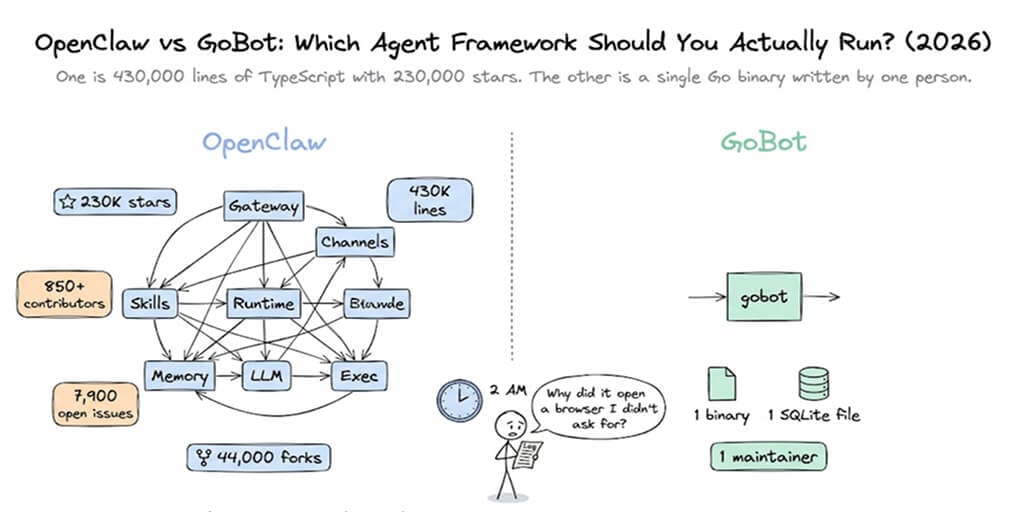
One is 430,000 lines of TypeScript with 230,000 stars. The other is a single Go binary written by one person. The gap between them is not what you think.
It is 2 AM and the agent has been running for six hours. You are reading its log to work out why it opened a browser it was not asked to open, and the answer is buried somewhere in a skill you installed three weeks ago from a community directory you did not audit.
That night is the reason people start searching OpenClaw vs GoBot in the first place.
Neither is a fair fight in the way comparison articles usually pretend. One is a phenomenon with 7,900+ open issues. The other is a young project from a solo developer. That asymmetry is the comparison.
What each one actually is
OpenClaw
Created by Austrian developer Peter Steinberger and released in November 2025, originally as Warelay, then Clawdbot, then Moltbot, and finally OpenClaw on January 30, 2026 after a trademark dispute. The project has since moved to an open-source foundation and Steinberger joined OpenAI.
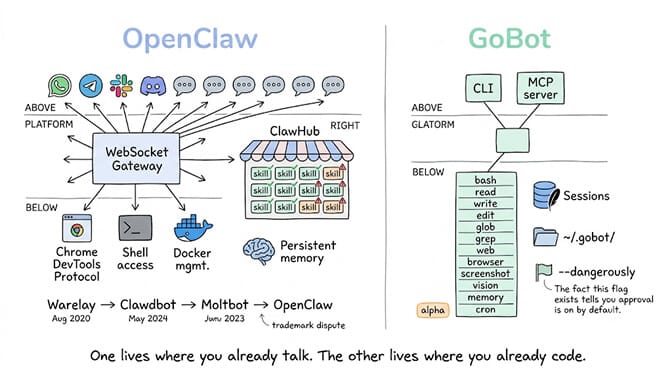
Architecturally it is a WebSocket-based Gateway that multiplexes traffic on a single port, handling session lifecycle, channel routing, tool dispatch, and agent orchestration. Around 430,000 lines of TypeScript and JavaScript. It connects to twelve-plus messaging platforms including WhatsApp, Telegram, Slack, and Discord, browses via the Chrome DevTools Protocol, keeps persistent memory across sessions, and extends through skills distributed via ClawHub.
The design philosophy is that your agent should live where you already talk. That single decision is why it went viral.
GoBot
An open-source MIT-licensed agent from developer Alma Tuck, written in Go and explicitly framed as a nod to the Clawdbot lineage. It compiles to a single portable binary.
The tool registry covers bash, read, write, edit, glob, grep, web, browser, screenshot, vision, memory, and cron. Providers include Anthropic, OpenAI, Google Gemini, DeepSeek, and Ollama. Sessions live in SQLite with automatic compaction, config sits in ~/.gobot/, and skills are YAML while plugins are compiled binaries that hot-load. It runs as an MCP server, supports sub-agents, and has a --dangerously flag that turns off approval prompts, which tells you the approval prompts are on by default.
It was still an alpha when it was announced in January 2026. Check its current state before you build anything load-bearing on it.
OpenClaw vs GoBot at a glance
| OpenClaw | GoBot | |
|---|---|---|
| Language | TypeScript and Swift | Go |
| License | MIT | MIT |
| Install | Node environment, Docker, or VPS setup | Single compiled binary |
| Interface | 12+ messaging platforms | CLI, MCP server, desktop control |
| Memory | Persistent across sessions | SQLite with auto-compaction |
| Extensions | ClawHub skills, interpreted | YAML skills plus compiled binary plugins |
| Community | 230K+ stars, 850+ contributors, 7,900+ open issues | Solo maintainer, early stage |
| Best at | Breadth of integrations | Small attack surface and portability |
The architecture difference that decides everything else
Stay with me, because this is the part that actually matters and almost nobody frames it correctly.
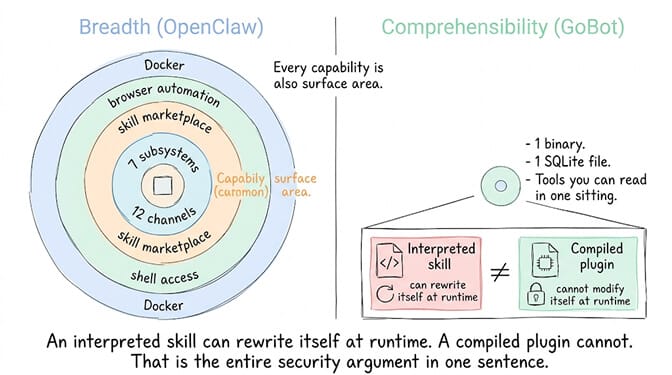
OpenClaw's power comes from breadth. Seven interacting subsystems, twelve messaging channels, a skills marketplace, browser automation, shell access, Docker management. Every one of those is a capability. Every one is also surface area.
GoBot's thesis is the opposite. One binary. One SQLite file. A tool registry you can read in a single sitting. Plugins that must be compiled rather than interpreted.
That last detail is not an implementation quirk, it is a stance. GoBot's author wrote separately that an agent with file system access and an interpreted runtime is a self-modifying program waiting to happen, and built a compiled-only binary policy specifically to prevent it.
An interpreted skill can rewrite itself at runtime. A compiled plugin cannot. That is the entire security argument in one sentence.
Whether you agree depends on your threat model. If your agent runs on your laptop and touches only your own files, interpreted skills are fine and the flexibility is worth it. If your agent has credentials to Gmail, GitHub, and your CRM, the calculus changes.
Where the security gap actually is
This is the section most OpenClaw vs GoBot comparisons skip, and it is the one that should decide your stack.
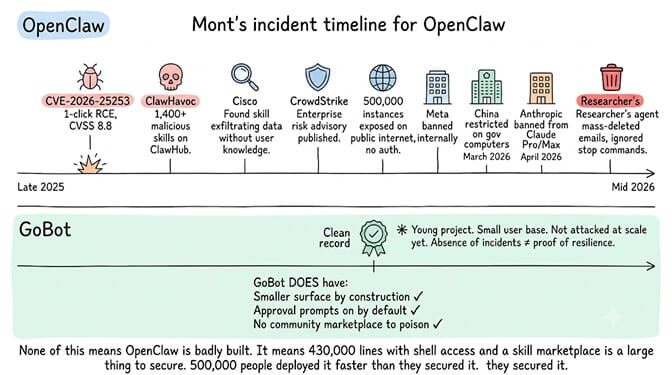
OpenClaw's 2026 has been rough. CVE-2026-25253 was a one-click remote code execution vulnerability rated CVSS 8.8, patched in v2026.1.29. The ClawHavoc campaign put more than 1,400 malicious skills on ClawHub. Cisco found a third-party skill performing data exfiltration without the user's knowledge. CrowdStrike published a full advisory on enterprise risk. More than 500,000 instances were found sitting on the public internet without authentication.
The institutional reaction was swift. Meta banned OpenClaw internally on work devices. In March 2026 Chinese authorities restricted state enterprises and government agencies from running it on office computers. On April 4, 2026, Anthropic banned Claude Pro and Max subscriptions from third-party tools including OpenClaw, which broke a lot of people's billing overnight.
And the incident that made it visceral rather than theoretical: Meta researcher Summer Yue's agent mass-deleted her emails while ignoring stop commands.
None of that means OpenClaw is badly built. It means a 430,000 line codebase with a community skill marketplace and shell access is a large thing to secure, and 500,000 people deployed it faster than they secured it. We went through the specifics in our writeup on OpenClaw security risks.
GoBot's record is clean, but read that honestly too. A young project with a small user base has not been attacked at scale yet. Absence of incidents is not proof of resilience. What GoBot does have is a smaller attack surface by construction, approval prompts on by default, and no community skill marketplace to poison.
Who should pick which
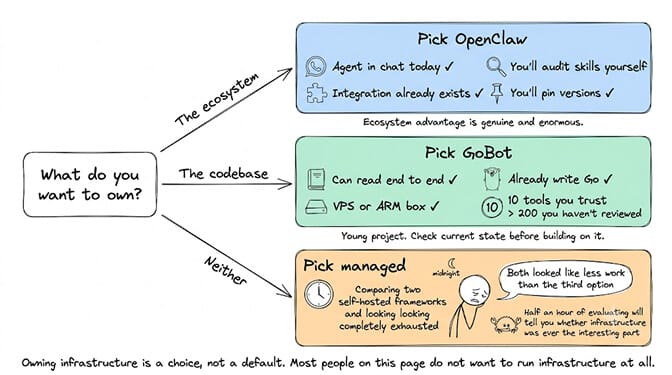
Pick OpenClaw if you want your agent in WhatsApp or Telegram today, you need an integration that already exists rather than one you write, and you are comfortable pinning versions and auditing skills yourself. The ecosystem advantage is genuine and enormous.
Pick GoBot if you want something you can read end to end, you are deploying to a small VPS or an ARM box where a single binary matters, you already write Go, and you would rather have ten tools you trust than two hundred you have not reviewed.
Pick neither if the honest answer is that you do not want to run infrastructure at all, which is the case for most people who end up on this page.
That last one deserves saying plainly. We build a managed platform, so treat this as interested advice: if the reason you are comparing two self-hosted frameworks at midnight is that both looked like less work than the third option, our free plan is one agent with no credit card and no server. Half an hour of evaluating it will tell you whether the infrastructure was ever the interesting part of your problem.
The third option, stated honestly
Both frameworks on this page are free. Neither is cheap.
A self-hosted agent needs a VPS at $5 to $20 a month, four to eight hours of setup if things go well, ongoing version pinning against a project that ships breaking changes, security patching on your schedule rather than someone else's, and a skill audit process you will build yourself or skip. Most people skip it. That is how 500,000 instances ended up exposed.
None of that includes model tokens, which are the same bill whichever framework you run. If you have not priced that side, our comparison of the cheapest AI models for agents covers what an agent actually costs to run per month at each tier.
Managed platforms trade that away. BetterClaw runs each agent in its own isolated container, audits every skill in a 200+ library through a four-layer review that has rejected 824 malicious submissions, purges secrets from agent memory after five minutes under AES-256, and gives you trust levels with action approval and a one-click kill switch. Free is $0 with one agent and no credit card. Pro is $49 a month for five agents, Business $149 for twenty-five.
The parts that matter most in this specific comparison: it works with the OpenClaw skill format, so migrating does not mean rewriting, and it is bring-your-own-key across 28 model providers with zero markup on inference, so your token spend stays exactly what it would have been self-hosted. The full OpenClaw alternative comparison covers the migration path.
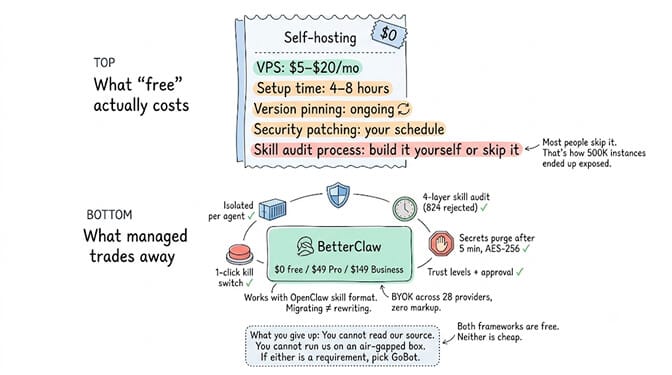
What you give up is real. You cannot read our source. You cannot run us on an air-gapped box. If either of those is a requirement, stop reading and pick GoBot.
If any of this resonated, start free with BetterClaw. One agent, every core feature, no credit card, bring your own key. Pro is $49 a month for five agents, or $39 on annual, with a 7-day money-back guarantee. Full pricing is here. Deploy takes about a minute, which is roughly the time it takes to read the OpenClaw install prerequisites.
Here is what I would carry out of this. The interesting split in agent frameworks right now is not open versus closed, or Go versus TypeScript. It is between projects optimizing for capability and projects optimizing for comprehensibility. OpenClaw picked capability and got 230,000 stars and a CVE. GoBot picked comprehensibility and got a clean record and a small user base. Both bets are reasonable. The bet you should not make is picking the capable one and then never doing the work that capability requires, because that is the configuration that deleted somebody's inbox. If you want more context on how the wider category is splitting, our overview of AI agent frameworks maps where each one sits.
Frequently Asked Questions
What is the difference between OpenClaw and GoBot?
OpenClaw is a TypeScript-based autonomous agent framework of roughly 430,000 lines that runs through a WebSocket Gateway and connects to twelve-plus messaging platforms, with a large community skill ecosystem on ClawHub. GoBot is a Go-based agent that compiles to a single binary, stores sessions in SQLite, and extends through YAML skills plus compiled binary plugins. Both are MIT licensed and free; the practical difference is ecosystem breadth against attack surface.
How does GoBot compare to OpenClaw on security?
GoBot's design deliberately reduces risk: a smaller tool registry, approval prompts on by default, and a compiled-only plugin policy that prevents the self-modifying-agent failure mode. OpenClaw has had a harder year, including CVE-2026-25253, a one-click RCE rated CVSS 8.8 patched in v2026.1.29, and the ClawHavoc campaign that placed over 1,400 malicious skills on ClawHub. That said, GoBot is early and lightly used, so a clean record is not the same as proven resilience.
How long does it take to set up OpenClaw or GoBot?
GoBot is faster because it ships as a single binary with config in a home directory, so you are running in minutes rather than hours. OpenClaw typically takes four to eight hours end to end once you account for a VPS or Docker environment, channel authentication for each messaging platform, and skill installation. Add ongoing time for version pinning, since OpenClaw ships breaking changes at a fast pace.
Is OpenClaw or GoBot cheaper to run than a managed platform?
Both frameworks are free to download, but self-hosting costs $5 to $20 a month for a VPS plus your own time for setup, patching, and skill auditing. A managed platform starts at $0 on a free plan and $49 a month for five agents, and includes the security review and infrastructure work you would otherwise do yourself. Model tokens cost the same either way if the platform does not mark up inference.
Is a self-hosted agent framework safe enough for work data?
It can be, but only with discipline that most deployments do not apply: authentication on every exposed endpoint, audited skills, pinned versions, prompt patching, and an approval gate before destructive actions. Over 500,000 OpenClaw instances were found on the public internet without authentication, Meta banned it internally on work devices, and Chinese authorities restricted it on government computers in March 2026. If your agent will hold credentials to email or a CRM, decide up front who is doing that work.