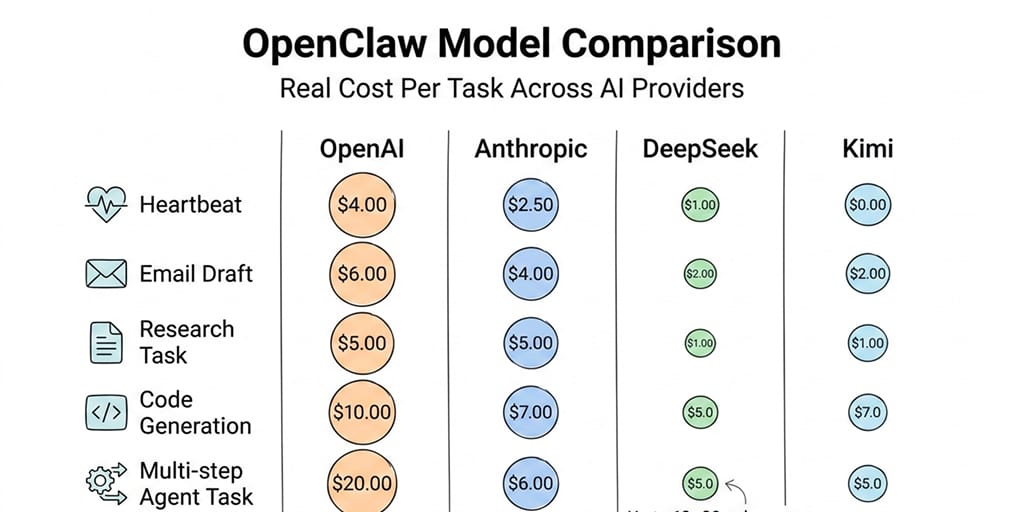
Ten current models, five everyday agent tasks, one config file. The price gap is wider than it was in March.
When we first published this comparison in March 2026, the lineup was GPT-4o, Claude Sonnet 4.6, DeepSeek V3.2 and Kimi K2.5. Every one of those has since been replaced at the top of its provider's list.
The lineup in late September 2026 looks like this: OpenAI shipped GPT-6 Sol and GPT-6 Luna on September 22 (GPT-6 Astra arrived earlier in the month). Anthropic has Opus 5.5 and Sonnet 5. DeepSeek retired V4 Flash and now serves everything through V4.1 Flash. Moonshot has Kimi K3, Z.ai has GLM 5.3, and Alibaba has the Qwen 3.8 family.
What hasn't changed is the lesson from March: the question isn't "which model is best?" It's "which model is best for this specific task at this specific price?"
For an always-on OpenClaw agent that runs dozens of tasks a day, the answer is worth a lot of money. The same monthly workload costs about $51 on Opus 5.5 and about $1.30 on GPT-6 Luna.
Why "best model" is the wrong question for OpenClaw
Most model comparisons rank providers on benchmarks: reasoning scores, coding accuracy, context window size.
Those matter if you're building a coding assistant. They matter much less for an autonomous agent that checks your calendar, triages email, runs scheduled research and fires reminders.
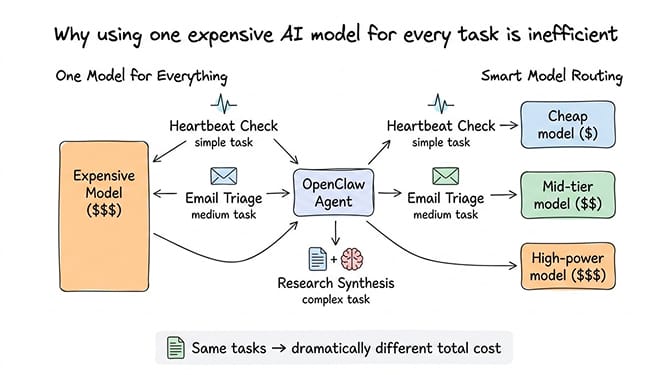
An OpenClaw agent does a mix of work with very different difficulty. A heartbeat (the periodic check-in that runs every 30 minutes by default on API-key auth) needs almost no reasoning. An email triage over 20 messages needs moderate judgment. A multi-step research synthesis needs real reasoning.
Paying the same per-token rate for all three is like paying steak prices for every meal, including breakfast cereal.
For how these costs compound across usage patterns, see our full breakdown of OpenClaw API costs.
The current models worth comparing (September 2026 pricing)
These are list prices per million tokens (input / output), checked on September 28, 2026 against each provider's pricing page or, where noted, the OpenRouter model listing.
| Model | Provider | Input / output per 1M | Context | OpenClaw model ref |
|---|---|---|---|---|
| Claude Opus 5.5 | Anthropic | $4.00 / $20.00 | 1M | anthropic/claude-opus-5-5 |
| Kimi K3 | Moonshot | $3.00 / $15.00 | 1M | moonshot/kimi-k3 |
| Claude Sonnet 5 | Anthropic | $2.00 / $10.00 | 1M | anthropic/claude-sonnet-5 |
| GPT-6 Sol | OpenAI | $2.00 / $10.00 | 1.05M | openai/gpt-6-sol |
| Qwen 3.8 Max | Alibaba | $2.00 / $6.00 | 1M | qwen/qwen3.8-max |
| GLM 5.3 | Z.ai | $1.40 / $4.40 | 1M+ | zai/glm-5.3 |
| Gemini 3.8 Flash | $0.75 / $3.75 | 1M | google/gemini-3.8-flash | |
| DeepSeek V4.1 Flash | DeepSeek | $0.15 / $0.60 off-peak ($0.30 / $1.20 peak) | 1M | deepseek/deepseek-flash |
| MiMo V2.6 Flash | Xiaomi | $0.14 / $0.28 (OpenRouter) | 1M | xiaomi/mimo-v2.6-flash |
| GPT-6 Luna | OpenAI | $0.10 / $0.50 | 1.05M | openai/gpt-6-luna |
A few things worth knowing before you pick:
GPT-6 comes in three sizes. Astra is the flagship at $10 / $50. Sol at $2 / $10 is the one most people should compare against Sonnet. Luna at $0.10 / $0.50 is the cheapest model any frontier lab currently sells.
Sonnet 5 is cheaper than Sonnet 4.6 was. $2 / $10 versus $3 / $15. Sonnet 4.6 is still available at the old price, so check which one your config actually points at.
Kimi is no longer the budget pick. Kimi K2.5 was around $0.45 / $2.25. Kimi K3 is $3 / $15, priced against Sonnet rather than DeepSeek. If price is the deciding factor, our breakdown of the cheapest model for OpenClaw compares the budget tier per task.
DeepSeek has peak and off-peak rates. Peak hours are 01:00–04:00 and 06:00–10:00 UTC, Monday to Friday. Everything else, including weekends, is off-peak at half price. The old deepseek-v4-flash model name still works, but DeepSeek now serves those requests with V4.1 Flash, so use deepseek-flash.
Gemini 3.8 Flash has a price rise scheduled. Google lists $0.75 / $3.75 through December 31, 2026, then $1.50 / $7.50 from January 1, 2027.
Cached input is far cheaper everywhere. Anthropic, OpenAI and Google bill cache reads at 10% of the input price. DeepSeek charges $0.003 per million for an off-peak cache hit on Flash. Agents resend the same system prompt and tool definitions on every turn, so caching matters more than the headline input price.
Cost per task: five common agent operations
We haven't re-run March's 70-run quality test on this generation of models. So instead of claiming new test results, here is the arithmetic: list price multiplied by a typical token profile for each task. It's transparent, you can redo it with your own numbers, and it's where most of the cost difference comes from.
Token profiles used (input / output):
- Heartbeat: 4,000 / 200 tokens, run in an isolated session, 48 times a day
- Morning briefing (calendar + weather + priority emails): 8,000 / 800
- Email triage (categorize and prioritize 20 emails): 15,000 / 1,500
- Parallel research (three sub-agents, each 20,000 / 2,000): 60,000 / 6,000 total
- Document report (analyze a document, extract data, write a report): 40,000 / 4,000
| Model | Heartbeat | Briefing | Email triage | 3-way research | Doc report | Monthly* |
|---|---|---|---|---|---|---|
| Claude Opus 5.5 | $0.020 | $0.048 | $0.090 | $0.36 | $0.24 | ~$51 |
| Kimi K3 | $0.015 | $0.036 | $0.068 | $0.27 | $0.18 | ~$38 |
| Claude Sonnet 5 | $0.010 | $0.024 | $0.045 | $0.18 | $0.12 | ~$25 |
| GPT-6 Sol | $0.010 | $0.024 | $0.045 | $0.18 | $0.12 | ~$25 |
| Qwen 3.8 Max | $0.009 | $0.021 | $0.039 | $0.16 | $0.10 | ~$23 |
| GLM 5.3 | $0.0065 | $0.015 | $0.028 | $0.11 | $0.074 | ~$16 |
| Gemini 3.8 Flash | $0.0038 | $0.009 | $0.017 | $0.068 | $0.045 | ~$9.50 |
| DeepSeek V4.1 Flash (off-peak) | $0.0007 | $0.0017 | $0.0032 | $0.013 | $0.0084 | ~$1.80 |
| MiMo V2.6 Flash | $0.0006 | $0.0013 | $0.0025 | $0.010 | $0.0067 | ~$1.50 |
| GPT-6 Luna | $0.0005 | $0.0012 | $0.0022 | $0.009 | $0.006 | ~$1.30 |
*Monthly = 48 heartbeats a day plus one of each other task a day, for 30 days, at list price with no caching. DeepSeek at peak rates doubles its row.
Heartbeats: the task where the model matters least and costs add up fastest
On Opus 5.5, heartbeats alone come to about $29 a month. On Sonnet 5 or GPT-6 Sol, about $14. On DeepSeek V4.1 Flash, about $1. Every one of those models can confirm "nothing needs attention" equally well.
The bigger lever is session isolation. By default a heartbeat runs in your main session and carries its history. OpenClaw's own docs put a heartbeat at roughly 100K tokens in that mode versus 2-5K with isolatedSession: true. At 100K tokens on Sonnet 5, that's about $0.20 a heartbeat and nearly $290 a month. Isolating the session matters more than which model you pick.
We cover the heartbeat math in detail in hidden OpenClaw costs from heartbeats and token overhead.
Briefings and triage: where mid-tier models earn their place
A daily briefing costs cents on anything in the table. Email triage is where a stronger model starts to pay for itself. In March, the premium model was clearly better at ambiguous subject lines and at telling real urgency from promotional noise. The budget model occasionally filed promotions as important. We'd expect that gap to have narrowed with this generation, but we haven't measured it. If a missed email costs you anything, run triage on Sonnet 5, GPT-6 Sol or GLM 5.3 and compare against a cheap model on a week of your own inbox before switching.
Sub-agents: where costs multiply
Each sub-agent is its own model call with its own context. Three sub-agents cost three times as much. At $0.18 a run on Sonnet 5 versus $0.013 on DeepSeek V4.1 Flash, a daily research job is the difference between about $5.40 and $0.40 a month. Run several a day and the gap grows quickly. Sub-agents usually do narrow, well-specified jobs, which is exactly where cheap models do fine.
Cron jobs and long sessions: the cost trap that ignores your model choice
A job that runs every five minutes executes 288 times a day. If it runs in a session that keeps growing, each run sends more input than the last. That's true on every provider. It's just 20-40x cheaper to be careless on a Flash-class model than on Opus.
OpenClaw has no single "max context tokens" setting. The controls that do exist:
- Run recurring jobs in isolated sessions (the cron equivalent of the heartbeat's
isolatedSession: true) - Enable
agents.defaults.contextPruningwithmode: "cache-ttl"to trim old tool results before each request - Use
/compact(summarize) or/new(fresh session) in chat when a session gets long
Our memory compaction guide explains when compaction triggers and how to control it. If context overflow is killing work mid-task, see the OpenClaw memory fix.
Complex reasoning: the task that justifies a premium model
A long document analysis costs $0.24 on Opus 5.5, $0.12 on Sonnet 5 and under a cent on the Flash-class models. For a report you'll act on, that difference is irrelevant. What matters is whether the report is right.
This is where Opus 5.5, Sonnet 5 and GPT-6 Sol belong. For real agent-task results on the top tier, our GPT-6 Astra vs Fable 5.1 vs Sonnet 5 comparison tests tool calling, cost per task and instruction-following.
What our March test found (and what still holds)
In March we ran seven tasks ten times each on GPT-4o, Claude Sonnet 4.6, DeepSeek V3.2 and Kimi K2.5. Those models are now a generation old, but three findings still shape how we'd set up an agent today.
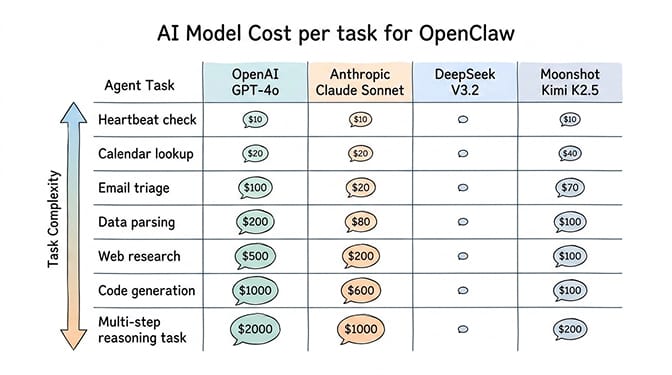
1. On routine tasks, the price gap was far bigger than the quality gap. Briefings from all four models were usable. Only email triage, code generation and the multi-step report showed a clear quality difference.
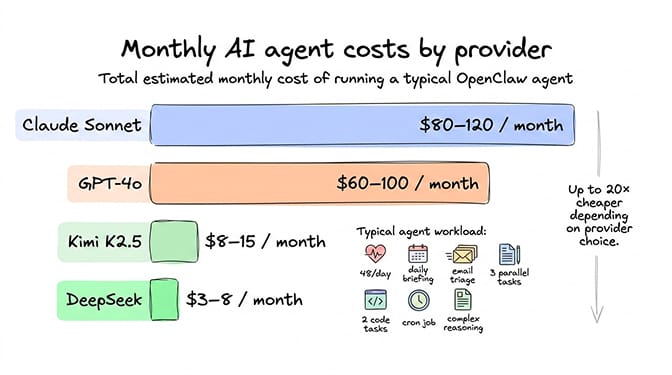
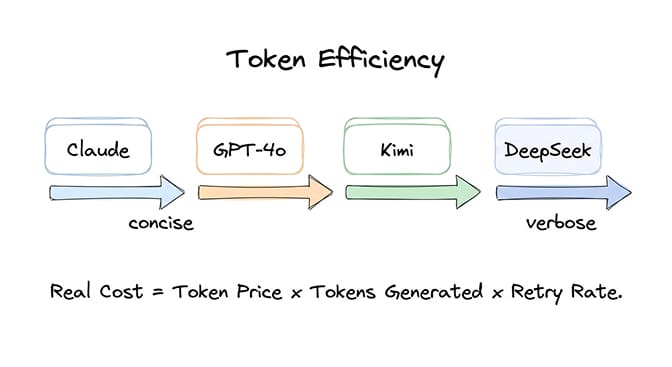
2. The cheapest model per token wasn't always the cheapest per task. DeepSeek V3.2 was the most verbose model we tested and Claude the most concise. Extra output tokens partly offset a low per-token price, and a verbose model fills its context faster, which brings on the long-session cost problem sooner.
3. Uncapped recurring jobs were the biggest cost trap, whatever the provider. That's still true, as the cron section above shows.
Verbosity varies by model version, so don't carry March's numbers over to V4.1 Flash or Sonnet 5. Check the output-token counts in your own provider dashboard after a week of real traffic.
Where each model fits
These are starting points based on price, context and how each vendor positions the model. They aren't new benchmark results.
Claude Opus 5.5 ($4 / $20): complex multi-step work where a wrong answer is expensive. At $4 input it's cheaper than Opus 4.x was ($5), but still the most expensive model in the table.
Claude Sonnet 5 / GPT-6 Sol ($2 / $10): the sensible default primary for an agent that touches your real email, calendar and files. They cost the same, so pick on tool-calling behavior in your own workflows and on which provider you already have limits with. Each makes a good fallback for the other.
Kimi K3 ($3 / $15): Moonshot's flagship, with a 1M-token context, image and video input, and open weights on Hugging Face if you ever want to self-host. At this price, compare it against Sonnet 5, not against the budget tier.
Qwen 3.8 Max ($2 / $6): a cheaper-output alternative to the $10-output tier. The open Qwen 3.8 27B (Apache 2.0) is the family's option for running locally. Read our note on Qwen 3.8 27B tool calls hanging in agents first.
GLM 5.3 ($1.40 / $4.40): the mid-price option, text input only. Z.ai also sells GLM 5.3 Flash at $0.15 / $0.50 for lighter work.
Gemini 3.8 Flash ($0.75 / $3.75): strong value while the 2026 price holds, with a free tier in Google AI Studio for development. For every zero-cost option, see our OpenClaw free models list.
DeepSeek V4.1 Flash, MiMo V2.6 Flash, GPT-6 Luna (roughly $0.10–0.15 input): heartbeats, sub-agents, classification, extraction and anything that runs dozens of times a day. Luna has the lowest input price. MiMo has the lowest output price (its larger sibling is covered in MiMo-V2.6-Pro for AI agents: setup and cost). DeepSeek is cheap off-peak and has open weights under the MIT license.
The smart play: mix models by task type
Here's what most model comparisons skip: you don't have to pick one provider.
OpenClaw lets you set a primary model, an ordered fallback chain, and separate models for heartbeats and sub-agents. The config is JSON5 at ~/.openclaw/openclaw.json:
// ~/.openclaw/openclaw.json
{
  agents: {
    defaults: {
      model: {
        primary: "anthropic/claude-sonnet-5",
        fallbacks: ["openai/gpt-6-sol", "zai/glm-5.3"],
      },
      heartbeat: {
        every: "30m",
        model: "deepseek/deepseek-flash",
        isolatedSession: true, // fresh session per heartbeat, no history
      },
      subagents: {
        model: "deepseek/deepseek-flash",
      },
    },
  },
}
The Gateway watches this file and applies changes automatically. You can make the same changes from the CLI:
openclaw models set anthropic/claude-sonnet-5
openclaw models fallbacks add openai/gpt-6-sol
openclaw models status                         # shows the resolved primary, fallbacks and auth
openclaw config get agents.defaults.model --json
On the workload above, this setup (Sonnet 5 for briefings, triage and reports, DeepSeek V4.1 Flash for heartbeats and research sub-agents) comes to about $7 a month instead of about $25 for Sonnet 5 on everything. Caching brings both numbers down further.
For a quick switch in chat, type /model deepseek/deepseek-flash and /model default to go back. One catch: a model you pick with /model is strict. If that provider goes down, the run fails visibly instead of falling back to your fallback chain. If you want failover to work, clear the pin with /model default.
If you'd rather let a router choose, OpenRouter's openrouter/auto picks a model per request. Our OpenClaw model routing guide covers the trade-offs. And if you want to compare these models side by side in one interface before committing them to a config, a multi-model comparison playground lets you eyeball quality differences first.
If you'd rather not manage config files at all, BetterClaw is a no-code AI agent platform with unlimited skills, bring-your-own-key on every plan and built-in cost tracking. The Free plan gives you 1 agent and 100 credits a month. Pro is $49/month for 5 agents.
For ideas on which workflows justify premium model spend, our guide to the best OpenClaw use cases ranks tasks by complexity and value.
What about security? (It matters more than you think)
Cost and quality aren't the only variables. Where your data goes matters too.
Anthropic (Claude) and OpenAI (GPT-6): US-based, with documented data-usage policies for API traffic. Prompt injection resistance is the property to weigh most heavily when your agent reads untrusted email and web pages. CrowdStrike's security advisory flagged prompt injection as a top risk for OpenClaw deployments.
Google (Gemini): US-based. On the Gemini API, free-tier traffic is used to improve Google's products and paid-tier traffic is not, so keep real business data on a paid key.
DeepSeek, Moonshot (Kimi), Alibaba (Qwen), Z.ai (GLM) and Xiaomi (MiMo): all Chinese companies. For personal automation that's usually fine. For regulated or business-critical data, read each provider's data-processing terms carefully, or run the open-weight versions (DeepSeek V4.1 Flash, Qwen 3.8 27B, Kimi K3, MiMo V2.6 Flash) on infrastructure you control.
For the full security picture, our OpenClaw security risks guide covers the documented incidents from CrowdStrike, Cisco and the ClawHavoc campaign.
My actual recommendation (September 2026)
Here's what I'd set up today for a typical personal or small-business agent:
Primary: Claude Sonnet 5. Direct interactions, email triage and anything that touches real data. At $2 / $10 it costs a third less than the Sonnet 4.6 I recommended in March.
Fallbacks: GPT-6 Sol, then GLM 5.3. Same price tier as Sonnet (Sol) plus a cheaper third option. A rate limit or outage on one provider no longer stalls the agent.
Heartbeats and sub-agents: DeepSeek V4.1 Flash in isolated sessions. Swap in GPT-6 Luna if you'd rather keep everything with US providers.
Occasional heavy lifting: Opus 5.5. Switch with /model for the few tasks that need it, then /model default to hand control back to the fallback chain.
Estimated cost for this setup: single-digit dollars a month in API fees for the workload modeled above, before caching. Heavier use scales roughly linearly from there.
The model market gets cheaper every quarter. Sonnet dropped a third in price this year and a frontier lab now sells a model at $0.10 per million input tokens. Treat today's setup as a starting point and re-check prices when you see a new release. (For how the frontier tier compares on quality, see our GPT vs Claude vs DeepSeek breakdown.)
If your bill keeps climbing on a single provider, try the mixed setup above. It's a five-minute config change and the savings show up in your first billing cycle.
And if you'd rather skip the config file, have a look at BetterClaw. The Free plan is 1 agent with 100 credits a month and BYOK. Pro is $49/month for 5 agents, with a 7-day money-back guarantee. Your first agent deploys in about 60 seconds.
Frequently Asked Questions
What is the best model for OpenClaw in September 2026?
There isn't one best model. Claude Sonnet 5 and GPT-6 Sol ($2 / $10 per million tokens) are the strongest default primaries for agents that handle real data. DeepSeek V4.1 Flash, GPT-6 Luna and MiMo V2.6 Flash cost roughly $0.10-0.15 per million input tokens and are the right choice for heartbeats, sub-agents and high-volume simple tasks. The most cost-effective setup mixes them: a mid-tier primary, a fallback from another provider, and a Flash-class model for automated work.
How does Claude Sonnet 5 compare to GPT-6 Sol for OpenClaw agents?
Both are priced at $2 input / $10 output per million tokens with roughly 1M-token context windows, and both get a 90% discount on cached input. Sonnet 5 is cheaper than Sonnet 4.6 ($3 / $15), which is still available. We haven't run a head-to-head quality test on these two yet, so test both on your own workflows. Since they cost the same, using one as the other's fallback costs nothing extra.
How do I switch AI models in OpenClaw?
Set agents.defaults.model.primary (and optionally fallbacks) in ~/.openclaw/openclaw.json. The Gateway applies config changes automatically. Or run openclaw models set <provider/model> and openclaw models fallbacks add <provider/model>. Check the result with openclaw models status. In chat, /model provider/model switches the current session. Note that a /model pick is strict and won't fall back, so use /model default to return to your configured chain.
How much does it cost to run OpenClaw per month?
For a moderate workload (48 heartbeats a day plus one briefing, triage, research run and report a day), list-price API costs range from about $1.30 a month on GPT-6 Luna to about $51 on Opus 5.5. Sonnet 5 or GPT-6 Sol for everything comes to about $25. A mixed setup with Sonnet 5 as primary and DeepSeek V4.1 Flash for heartbeats and sub-agents comes to about $7. Prompt caching lowers all of these. Running heartbeats in the main session instead of an isolated one can add hundreds of dollars a month.
Is DeepSeek reliable enough for production OpenClaw agents?
DeepSeek V4.1 Flash supports tool calls, JSON output and a 1M-token context, and it costs $0.15 / $0.60 off-peak. It's well suited to heartbeats, sub-agents and non-sensitive routine tasks. Two things to plan around: peak-hour pricing doubles the rate (01:00-04:00 and 06:00-10:00 UTC on weekdays), and the first-party API is run by a Chinese company. For sensitive data, use a US provider or self-host the MIT-licensed open weights.