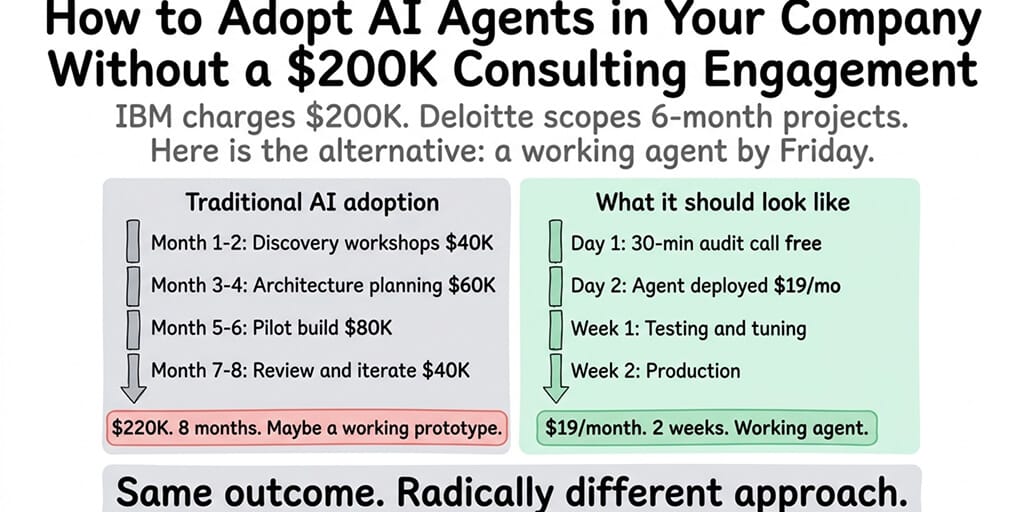
IBM charges $200K. Deloitte scopes 6-month projects. McKinsey says 95% of AI pilots fail. Here's the alternative: a 30-minute audit and a working agent by Friday.
A CTO friend of mine sat through a three-hour "AI readiness workshop" from a Big Four consulting firm. At the end, they presented a slide deck with a 6-month timeline and a $180,000 budget. The deliverable was a "pilot program." Not a working agent. A pilot program. With a steering committee.
He asked one question: "What will the agent actually do?"
The room went quiet. Nobody had defined a specific task. The engagement was about "strategy" and "governance" and "organizational readiness." The agent itself was somewhere in month 5.
This is how most companies adopt AI agents. Slowly. Expensively. Through layers of process that exist to justify the consulting fee, not to get an agent running.
Here's what nobody tells you: you can deploy a working AI agent for your business in a day. Not a prototype. Not a proof of concept. A working agent that handles real tasks on real channels. The consulting industry doesn't want you to know this because it destroys their business model.
Why 95% of AI pilots fail (and it's not the technology)
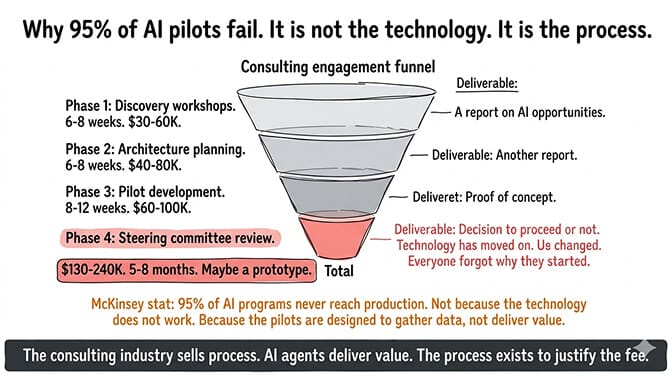
McKinsey's research shows that 95% of AI pilot programs never reach production. Not because the technology doesn't work. Because the pilots are designed to gather data, not deliver value.
The typical AI adoption process:
Phase 1: Discovery workshops. $30-60K. Consultants interview stakeholders. Produce a report on "AI opportunities." Takes 6-8 weeks.
Phase 2: Architecture planning. $40-80K. Technical team designs infrastructure. Evaluates vendors. Produces another report. Takes 6-8 weeks.
Phase 3: Pilot development. $60-100K. Build a proof of concept. Test with a small group. Takes 8-12 weeks.
Phase 4: Review and decision. The steering committee decides whether to proceed. By now, the technology has moved on, the original use case has changed, and everyone's forgotten why they started.
Total: $130-240K. Timeline: 5-8 months. Outcome: maybe a prototype. Maybe not.
Grant Thornton found that 78% of executives can't pass an AI governance audit. Not because they're failing at AI. Because the governance frameworks are designed for $200K projects, not $49/month tools.
The consulting industry sells process. AI agents deliver value. The process exists to justify the fee. The value exists in the first working agent.
The part that sounds too simple (but works)
Here's the alternative. It takes four steps and costs less than your team's weekly coffee budget.
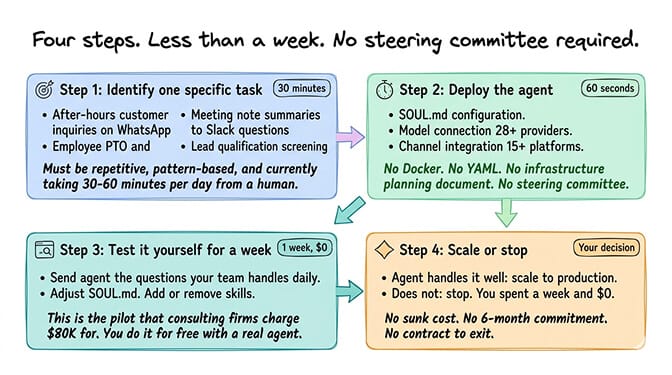
Step 1: Identify one specific, repetitive task (30 minutes)
Not "transform our customer experience." One specific task. Examples:
- Responding to after-hours customer inquiries on WhatsApp
- Summarizing meeting notes and distributing them to Slack channels
- Answering recurring employee questions about PTO policies, benefits, or procedures
- Qualifying inbound leads by asking three screening questions before routing to sales
Each of these tasks has three things in common: they happen repeatedly, they follow a pattern, and a human currently spends 30-60 minutes per day on them. That's your first agent.
For the full list of practical agent use cases, our use cases page covers the scenarios that work best as first deployments.
Step 2: Deploy the agent (60 seconds)
Not 60 days. 60 seconds.
A managed AI agent platform deploys a working agent with a SOUL.md (personality and instructions), model connection (your choice of 28+ providers), and channel integration (Slack, Telegram, WhatsApp, Teams, or any of 15+ platforms). You configure what the agent does. The platform handles where it runs.
No Docker setup. No YAML files. No infrastructure planning document. No architecture review. No steering committee approval. The agent runs on managed infrastructure with Docker-sandboxed execution, AES-256 encryption, and verified skills.
Step 3: Test it yourself for a week (free)
Use the agent internally before exposing it to customers. Send it the questions your team handles daily. See how it responds. Adjust the SOUL.md. Add skills. Remove skills. This is the "pilot" that consulting firms charge $80K for. You're doing it in a week, for free, with a real agent handling real messages.
Step 4: Scale or stop (your decision)
After a week, you know. Either the agent handles the task well (scale it to production) or it doesn't (stop, you've lost a week and $0). No sunk cost fallacy. No 6-month commitment. No contract to exit.
This is the part consulting firms structurally can't offer. Their business model requires commitment before proof. The platform model offers proof before commitment.
The security question (the one your CISO will ask)
Here's where it gets messy.
Your CISO will ask: "Is this safe?" Fair question. AI agents have a documented security problem. OpenClaw (the most popular open-source agent framework, 230,000+ GitHub stars) has accumulated 138+ CVEs in 2026. Microsoft recommended against running it on work machines. CrowdStrike published an enterprise security advisory. 1,400+ malicious skills were found on the community marketplace.
The answer depends on how you deploy. Self-hosted on a developer's laptop? Not safe (that's what Microsoft warned against). On a managed platform with Docker-sandboxed execution, verified skills, and secrets auto-purge? Significantly safer.
For the complete OpenClaw security breakdown, our 2026 security deep-dive covers every CVE, every vendor response, and the specific mitigations.
BetterClaw addresses the three security concerns CISOs care about: skill supply chain (verified marketplace, not community uploads), credential exposure (secrets auto-purge after 5 minutes), and execution isolation (Docker-sandboxed, not running on your corporate network with host privileges). Enterprise plans add SAML SSO and audit logs for compliance requirements.
What this actually costs
Here's the math that makes consulting engagements look absurd.
Option A (consulting firm): $180,000 engagement. 6-month timeline. Deliverable: a pilot program with a steering committee. Agent maybe running by month 5. Ongoing consulting retainer for maintenance.
Option B (platform): $0 for the free tier (1 agent, BYOK). $49/month for Pro. $149/month for Business. Custom pricing for Enterprise with SSO and audit logs. Agent running in 60 seconds. No consulting fee. No retainer. Cancel anytime.
The API cost is the same either way. Whether a consulting firm deploys the agent or you deploy it yourself, the model provider charges the same per-token rate. BYOK means you pay your provider directly. No markup.
For the complete cost breakdown by company size, our pricing page covers what each tier includes.
A consulting firm charges $200K to discover what you already know: which tasks are repetitive and which ones should be automated. A managed platform lets you test that hypothesis in a week for $0. The discovery is the deployment.
When you actually do need a consultant (honest answer)
Here's the honest take.
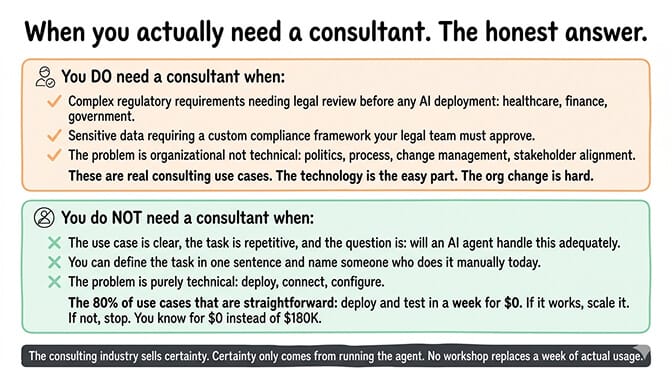
You need a consultant when: your organization has complex regulatory requirements that need legal review before any AI deployment (healthcare, finance, government). When the use case involves sensitive data that requires a custom compliance framework. When the problem is organizational (politics, process, change management), not technical.
You don't need a consultant when: the use case is clear, the task is repetitive, and the question is "will an AI agent handle this adequately." You can answer that question in a week with a free tier agent. If the answer is yes, scale it. If no, stop. Either way, you know for $0 instead of $180K.
The consulting industry is selling certainty. But certainty about whether an agent works only comes from running the agent. No amount of discovery workshops or architecture planning replaces a week of actual usage.
If your organization is considering AI agents but doesn't know where to start, we offer a free AI readiness audit. Not a 6-month consulting engagement. A 30-minute conversation where we identify the highest-impact use cases for your specific operations, share a clear proposal with specific agents and expected outcomes, and if it makes sense, implement it on the BetterClaw platform. No commitment required. No steering committee. No $200K invoice. Just the answer to "where should we start?"
Frequently Asked Questions
What is an AI agent for business?
An AI agent is software that autonomously handles repetitive business tasks on your behalf. It connects to your communication channels (Slack, WhatsApp, Teams, email), processes incoming messages, executes tasks (answering questions, summarizing information, qualifying leads, scheduling), and operates 24/7 without human intervention. Unlike chatbots, agents can use tools, maintain memory across conversations, and take multi-step actions.
How much does it cost to implement AI agents in a company?
Traditional consulting firms charge $130-240K for a 5-8 month engagement that delivers a pilot program. Platform-based deployment costs $0-19/month per agent plus API costs ($5-30/month depending on model and usage). The consulting approach adds process overhead. The platform approach delivers a working agent in 60 seconds. Both answer the same question: does this work? One costs $200K more.
How long does it take to deploy an AI agent for business?
On a managed platform like BetterClaw: 60 seconds for deployment, plus 30-60 minutes for SOUL.md configuration and channel setup. A week of internal testing before production use. Through a consulting firm: 5-8 months from engagement to pilot, with a working agent arriving around month 5. The deployment time difference is structural: platforms deploy, then optimize. Consultants plan, then maybe deploy.
Is it safe to use AI agents in a business environment?
On managed platforms with proper security (Docker-sandboxed execution, verified skills, secrets auto-purge, AES-256 encryption): yes, with appropriate task scoping. On self-hosted setups without security hardening: documented risks include 138+ CVEs, 1,400+ malicious skills, and 500K+ exposed instances. Microsoft, Kaspersky, and CrowdStrike all recommended against unprotected deployment. The security depends entirely on the deployment method.
Do I need a consulting firm to adopt AI agents?
For most use cases, no. If your task is clear, repetitive, and pattern-based (customer support, meeting summaries, lead qualification, employee FAQ), you can deploy and test in a week without external help. You need a consultant when the problem is regulatory compliance, complex organizational change management, or custom integration with legacy systems. For the 80% of use cases that are straightforward, a platform and a 30-minute audit call replaces a 6-month consulting engagement.