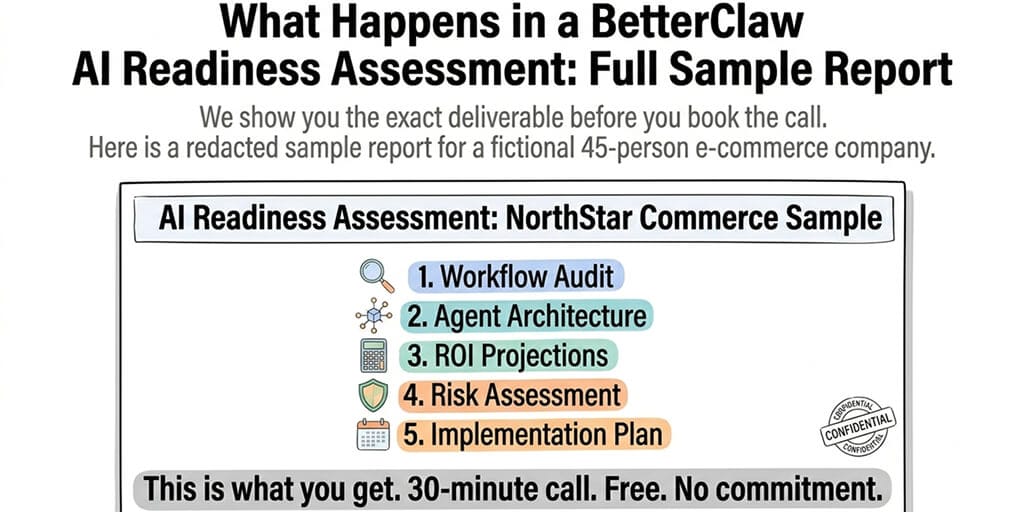
We show you the exact deliverable before you book the call. Here's a redacted sample report for a fictional 45-person e-commerce company.
A VP of Operations at a 45-person e-commerce company booked a call with us last month. She'd seen the AI agent hype. Her CEO was asking about it. She'd gotten a proposal from a consulting firm: $85,000 for a "discovery phase." Eight weeks. Deliverable: a PowerPoint.
She asked us: "What would your assessment actually tell me that theirs wouldn't?"
Fair question. So we showed her the report structure before the call. The same structure we're publishing here. Because the best way to sell an assessment is to show you the deliverable before you commit.
This is a redacted sample report for "NorthStar Commerce," a fictional 45-person e-commerce company. The numbers are realistic. The format is exactly what our assessment produces. If you want this for your company, the assessment is free and takes 30 minutes.
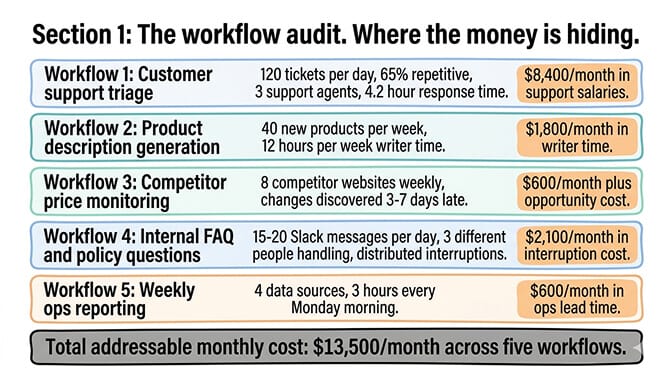
Section 1: The workflow audit (where the money is hiding)
The first thing we do is map your team's repetitive workflows. Not the interesting work. The boring work. The tasks someone does 30+ times per week that follow the same pattern every time.
For NorthStar Commerce, the audit identified five workflows with the highest automation potential.
Workflow 1: Customer support triage. 120 support tickets/day via email and WhatsApp. 65% are order status, return requests, and shipping questions. Currently handled by 3 support agents. Average response time: 4.2 hours. Cost: $8,400/month in support salaries allocated to repetitive tickets.
Workflow 2: Product description generation. 40 new products/week need descriptions, meta tags, and social media copy. Currently handled by a junior copywriter (12 hours/week on product descriptions alone). Cost: $1,800/month in writer time allocated to product copy.
Workflow 3: Competitor price monitoring. Manual weekly check of 8 competitor websites. Currently handled by an analyst (3 hours/week). Changes discovered 3-7 days late. Cost: $600/month + opportunity cost of late price responses.
Workflow 4: Internal FAQ and policy questions. HR and ops receive 15-20 Slack messages per day asking about PTO policy, expense procedures, shipping cutoffs, and return windows. Currently handled by 3 different people across departments. Cost: approximately $2,100/month in distributed interruption cost.
Workflow 5: Weekly ops reporting. Monday morning report compiled from Shopify, Google Analytics, Zendesk, and Slack. Takes 3 hours every Monday. Cost: $600/month in ops lead time.
Total addressable monthly cost: $13,500/month across five workflows.
For the complete list of use cases that work best as first deployments, our use cases page covers the patterns behind each workflow type.
Section 2: The agent architecture (what we'd actually build)
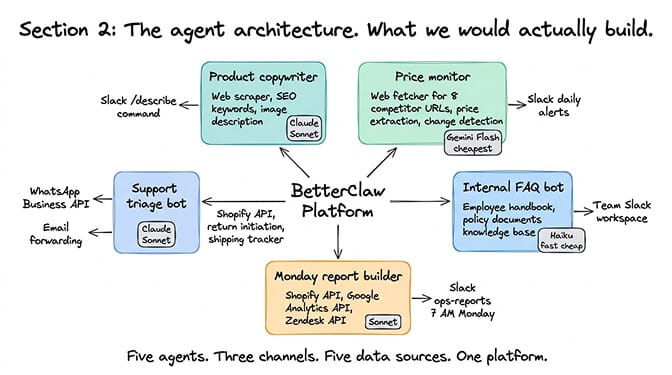
Here's where the assessment gets specific. For each identified workflow, we design the agent: which model, which channel, which skills, and how they connect.
Agent 1: Support triage bot (WhatsApp + email). Model: Claude Sonnet (strong instruction following for support). Channel: WhatsApp Business API + email forwarding. Skills: Order lookup (Shopify API), return initiation, shipping tracker. Behavior: Answers 65% of tickets automatically. Routes complex issues to human agents with full context attached. Expected resolution rate: 60-70% fully automated.
Agent 2: Product copywriter (Slack command). Model: Claude Sonnet. Channel: Slack (triggered by /describe command with product URL). Skills: Web scraper for product specs, image description, SEO keyword integration. Behavior: Generates product description, meta title, meta description, and 3 social media variations. Writer reviews and publishes (2 minutes per product instead of 18).
Agent 3: Price monitor (automated, reports to Slack). Model: Gemini Flash (cheapest for simple comparison tasks). Channel: Slack (daily alert channel). Skills: Web fetcher for 8 competitor URLs, price extraction, change detection. Behavior: Checks all competitors daily at 6 AM. Posts only when changes are detected. Includes old price, new price, and percentage change.
Agent 4: Internal FAQ bot (Slack). Model: Haiku (fast, cheap, sufficient for FAQ). Channel: Team Slack workspace. Skills: Knowledge base search (employee handbook, policy documents). Behavior: Answers PTO, expense, shipping, and return questions instantly. Routes unclear questions to the appropriate department lead.
Agent 5: Monday report builder (scheduled). Model: Sonnet. Channel: Slack (posted to #ops-reports every Monday at 7 AM). Skills: Shopify API, Google Analytics API, Zendesk API. Behavior: Pulls weekly numbers, formats into the existing report template, posts automatically.
Section 3: The ROI projections (the table that sells itself)
Here's the part the VP of Operations actually cared about.
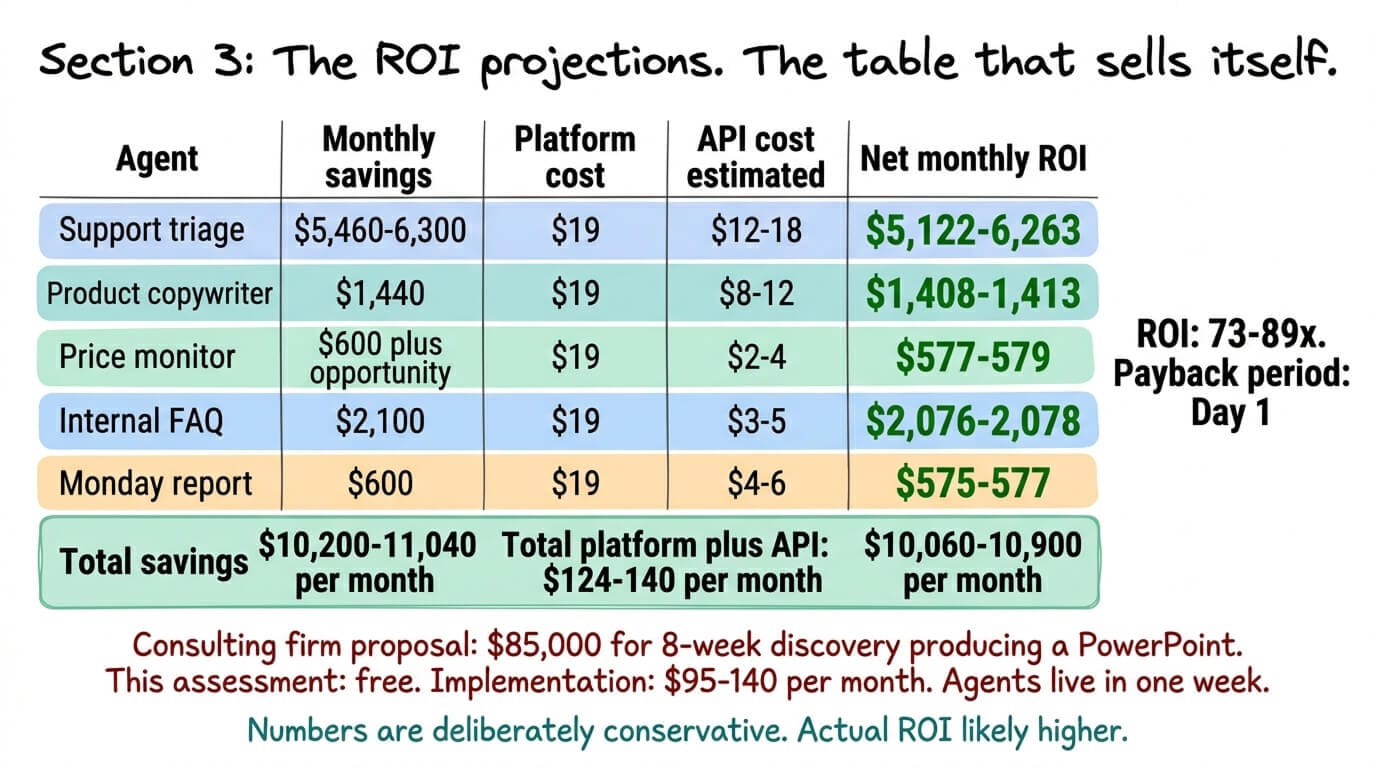
Monthly cost breakdown for NorthStar Commerce:
| Agent | Monthly Savings | Platform Cost | API Cost (est.) | Net Monthly ROI |
|---|---|---|---|---|
| Support triage | $5,460-6,300 | Included | $12-18 | $5,442-6,288 |
| Product copywriter | $1,440 | Included | $8-12 | $1,428-1,432 |
| Price monitor | $600 + opportunity value | Included | $2-4 | $596-598 |
| Internal FAQ | $2,100 | Included | $3-5 | $2,095-2,097 |
| Monday report | $600 | Included | $4-6 | $594-596 |
| Total | $10,200-11,040 | $49 | $29-45 | $10,106-10,962 |
All five agents run on a single $49/month Pro plan, which includes 5 agents.
Payback period: Day 1. Total platform + API cost: $78-94/month. Total savings: $10,200-11,040/month. ROI: 108-142x.
For comparison: the consulting firm's proposal was $85,000 for an 8-week discovery phase that would produce a PowerPoint recommending something similar. The assessment we're describing here is free. The implementation costs $78-94/month. The agents are live in a week.
The ROI table is deliberately conservative. Support triage savings assume 65% automation (not 80%+). Product copy savings assume review time (not full automation). Competitor monitoring doesn't quantify the value of faster price response. The actual ROI is likely higher.
If this type of assessment sounds like what your team needs, it's free. 30-minute call. We map your workflows, design the agent architecture, and produce the ROI projections. No commitment. No consulting fee. If the numbers make sense for your organization, we implement on the BetterClaw platform. A Pro plan is $49/month and covers up to 5 agents. If they don't, you keep the report.
Section 4: The risk assessment (the part most assessments skip)
Here's what nobody tells you about AI readiness assessments.
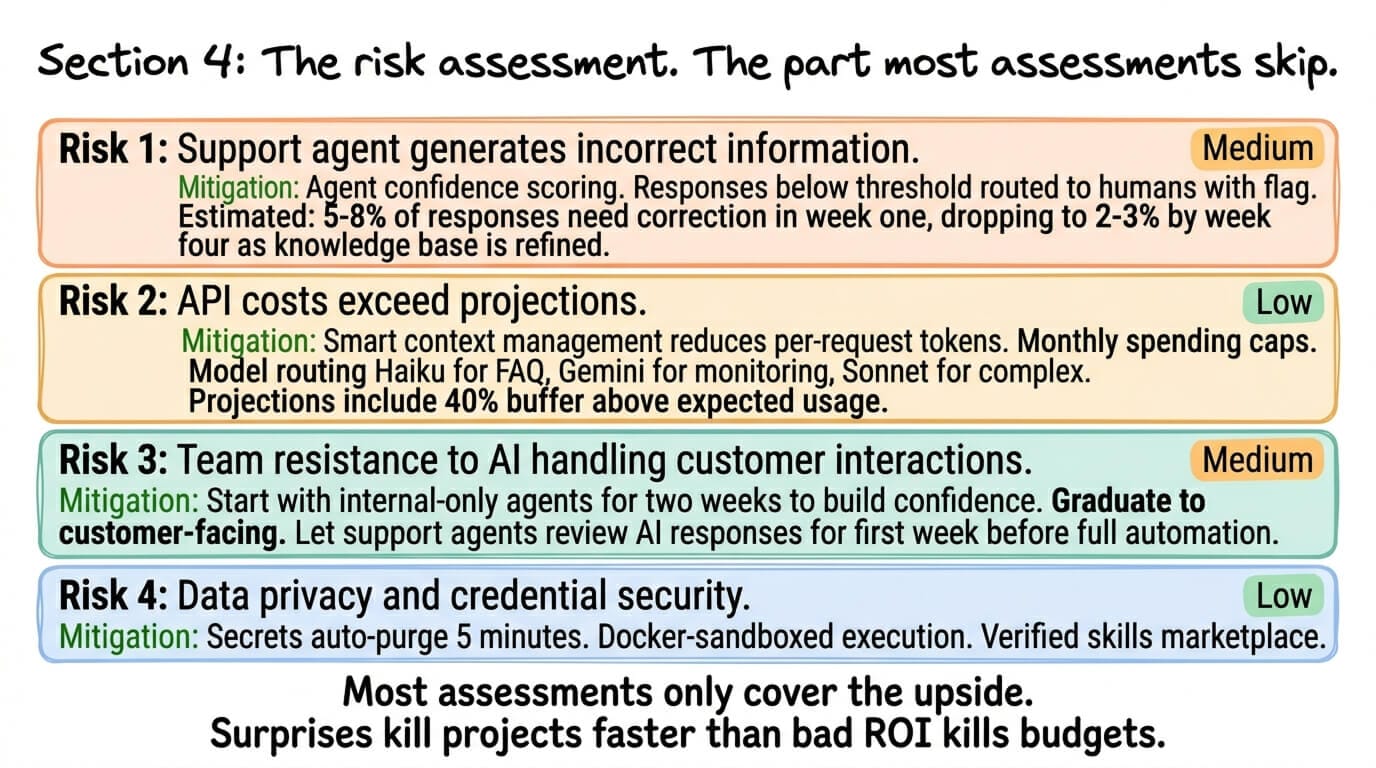
Most assessments only cover the upside. We include the risks because surprises kill projects faster than bad ROI kills budgets.
Risk 1: Support agent generates incorrect information. Mitigation: Agent confidence scoring. Responses below confidence threshold get routed to humans with a flag. Weekly review of flagged responses to identify knowledge gaps. Estimated occurrence: 5-8% of automated responses need correction in week 1, dropping to 2-3% by week 4 as the knowledge base is refined.
Risk 2: API costs exceed projections. Mitigation: Smart context management reduces per-request token volume. Monthly spending caps on all providers. Model routing (Haiku for FAQ, Gemini for monitoring, Sonnet for complex tasks). Estimated risk: low. The projections include 40% buffer above expected usage.
Risk 3: Team resistance to AI handling customer interactions. Mitigation: Start with internal-only agents (FAQ bot, report builder) to build confidence. Graduate to customer-facing (support triage) after 2 weeks of internal validation. Let support agents review AI responses for the first week before enabling full automation.
Risk 4: Data privacy and credential security. Mitigation: BetterClaw's secrets auto-purge erases credentials from agent memory after 5 minutes. Docker-sandboxed execution prevents skills from accessing host systems. Verified skills marketplace eliminates supply chain risk. For the complete security picture, our security guide covers every protection layer.
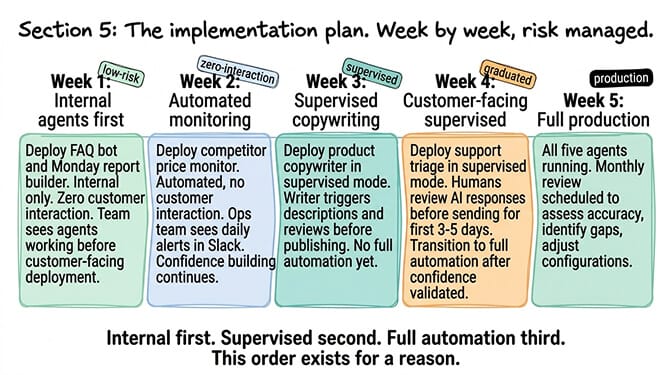
Section 5: The implementation plan (week by week)
Week 1: Deploy agents 4 and 5 (internal FAQ bot and Monday report). These are internal-only, low-risk, and immediately useful. The team sees AI agents working before any customer-facing deployment.
Week 2: Deploy agent 3 (competitor price monitor). Automated, no customer interaction. The ops team sees daily competitor alerts in Slack.
Week 3: Deploy agent 2 (product copywriter) in supervised mode. Writer triggers descriptions and reviews before publishing. No full automation yet.
Week 4: Deploy agent 1 (support triage) in supervised mode. Human reviews AI responses before sending for the first 3-5 days. Transition to full automation after confidence is validated.
Week 5: All five agents running in production. Monthly review scheduled to assess accuracy, identify gaps, and adjust configurations.
For the customer support use case details, our support use case page covers the specific channel configurations and skill setups.
What the assessment actually costs (nothing)
Here's the honest take.
The assessment is free because the conversation is worth more to us than the fee. Every company that goes through the assessment either becomes a customer (the ROI makes it obvious) or doesn't (the use case wasn't a fit). Either way, we learn what businesses actually need, which makes our product better.
The consulting industry charges $50K-200K for assessments because the assessment IS their product. Our product is the platform. The assessment is how you discover whether the platform fits.
McKinsey says 95% of AI pilots fail. Grant Thornton says 78% of executives can't pass an AI governance audit. The failure rate isn't because the technology is bad. It's because the pilot process is designed to gather data, not deliver value. Our assessment skips the gathering and goes straight to "here are five agents, here's what they cost, here's the ROI, do you want to deploy them."
If your organization is exploring AI agents and you want the same report we showed above, customized for your specific operations, book the free AI readiness assessment. 30-minute call. We identify the highest-impact workflows, design the agent architecture, and produce the ROI table. No commitment required. No consulting fee. The deliverable is yours regardless of whether you become a customer.
Frequently Asked Questions
What is an AI readiness assessment?
An AI readiness assessment identifies which business workflows can be automated with AI agents, designs the specific agent architecture for each workflow, and projects the ROI with specific dollar savings. BetterClaw's assessment is free, takes 30 minutes, and produces a deliverable with five sections: workflow audit, agent architecture, ROI projections, risk assessment, and implementation plan.
How long does the BetterClaw AI readiness assessment take?
The initial call takes 30 minutes. We ask about your team's repetitive workflows, communication channels, and current tools. The report is delivered within 48 hours with specific agent designs, cost projections, and an implementation timeline. Total time investment on your side: 30 minutes for the call plus 15 minutes to review the report.
How much does an AI readiness assessment cost?
BetterClaw's assessment is free. No consulting fee. No commitment required. The report is yours regardless of whether you deploy on the platform. If you choose to implement, a Pro plan is $49/month and covers up to 5 agents. API costs (BYOK, you pay providers directly) typically run $2-18/month per agent depending on model choice and usage volume.
What makes BetterClaw's assessment different from consulting firm proposals?
Consulting firms charge $50K-200K for discovery phases that produce PowerPoint recommendations over 6-8 weeks. BetterClaw's assessment is free, takes 30 minutes, and produces a specific implementation plan with agent designs and ROI projections. The difference: consultants sell process. We sell a platform. The assessment proves whether the platform fits your needs. If it does, implementation takes days, not months.
Is the AI readiness assessment a sales pitch?
No. The deliverable includes specific workflow analysis, agent architecture, ROI projections, risk assessment, and implementation plan. If the numbers don't make sense for your organization, we'll tell you. Not every business has workflows that benefit from AI agents. The assessment identifies whether yours does. If the answer is no, you'll know in 30 minutes for free instead of $85K and 8 weeks.