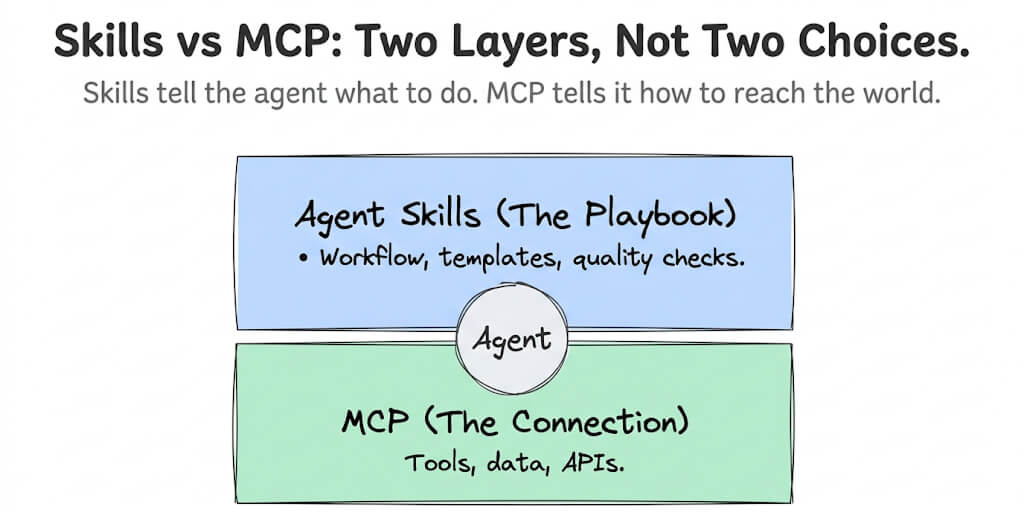
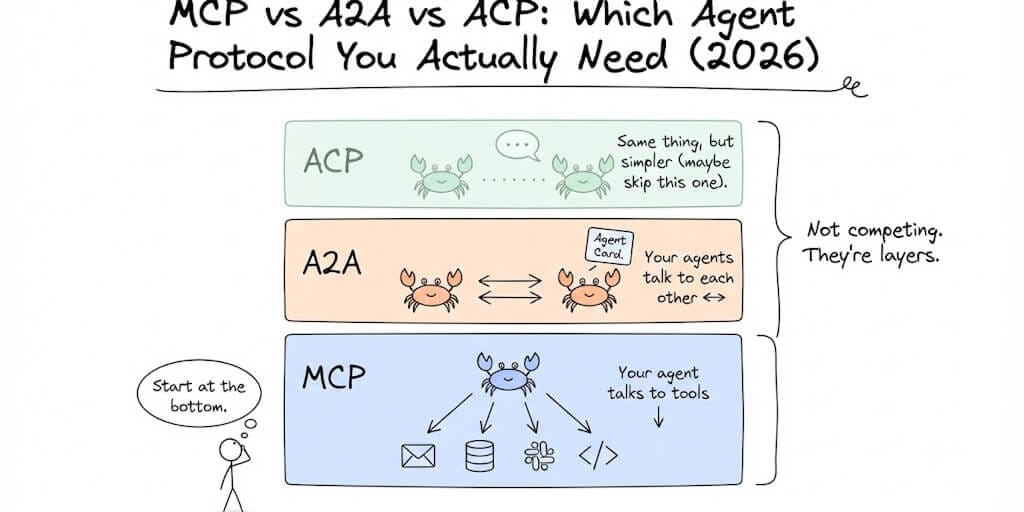
They're not competing. They're layers in a stack. Here's which layer you need first, second, and probably never.
Someone on our team asked a simple question last month: "Do we need to support MCP, A2A, or both?"
We spent forty-five minutes in a meeting debating it before someone said, out loud, what the confusion actually was: we were comparing three protocols as if they competed with each other. They don't. They solve different problems at different layers of the stack, and the question "which one do I need" has a clearer answer than most comparison posts make it sound.
MCP connects your agent to tools. A2A connects your agent to other agents. ACP also connects agents to agents, but simpler. That's it. The rest of this post is the detail behind that sentence, with a verdict on which one you should adopt first, second, and probably never.
Skip the protocol wiring entirely.
BetterClaw ships 25+ one-click integrations and 200+ verified skills with no MCP server configs to write or maintain. Free forever, not a trial. Start free → No credit card · No Docker · No config files
The one-line version of each protocol
MCP (Model Context Protocol): created by Anthropic in November 2024, donated to the Linux Foundation in December 2025. It standardizes how an AI agent connects to external tools, APIs, and data sources. Think of it as USB-C for AI agents: before MCP, every agent-to-tool connection required custom code. MCP hit 97 million monthly SDK downloads by early 2026 and has been adopted by every major AI provider: Anthropic, OpenAI, Google DeepMind, Microsoft, and AWS.
A2A (Agent-to-Agent Protocol): created by Google in April 2025, also donated to the Linux Foundation. It standardizes how agents discover, delegate to, and coordinate with other agents across teams and organizations. In April 2026, A2A reached version 1.0, a stable production standard, shipping alongside signed Agent Cards for verifiable identity, with over 150 organizations running it in production and SDKs across five languages.
ACP (Agent Communication Protocol): community-driven, originally from BeeAI (IBM Research). It also handles agent-to-agent communication, but with a simpler, more lightweight approach. Smaller ecosystem, less enterprise adoption, merged governance with A2A under the Linux Foundation.
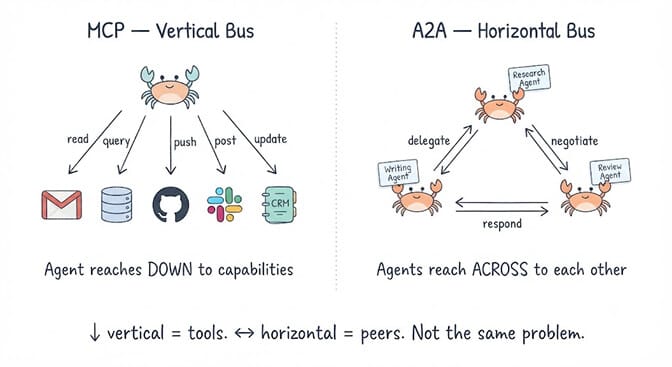
MCP is the vertical bus. A2A is the horizontal bus. ACP is a lighter-weight horizontal bus. You plug into the power strip (MCP), sit at your desk, and call your colleagues (A2A or ACP). None of them replace each other.
MCP vs A2A: the difference that actually matters
This is where most comparison posts get tangled, so here's the cleanest version.
MCP is what your agent uses to do things. Read Gmail. Query a database. Push a commit. Call a Slack API. The agent invokes a tool, the tool returns a result. It's a vertical connection: your agent reaches down to a capability and uses it.
A2A is what your agent uses to work with other agents. Your research agent discovers a summarization agent, delegates a task, and receives the result. The agents negotiate. One might say "I can do this but I need more context." It's a horizontal connection: peer agents coordinate.
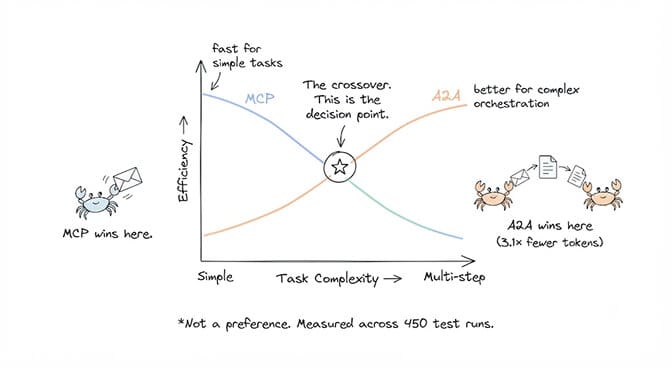
Here's the part most guides skip: they're not just conceptually different, they're empirically different. Peer-reviewed research across 450 test executions found that MCP is statistically faster for simple, single-source queries (p < 0.0001), while A2A consumes 3.1 times fewer tokens for complex multi-source queries, reducing cost by 39 percent.
That's not a preference. That's a measured performance crossover. Simple tasks should go through MCP. Complex, multi-step orchestration where one agent needs to delegate to another should go through A2A. Using A2A for simple tool calls wastes overhead. Using MCP to coordinate multiple agents bloats your context window.
Where ACP fits (and whether it matters to you)
ACP emerged from IBM Research's BeeAI project as a lighter alternative to A2A for agent-to-agent communication. Simpler spec, smaller ecosystem, fewer enterprise features.
Here's the honest verdict: for most teams, MCP is the only protocol that matters immediately. It has critical mass: 10,000 or more servers, universal tool support, and a spec stable enough for production.
A2A matters when you genuinely have multiple agents that need to discover each other and delegate tasks across teams, frameworks, or organizational boundaries. That's a real need, but it's a later-stage need than most projects admit.
ACP is the answer for teams that want simple agent-to-agent messaging without the full A2A ceremony. If your two agents are both in the same codebase and just need to pass messages, ACP's lightweight approach gets you there faster. If your agents need to discover each other across organizational boundaries, authenticate via signed Agent Cards, and negotiate capabilities, that's A2A territory and ACP doesn't cover it.
Adopt A2A when you genuinely have multiple agents that must interoperate across teams, frameworks, or organizations, which is a later stage than most projects admit. Single-agent products dressed as multi-agent systems buy complexity without buying capability.
The adoption numbers that settle the "which first" question
MCP has crossed 97 million monthly SDK downloads (Python plus TypeScript combined). The official registry holds approximately 10,000 server records, with over 15,000 repositories using the mcp-server topic on GitHub. Every major AI provider supports it. Every major agent framework supports it. If something says "we support tool calling," it almost certainly means MCP.
A2A reached version 1.0 in April 2026 with over 150 organizations in production, SDKs across five languages, and native support in LangGraph, CrewAI, LlamaIndex, Semantic Kernel, AutoGen, and Google's ADK. IBM's competing Agent Communication Protocol formally merged into A2A in August 2025, consolidating the agent-to-agent layer rather than fragmenting it.
ACP's adoption numbers are smaller by a significant margin. It's under the Linux Foundation alongside MCP and A2A, which gives it governance credibility, but its ecosystem hasn't reached the density where you'd choose it over A2A for a greenfield project unless you specifically value the simpler spec.
The verdict: start with MCP. Add A2A when you have a genuine multi-agent coordination need. Evaluate ACP only if A2A's complexity exceeds what your use case requires.
What this means if you're building an agent right now
If you're building a single agent that needs to read email, query a database, post to Slack, and update a CRM, MCP is the only protocol you need. The agent connects to each tool through an MCP server, and the protocol handles the standardized interface between the agent and each tool.
If you're building a system where a research agent needs to hand off findings to a writing agent, which then passes a draft to a review agent, A2A is the coordination layer. Each agent publishes an Agent Card describing its capabilities, and the other agents discover and delegate to it.
If you're building one agent and spending time evaluating agent-to-agent protocols, you're solving a problem you don't have yet. That's not a criticism. It's the most common misallocation of effort we see in the agent-building space. Wrapping your internal capabilities as MCP servers is the highest-return integration work available in 2026.
If the idea of managing MCP servers, writing tool interfaces, and wiring up protocol layers yourself sounds like the wrong use of your time, that's basically why BetterClaw exists. We built a visual agent builder that handles the protocol layer for you: 25+ one-click OAuth integrations, 200+ verified skills, and 28+ AI model providers, all connected through the platform without you writing MCP server configs or tool schemas. Free plan, no credit card, 60-second deploy.
The security question nobody is asking loudly enough
Here's the part of this protocol conversation that matters more than the comparison table, and it's the part most comparison posts skip entirely.
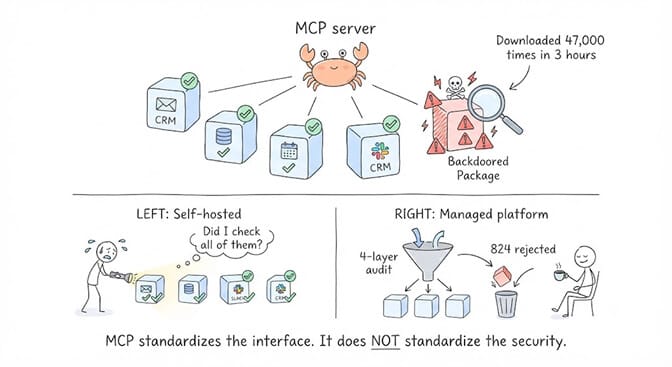
The April 2026 ecosystem conversation has shifted from "what is MCP?" to "how do we ship it without making a mess." And the mess is real. A compromised LiteLLM package on PyPI in March 2026, sitting for three hours, was downloaded 47,000 times, and it served as the language-model gateway for CrewAI, DSPy, Microsoft GraphRAG, and dozens of other agent frameworks.
MCP servers are the new npm packages. They're the new attack surface. Every MCP server your agent connects to is a trust boundary, and every tool it exposes is a potential vector for prompt injection, data exfiltration, or unauthorized action. The protocol standardizes the interface. It does not standardize the security. That's still your job, or the job of whatever platform you're running on.
On BetterClaw, this is why we run a 4-layer security audit on every skill, which has already rejected 824 malicious ones. On raw self-hosted setups, you're vetting each MCP server the same way you'd vet a third-party npm package before putting it in a production codebase. Which is to say: most teams don't do it thoroughly enough. For more on how these security controls work in practice, our production agent guardrails guide covers the seven controls that matter most.
Here's the decision tree
Worth screenshotting.
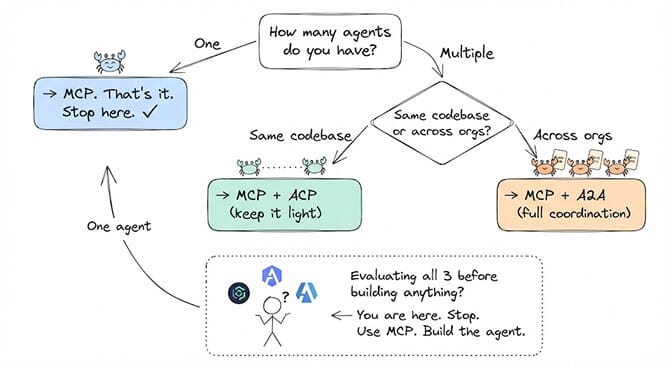
Do you have one agent that needs to connect to external tools? → MCP. That's all you need right now.
Do you have multiple agents that need to coordinate across teams or organizations? → MCP for tools, plus A2A for agent-to-agent coordination.
Do you have two agents in the same codebase that just need to pass messages? → MCP for tools, plus ACP for lightweight inter-agent messaging. A2A is overkill here.
Do you have one agent and you're evaluating all three protocols? → Stop. Use MCP. Build the agent. Add protocols when the need arrives, not before.
The takeaway worth keeping
These three protocols are going to merge and mature over the next year. All three are under the Linux Foundation. A2A absorbed ACP governance. The boundaries will blur. New protocols will emerge for payments (AP2), web browsing (WebMCP), and semantic meaning (OSI).
But the principle underneath won't change: start with the layer closest to your actual problem, and don't adopt the next layer until the current one is genuinely running in production.
For most teams in July 2026, that means MCP first, A2A later, ACP maybe never. And whichever protocol layer your agent runs on, the agent itself still needs the same fundamentals: a clear SOUL.md and AGENTS.md configuration, token-efficient context management, and guardrails that hold in production.
If you'd rather have the protocol wiring handled for you while you focus on what the agent actually does, give BetterClaw a try. Free plan with one agent, every feature, and 500 credits a month. $49 a month for Pro when you need 5 agents and 12,000 credits. 25+ integrations already wired, no MCP server setup required. Your first deploy takes about 60 seconds. We handle the plumbing. You handle the decisions.
Frequently Asked Questions
What is the difference between MCP, A2A, and ACP?
MCP connects agents to tools (Gmail, databases, APIs). A2A connects agents to other agents across teams and organizations. ACP also connects agents to agents but with a simpler, lighter-weight spec. They're layers in a stack, not competitors, and most teams only need MCP to start.
How does MCP compare to A2A for AI agents?
MCP handles the vertical connection between an agent and its tools, while A2A handles the horizontal connection between peer agents. Empirical research shows MCP is faster for simple, single-source queries, while A2A uses 3.1 times fewer tokens for complex multi-agent orchestration. Use MCP for tool access. Add A2A when you genuinely need agent-to-agent coordination.
Which agent protocol should I adopt first in 2026?
MCP, without question. It has 97 million monthly SDK downloads, approximately 10,000 registered servers, and adoption from every major AI provider. It's the highest-return integration work available right now. Add A2A when you have a real multi-agent coordination need, typically at a later stage than most projects reach.
How much does it cost to implement MCP or A2A?
The protocols themselves are open source and free. The cost is in implementation and maintenance: writing MCP server configurations, vetting tool security, and handling protocol upgrades. On a managed platform like BetterClaw, 25+ integrations come pre-wired starting at $0 on the free plan, with no MCP server setup required.
Is MCP secure enough for production AI agents?
MCP standardizes the interface but not the security. Every MCP server your agent connects to is a trust boundary that needs vetting. In March 2026, a backdoored LiteLLM package was downloaded 47,000 times in three hours, illustrating the real risk. Production use requires input sanitization, tool-level permissions, and a security audit process for every server you connect.