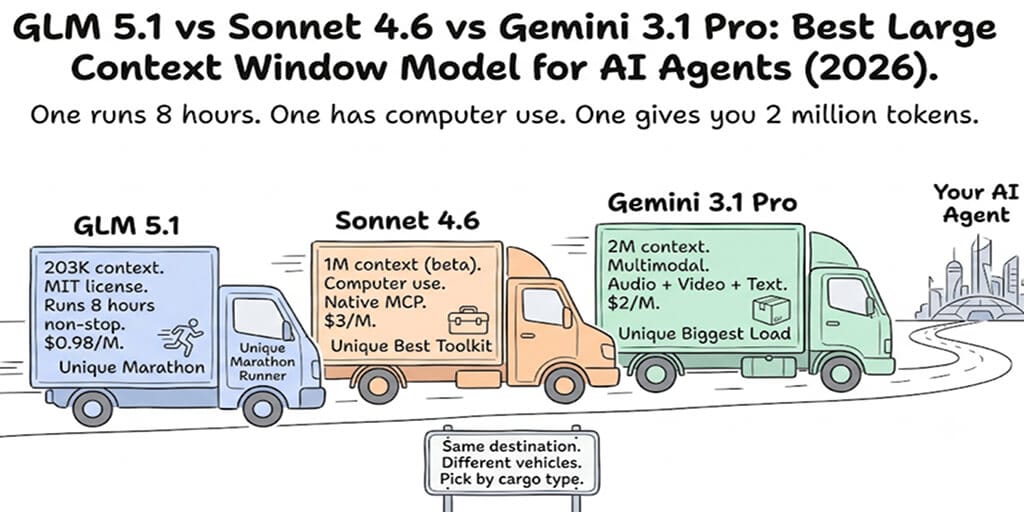
Three frontier models, three different approaches to long context. One runs for 8 hours straight. One has native computer use. One gives you 2 million tokens. Here's which one fits your agent.
We loaded a 400,000-token codebase into three different models and asked each one to find a race condition in the authentication layer.
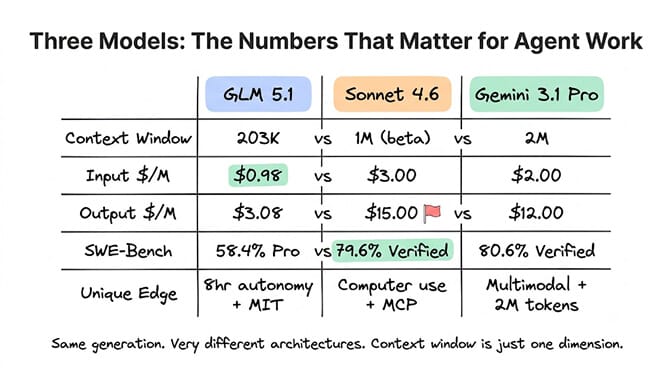
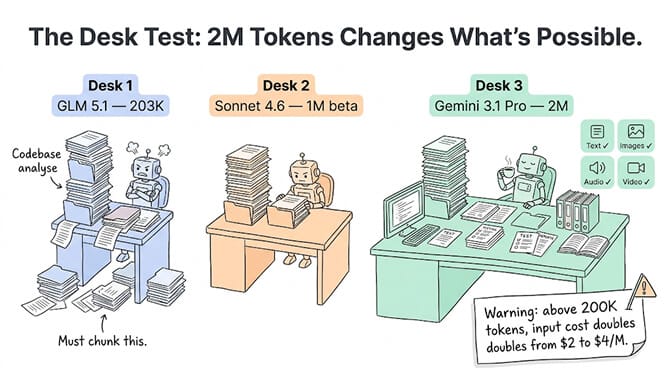
Gemini 3.1 Pro handled it without flinching. The 2M-token window swallowed the entire codebase with room to spare. Sonnet 4.6 required the 1M beta context, which worked but added latency. GLM 5.1 couldn't fit the full codebase in its 203K window at all. We had to chunk it.
But here's what the context window numbers don't tell you. When we gave GLM 5.1 the relevant files (about 50K tokens), it found the bug and proposed a fix that was architecturally cleaner than what the other two suggested. Sometimes the best large context window model isn't the one with the biggest window. It's the one that reasons best over what's in it.
If you are wondering what the "G" in GLM means, it is General Language Model — a brand now, not a separate architecture.
The specs, straight up
GLM 5.1 from Z.AI. April 2026. Context: 203K tokens. Architecture: ~754B/~42B active MoE. MIT license. SWE-Bench Pro: 58.4%. Can work autonomously for up to 8 hours on complex tasks. Pricing: $0.98/$3.08 per million tokens, with blended rates as low as $0.74 via providers like DeepInfra. Text only.
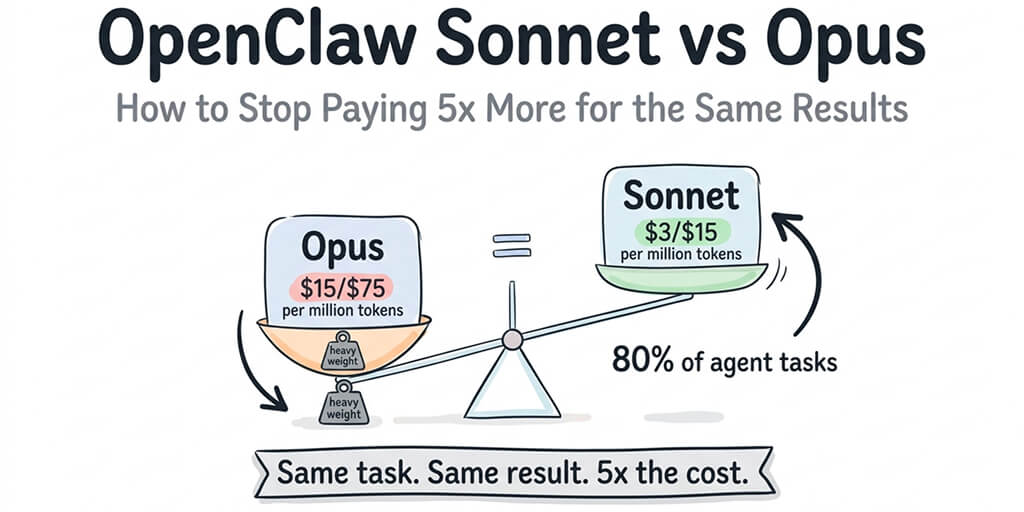
Claude Sonnet 4.6 from Anthropic. February 2026. Context: 200K standard, 1M in beta. SWE-bench Verified: 79.6%. OSWorld-Verified: 72.5%. Native MCP support, computer use, extended thinking. Pricing: $3/$15 per million tokens.
Gemini 3.1 Pro from Google. February 2026 (preview). Context: 1M standard, 2M available. SWE-bench Verified: 80.6%. GPQA Diamond: 94.3%. Native multimodal (text, image, audio, video). Thinking levels (low to max). Pricing: $2/$12 per million tokens under 200K context, $4/$18 above 200K. Still in preview, no GA date confirmed.
GLM 5.1: the smallest window, the longest stamina
GLM 5.1's context window is the smallest of the three at 203K tokens. For agents processing full codebases or long document sets in a single pass, that's a limitation.
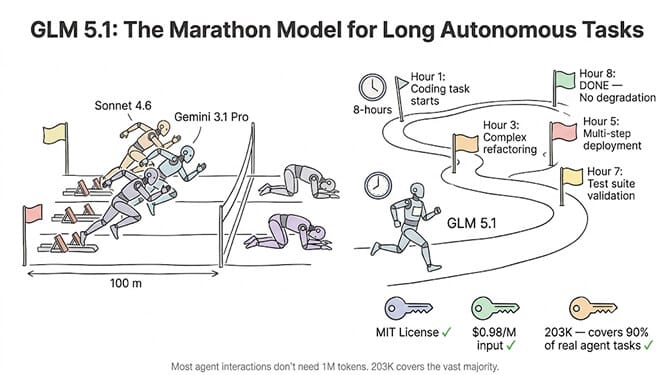
But here's what nobody tells you about large context windows: most agent interactions don't need a million tokens. A support triage agent processes one ticket at a time (maybe 2,000 tokens). A code review agent looks at one diff (5,000 to 50,000 tokens). A research agent processes one document (10,000 to 100,000 tokens). 203K covers the vast majority of real agent workloads.
Where GLM 5.1 genuinely differentiates is sustained autonomous execution. Z.AI demonstrated it running continuously for 8 hours on complex coding tasks without degradation. For overnight batch processing, multi-step deployment pipelines, or research tasks that require hours of sequential reasoning, that autonomy duration matters more than context window size.
The MIT license is the most permissive of the three. Download it, host it, build commercial products with it. No restrictions.
And the pricing is the lowest by a wide margin. $0.98 per million input tokens (or as low as $0.74 blended). Output at $3.08. For high-volume agent workloads, GLM 5.1 costs 50 to 80% less than the other two models.
For the full breakdown of how GLM 5.1 compares to MiniMax M3, see our MiniMax M3 vs GLM 5.1 comparison for agents.
Sonnet 4.6: the best agent toolkit
Sonnet 4.6's 1M-token context (in beta) puts it in the same class as Gemini 3.1 Pro on raw window size. But what makes Sonnet stand out for agents isn't the context window. It's everything else.
Computer use at 72.5% OSWorld-Verified means Sonnet 4.6 can operate GUIs, fill forms, interact with desktop applications. Neither GLM 5.1 nor Gemini 3.1 Pro offers this at the same level. If your agent needs to interact with software that doesn't have an API, Sonnet is the only option here.
MCP (Model Context Protocol) support is native. Sonnet 4.6 scored 61.3% on MCP-Atlas, giving your agent standardized connections to CRMs, databases, file systems, and third-party APIs. For multi-tool agent workflows, this reduces integration complexity.
Extended thinking with adaptive effort automatically adjusts reasoning depth based on task complexity. Simple queries get fast responses. Complex reasoning chains get deeper processing. You don't have to configure thinking levels manually.
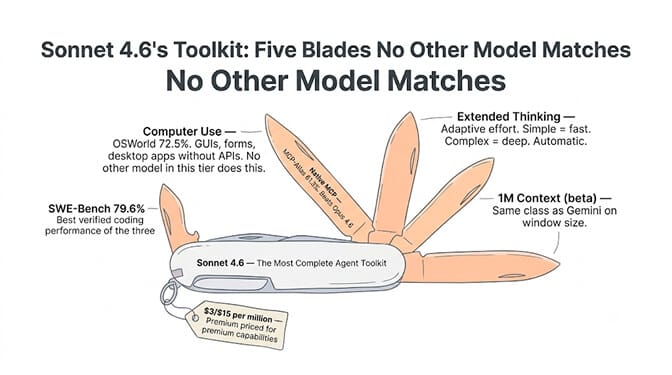
The tradeoff is cost. $3/$15 per million tokens makes Sonnet 4.6 the most expensive of the three on input and significantly more expensive on output ($15 vs $3.08 for GLM 5.1 and $12 for Gemini). For a detailed comparison of Sonnet 4.6 against Qwen 3.7 (another strong agent model), check our Qwen 3.7 vs Sonnet 4.6 comparison.
Gemini 3.1 Pro: the biggest window, the broadest input
Gemini 3.1 Pro has the largest context window of any frontier model: 2 million tokens with long-context pricing enabled. That's 10x GLM 5.1 and 2x Sonnet 4.6's beta window.
For agents that genuinely need to process massive amounts of information in a single pass, nothing else comes close. An entire 500-page legal contract plus 50 supporting documents. A full codebase plus its test suite plus its documentation. 20 research papers simultaneously. These use cases are real, and only Gemini's 2M window handles them without chunking.
Native multimodal input (text, image, audio, video) means your agent can process screenshots, audio recordings, video walkthroughs, and documents in the same request. Neither GLM 5.1 (text-only) nor Sonnet 4.6 (text and images, limited video) matches this breadth.
Thinking levels (low, medium, high, max) give you explicit cost control. Simple classification tasks run at low thinking (fast, cheap). Complex reasoning runs at high or max (slower, expensive). This is a useful lever for agent workloads where task complexity varies.
The 2M context window is Gemini's unique advantage. But it comes with a pricing catch: above 200K tokens, input costs double from $2 to $4 per million, and output jumps from $12 to $18.
That tiered pricing means the first 200K tokens of context are cheap, but going deep into the 2M range gets expensive fast. For an agent that routinely sends 500K-token prompts, the effective cost is higher than the headline $2/$12 suggests.
And Gemini 3.1 Pro is still in preview. No confirmed GA date, no production SLA. For enterprises that need contractual reliability guarantees, the preview status is a real consideration.
The cost comparison that matters
BetterClaw supports all three models via BYOK with zero inference markup. You pay providers directly. We don't take a cut. That means the model pricing comparison is the only cost comparison that matters for the inference layer. Free plan, $49/month for Pro. Pricing here.
For a typical agent processing 500 interactions per day at 10,000 input tokens and 2,000 output tokens each:
GLM 5.1 (Z.AI): ~$175/month. The cheapest by far.
Gemini 3.1 Pro (under 200K context): ~$460/month. Mid-tier pricing.
Sonnet 4.6: ~$540/month. The most expensive.
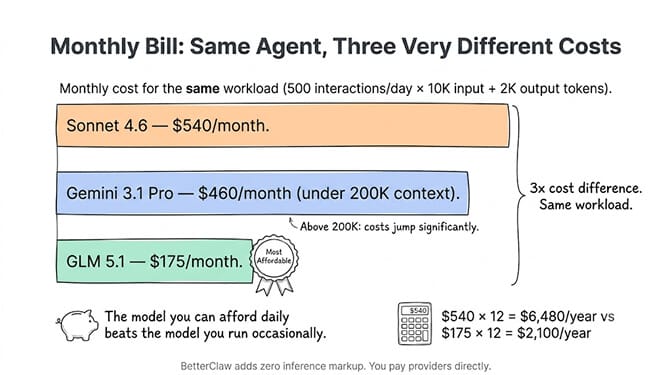
The model you can afford to run every day is worth more than the model you can afford to run occasionally. GLM 5.1's pricing makes it the most sustainable choice for high-volume agents.
Gartner projects 40% of enterprise applications will embed AI agents by end of 2026. McKinsey estimates $2.6 to $4.4 trillion in addressable value. At those deployment scales, the difference between $0.98 and $3 per million input tokens isn't academic. It's the difference between a profitable agent product and one that bleeds money.
Our recommendation
Choose GLM 5.1 if: Cost is your primary constraint. Your agent handles tasks within a 200K context window (most do). You need long-running autonomous execution. You want MIT-licensed open weights for self-hosting flexibility.
Choose Sonnet 4.6 if: Your agent needs computer use (GUI interaction). You're building multi-tool workflows with MCP. Coding quality matters most (79.6% SWE-bench). Safety and prompt injection resistance are priorities.
Choose Gemini 3.1 Pro if: Your agent genuinely processes massive documents or codebases (500K+ tokens). You need native multimodal input (audio, video). You want configurable thinking levels for cost optimization. You're already in the GCP ecosystem.
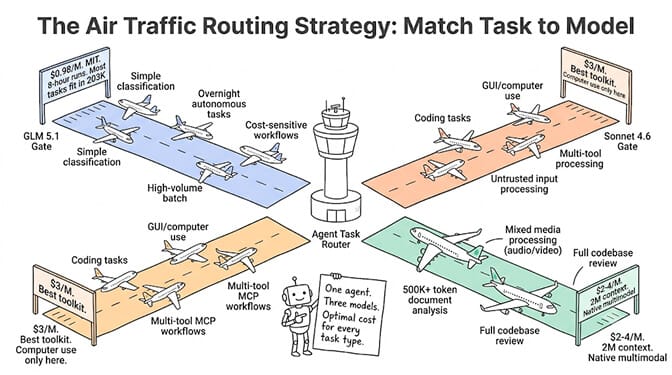
The smart play: route between them. BetterClaw's multi-provider BYOK lets you configure all three and route tasks to the best-fit model. Simple classification goes to GLM 5.1 (cheapest). Coding goes to Sonnet 4.6 (best SWE-bench). Document analysis with mixed media goes to Gemini 3.1 Pro (broadest input). One agent, three models, optimal cost.
If any of this resonated, give BetterClaw a look. Free plan with 1 agent and 100 credits a month. $49/month for Pro. 28+ model providers via BYOK with zero inference markup. Deploy in 60 seconds. We handle the infrastructure. You pick the models that fit.
Start free here. | See full pricing.
What this three-way comparison really shows
A year ago, "large context window" meant one thing: Gemini had a million tokens, everyone else had 128K, and the comparison was over before it started. Now GLM 5.1 has 203K, Sonnet 4.6 has 1M, and Gemini has 2M, but context window size has become the least interesting dimension of the comparison.
What matters more is what the model does with the context. How well it retrieves from the middle. How it handles tool calls across long sessions. Whether it degrades over 8 hours of continuous work. Whether it can interact with a GUI when the data source doesn't have an API.
The context window is the table stakes. The agent capabilities built on top of it are what determine the winner for your specific workflow.
Frequently Asked Questions
Which model has the largest context window for AI agent work in 2026?
Gemini 3.1 Pro offers the largest production context window at 2 million tokens, followed by Claude Sonnet 4.6 at 1M (beta) and GLM 5.1 at 203K. However, context window size alone doesn't determine agent performance. GLM 5.1 compensates with 8-hour autonomous execution capability, and Sonnet 4.6 adds computer use and native MCP support. Most agent workloads operate well within 200K tokens.
How does GLM 5.1 compare to Sonnet 4.6 for long context agent tasks?
GLM 5.1 is 68% cheaper on input ($0.98 vs $3.00) and 80% cheaper on output ($3.08 vs $15.00), with an MIT license for self-hosting. Sonnet 4.6 has a larger context window (1M vs 203K), better coding benchmarks (79.6% vs 58.4% on SWE-bench), and unique capabilities like computer use and native MCP support. For cost-sensitive or long-running autonomous agents, GLM 5.1 wins. For coding and multi-tool agents, Sonnet 4.6 wins.
How do I choose between Gemini 3.1 Pro and Sonnet 4.6 for my AI agent?
Choose Gemini 3.1 Pro if you need the 2M-token context window, native multimodal input (especially audio and video), or you're in the GCP ecosystem. Choose Sonnet 4.6 if you need computer use (GUI interaction), native MCP for multi-tool workflows, or stronger coding performance (79.6% SWE-bench vs 80.6%, but Sonnet has better third-party validation). Gemini is cheaper on input ($2 vs $3) but still in preview without production SLAs.
What does it cost to run each model for a production AI agent?
For 500 daily interactions at ~10K input and ~2K output tokens each: GLM 5.1 costs roughly $175/month, Gemini 3.1 Pro costs roughly $460/month (under 200K context), and Sonnet 4.6 costs roughly $540/month. GLM 5.1 is the most affordable for high-volume agents. BetterClaw adds zero inference markup on any model via BYOK, starting at $0/month on the free plan.
Is Gemini 3.1 Pro stable enough for production agent deployments?
Not yet with full guarantees. Gemini 3.1 Pro remains in preview as of mid-2026, with no confirmed GA date or contractual SLAs. The 2M context window and benchmark scores are strong, but preview status means rate limits and availability may fluctuate. For production agents requiring contractual reliability, Sonnet 4.6 (GA with Anthropic SLAs) or GLM 5.1 (MIT-licensed, self-hostable) provide more predictable foundations.