Two open-weight models built specifically for agent work. One has a million-token context window. The other can run autonomously for 8 hours. Here's how to choose.
We swapped our agent's model from GPT-5.4 to GLM 5.1 on a Tuesday. On Wednesday, we swapped it to MiniMax M3. By Friday, we had an opinion: they're both good enough for production agent work, and they're both 80%+ cheaper than what we were paying. But they're good at different things.
MiniMax M3 vs GLM 5.1 is the comparison that matters right now if you're building AI agents on a budget. Both are open-weight. Both score above 58% on SWE-Bench Pro. Both support tool use and function calling. Both cost a fraction of Claude or GPT.
But the differences are real, and they'll determine which one works better for your specific agent use case.
The specs that actually matter for agents
Let's cut through the benchmark noise and focus on the specs that directly impact agent performance.
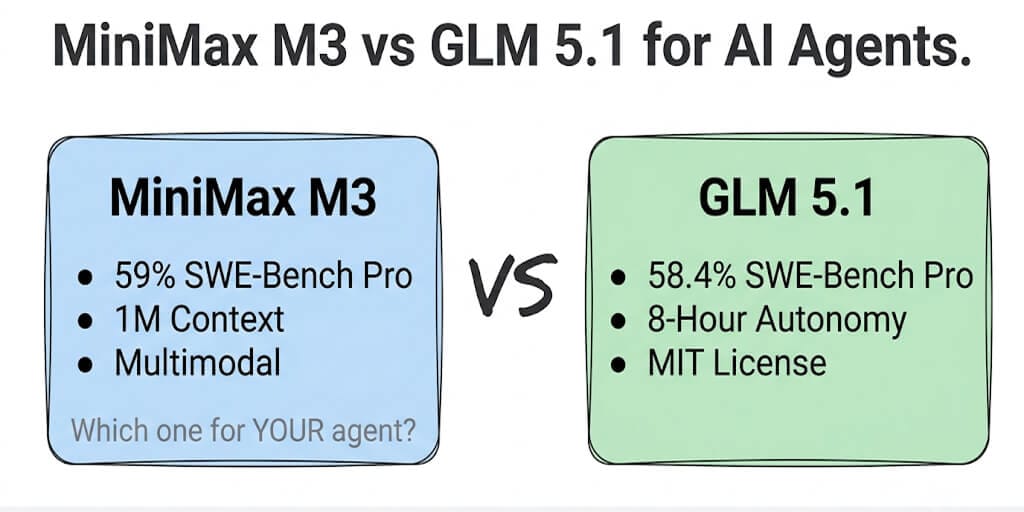
MiniMax M3 launched June 1, 2026. Architecture: 428B total parameters, 23B active (MoE). Context window: 1 million tokens. That's five times larger than GLM 5.1's. Native multimodal input (text, image, video). SWE-Bench Pro: 59.0%. BrowseComp: 83.5 (surpasses Claude Opus 4.7). API pricing: $0.60/$2.40 per million tokens standard, with promo rates at $0.30/$1.20. The MSA (MiniMax Sparse Attention) architecture is what makes the million-token context practical rather than just a spec-sheet number, cutting per-token compute to 1/20th of the prior generation.
GLM 5.1 launched April 7, 2026. Architecture: ~754B total parameters, ~42B active (MoE). Context window: 203K tokens. Text only (GLM-5V-Turbo handles multimodal). SWE-Bench Pro: 58.4% (beats GPT-5.4's 57.7%). Key differentiator: can work autonomously for up to 8 hours on complex coding tasks. MIT license. API pricing: $0.98/$3.08 per million tokens via Z.AI, with blended rates as low as $0.74 per million across some providers.
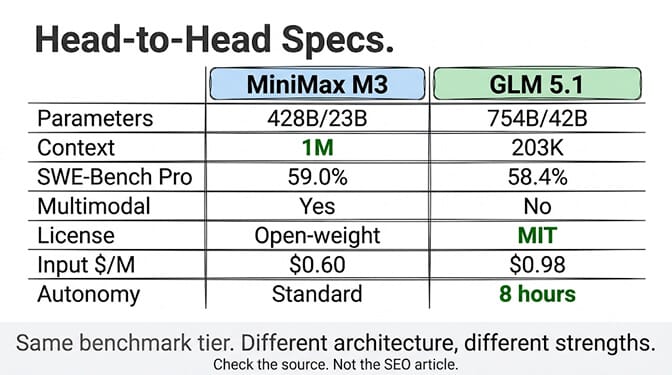
For most agent builders, the choice comes down to one question: do you need a million tokens of context, or do you need 8 hours of autonomous execution?
When M3 wins: context-heavy agent workflows
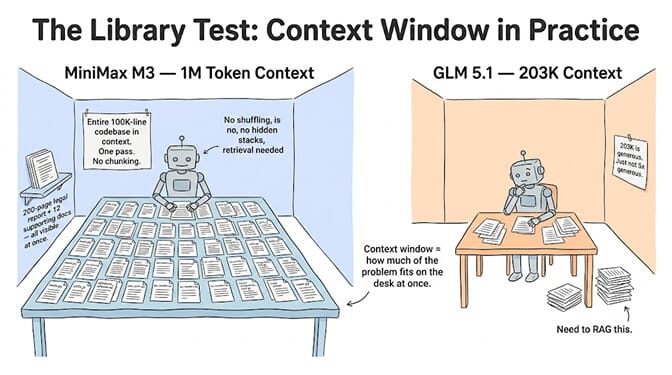
MiniMax M3's million-token context window isn't just a bigger number. It changes what your agent can do in a single session.
An agent analyzing a full codebase (100,000+ lines of code) can hold the entire project in context at once. No chunking, no RAG retrieval, no hoping the model remembers something from five turns ago. The whole codebase is right there.
For document-heavy agent workflows (legal review, research synthesis, long-form content analysis), that context window means your agent can process an entire 200-page report in one pass while simultaneously referencing a dozen supporting documents. GLM 5.1's 203K context is generous by normal standards, but it's a fifth of what M3 offers.
M3 also wins on multimodality. If your agent needs to interpret screenshots, analyze images in support tickets, or process video content, M3 handles text, image, and video natively. GLM 5.1 is text-only (you'd need GLM-5V-Turbo for vision, which is a different model with different pricing).
And on raw pricing, M3 is cheaper. $0.60 per million input tokens versus GLM 5.1's $0.98. On output, M3 costs $2.40 per million versus GLM 5.1's $3.08. For high-volume agent workloads, that gap compounds.
When GLM 5.1 wins: long-running autonomous tasks
Here's where GLM 5.1 has a genuinely unique advantage.
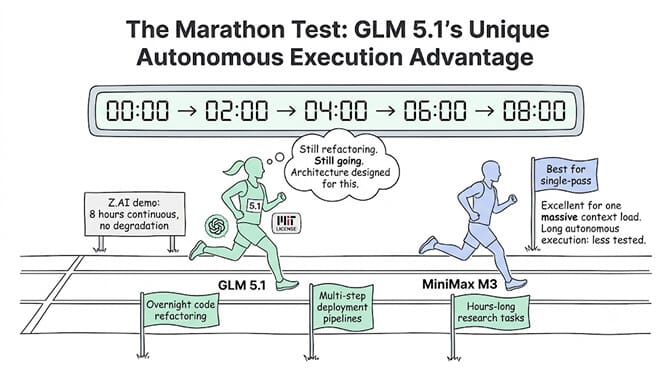
GLM 5.1 is designed for sustained autonomous work. Z.AI demonstrated it running continuously for 8 hours on complex coding tasks without degradation. That's not just a longer prompt window. It's a fundamentally different execution model where the agent can break down a multi-hour task, execute it step by step, and refine its approach as it goes.
For agent workflows like overnight code refactoring, multi-step deployment pipelines, or research tasks that span hours of reading and analysis, GLM 5.1's architecture is built for exactly this pattern.
The MIT license is also a meaningful advantage. MiniMax's M3 weights come with potential commercial-use restrictions that may require written authorization (following the M2.7 licensing precedent). GLM 5.1 is MIT, full stop. Download it, host it, sell products built on it. No permission needed.
For a deeper look at how to run M3 locally and what other models fit into a local agent setup with Ollama, we covered that in detail in our local agent setup guide.
What about self-hosting?
Both models are self-hostable, but the hardware requirements differ.
M3 at 428B/23B MoE needs roughly 128GB+ of RAM for the smallest GGUF quantization. That's Mac Studio territory or 2+ A100 GPUs. Most developers will use the Ollama cloud path or the API.
GLM 5.1 at 754B/42B MoE is even larger. Self-hosting requires serious infrastructure. For most agent builders, the API is the practical path.
Neither model is practical to run on consumer hardware. If you need a model that runs on a laptop, look at Qwen 3.6 35B-A3B (3B active parameters, runs on 16GB RAM) instead.
Both models are available on BetterClaw via BYOK. Connect your API key from any supported provider, including OpenRouter (which serves both models), and build your agent in the visual builder. You pick the model. We handle the infrastructure. Free plan with 1 agent and 500 credits a month, $49/month for Pro. No inference markup, you pay providers directly. Pricing here.
The pricing math for agent workloads
Agent workloads burn tokens differently than chat. A typical agent call involves a system prompt (500-2,000 tokens), conversation history (variable), tool definitions (1,000-5,000 tokens), tool call results (variable), and the agent's response. A single agent turn might use 5,000 to 50,000 input tokens depending on context size.
At 1,000 agent interactions per day with an average of 10,000 input tokens each:
MiniMax M3 at standard pricing: 10M input tokens/day × $0.60/M = $6/day. Plus output tokens. Roughly $200 to $300/month total.
GLM 5.1 at Z.AI pricing: 10M input tokens/day × $0.98/M = $9.80/day. Roughly $350 to $450/month total.
GLM 5.1 at DeepInfra's blended rate: Closer to $0.74/M, bringing it down to roughly $250 to $350/month.
For comparison, GPT-5.5 at $10/M input would cost roughly $3,000+/month for the same workload. Claude Opus 4.7 at $15/M would be $4,500+/month.
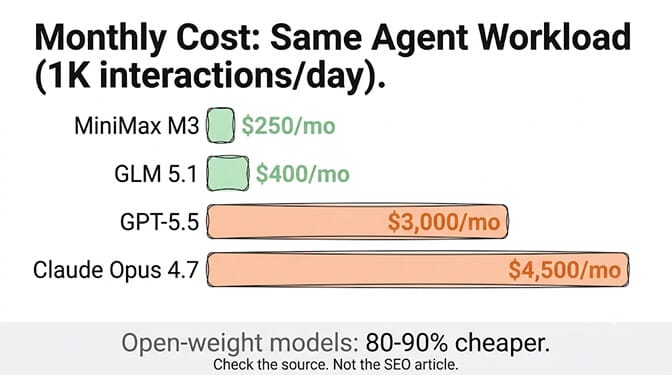
Both M3 and GLM 5.1 deliver frontier-adjacent agent performance at 80 to 90% less than closed-source alternatives. The model choice matters less than the decision to move off closed-source pricing.
Our recommendation
Choose MiniMax M3 if: Your agent needs large context windows (codebase analysis, document review, research). You need multimodal input. You want the lowest per-token cost. You're okay with potentially restricted commercial licensing.
Choose GLM 5.1 if: Your agent runs long, autonomous tasks (overnight code refactoring, multi-hour research). You need MIT licensing for commercial products. You want the largest community of API providers (10+ benchmarked options). You don't need multimodal input.
Choose both if: You're building a hybrid agent that routes simple tasks to one model and complex long-horizon tasks to the other. This is the pattern we see most often among serious agent builders. BetterClaw supports multi-provider BYOK configurations for exactly this reason, with 28+ model providers available through a single agent setup.
Gartner projects 40% of enterprise applications will embed AI agents by end of 2026. The open-weight model tier (M3, GLM 5.1, DeepSeek V4, Kimi K2.7) is where the cost structure actually works for production deployment. Closed-source models are great for prototyping. Open-weight models are where agents scale.
If any of this resonated, give BetterClaw a look. Free plan with 1 agent and 500 credits a month. $49/month for Pro. Connect MiniMax M3, GLM 5.1, or any of our 28+ supported providers via BYOK with zero inference markup. Your first deploy takes about 60 seconds. We handle the infrastructure. You handle the interesting part.
Start free here. | See full pricing.
The bigger picture
A year ago, the idea of running a 59% SWE-Bench Pro model at $0.60 per million tokens would have sounded absurd. Two years ago, there wasn't even a credible open-weight alternative to GPT-4 for agent work.
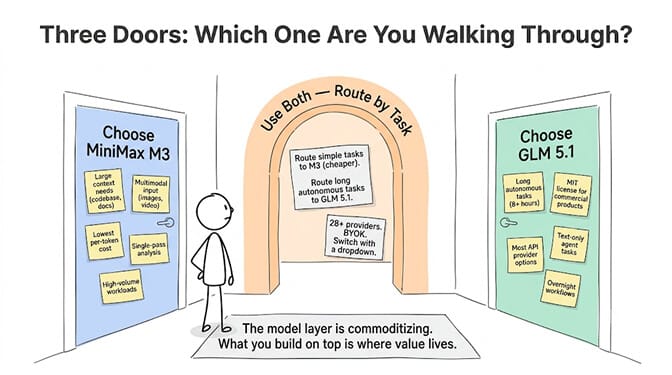
The model layer is commoditizing. Fast. The question isn't which model to choose anymore. It's what you build on top of it. The agent platform, the integrations, the memory architecture, the trust levels, the skill system... that's where the value lives.
M3 and GLM 5.1 are both excellent. Pick one (or both). Then focus on what actually matters: the agent workflows that save your users time.
Frequently Asked Questions
What are MiniMax M3 and GLM 5.1 and why compare them for AI agents?
MiniMax M3 (June 2026) and GLM 5.1 (April 2026) are both open-weight MoE models built specifically for agentic coding and tool-use tasks. They score within 1 point of each other on SWE-Bench Pro (59.0% vs 58.4%), making them the two strongest open-weight options for AI agent backends. The comparison matters because they excel in different dimensions: M3 on context length and multimodality, GLM 5.1 on autonomous long-horizon execution and MIT licensing.
How does MiniMax M3's context window compare to GLM 5.1 for agent work?
M3 offers 1 million tokens of context versus GLM 5.1's 203K tokens. For agents that need to process entire codebases, long documents, or multi-session conversation histories in a single pass, M3 has a 5x advantage. GLM 5.1's 203K context is still generous and sufficient for most agent tasks, but M3 is the better choice for context-heavy workloads like code review, legal analysis, or research synthesis.
How do I use MiniMax M3 or GLM 5.1 as my AI agent's model?
Both models are available via API. M3 is accessible through the MiniMax API and OpenRouter. GLM 5.1 is available through Z.AI, OpenRouter, DeepInfra, and 7+ other providers. In BetterClaw, connect either model via BYOK by pasting your API key in the visual builder. Your agent is live in 60 seconds with whichever model you choose, and you can switch providers anytime without rebuilding the agent.
Is MiniMax M3 or GLM 5.1 cheaper for AI agent workloads?
MiniMax M3 is cheaper per token: $0.60/$2.40 per million tokens (standard) versus GLM 5.1's $0.98/$3.08. For a typical agent workload of 1,000 interactions per day, M3 costs roughly $200 to $300/month versus GLM 5.1's $350 to $450/month at Z.AI pricing. Both are 80 to 90% cheaper than GPT-5.5 or Claude Opus 4.7 for the same workload. GLM 5.1's pricing varies by provider, with DeepInfra offering rates as low as $0.74/M blended.
Are open-weight models like M3 and GLM 5.1 reliable enough for production agents?
Yes, with caveats. Both models score in the top tier on coding and agentic benchmarks, and both support tool use and function calling natively. For production deployment, monitor output quality on your specific tasks rather than relying solely on benchmark scores. BetterClaw adds production safeguards on top of any model: trust levels that control what the agent can do, real-time health monitoring, auto-pause on anomalies, and a one-click kill switch. The model provides intelligence. The platform provides safety.