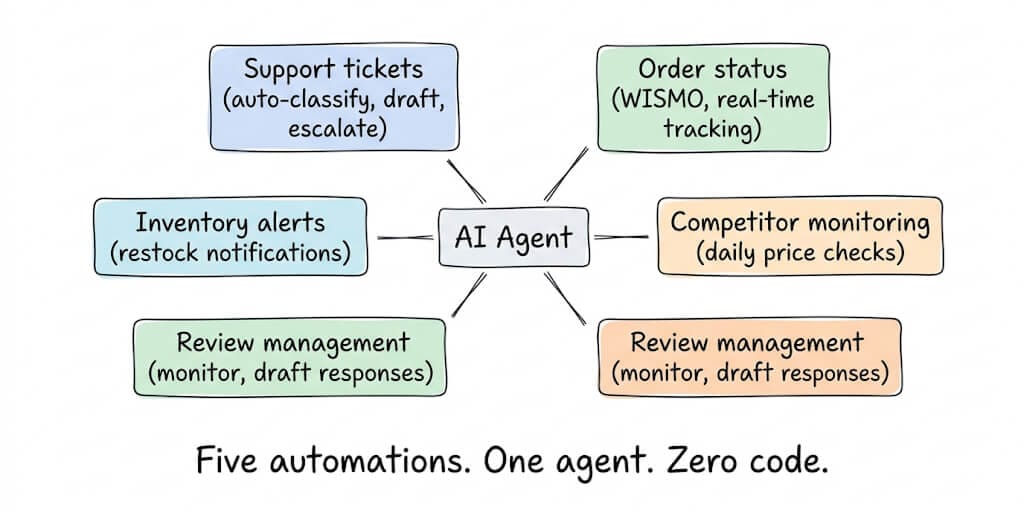
"Where is my order?" makes up 40% of your support tickets. An AI agent answers it in 3 seconds using your live Shopify data. Here are five ecommerce automations you can build without code, and a step-by-step guide to getting the first one running in 10 minutes.
A Shopify store owner in our community was spending 3 hours every morning answering the same question: "Where is my order?"
Not variations. The same question. Over and over. Different customers, same words, same answer: check the tracking link she'd already included in the order confirmation email.
She built an AI agent on a Saturday morning. Connected her Shopify data. Connected her Gmail. Told the agent: "When someone asks about their order status, look up the order, check the tracking, and respond with the current status."
Monday morning, the agent had already handled 23 order status queries before she opened her laptop. Three hours of her day, back. Every morning. Automatically.
That's the best AI agent for ecommerce. Not a chatbot that asks "Would you like to check your order status?" and links to a generic tracking page. An agent that actually pulls the customer's order, checks the carrier, and responds with "Your order #4821 shipped Tuesday via UPS. It's currently in Memphis and expected to arrive Thursday."
Why ecommerce teams need AI agents (the math that makes it obvious)
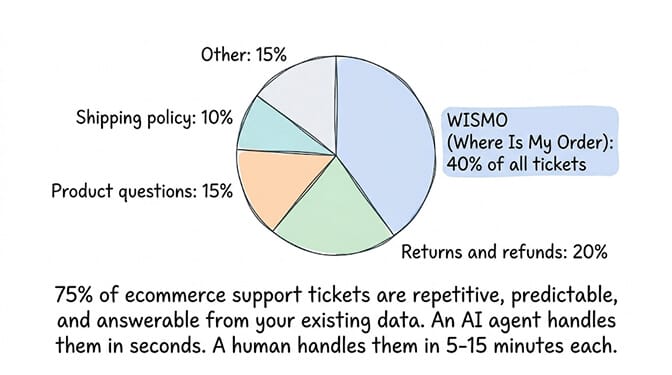
E2M Solutions' analysis puts it bluntly: WISMO tickets account for up to 40% of total support volume. Returns and refund queries add another 20%. Product questions and shipping policy make up most of the rest.
That means roughly 75% of your support workload is repetitive, predictable, and answerable from data you already have (order status, tracking numbers, return policies, product specs).
A human support agent handles these at 5-15 minutes per ticket, including context switching, looking up the order, typing a response, and moving to the next one. An AI agent handles them in 3-10 seconds with live data.
The math for a store processing 50 tickets per day:
37 of those tickets are automatable (75%). At 10 minutes per ticket for a human, that's 6.2 hours of human work daily. At $20/hour, that's $124/day or $3,720/month in labor on repetitive queries.
An AI agent handling those 37 tickets costs approximately $10-30/month in LLM API fees on BetterClaw's free plan.
The ROI isn't debatable. It's $3,720/month in labor replaced by $10-30/month in API costs. The agent pays for itself in the first 4 hours of operation.
For the complete guide to AI agent use cases across industries, our AI agent use cases post covers 20+ workflows beyond ecommerce.
Five ecommerce AI agent automations (ranked by ROI)
1. Customer support triage (the one everyone should start with)
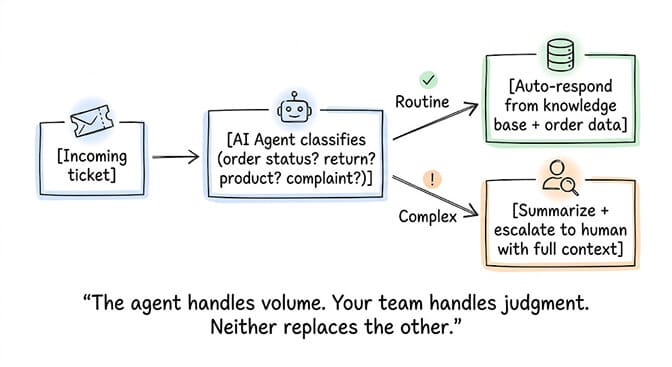
Every incoming ticket gets classified automatically: order status, return request, product question, billing issue, complaint. The agent drafts a response based on your knowledge base and order data. Routine tickets (order status, shipping policy, return instructions) get answered automatically. Complex tickets (complaints, refund disputes, damaged items) get escalated to a human with full context attached.
The result: First-response time drops from hours to seconds. Your human support team handles the 25% of tickets that actually need judgment instead of the 75% that don't.
2. Order status automation (the WISMO killer)
"Where is my order?" deserves its own automation because it's 40% of your tickets and 100% answerable from data.
The agent connects to your Shopify, WooCommerce, or order management system. When a customer asks about their order (via email, WhatsApp, Telegram, or Slack), the agent looks up the order by email address or order number, checks the carrier tracking, and responds with the specific status.
Not "check your tracking link." The actual status. "Your order #7294 shipped Monday via FedEx. It cleared the Los Angeles distribution center this morning and is expected to arrive Wednesday by 5 PM."
Why this matters: Chatbase's analysis found that generic "check your tracking link" responses still generate follow-up questions. Personalized status responses with specific dates and locations resolve the conversation in one reply.
3. Competitor price monitoring (the one nobody thinks of)
Here's what nobody tells you about AI agents for ecommerce. Most people think "support automation" first. But competitor price monitoring has some of the highest ROI for established stores.
Your agent checks 5-10 competitor product pages daily. When a price changes, it posts an alert to Slack or Telegram with the product, the old price, the new price, and the percentage change. You start every day knowing what the competition did yesterday.
A DTC brand on our platform monitors 47 competitor SKUs daily. The agent caught a competitor's 30% flash sale within 2 hours of launch. They matched the price on their three overlapping products the same day. Without the agent, they'd have noticed the sale 3 days later from a customer comment.
Our 12 best AI agent builders comparison ranks the options by setup time and who each suits, including non-technical teams.
4. Review monitoring and response drafting
New reviews appear on Google, Amazon, Trustpilot, and your Shopify store. The agent monitors all of them. For positive reviews (4-5 stars), the agent drafts a thank-you response personalized with the customer's name and product. For negative reviews (1-2 stars), the agent drafts a response that acknowledges the issue, apologizes, and offers to resolve it, then flags the draft for human review before posting.
Why this matters beyond reputation: Ecommerce stores that respond to reviews within 24 hours see 12-15% higher conversion rates on review platforms (BrightLocal). An AI agent responds in minutes, not days.
5. Inventory restock alerts (the one that prevents lost revenue)
The agent monitors your inventory levels. When a product drops below your restock threshold (say, 15 units), it sends an alert to Slack with the product name, current stock, average daily sales, and estimated days until stockout. For fast-moving products, it can also draft the restock order for your supplier.
A supplement brand using BetterClaw caught a stockout 4 days before it would have happened. Their top-selling product was at 12 units with an average daily sale of 3. Without the alert, they'd have run out on a Friday when the supplier was closed for the weekend.
If building a support triage agent, order status automation, competitor monitor, review manager, and inventory alerter sounds like it would save your team hours every day, that's exactly what we built BetterClaw for. No code. No Shopify app installation headaches. Connect your data via OAuth, describe the workflow, and the agent is live. Free plan with 1 agent and 100 credits a month, $49/month for Pro. 200+ verified skills. 15+ channels including WhatsApp, email, and Telegram.
How to build your first ecommerce AI agent in 10 minutes (step by step)
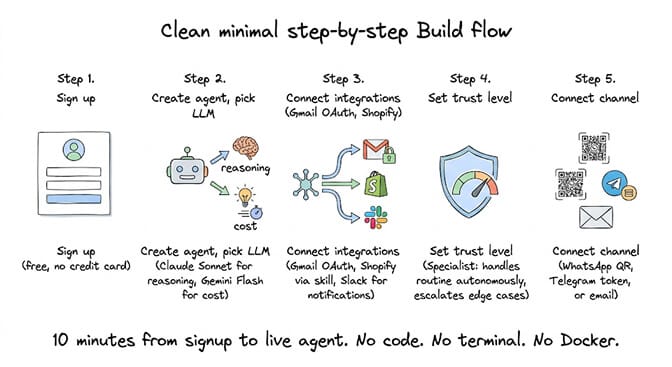
Let's build the support triage agent. This is the one that delivers the fastest ROI for any ecommerce store. (Our how to create an AI agent guide covers the general 7-step walkthrough if you want more depth.)
Step 1: Sign up. Go to BetterClaw. No credit card. No billing setup. The free plan includes 1 agent, 100 credits/month, and 3 connectors.
Step 2: Create your agent. Click "Create Agent." Pick your LLM. Claude Sonnet for best reasoning on complex tickets. Gemini Flash for lowest cost on high-volume simple queries. Paste your API key or use BetterClaw's managed credits.
Step 3: Connect your integrations. Gmail (one-click OAuth). Slack for internal notifications. Add your product knowledge base or FAQ document. If you use Shopify, connect the ecommerce skill from BetterClaw's marketplace.
Step 4: Set trust level. Start with "Specialist." This means the agent handles routine queries (order status, shipping policy, FAQ answers) autonomously and escalates complex queries (complaints, refund disputes, damaged items) with a summary and suggested response for human review.
Step 5: Connect your customer channel. WhatsApp (scan QR). Telegram (paste bot token). Email (auto-forward). Slack (for internal support requests).
That's it. The agent is live. Incoming support queries on your connected channel get classified, and routine queries get answered automatically using your knowledge base and connected data.
Start narrow. Don't try to automate everything on day one. Start with order status queries only (the 40% of volume). Verify the agent is accurate for a week. Then expand to returns. Then product questions. Build trust incrementally.
Which AI agent builder is best for ecommerce?
This is where most people get it wrong. They compare platforms on features without asking the right question: who on your team is going to build and maintain this? (Our AI agent builder comparison covers the questions to ask.)
If you have developers: CrewAI (47K+ GitHub stars) lets you build sophisticated multi-agent systems with custom Shopify API integrations. Full code control. Python required. You manage hosting.
If you have a GCP account and cloud expertise: Google Vertex AI Agent Builder offers strong RAG grounding against your product catalog. Complex setup and usage-based pricing across four billing dimensions.
If you want a dedicated ecommerce support tool: Gorgias, eDesk, and Yuma AI are purpose-built for ecommerce support. Deep Shopify integrations. Ticket-volume pricing.
If you want a general-purpose agent that works across channels without code: BetterClaw deploys in 60 seconds, works on WhatsApp, Telegram, Slack, email, and 15+ channels, and handles support, monitoring, and alerting from a single agent. Free plan. $49/month Pro.
The ecommerce-specific tools (Gorgias, eDesk) are excellent for support-only use cases. But they don't do competitor monitoring, inventory alerts, or review management. BetterClaw handles all five use cases from this article with a single agent.
For the detailed comparison of BetterClaw vs enterprise platforms, our BetterClaw vs Vertex AI breakdown covers the feature-by-feature differences.
The part about channels (why it matters more than you think)
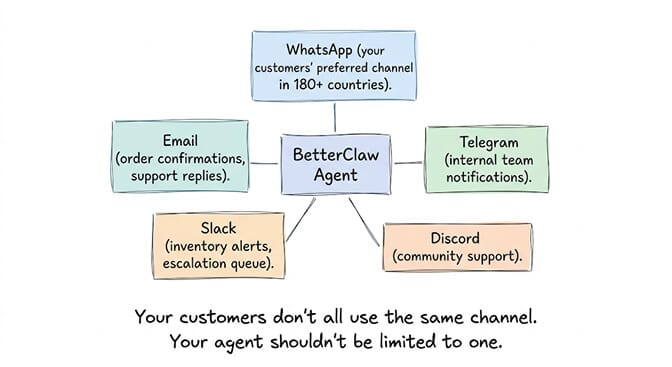
Most ecommerce AI agent tools are web-chat only. A widget on your website. That's fine for customers who are browsing your store. But what about:
The customer who emails about a damaged product?
The customer who messages on WhatsApp (the preferred channel in 180+ countries)?
The team member who needs an inventory alert in Slack?
The operations lead who wants the daily competitor price summary in Telegram?
A multi-channel agent handles all of these from a single configuration. One agent. Multiple channels. The same knowledge base, the same trust levels, the same memory across all of them.
BetterClaw supports 15+ channels out of the box. The same agent that answers "where is my order?" on WhatsApp also posts the inventory alert in Slack and sends the competitor price summary to Telegram. No separate configurations. No separate agents. One agent, everywhere your business needs it.
For the complete guide to AI agents for Shopify stores specifically, our AI agent for Shopify post covers the platform-specific setup in detail. If you're coming from the OpenClaw side of the ecosystem, our OpenClaw agents for ecommerce post covers that angle.
The honest take
Here's what I wish every ecommerce store owner knew about AI agents.
You don't need a sophisticated multi-agent system. You need one agent that answers "where is my order?" accurately, drafts return instructions from your policy document, and alerts you when competitor prices change. That's three workflows on one agent. It saves hours daily. It costs $0-19/month plus LLM fees.
The stores that are winning with AI agents right now aren't the ones with the most complex architecture. They're the ones that deployed a simple support triage agent two months ago and have been compounding the time savings ever since.
Start with WISMO. It's 40% of your tickets. It's 100% automatable. It takes 10 minutes to set up. The ROI is measurable by end of day one.
If any of this resonated, give BetterClaw a try. Free plan with 1 agent and 100 credits a month. $49/month for Pro. Your first ecommerce agent takes about 10 minutes to build. We handle the infrastructure. You handle the selling.
Frequently Asked Questions
What is an AI agent for ecommerce?
An AI agent for ecommerce is autonomous software that handles online store operations: customer support (order status, returns, product questions), competitor monitoring (daily price and feature checks), review management (monitoring and response drafting), and inventory alerts (restock notifications). Unlike a chatbot, an AI agent connects to your Shopify or order management system, pulls live data, and takes action autonomously.
Which is the best AI agent builder for ecommerce?
It depends on your team. For non-technical store owners who want agents running across WhatsApp, email, Telegram, and Slack without code, BetterClaw deploys in 60 seconds with a free plan. For ecommerce-only support with deep Shopify integration, Gorgias and eDesk are purpose-built. For developers who want custom multi-agent systems, CrewAI (47K+ GitHub stars) offers full Python control. BetterClaw is the only option that handles support, monitoring, reviews, and inventory from a single no-code agent.
How long does it take to build an AI agent for my online store?
With a no-code platform like BetterClaw, about 10 minutes for a support triage agent. Sign up (free, no credit card), pick your LLM, connect Gmail and Shopify via OAuth, set the trust level, and connect your customer channel (WhatsApp, email, Telegram). With a code-first framework like CrewAI, expect 4-8 hours for a basic setup plus ongoing hosting management.
How much does an ecommerce AI agent cost?
BetterClaw's free plan is $0/month (1 agent, 100 credits a month). Pro is $49/month with 5 agents and 12,000 credits a month. LLM API costs add $10-30/month for typical ecommerce volumes (50-100 tickets/day). Purpose-built ecommerce tools like Gorgias charge based on ticket volume, typically $60-750/month. Self-hosted frameworks are free but require $50-200/month in hosting and developer maintenance time.
Can an AI agent handle sensitive customer data like orders and payments safely?
With proper security, yes. BetterClaw uses AES-256 encryption, auto-purges secrets from agent memory after 5 minutes, runs each agent in an isolated Docker container, and offers trust levels (Intern, Specialist, Lead) that control what actions require human approval. For payment operations, set the trust level to "Intern" so the agent always asks before taking action on refunds or billing changes. 50+ companies including Carelon and Grainger use BetterClaw in production.