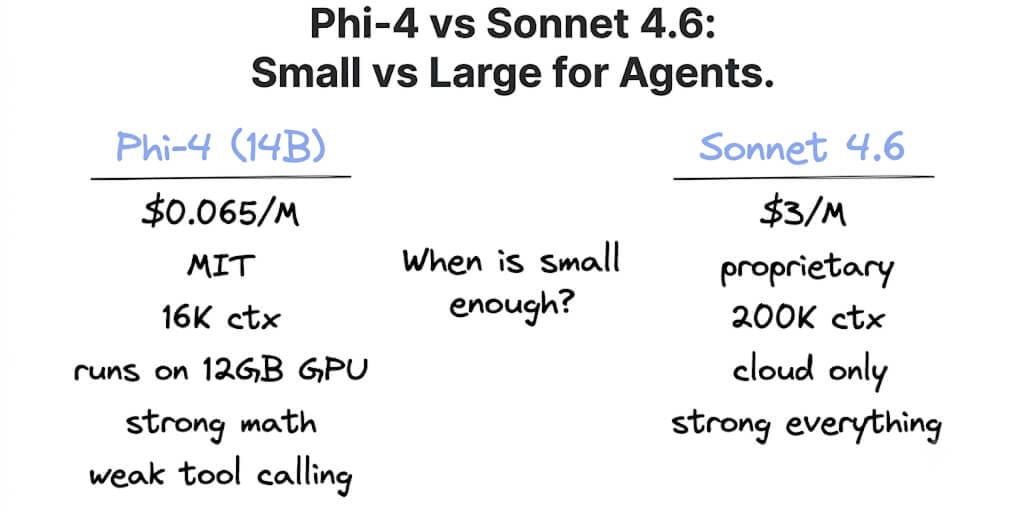
Phi-4 costs 46x less per input token than Sonnet 4.6. It runs locally on a $300 GPU. But it has a 16K context window and a "weak agentic score." Here's exactly where the 14B model works, where it breaks, and where the hybrid setup beats both.
My classification agent runs on Phi-4. 14 billion parameters. Runs on a single RTX 4060 with 8 GB VRAM (Q4 quantization). Classifies 500 support emails per day into five categories. Accuracy: 94%.
Same task on Claude Sonnet 4.6. Accuracy: 97%. Cost: $1.86/day. On Phi-4 locally: $0/day.
Is 94% vs 97% worth $1.86/day? For email classification, probably not. That's $56/month for a 3% accuracy bump on a task where a human reviews the output anyway.
But when I tried Phi-4 on a multi-step agent that reads a 40-page contract, extracts clauses, and drafts amendments... it couldn't even load the document. Phi-4's context window is 16,384 tokens. A 40-page contract is 50,000+ tokens. The model physically can't see the input.
That's the entire Phi-4 vs Sonnet 4.6 question in two scenarios. For simple, structured, short-context tasks, the small model is good enough. For complex, long-context, tool-heavy agent work, it isn't close.
The specs that matter for agents
| Phi-4 (14B) | Phi-4-mini (3.8B) | Claude Sonnet 4.6 | |
|---|---|---|---|
| Input per 1M | $0.065 | $0.065 | $3.00 |
| Output per 1M | $0.14 | $0.14 | $15.00 |
| Context window | 16K | 128K | 200K |
| Function calling | Limited | Yes (built-in) | Strong |
| Tool hallucination | ~15-20% | ~12-15% | 3% |
| MMLU | 84.8% | ~80% | ~88% |
| Math (MATH bench) | Beats GPT-4o | Strong | Strong |
| License | MIT | MIT | Proprietary |
| Local inference | 12 GB GPU (Q4) | 4-8 GB GPU | Cloud only |
| Speed (local) | 30-50 tok/s | 60-80 tok/s | N/A (cloud) |
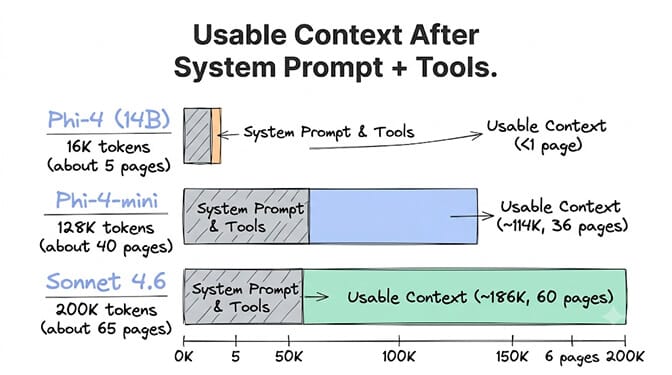
The critical limitation for agents: Phi-4's 16K context window. Agent system prompts alone consume 2-4K tokens. Add tool definitions (another 2-6K) and conversation history, and you have 6-10K tokens left for actual work. That's roughly 4-5 pages of text. Most agent tasks need more.
Phi-4-mini saves the day. With 128K context and built-in function calling, Phi-4-mini is actually the better agent model in the Phi-4 family despite being smaller (3.8B). It fits on 4 GB VRAM at Q4 and handles much longer conversations. The tradeoff: lower reasoning quality than the 14B model.
Where Phi-4 wins (and it's not nothing)
Simple classification (94-97% accuracy is often enough)
Email classification. Ticket routing. Sentiment analysis. Intent detection. For structured tasks with short inputs and clear categories, Phi-4's 84.8% MMLU translates to 94-96% accuracy on well-prompted classification. That's 2-3% below Sonnet, at 46x lower cost.
For 500 classifications per day: Phi-4 locally costs $0. Sonnet costs $56/month. The math is hard to argue with.
Math and STEM reasoning
Phi-4 was specifically trained on synthetic math data. It beats GPT-4o on math competition problems. For agents that calculate, analyze data, or solve quantitative problems, Phi-4 punches way above its weight class. The Phi-4-reasoning variant (also 14B) approaches DeepSeek R1 on math benchmarks.
Edge and offline deployment
Phi-4 runs on a laptop GPU. No internet required. No API keys. No per-token billing. For agents that need to run air-gapped, on-device, or in environments with unreliable connectivity, Phi-4 is one of the few models that delivers reasonable quality at this size.
Privacy-first workloads
Data never leaves your machine. For healthcare, legal, or financial agents processing sensitive information, local inference on Phi-4 eliminates third-party data exposure entirely. Compare to Sonnet: every API call sends your data to Anthropic's servers.
Where Sonnet 4.6 wins (and it's decisive for agent tasks)
Context window (12.5x larger)
200K tokens vs 16K tokens. This alone disqualifies Phi-4 from most production agent workloads. Agent system prompts (2-4K) + tool definitions (2-6K) + conversation history leave Phi-4 with 6-10K tokens for actual content. A medium email thread exceeds that. A document summary task exceeds that. Any multi-turn conversation beyond 10 messages exceeds that.
Phi-4-mini (128K) partially solves this, but at the cost of reasoning quality.
Tool calling reliability
Sonnet's 3% tool-call hallucination rate vs Phi-4's ~15-20%. On an agent making 5 tool calls per task across 500 daily tasks, that's the difference between 75 failures (Sonnet) and 375-500 failures (Phi-4). For agents that book meetings, update CRMs, send emails, or move money, wrong tool calls have real consequences. See our model routing setup guide for how to route tool-heavy tasks to capable models.
Multi-step reasoning
Complex agent chains (read email -> look up customer -> check subscription -> draft response -> schedule follow-up) require instruction following across multiple steps. Sonnet maintains coherence across 5-10 step chains. Phi-4 starts drifting after 3-4 steps. Context management helps, but the underlying model capability gap is real.
Output quality for customer-facing text
If your agent drafts emails, writes reports, or generates content that humans read, Sonnet produces measurably better prose. Phi-4's output is functional but generic. For internal agents, fine. For customer-facing agents, the quality gap is visible.
The hybrid setup (where this gets practical)
Here's the approach that makes both models useful.
Phi-4 locally for: Classification, routing, intent detection, simple extraction, math calculations. Any task with short input, structured output, and tolerance for occasional errors.
Sonnet via API for: Multi-step tool chains, long-document analysis, customer-facing drafts, complex reasoning, anything requiring 16K+ tokens of context.
If you want both models through one dashboard without managing separate local inference servers and cloud API configurations, BetterClaw supports local Ollama endpoints alongside 28+ cloud providers via BYOK with zero inference markup. Route classification tasks to your local Phi-4 and complex tasks to Sonnet. Free plan with 1 agent and 100 credits a month. $49/month on Pro.
Monthly cost comparison:
All-Sonnet (500 tasks/day): $56/month.
All-Phi-4 local: $0/month (but 15-20% of tasks fail on complexity).
Hybrid (70% Phi-4 local, 30% Sonnet): $17/month with near-zero failures.
The question isn't "Phi-4 or Sonnet." It's "which 70% of your agent's tasks can a 14B model handle, and which 30% need a frontier model?" Route accordingly.
The honest assessment
Phi-4 is a remarkable model for its size. 84.8% MMLU at 14B parameters. Math reasoning that beats models 10x larger. Runs on consumer hardware. MIT licensed.
But for autonomous agents in production, the 16K context window and 15-20% tool-call hallucination rate are not minor limitations. They're fundamental constraints. You can work around them with careful task routing, but you can't pretend they don't exist.
The builders getting the best results aren't choosing one or the other. They're using Phi-4 where it's strong (classification, math, privacy, cost) and Sonnet where it's essential (tool chains, long context, reliability). The routing layer is the real product decision.
Give BetterClaw a look if you want local and cloud models routed through one dashboard. Free plan with 1 agent and 100 credits a month. $49/month for Pro. BYOK with zero markup. We handle the routing. You handle the agent logic.
Frequently Asked Questions
Is Phi-4 good enough for AI agents?
For simple, structured tasks (classification, routing, math, extraction), yes. Phi-4 achieves 94-96% accuracy on classification at $0/month locally. For complex multi-step agent work (tool chains, long documents, customer-facing output), no. The 16K context window and 15-20% tool-call hallucination rate limit production reliability. Phi-4-mini (3.8B, 128K context, built-in function calling) is actually better for agents despite being smaller.
How much cheaper is Phi-4 than Claude Sonnet 4.6?
Phi-4 costs $0.065/M input and $0.14/M output vs Sonnet at $3/$15/M. That's 46x cheaper on input and 107x cheaper on output. Running locally on Ollama, Phi-4 costs $0/token. At 500 daily tasks, all-Sonnet costs $56/month. All-Phi-4 local costs $0/month. A hybrid (70% local, 30% Sonnet) costs approximately $17/month.
Can Phi-4 run on my laptop?
Yes. Phi-4 (14B) runs on any GPU with 12+ GB VRAM at Q4 quantization (RTX 3060, RTX 4060, Apple Silicon with 16 GB). At Q4 on Apple Silicon, expect 30-50 tok/s. Phi-4-mini (3.8B) runs on 4-8 GB VRAM. Both are available on Ollama (ollama pull phi4 and ollama pull phi4-mini). Neither requires internet for inference.
Should I use Phi-4 or Phi-4-mini for agents?
For agents specifically, Phi-4-mini is often the better choice despite being smaller. Phi-4-mini has 128K context (vs 16K), built-in function calling, and runs on less hardware (4 GB VRAM vs 12 GB). The tradeoff: lower reasoning quality on complex tasks. Use Phi-4 (14B) for math/STEM-focused agents where context length isn't an issue. Use Phi-4-mini for general agent tasks where context and tool calling matter more than raw reasoning power.
What's the best setup for using small and large models together?
Route by task complexity. Use Phi-4 or Phi-4-mini locally for classification, routing, simple extraction, and math (70% of typical agent tasks). Use Sonnet 4.6 via cloud API for multi-step tool chains, long-document analysis, and customer-facing output (30% of tasks). On BetterClaw, connect both your local Ollama endpoint and cloud API keys via BYOK. Per-agent cost caps and model routing handle the switching automatically. Monthly cost: approximately $17 vs $56 all-Sonnet.