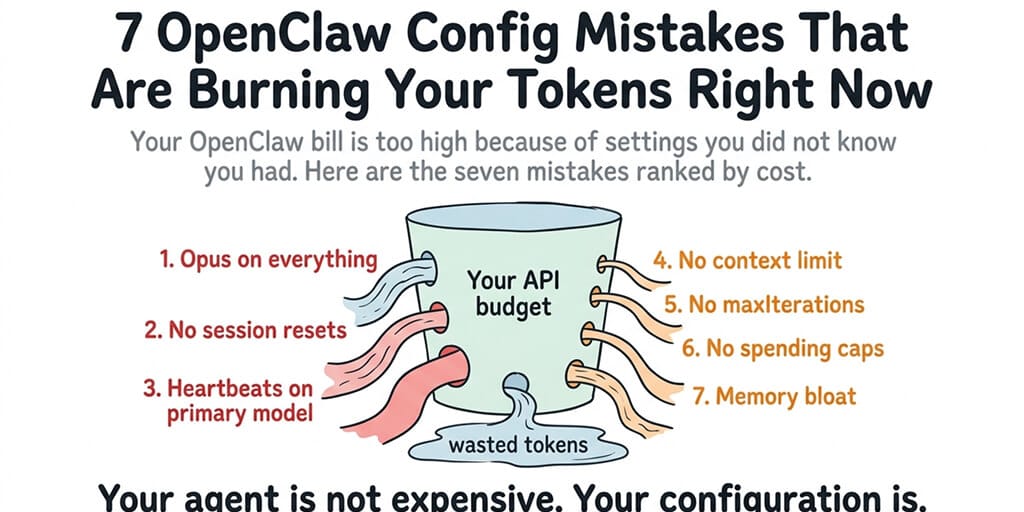
Your OpenClaw bill is too high because of settings you didn't know you had. Here are the seven mistakes, ranked by how much money they're costing you.
A user in the OpenClaw Discord posted his Anthropic dashboard screenshot last month. $247 in API costs. For one agent. In three weeks. He was convinced something was broken.
Nothing was broken. Every setting was on default. And that was the problem.
OpenClaw's default configuration optimizes for capability, not cost. It uses your most expensive model for everything, sends the full conversation history with every request, runs heartbeats on your primary model, and sets no limits on how many times a skill can retry. Each of these defaults is reasonable in isolation. Together, they burn through API credits faster than most people expect.
Here are the seven config mistakes, ranked by how much they cost you. Fix them in order. Most people recover 80% of their wasted spend by fixing the first three.
Mistake 1: Running Opus (or the most expensive model) on everything
Cost impact: 5-10x overspend.
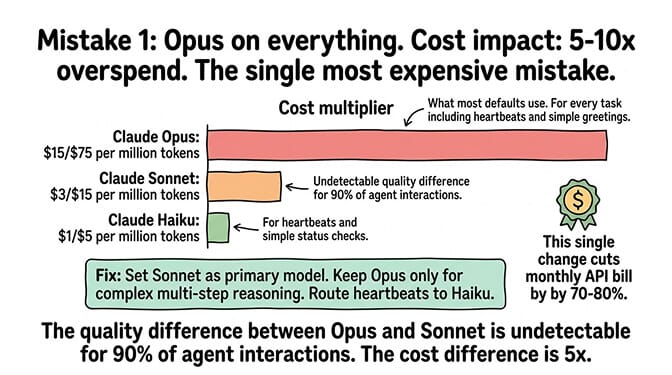
This is the single most expensive mistake. If your primary model is Claude Opus ($15/$75 per million tokens), every heartbeat, every "what time is it," every simple greeting costs the same per token as a complex research task.
The fix: Set Claude Sonnet ($3/$15 per million tokens) as your primary model. The quality difference is undetectable for 90% of agent interactions. Route Opus only to tasks that genuinely need it (complex multi-step reasoning, nuanced creative work).
For most users, this single change cuts their monthly API bill by 70-80%.
Mistake 2: Never resetting your session
Cost impact: 3-5x overspend on long conversations.
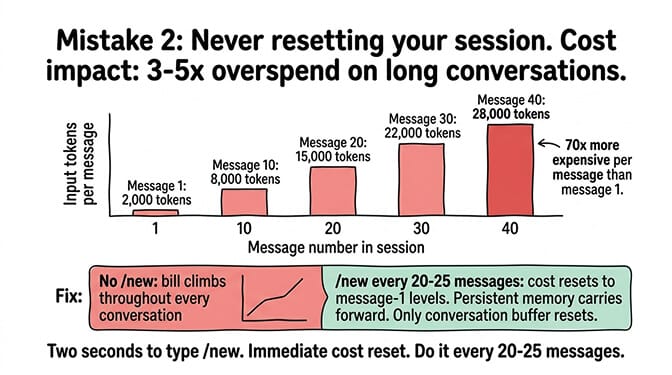
Every message re-sends the entire conversation history as input tokens. By message 40, a single request contains 25,000-30,000 input tokens. That's 70x more expensive per message than the first message in the session.
The fix: Use /new every 20-25 messages. Your persistent memory (MEMORY.md, memory-wiki) carries forward. Only the conversation buffer resets. Response cost drops back to message-1 levels immediately.
For the detailed session optimization math, our cost guide covers the token accumulation mechanics.
Mistake 3: Heartbeats running on your primary model
Cost impact: $3-8/month wasted.
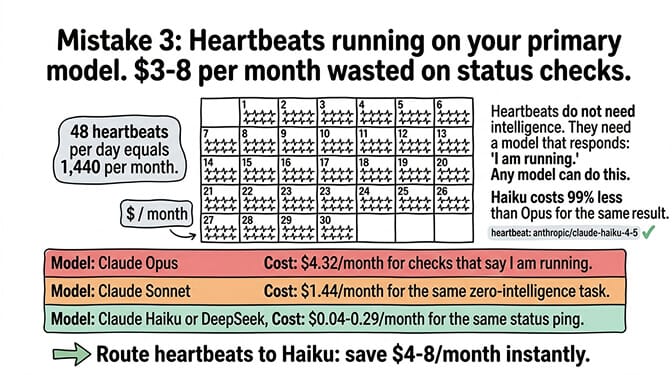
OpenClaw sends approximately 48 heartbeat checks per day. These are simple "are you alive" status checks. If they run on Sonnet, they cost roughly $1.44/month. On Opus, $4.32/month. On Haiku ($1/$5 per million tokens), they cost $0.29/month.
The fix: Route heartbeats specifically to Haiku or DeepSeek. They don't need intelligence. They need a model that responds "I'm running."
Mistake 4: No context window limit
Cost impact: 30-40% overspend on input tokens.
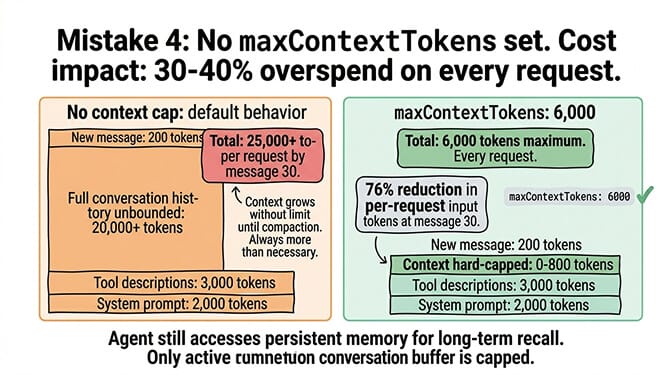
Without maxContextTokens set, the conversation context grows until compaction kicks in. Compaction helps but still leaves substantial context overhead. Without a hard cap, you're always sending more context than necessary.
The fix: Set maxContextTokens to 4,000-8,000. This forces the system to keep the active context lean regardless of conversation length. The agent still has access to persistent memory for long-term recall. The input token volume per request stays bounded.
Mistakes 1-4 account for roughly 90% of avoidable token waste. Fix these four and your bill drops dramatically. Mistakes 5-7 are smaller but still worth fixing.
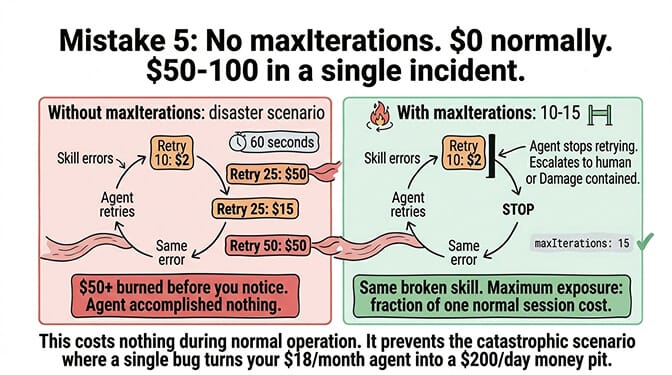
Mistake 5: No maxIterations limit
Cost impact: $0 normally, $50-100 during a single incident.
Without maxIterations set, a broken skill can loop indefinitely. Each retry is an API call. A 50-iteration loop in 60 seconds can burn $10-50 in API credits before you notice. It might happen once a month. Or never. But when it happens, the bill spike is brutal.
The fix: Set maxIterations to 10-15. This costs nothing during normal operation. It prevents the catastrophic scenario where a single bug turns your $18/month agent into a $200/day money pit.
For the complete guide to diagnosing and preventing agent loops, our loop troubleshooting post covers the specific patterns.
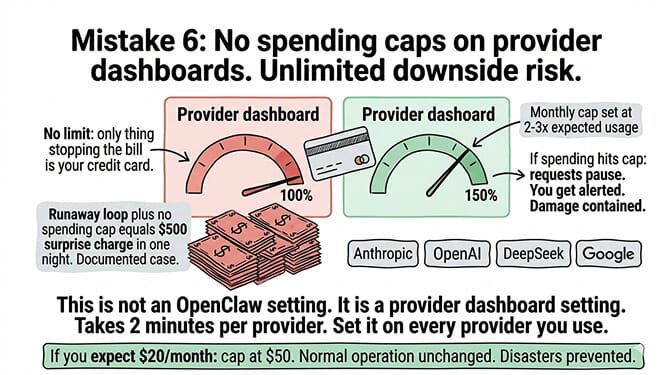
Mistake 6: No spending caps on your provider dashboard
Cost impact: Unlimited downside risk.
This isn't an OpenClaw setting. It's a provider setting. Every model provider (Anthropic, OpenAI, DeepSeek, Google) has a monthly spending cap option. If you don't set it, the only limit on your bill is your credit card.
The fix: Set monthly spending caps on every provider dashboard at 2-3x your expected monthly usage. If you expect $20/month in API costs, cap at $50. This doesn't change normal operation. It prevents disasters.
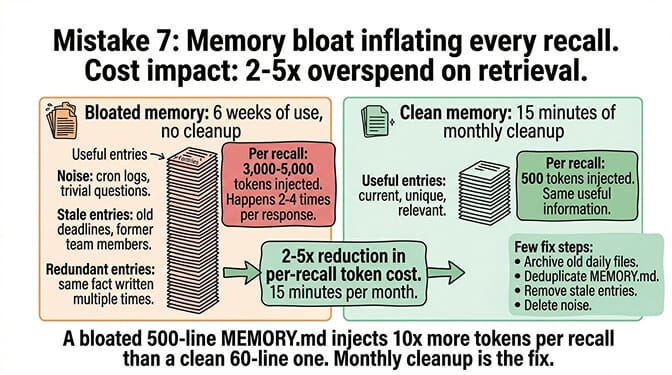
Mistake 7: Memory bloat inflating every recall
Cost impact: 2-5x overspend on memory retrieval.
After a few weeks of use, your memory files (MEMORY.md, daily logs) accumulate redundant entries, stale facts, and noise. Every memory recall searches these bloated files and injects retrieved chunks into the prompt. A clean 60-line MEMORY.md injects roughly 500 tokens per recall. A bloated 500-line file injects 3,000-5,000 tokens.
The fix: Monthly cleanup. Archive old daily files, deduplicate MEMORY.md, remove stale entries. 15 minutes per month. For the complete memory bloat cleanup guide, our memory troubleshooting post covers the step-by-step process.
If identifying these mistakes, fixing them across config files, and maintaining the optimizations over time sounds like more configuration work than you want, BetterClaw prevents most of these mistakes by design. Smart context management eliminates the context bloat (mistakes 2, 4, 7). Model selection from a dropdown makes routing easy (mistakes 1, 3). Health monitoring catches loops before they drain credits (mistake 5). Free tier with 1 agent and BYOK. $49/month for Pro (5 agents included). The optimization is built into the platform because we got tired of watching users spend $150/month on agents that should cost $18.
The uncomfortable math
Here's what nobody tells you about OpenClaw token costs.
The difference between a $150/month agent and an $18/month agent is seven config settings. Not the model quality. Not the hosting provider. Not the number of skills. Seven settings that most users never change from defaults because the defaults work. They just work expensively.
The viral "I Spent $178 on AI Agents in a Week" Medium post? Default settings. The $247 Discord screenshot? Default settings. Almost every cost complaint in the OpenClaw community traces back to the same seven mistakes.
The agent doesn't need to change. The configuration does.
If you want these optimizations pre-configured so you never make these mistakes in the first place, give BetterClaw a try. Free tier with 1 agent and BYOK. $49/month for Pro (5 agents included). Smart context management. Model routing from a dropdown. Loop detection with auto-pause. The seven mistakes are prevented by the platform architecture, not by your memory of which config settings to change.
Frequently Asked Questions
Why is my OpenClaw so expensive?
Almost always: default configuration. OpenClaw defaults to your most expensive model for all tasks (including heartbeats), sends unbounded conversation history as input tokens, sets no iteration limits on skill retries, and accumulates memory files without cleanup. Fixing seven specific config settings (model routing, session resets, heartbeat routing, context limits, iteration caps, spending caps, memory cleanup) typically reduces costs by 80-90%.
What is the biggest OpenClaw config mistake for cost?
Running your most expensive model (Opus at $15/$75 per million tokens) on every task. This single mistake accounts for 5-10x overspend. Switching your primary model to Sonnet ($3/$15) while keeping Opus only for complex tasks cuts costs by 70-80% with minimal quality difference for routine interactions.
How do I reduce OpenClaw token usage?
Seven fixes in order of impact: switch primary model to Sonnet (saves 70-80%), use /new every 20-25 messages (saves 3-5x on long sessions), route heartbeats to Haiku or DeepSeek (saves $3-8/month), set maxContextTokens to 4K-8K (saves 30-40% on input), set maxIterations to 10-15 (prevents loop disasters), set provider spending caps (prevents unlimited bills), clean memory files monthly (saves 2-5x on recall costs).
How much should OpenClaw cost per month after optimization?
A well-optimized moderate-usage agent (50 messages/day on Sonnet with model routing, session hygiene, and context limits) costs approximately $12-18/month in API fees. Add hosting ($6-19/month depending on VPS vs managed). Total: $18-37/month. Before optimization, the same usage pattern costs $100-178/month. The difference is entirely configuration.
Does BetterClaw automatically prevent these cost mistakes?
BetterClaw prevents most of these mistakes by design. Smart context management handles session and context optimization automatically (mistakes 2, 4, 7). Model selection from a dropdown makes routing straightforward (mistakes 1, 3). Health monitoring with auto-pause catches loops before they drain credits (mistake 5). BYOK with zero inference markup means you pay providers directly at their rates. Free tier with 1 agent. $49/month for Pro (5 agents included).