We spent three weeks building an AI agent on n8n. Email comes in. Agent classifies it. Agent looks up the customer in HubSpot. Agent drafts a response. Agent sends it (after approval).
The workflow worked. Five nodes, clean logic, satisfying to watch in the execution log.
Then on day four, the agent forgot the customer's context from two hours earlier. Same customer, same thread, completely fresh start. No memory of the previous interaction.
Oh right. n8n doesn't have persistent memory.
So we started evaluating Make instead. Better visual builder. Make AI Agents had just launched. Looked promising.
Then we ran a 6-step workflow and realized Make charges per module step, not per workflow run. Our agent was burning 6 credits per email. At 200 emails a day, we'd chew through 36,000 credits a month. The Core plan includes 10,000.
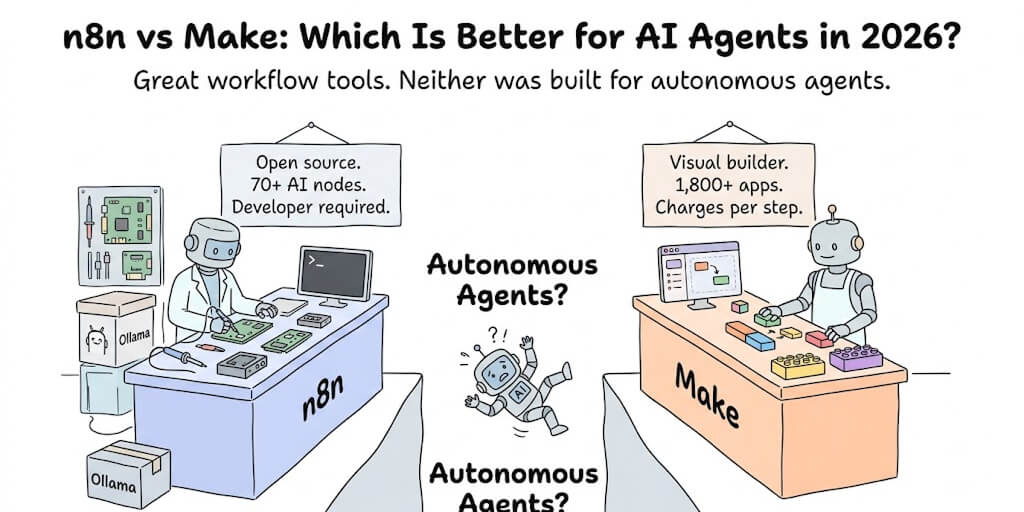
That's the n8n vs Make dilemma in 2026: n8n gives you technical depth but demands developer time. Make gives you visual simplicity but charges per step. And neither was designed from the ground up for autonomous AI agents.
Where n8n wins (and where it starts to struggle)
n8n is the developer's choice, and for good reason. Open-source, self-hostable, and loaded with AI capabilities that no other workflow tool matches.
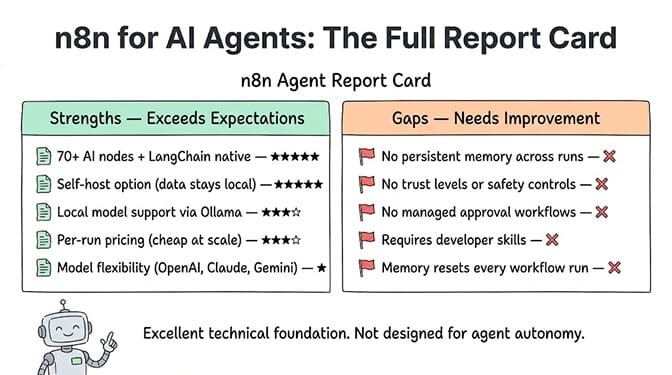
70+ dedicated AI nodes with native LangChain integration. You can build multi-step AI agent workflows with tool use, RAG pipelines, vector database queries, and custom function calling. The AI Agent node lets you create autonomous agents that decide which tools to call based on incoming data.
Model flexibility is excellent. Connect to OpenAI, Anthropic Claude, Google Gemini, Mistral, or local models through Ollama. Self-hosted n8n can run AI workflows where prompts and responses never leave your server. For teams with data residency requirements, this is a genuine differentiator.
Pricing favors volume. n8n counts per workflow run, not per step. A 10-step workflow counts as 1 execution, not 10. Self-hosted Community Edition is free with unlimited executions. You just need a server ($3-7/month). Cloud starts at €24/month for 2,500 executions.
But here's where n8n struggles for AI agent work specifically:
No persistent memory. n8n has "memory nodes" that persist context within a single workflow run. But across runs? Gone. If a customer emails you at 9 AM and again at 2 PM, the agent starts from scratch at 2 PM. You'd need to build your own memory layer with a vector database, which requires significant engineering.
No trust levels or safety controls. There's no built-in concept of "this agent can read but not send" or "this agent needs human approval before executing." You can build approval logic manually, but it's your responsibility to get it right.
Requires developer skills. Building advanced AI workflows in n8n means understanding vector embeddings, API schemas, LangChain concepts, and how to chain prompts. The 70+ AI nodes are powerful. They're also meaningless if your team can't configure them.
Where Make wins (and where it hits the wall)
Make (formerly Integromat) is the visual-first option. Founded in 2012, it's polished, intuitive, and genuinely easier to learn than n8n.
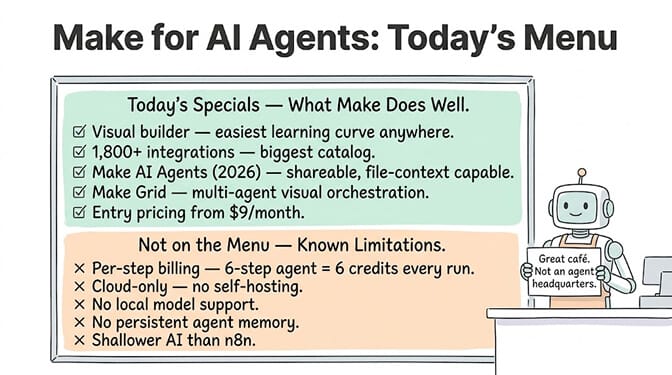
Make AI Agents launched in 2026 with autonomous agents built directly into the scenario builder. Agents can interpret input, choose tools, and adapt within workflows. You can upload files for context (no custom RAG pipeline needed), and agents are shareable across teams. Make Grid provides visual orchestration for complex multi-agent setups. Make's MCP server turns agents into callable tools for other systems.
1,800+ app integrations versus n8n's 400+. For connecting SaaS tools without custom API work, Make has a wider catalog out of the box.
The visual builder is genuinely intuitive. Non-technical teams pick it up in hours, not days. The canvas-based editor handles branching, loops, and parallel paths better than most competitors.
Pricing starts lower. Free plan with 1,000 credits/month. Core at $9/month for 10,000 credits. Pro at $16/month. Significantly cheaper than n8n Cloud for light usage.
Here's where Make hits the wall for agent work:
Credit-based pricing compounds fast. Make charges per module step ("credit"). A 5-step workflow uses 5 credits per run. n8n charges per workflow run regardless of steps. That same workflow uses 1 execution on n8n. For AI agent workflows that typically involve 5-10 steps (classify, lookup, draft, approve, send), Make's per-step billing adds up quickly.
At 200 workflow runs per day with 6 steps each, you'd use 36,000 credits monthly. The Core plan includes 10,000. You'd need to buy additional credit packs at roughly $11 per 10,000, pushing your monthly cost past $35. On n8n self-hosted, 6,000 monthly executions costs $0 in software fees.
No self-hosting option. Make is cloud-only. Your data goes through Make's servers. For teams with compliance requirements or wanting data sovereignty, this is a hard stop.
AI depth is shallower than n8n. Make's AI modules work well for straightforward tasks like summarization, classification, and content generation. But for complex multi-step reasoning, RAG pipelines with custom vector stores, or local model support, n8n's LangChain integration is significantly more capable.
The pricing math that changes everything
Let's get specific. A typical AI agent workflow (email triage with CRM lookup and response drafting) runs about 6 steps and processes 100 emails per day.
On n8n self-hosted: 3,000 executions/month. Cost: $0 software + $5 VPS = $5/month total.
On n8n Cloud (Pro): 3,000 of 10,000 monthly executions. Cost: $60/month.
On Make Core: 18,000 credits/month (100 emails x 6 steps x 30 days). Exceeds the 10,000 credit base. You'd need a credit add-on. Cost: approximately $20/month.
On Make Pro with add-on credits: approximately $30/month for the same volume with priority execution.
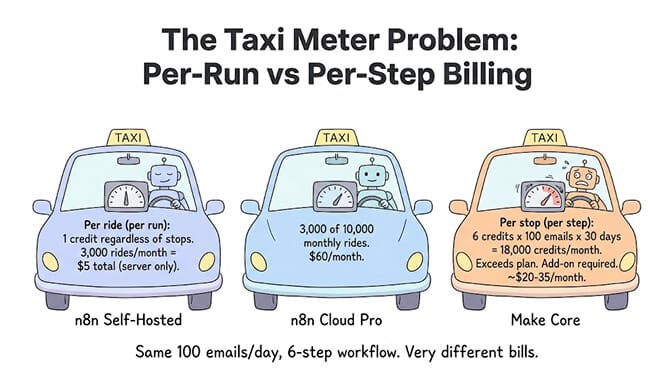
At low volume, Make is cheaper than n8n Cloud. At high volume, n8n self-hosted is essentially free. The crossover point is around 30,000+ credits/month on Make, which is where n8n's per-run pricing model starts saving serious money.
n8n counts per workflow run. Make counts per step. For AI agents that average 5-10 steps per task, this difference is a 5-10x cost multiplier.
But here's the question nobody asks in these comparisons: is a workflow automation tool even the right choice for autonomous AI agents?
The honest problem with both (for agent builders)
Both n8n and Make are excellent workflow automation platforms. They connect apps, move data between services, and execute multi-step processes reliably.
But workflow automation and autonomous AI agents are fundamentally different things.
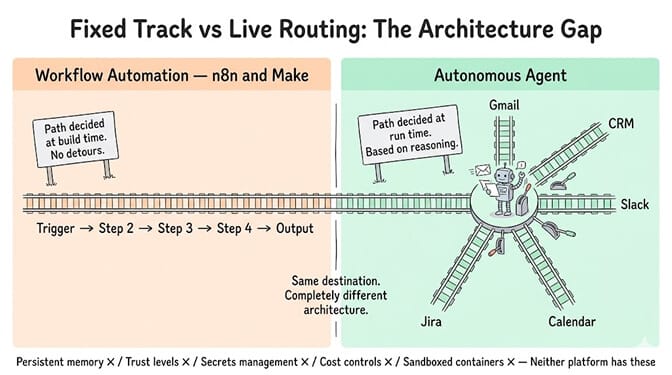
A workflow follows a predetermined path. Step 1 triggers Step 2. Step 2 triggers Step 3. The logic is fixed when you build it.
An autonomous agent decides what to do based on context. It reads a message, reasons about it, chooses which tools to use, executes, evaluates the result, and decides whether to act again or wait. The path isn't fixed. It emerges from the agent's reasoning.
n8n's AI Agent node gets closer to real autonomy than Make does. But both platforms still fundamentally think in terms of "scenarios" and "workflows," not persistent agents with memory, trust levels, and independent judgment. If the second thing is what you actually want, you can build an agent without writing code on a platform designed around agents rather than scenarios.
Neither platform has:
Persistent memory across conversations. Your agent can't remember that this customer complained last week and was offered a discount.
Trust levels. There's no "Intern" mode where the agent drafts but never sends, or "Lead" mode where it acts autonomously within defined boundaries.
Secrets management. API keys and credentials live in your configuration permanently. There's no auto-purge from agent memory after use.
Per-agent cost controls. You can't set a spending cap of $5/month on Agent A while giving Agent B unlimited budget.
Isolated execution environments. Each agent doesn't run in its own sandboxed container. A buggy workflow can affect your entire instance.
These aren't nice-to-haves for toy projects. They're requirements for running AI agents in production. Gartner estimates 40% of enterprise apps will embed AI agents by end of 2026. The gap between "workflow with LLM calls" and "production autonomous agent" is where most projects stall.
This is exactly why we built BetterClaw as a purpose-built AI agent platform instead of adding AI to a workflow tool. Persistent memory with hybrid vector plus keyword search. Trust levels (Intern, Specialist, Lead) with action approval. Secrets auto-purge after 5 minutes. Isolated Docker containers per agent. Unlimited skills, with a 4-layer security audit on our curated set. All of it managed. Free plan with 1 agent and 100 credits a month. $49/month on Pro. BYOK with zero inference markup.
When to use which (the honest recommendation)
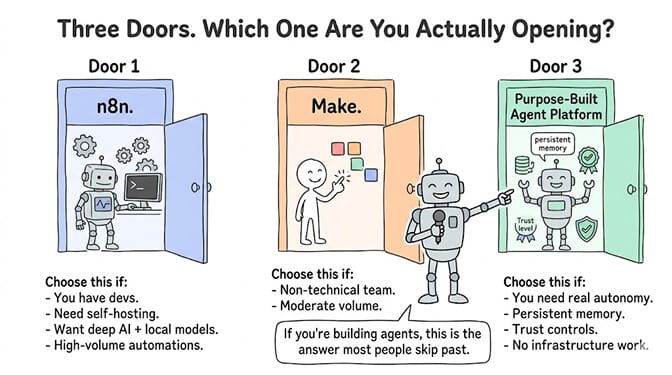
Use n8n when: you have developers on your team who can build and maintain workflows. You need self-hosting for data sovereignty or compliance. Your AI needs are specific and technical (custom RAG pipelines, local model inference, complex LangChain chains). You're running high-volume automations where per-run pricing saves money.
Use Make when: your team is non-technical and needs the most intuitive visual builder available. You're connecting many SaaS tools (Make's 1,800+ app catalog is hard to beat). Your AI needs are straightforward (summarize this, classify that, generate content). Your volume is moderate (under 30,000 credits/month).
Use neither when: you need an actual autonomous agent with persistent memory, trust levels, and independent reasoning. You want your agent to work across conversations over days and weeks. You need per-agent cost controls and security sandboxing. You don't want to build and maintain infrastructure for something that should just work. (If that's you, our managed n8n alternative for AI agents post covers the no-Docker path.)
That's where purpose-built agent platforms come in. The tooling has matured enough in 2026 that you don't have to retrofit a workflow tool into an agent platform anymore. We made the full case in BetterClaw vs n8n.
The uncomfortable truth about this comparison
Most "n8n vs Make" articles end with "it depends on your needs" and leave you exactly where you started. Here's a more useful framing:
If you're building automations (move data from A to B, trigger actions based on events, connect SaaS tools), both n8n and Make are excellent. Pick based on your team's technical skill and volume needs. If you pick n8n and add an agent later, the n8n workflow skill lets that agent trigger and monitor the workflows you already built.
If you're building agents (autonomous systems that reason, remember, and act independently), you've already outgrown what workflow tools were designed to do. The fact that both platforms have added "AI Agent" features doesn't change the underlying architecture. It's still a workflow engine with LLM calls bolted on. (If that distinction is still fuzzy, our breakdown of workflow tools vs AI agents draws the line clearly.)
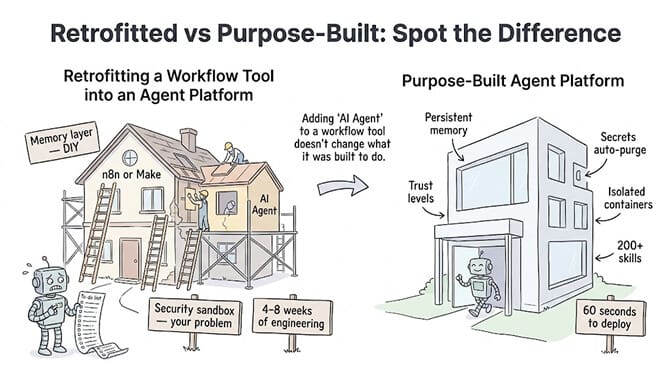
The best tool isn't the one with the most features. It's the one built for the problem you're actually solving.
If you're building automations, pick n8n or Make. If you're building agents, give BetterClaw a look. Free plan with 1 agent and 100 credits a month. $49/month for Pro on Pro. Deploy in 60 seconds. No infrastructure to manage. Your agent remembers conversations, follows trust levels, and runs in its own isolated container.
Frequently Asked Questions
What is the main difference between n8n and Make?
n8n is an open-source, developer-first workflow automation platform with self-hosting options and deep AI integration (70+ AI nodes, LangChain native). Make is a cloud-only, visual-first platform with 1,800+ app integrations and an easier learning curve. The biggest practical difference is pricing: n8n counts per workflow run while Make counts per module step, making n8n 5-10x cheaper at scale for multi-step workflows.
How does n8n compare to Make for AI agent workflows?
n8n has significantly deeper AI capabilities: native LangChain integration, an AI Agent node for autonomous tool use, vector database support, local model support through Ollama, and RAG workflow building. Make added AI Agents in 2026 with visual agent building and MCP server support, but the integration is shallower. Neither platform has persistent agent memory, trust levels, or security sandboxing for agents.
Can I build an autonomous AI agent on n8n or Make?
You can build AI-powered workflows that use LLM reasoning, but true autonomous agents with persistent memory, independent decision-making across sessions, and safety controls aren't natively supported by either platform. n8n's AI Agent node gets closest, but memory resets between workflow runs and there are no built-in trust levels or approval workflows. For production autonomous agents, purpose-built platforms like BetterClaw provide these capabilities out of the box.
Which is cheaper, n8n or Make, for AI agent workflows?
It depends on volume. At low volume (under 3,000 runs/month), Make Core at $9/month is cheaper than n8n Cloud at €24/month. At high volume, n8n self-hosted is dramatically cheaper because it's free software with unlimited executions (you pay only $3-7/month for server hosting). The critical factor is that Make charges per step while n8n charges per run, so a 6-step agent workflow costs 6x more per run on Make.
Is n8n or Make more secure for handling sensitive data?
n8n's self-hosting option gives you complete data control, which is its strongest security advantage. Your data never leaves your infrastructure. Make is cloud-only, so data passes through Make's servers. Neither platform offers agent-specific security features like secrets auto-purge from memory, isolated execution containers per agent, or trust-level-based permission controls. BetterClaw includes AES-256 encrypted credentials with auto-purge after 5 minutes and isolated Docker containers per agent.