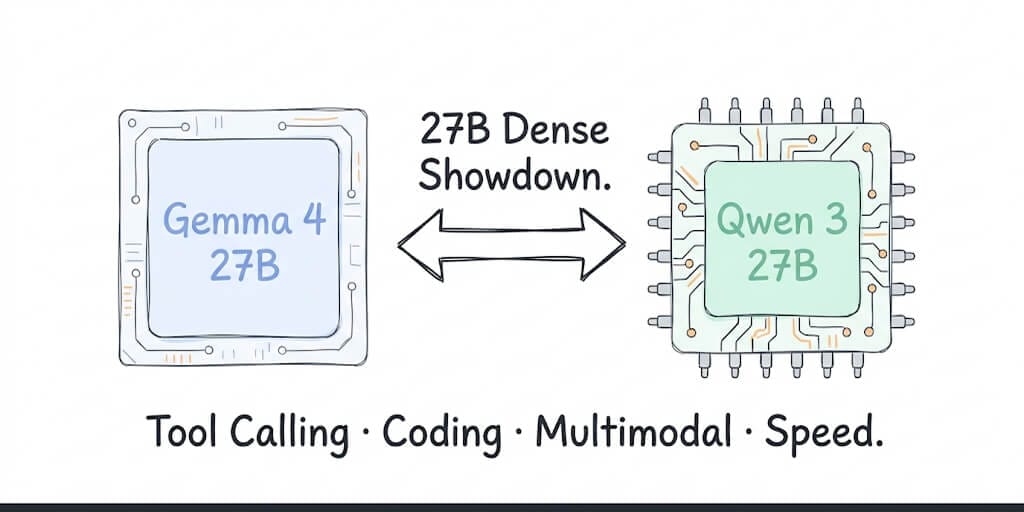
Both fit in 24GB at 4-bit. Both are Apache 2.0. One of them will make your agent embarrassingly slow. Here's which is which.
Skip the GPU cluster.
Bring your own Gemma or Qwen endpoint, get the visual builder and 200+ verified skills, deploy in 60 seconds. Free forever, not a trial. Start free → No credit card · No Docker · No config files
The premise sounds too good to be true.
Two dense models, one at 31B parameters and one at 27B. No sparse routing weirdness. Both Apache 2.0. Both fit on a single 24GB GPU at 4-bit quantization. You can run either right now, locally, on consumer hardware that already exists in your home office or your company's on-prem server.
And yet they are genuinely different animals under the hood. One is a conventional dense transformer that posts Google's best long-context retrieval numbers. The other mixes linear attention layers into a dense model built to keep long sequences cheap. One is better at following tool-call schemas. The other generates cleaner code with fewer hallucinated library names.
If you are choosing a local model to power AI agents in 2026, this comparison is the one you need. Not benchmarks for their own sake. Head-to-head on the tasks that actually matter when an agent is running in production.
Let's get into it.
First, There Is No Gemma 4 27B
If you searched for "Gemma 4 27B," you are not alone, and you are not going to find it. Gemma 3 topped out at 27B. Gemma 4 does not have a 27B.
The Gemma 4 family ships five sizes: E2B, E4B, 12B, 26B A4B, and 31B. The two that sit near 27B are very different:
- Gemma 4 31B is dense. Every parameter works on every token. This is the one this post compares, because it is the like-for-like match for a dense 27B.
- Gemma 4 26B A4B is a mixture-of-experts model with 25.2B total parameters and only 3.8B active per token. It is faster and lighter, but comparing it to a dense 27B is comparing two different kinds of model. Our Gemma 4 vs Qwen 3.5 size-by-size comparison pairs it with Qwen's 35B-A3B instead.
What You Are Actually Comparing
Before the benchmarks, a quick grounding.
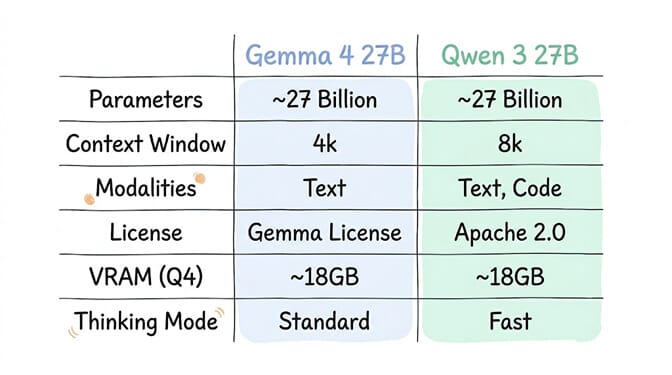
Google Gemma 4 31B is the dense flagship of Google DeepMind's Gemma 4 family, released April 2, 2026. It has 30.7B parameters, a 256K context window, configurable thinking modes, and native function calling. Input is text and images, and it can analyze video as a sequence of frames. It does not take audio: in Gemma 4, native audio is limited to the E2B, E4B, and 12B models. Google lists about 70GB to load it at BF16, 35GB at 8-bit, and 17.5GB at 4-bit. Ollama's gemma4:31b download is 20GB.
Alibaba Qwen 3.6 27B (Qwen3.6-27B) is the dense model in the Qwen 3.6 family, released April 22, 2026, alongside the 35B-A3B mixture-of-experts model. It is a hybrid reasoning model with thinking on by default, which you can switch off per request for fast answers (see how thinking mode works in agents). Its architecture mixes Gated DeltaNet linear attention with gated attention layers. Context window of 262K tokens natively, extensible to roughly 1M. Text, image, and video input. Ollama's qwen3.6:27b download is 18GB.
Both are Apache 2.0 licensed. Both are genuinely useful for building real AI agents. Neither requires a cloud API call. On tighter hardware, see our Gemma 4 12B vs Qwen 3.5 9B comparison for the smaller siblings.
One more thing before you pull anything: Qwen 3.6 is no longer the newest open Qwen at this size. Alibaba released Qwen3.8-27B on August 14, 2026, also dense, Apache 2.0, and on Ollama as qwen3.8:27b. Most of what follows applies to it too, but some agent integrations currently hang on it through Ollama's /v1 endpoint. Our Qwen3.8 27B tool-calling fix covers the workaround, which is to use qwen3.6:27b.
Tool Calling: The One That Actually Matters for Agents
Here's the thing about local models and agents. Most developers compare them on MMLU or HumanEval and then wonder why their agent hallucinates a JSON field name at 2 AM.
Tool calling accuracy under real-world schema complexity is the benchmark that matters. Not "can it generate Python" but "can it correctly identify which tool to call, populate all required arguments, and not invent optional fields that do not exist."
Qwen 3.6 27B wins this category in our experience. Its training appears to have included substantially more tool-call formatted data. In practice, schema adherence is tighter, argument types are more consistently correct, and the model is notably less likely to call a tool with a hallucinated parameter name. When you give it a 15-tool schema with nested objects, it does not panic.
Gemma 4 31B is solid on tool calling too. Google reports 76.9% on Tau2, an agentic tool-use benchmark, up from 16.2% for Gemma 3 27B. It handles Google-style function declarations well (unsurprisingly, given its lineage) and its error recovery when a tool returns an unexpected response is often cleaner. But for strict JSON schema compliance under pressure, Qwen edges it out.
Bottom line: Qwen 3.6 27B for tool-heavy agents. Gemma 4 31B is a close second, especially if your tools use Google-style function declarations.
Coding: Where Qwen Built Its Reputation
Qwen 3.6 27B generates cleaner code. This is not a hot take. On Alibaba's own model card, Qwen3.6-27B scores 77.2 on SWE-bench Verified against 52.0 for Gemma 4 31B, and 83.9 against 80.0 on LiveCodeBench v6. Those are vendor-reported numbers, so treat the size of the gap with some suspicion, but the direction matches what we see.
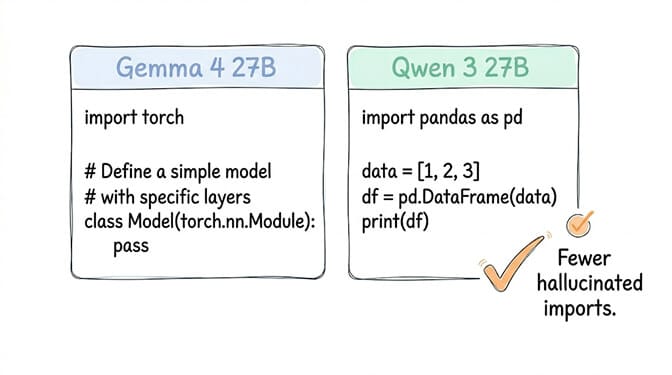
More importantly for agent builders: it hallucinates library names less. When your agent is writing a Python script to process a file, you want the imports to be real. Qwen 3.6 27B is more conservative here. It reaches for standard library solutions before inventing a convenience wrapper that does not exist.
Gemma 4 31B is a competent coder. It is not embarrassing on code tasks. But if your agent frequently generates and executes code as part of its workflow, Qwen is the better call.
The one area where Gemma 4 pulls ahead: it tends to write more readable, commented code. Qwen optimizes for correctness; Gemma 4 optimizes for something that reads like a senior developer wrote it. Depending on your use case, that might matter.
Multimodal: Closer Than You Have Been Told
This is where most comparisons of these two get it wrong.
Gemma 4's headline audio support does not reach the 31B. Google's model card lists the 31B as text and image input, with video handled as a sequence of frames. Native audio lives on the smaller E2B, E4B, and 12B models.
Qwen 3.6 27B takes text, images, and video. No audio either.
So at this weight class, neither model will transcribe a voicemail for you, and both can look at screenshots and video. If your agent genuinely needs audio in a single model call, the answer is not a bigger model. It is Gemma 4 12B, which handles text, image, and audio in one encoder-free decoder and runs in about 8GB. Our Gemma 4 12B vs Qwen 3.5 9B comparison covers it.
If your agent is text-and-image, which covers the majority of real-world agent tasks, multimodal is not the deciding factor between these two.
Context Window: Both Big, Built Differently
262K native context on Qwen 3.6 27B. Gemma 4 31B ships with a 256K context window. On paper that is a tie. In practice, effective context performance differs.
Gemma 4 31B has the stronger published retrieval number. Google reports 66.4% on MRCR v2 (8 needles at 128K), against 13.5% for Gemma 3 27B. If your agent has to find specific facts buried deep in a long document, that is the number to care about.
Qwen 3.6 27B's advantage is cost per token of context. Its Gated DeltaNet layers use linear attention, so memory and compute grow more gently as the sequence gets longer. For agents running persistent memory loops or ingesting large documents mid-conversation, that keeps long sessions cheaper to serve. Watch the thinking mode, though: reasoning tokens are generated into the conversation too, and on long tasks they add up.
Both need their context capped on consumer hardware. KV cache at anything near 256K will exhaust a 24GB card long before the weights do.
Speed and Hardware Reality
Both models on a single A100 80GB (or a pair of 48GB workstation cards): inference speed is comparable. In the 15-25 tokens-per-second range at fp16, depending on batch size.
Quantized to Q4: expect 20-35 tokens per second on a single 24GB consumer GPU (4090, A5000). Qwen 3.6 27B tends to be slightly faster at Q4, because it is about 4B parameters smaller and its linear attention layers are cheaper on long sequences. It also leaves more room: 18GB against 20GB for the default Ollama downloads.
For an agent that needs to respond in under 3 seconds, both models are workable at Q4 on 24GB VRAM, with thinking mode off for simple turns. For a high-volume agent handling hundreds of concurrent requests, you need to profile on your actual workload. Neither model is going to match a hosted API in raw throughput without serious investment in serving infrastructure.
The honest hardware math: if you are running one agent, a single 4090 + Q4 quantization works for either model. If you are running a fleet, the serving infrastructure cost starts to add up fast.
This is exactly where teams running local models for their agents start to notice the hidden cost. The GPU is a one-time purchase. The electricity, the inference server, the monitoring, the model updates... those are ongoing. If you are building agents primarily to avoid per-token API costs, the math deserves a careful look at total cost of ownership versus simply bringing your own API key to a managed platform.
If you want to experiment with either model before committing to the hardware investment, BetterClaw supports both Gemma and Qwen model families via BYOK. You connect your own inference endpoint, pay your provider directly, and get the full visual agent builder and 200+ verified skills without managing infrastructure. Free plan available, no credit card. Worth a look if you want to test your agent logic before spinning up the GPU cluster.
The Agent Decision Matrix
Not every agent task maps cleanly to one model. Here is the honest breakdown:
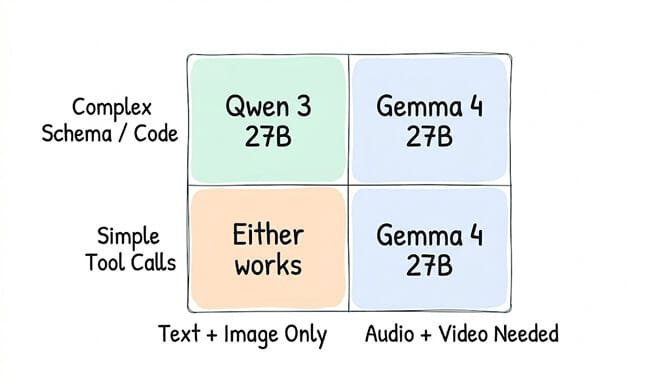
Pick Qwen 3.6 27B if: Your agent primarily calls tools with complex schemas, you value tight code generation for script-executing agents, you need a little more VRAM headroom on a 24GB card, or you want long sessions to stay cheap to serve.
Pick Gemma 4 31B if: Your agent has to retrieve specific facts from very long documents, your team is already using Google's function-calling format, or you want more readable generated code in agents that explain their own outputs.
Pick neither if: Your agent needs audio input. Drop to Gemma 4 12B.
Where they are roughly equal: Instruction following on straightforward tasks, image and video understanding, RAG pipeline performance, general reasoning, and multilingual tasks.
What Nobody Tells You About Running 27B-Class Models for Agents
The benchmarks show one thing. Production shows another.
The biggest practical difference between running Gemma 4 31B and Qwen 3.6 27B in an agent loop is not the model. It is the system prompt size, the tool schema serialization format, and whether your agent framework handles partial tool-call responses gracefully.
Thinking mode adds latency on both. Qwen 3.6 thinks by default, and Gemma 4 has a configurable thinking mode of its own. If you enable deep reasoning on every turn, you will see 2-5x slower responses for simple tasks. You need to build a routing layer that decides when thinking mode is worth the overhead and when fast mode is fine. That is not complicated, but it is work that does not show up in any benchmark.
Vision input requires the right inference server. Not every Ollama setup or llama.cpp build exposes image and video input cleanly for every model. If you are deploying either model for multimodal agents, verify your serving layer handles those input types before you build your agent around them.
Both models benefit from well-structured system prompts. Vague instructions produce worse results than tight, specific role definitions with explicit tool-use guidelines. That is not a model-specific insight. It is just agent development hygiene.
For reference on how to build skills and tool integrations that work cleanly across local models, the skills that actually reduce token usage breakdown is worth reading alongside this comparison. The same patterns that prevent token bloat in hosted models matter even more when you are working with a 256K context window at 25 tokens per second locally.
Connecting Local Models to Real Agent Workflows
Here is a question worth asking: why are you running local in the first place?
If the answer is data privacy, both models give you that. No API call leaves your network.
If the answer is cost, the math is more complex than it looks. Local inference on 27B-class models is not free. A single 4090 at current electricity prices, amortized over three years, costs roughly $0.08-0.12 per hour of inference. At typical agent task volumes, hosted BYOK models on platforms with zero inference markup often come out cheaper than the electricity bill.
If the answer is latency, local wins cleanly. Sub-100ms first-token latency on a good setup beats any hosted API.
If the answer is compliance or air-gap requirements, local is the only answer.
For teams who want the flexibility of local models for development but the reliability of managed infrastructure in production, it is worth knowing that BetterClaw supports 28+ LLM providers, including self-hosted endpoints. You can build and test against your local Gemma or Qwen instance, then point your production agents at a managed provider when you need reliability guarantees. The agent logic does not change. Just the endpoint.
The Honest Verdict
Qwen 3.6 27B is the better all-around agent model. Tighter tool calling, stronger code generation, thinking mode for complex planning, a 262K context window that stays cheap on long sessions, and a smaller footprint on a 24GB card.
Gemma 4 31B is the right choice when long-document retrieval is the heart of your agent, or when you want the cleanest integration with Google's tooling ecosystem.
Neither is a wrong choice. Both are genuinely impressive at this size. The fact that you can run either on a single consumer GPU, for free, with an Apache 2.0 license, is something that would have sounded like science fiction in 2022.
If you are starting fresh today, also test Qwen 3.8 27B, the newer open-weight Qwen at the same size, once your agent framework works cleanly with it.
The more interesting constraint is not which model. It is what you build around it. Tool schemas, system prompt quality, context management, and memory architecture matter more than the model choice for most real agent tasks. A well-engineered agent on Qwen 3.6 27B will outperform a sloppily built one on GPT-4o.
Pick the model that fits your workload. Then invest your engineering time in the agent architecture. That is where the real performance gap gets made.
If you want to connect either of these models to a full agent stack without building the infrastructure yourself, give BetterClaw a try. Bring your own inference endpoint, use the visual builder, and get 200+ verified skills out of the box. Free plan, no credit card, first deploy in 60 seconds. We handle the agent infrastructure so you can focus on what the agent actually does.
Frequently Asked Questions
Is there a Gemma 4 27B?
No. Gemma 4 ships at E2B, E4B, 12B, 26B A4B, and 31B. The 27B size belonged to Gemma 3. If you want a dense Gemma 4 to compare against a 27B model, use Gemma 4 31B. If you want the faster option, the 26B A4B is a mixture-of-experts model with 3.8B active parameters per token.
What is the difference between Gemma 4 31B and Qwen 3.6 27B for AI agents?
Both are dense, Apache 2.0 models that run on a 24GB GPU at 4-bit. Qwen 3.6 27B generally has the edge on tool calling and code generation, and Alibaba's model card shows it ahead on SWE-bench Verified (77.2 vs 52.0). Gemma 4 31B has Google's strongest long-context retrieval result (66.4% on MRCR v2). Neither takes audio input; in Gemma 4 that is limited to the E2B, E4B, and 12B models.
How does Qwen 3.6 27B compare to Gemma 4 31B on tool calling?
Qwen 3.6 27B edges out Gemma 4 31B on tool calling in our testing, particularly for complex nested schemas with many parameters. Its training appears to include more tool-call formatted data, resulting in tighter JSON schema compliance and fewer hallucinated argument names. Gemma 4 31B handles tool calling well, with Google reporting 76.9% on Tau2, especially for Google-style function declarations, but Qwen is the safer choice for strict schema adherence in production agents.
How do I run Gemma 4 31B or Qwen 3.6 27B locally for AI agents?
Both models can be run locally via Ollama, llama.cpp, or vLLM. On Ollama, pull gemma4:31b (20GB) or qwen3.6:27b (18GB). For Q4 quantized inference, a single 24GB GPU (such as an NVIDIA 4090 or A5000) is sufficient for either model if you cap the context length. Both have thinking modes that need configuring so they only activate when a task needs them.
Should I use Qwen 3.8 27B instead of Qwen 3.6 27B?
Qwen3.8-27B, released August 14, 2026, is the newer open-weight dense Qwen at the same size and is on Ollama as qwen3.8:27b. It is worth testing for new builds. For agents already running on Qwen 3.6 27B there is no rush, and if your agent hangs on Qwen 3.8 through Ollama's /v1 endpoint, see our Qwen3.8 27B tool-calling fix.
Is it worth running a 27B-class local model versus using a hosted API for agents?
It depends on your requirements. Local 27B-class models provide data privacy, no per-token API cost, and low latency. However, the total cost of ownership including hardware amortization, electricity, and maintenance is often higher than using a BYOK hosted provider with zero inference markup. For compliance or air-gap requirements, local is the only option. For most teams, a hybrid approach, developing locally and deploying via a managed provider, balances cost and reliability best.
Are Gemma 4 31B and Qwen 3.6 27B safe and reliable enough for production agent workflows?
Both models are production-grade at this scale. The more relevant reliability questions are around your serving infrastructure, not the models themselves. Inference server uptime, quantization quality, context window management, and tool schema handling matter more than the base model for production reliability. In agent deployments specifically, the quality of your system prompt, tool definitions, and memory architecture will have a larger impact on reliability than the model choice between these two.
Test local, deploy anywhere.
Build against your local Gemma or Qwen endpoint, then point production at any of 28+ providers. Same agent logic. Free forever, not a trial. Start free →