The agents people actually keep running in year two aren't the flashy ones. Here's what the survivors look like.
Someone showed me their first OpenClaw agent last month.
It was supposed to handle their entire customer support workflow. Read every ticket. Understand sentiment. Pull the customer's full history. Decide whether to escalate. Draft a response in the company's voice. Approve some, flag others, apologize when necessary, upsell when appropriate.
One agent. Seven responsibilities. Six weeks of building. Two weeks of production testing. They shut it off after nine days because it kept making expensive decisions that a human would have made differently.
I asked what they were going to build next. They said, "Something simpler."
That's the lesson. That's the whole post.
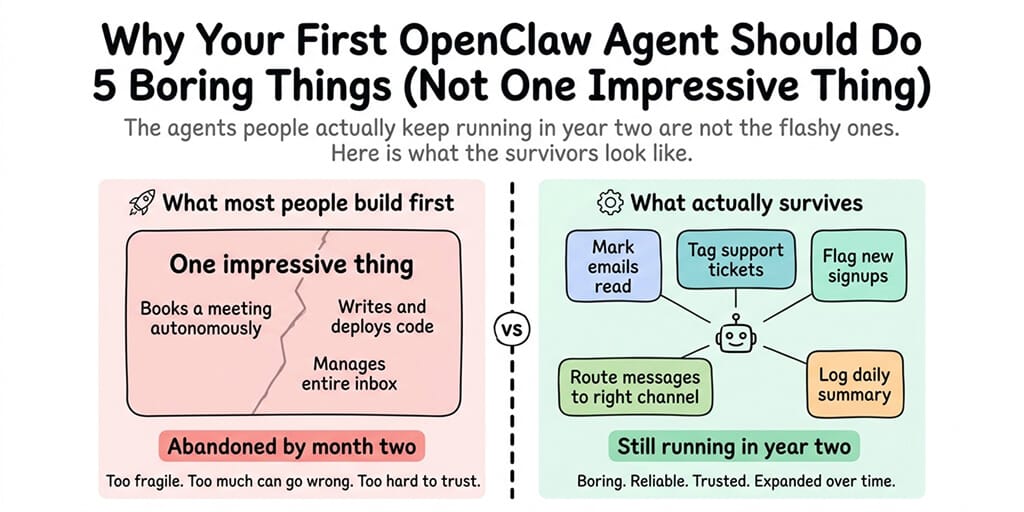
Your first OpenClaw agent should do five boring things, not one impressive thing. Every operator figures this out eventually. Most of them figure it out the expensive way.
The myth of the impressive first agent
We're in the era of agent demos. Twitter is full of them. You've seen the 90-second clips. An agent plans your week, books your flights, negotiates with your landlord, writes your novel, and files your taxes. It looks incredible.
Here's the weird part. Almost none of those demos are running in production six months later.
The agents that survive, the ones people actually keep paying for, are the ones doing unglamorous work in the background. Marking Slack threads as read when the topic's been resolved elsewhere. Tagging incoming support tickets by category. Logging a one-line summary of every new customer signup to a channel. Flagging PRs that haven't been reviewed in 48 hours. Pulling the week's top-voted feature requests into a doc.
None of those will go viral. All of them compound into real operational value over time.
The best first agent isn't the one that does the hardest thing. It's the one that does five easy things reliably for three months.
That's a less sexy thing to tweet. It's also how you actually end up with a working automation stack.
Why five boring things beats one impressive thing
Three reasons, in order of how painfully I've learned them.
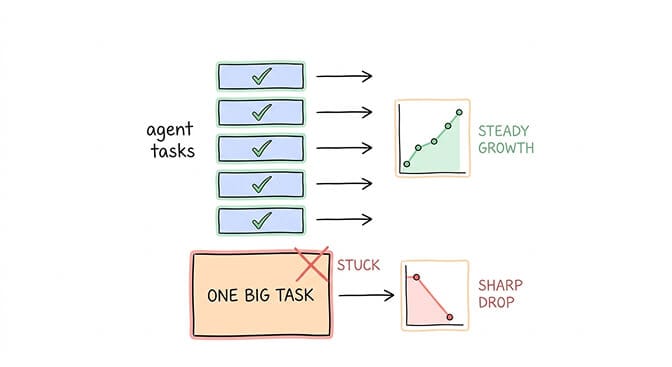
Reliability compounds. Five small tasks each working 95% of the time gives you real operational lift. One big task working 70% of the time is a liability that needs constant supervision. Small scope makes reliability tractable. Big scope makes it aspirational.
Retreat is cheap. When one of five boring tasks breaks, you disable that one task and the other four keep working. When your one big ambitious agent breaks, the whole workflow stops and you're back to doing it manually. Modularity is survivability.
You learn what's actually useful. You don't know what your agent should do yet. You think you do. You don't. Five small deployments teach you which tasks generate real value and which were just cool-sounding ideas. One big deployment teaches you nothing because you can't tell which part was valuable and which part you could have skipped.
The demos get glory. The boring agents get to year two.
The five boring things that always earn their keep
Let me be specific. These are patterns I've seen work across companies, not things I made up.
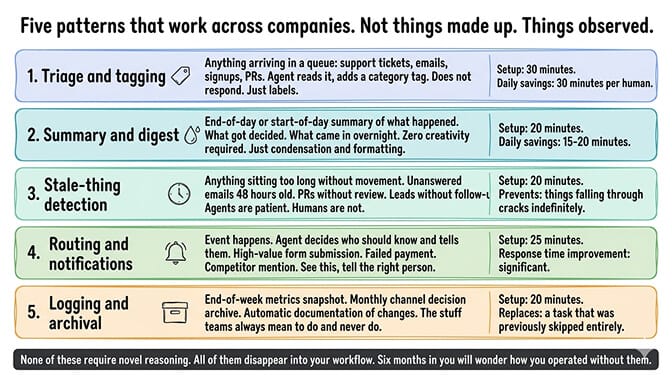
1. Triage and tagging. Anything that arrives in a queue (support tickets, inbound emails, new sign-ups, PRs, bug reports) benefits from having an agent read it and add a tag or a label. Agent doesn't need to respond. It just needs to say "this is category X." Five minutes of setup, saves humans 30 minutes a day.
2. Summary and digest. End-of-day or start-of-day summaries of what happened in a specific channel or system. "Here's what got decided in #product yesterday." "Here are the five tickets that came in overnight." Zero creativity required. Just condensation and formatting.
3. Stale-thing detection. Flag anything that's been sitting for too long without movement. Unanswered emails over 48 hours old. PRs without a review. Leads that never got a follow-up. Invoices past due. Agents are patient. Humans are not. This pairing is the whole point.
4. Routing and notifications. An event happens. Agent decides who should know and tells them. Somebody high-value filled out a Typeform. A payment failed. A customer mentioned a competitor in a call transcript. The agent's entire job is "see this, tell the right person."
5. Logging and archival. End-of-week snapshot of key metrics into a doc. Monthly archive of decisions made in a specific channel. Automatic documentation of what changed. The stuff teams always mean to do and never do.
None of these require novel reasoning. All of them disappear into your workflow once they're running. Six months in, you'll wonder how you ever operated without them.
Look at the top OpenClaw use cases that have emerged in production deployments across the ecosystem. The common thread isn't raw capability. It's boring things, running quietly, for long periods.
The Summer Yue lesson
I keep coming back to the Meta incident. Summer Yue, a researcher at Meta, had an agent mass-delete her emails while ignoring stop commands. That's the canonical story of "first agent goes wrong."
Here's what nobody notices about that story. The agent had too much authority. Not too little skill. Nobody's arguing Summer's agent lacked intelligence. The problem was that its scope included the power to delete things irreversibly, and nothing in the architecture caught the mistake before it propagated.
That's what you get when your first agent is designed to do one impressive thing instead of five boring ones. Impressive usually requires broad permissions. Broad permissions mean a single bad decision has a large blast radius. Five narrow tasks with narrow permissions give you five small blast radii, each survivable on its own.
Meta banned OpenClaw internally on work devices after incidents like Summer's. That's not a statement about OpenClaw's quality. It's a statement about how teams were using it. They were reaching for one impressive thing when they should have been building five boring ones.
Why everyone builds the wrong first agent anyway
Stay with me here. You already know the argument. You've nodded along to the whole post. You're still going to want your first agent to do one impressive thing.
Here's why.
Founders build impressive first agents because impressive is what they can pitch. Developers build impressive first agents because impressive is what they can show. Ops leads build impressive first agents because impressive is what justifies the budget.
The boring path loses out every time at the decision table, even though it wins every time in production.
The trick is to stop pretending you're building a hero product and start pretending you're building a utility. You don't demo a utility. You just notice, six months later, that your team runs 20% smoother and you can't quite remember what life was like before.
If your team has never shipped an OpenClaw agent before, the fastest path to "shipped and running" is the boring path. BetterClaw lets you ship five small OpenClaw agents instead of one big one, each with their own scoped skills, encrypted credentials, and auto-pause on anomalies. $49/month for Pro, BYOK, and all five included in that price is still cheaper than one developer-week spent wrestling with Docker.
The design pattern that saves you
Here's the specific pattern I'd recommend for every team's first agent rollout.
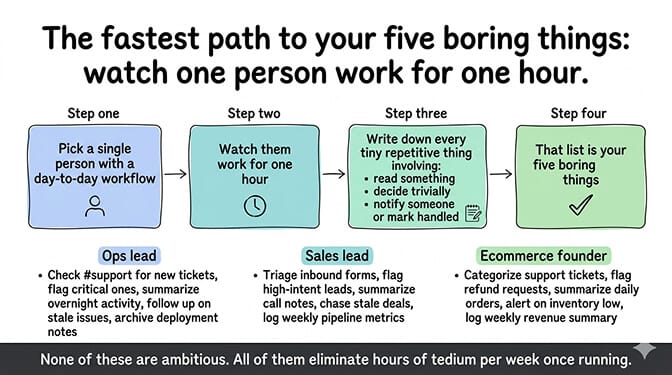
Pick a single person in your company who has a day-to-day workflow. Watch them work for an hour. Write down every tiny repetitive thing they do that involves reading something, deciding something trivial, and either notifying someone or marking something as handled.
That list is your five boring things.
For an ops lead, it might be checking the #support channel for new tickets, flagging critical ones, summarizing overnight activity, following up on stale issues, and archiving last week's deployment notes. For a sales lead, it might be triaging inbound form submissions, flagging high-intent leads, summarizing call notes, chasing stale deals, and logging weekly pipeline metrics. For an ecommerce founder, it might be the specific support-and-operations patterns covered in OpenClaw agents for ecommerce.
None of these are ambitious. All of them disappear hours of tedium a week once they're running.
The self-discipline problem
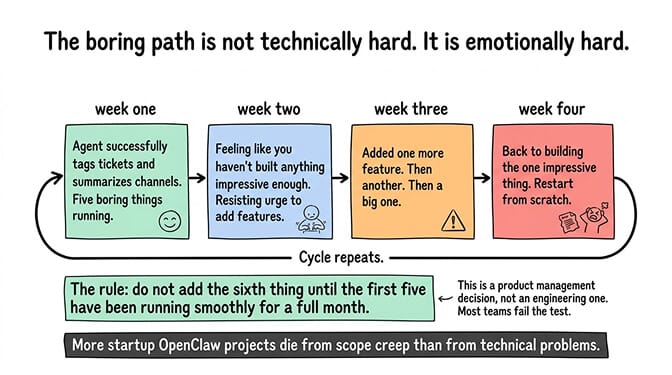
The boring path is not technically hard. It's emotionally hard.
You'll be sitting there in week two, with your agent successfully tagging tickets and summarizing channels, feeling like you haven't built anything impressive enough. You'll want to bolt on one more feature. Then another. Then a big one. By week four, you're back to building the one impressive thing.
This is how every first agent ends up rebuilt.
The discipline isn't technical. It's "don't add the sixth thing until the first five have been running smoothly for a full month." That's a product management decision, not an engineering one. Most teams fail the test.
OpenClaw for startups has a specific version of this trap, because startups are culturally predisposed to "ship the impressive thing first." I've watched more startup OpenClaw projects die from scope creep than from technical problems.
The teams that make it past month three are the ones who treat the boring list as sacred and the ambitious ideas as quarterly experiments to bolt on later, only after the foundation is proven.
When agents start doing one big thing well
There's a point at which ambitious agent workflows do become viable. It's not your first agent. It's your third or fourth, after you've learned how your team actually uses them and where the genuinely high-leverage work is.
Once you've run five boring things reliably for three months, you'll have a much clearer picture of where the real value lives. That's when you build the more ambitious agent. By that point you know exactly which human decisions it's replacing, what the failure modes look like, and where the blast radius has to be bounded.
The sequence matters. Boring things first. Ambitious things earned.
The operations-focused use cases we've seen succeed in the BetterClaw ecosystem all follow this pattern. Nobody's flagship agent is their first agent. The good ones grow out of months of smaller wins.
One last thing
If you've been avoiding building your first OpenClaw agent because you haven't thought of something impressive enough, I want to give you explicit permission to stop.
Your first agent should be embarrassing to demo. That's the point. The ceiling of what a first agent should do is "makes your Monday 10% less annoying." Not "runs your customer success team." Not "replaces your operations lead." Not "autonomously manages your Stripe account." Ten percent less annoying, on five small axes, for three months.
That's what wins. That's what compounds. That's what's still running when this week's viral demo is quietly deleted.
If you've been sitting on ideas for boring things an agent could do and want to ship one this weekend, give BetterClaw a try. $49/month for Pro, BYOK, five boring agents cost less than an hour of your time, and your first deploy takes about 60 seconds. We handle the infrastructure. You handle the part where you resist the urge to make it impressive.
One more thing worth sitting with. The best operators I know all describe their most valuable agents the same way. They describe them as unremarkable. You don't even notice them running. They just make everything slightly smoother, slightly faster, slightly less annoying, and they've been doing it for long enough that nobody remembers life before.
That's the bar. Not impressive. Unremarkable. Reliable. Essential.
Start there.
Frequently Asked Questions
What should my first OpenClaw agent do?
Your first OpenClaw agent should handle five small, repetitive, low-risk tasks rather than one ambitious one. Good candidates: triaging and tagging incoming messages, generating summary digests, flagging stale items, routing notifications, and logging recurring events. Each task should take under 30 minutes to set up and should replace work that annoys someone on your team daily.
How does building five boring agent tasks compare to one ambitious agent workflow?
Five small tasks at 95% reliability give you real daily lift with survivable failure modes. One ambitious workflow at 70% reliability creates a supervision burden that often kills the project. Boring tasks also teach you which work is genuinely high-value before you invest in building something complex.
How long does it take to deploy a first OpenClaw agent on a managed platform?
On a managed OpenClaw platform, a first agent handling basic triage or summary tasks takes about 15 to 30 minutes from signup to running, including picking skills and configuring credentials. The first deploy on BetterClaw takes about 60 seconds; the rest is defining what you want the agent to do. Self-hosted setups take significantly longer because you're also configuring infrastructure.
Is an OpenClaw agent worth the $49/month subscription for small teams?
For most teams, yes. A single agent replacing 30 minutes of repetitive daily work is already earning its keep at $49/month. Teams usually find that once they have one agent running well, they want three or four — which is why Pro bundles five. BYOK means your real cost is the API bills from the model providers, not the agent fee itself.
What happens when an OpenClaw agent gets stuck or confused?
Most agents fail by looping or repeating the same action. The fix is setting retry limits, running the agent with a narrow scope so failures have a small blast radius, and monitoring for the patterns described in why OpenClaw agents get stuck in loops. Starting with five boring tasks instead of one ambitious one makes failures easier to diagnose and less damaging when they happen.