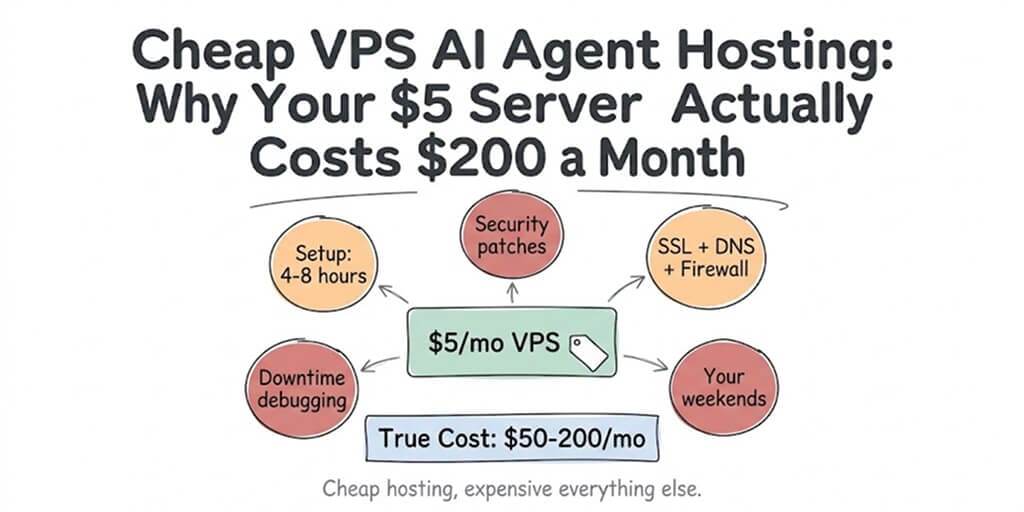
The sticker price is $5. The real price is your weekends, your security, and your sanity. Here's the full math.
The Hetzner receipt said $4.51.
I'd found the cheapest possible way to host an AI agent. A CX22 instance in Nuremberg, 4GB RAM, 2 vCPUs, 40GB disk. Enough to run a containerized agent framework with a single agent handling support tickets through Telegram.
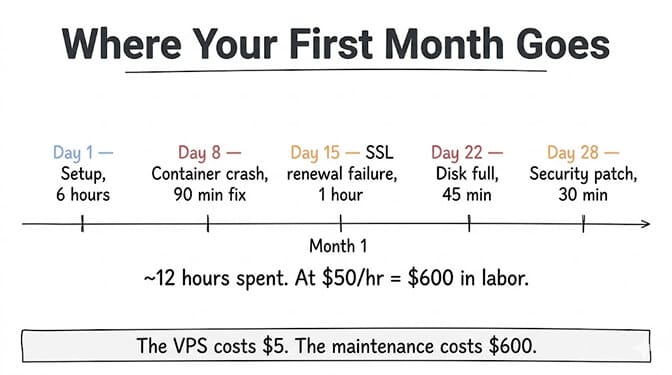
Setup took a Saturday afternoon. Docker install, nginx reverse proxy, Let's Encrypt for SSL, a firewall config that took three attempts because I kept locking myself out of SSH. By 6 PM, the agent was responding. I felt genuinely clever.
Then the first month happened.
The agent crashed at 3 AM on a Tuesday because a dependency update broke the container. I spent 90 minutes debugging it the next morning instead of prepping for a client call. Two weeks later, a Telegram webhook stopped receiving messages because the SSL certificate auto-renewal had silently failed. That took another hour to diagnose. Then I discovered I hadn't configured log rotation, and the disk was 94% full from agent conversation logs nobody was reading.
By the end of month one, my $4.51 VPS had consumed roughly 12 hours of my time. If my time is worth even $50/hour (conservative for a founder), that's $600 in invisible labor. On a $5 server.
This is the cheap VPS AI agent hosting trap. And it catches almost everyone who tries it.
The $5 VPS: what you actually get (and what you don't)
Let's be specific about what cheap VPS AI agent hosting looks like in June 2026. Here are real prices from major providers:
- DigitalOcean: $6/month (1 vCPU, 1GB RAM, 25GB SSD). Or $12/month for 2GB RAM.
- Hetzner: $4.51/month (2 vCPU, 4GB RAM, 40GB SSD). Best raw value.
- Contabo: $6.49/month (4 vCPU, 8GB RAM, 50GB SSD). Highest specs per dollar.
- Hostinger: $5.99/month (1 vCPU, 4GB RAM, 50GB SSD).
These are real machines. They work. You can SSH in, install Docker, pull an agent framework image, and have something running in a few hours.
Here's what you don't get:
No automatic updates. When a security patch drops (and in the AI agent space, they drop frequently), you apply it manually. Or you don't, and your exposed instance joins the 500,000+ agent framework instances running on the public internet without authentication that Bitsight and Hunt.io documented in early 2026.
No monitoring. Your agent crashes at 2 AM and nobody notices until a customer complains at 9 AM. Seven hours of silent failure. No health checks. No auto-restart. No anomaly detection.
No secrets management. Your API keys sit in a .env file on the server. If someone gets SSH access (and if you're running a default config with password auth, that's a matter of time), they get every credential your agent uses. Gmail. HubSpot. Slack. All of it.
No isolation. If you run multiple agents on the same VPS, they share everything. One compromised agent can access another agent's data, credentials, and conversation history.
For the full security picture of what happens when agent frameworks run on exposed infrastructure, the numbers are sobering. CrowdStrike published a full enterprise advisory. Cisco found a third-party skill performing data exfiltration. The ClawHavoc campaign compromised 1,400+ skills on the open marketplace.
A $5 VPS gives you compute. It doesn't give you operations, security, monitoring, or sleep. You supply those yourself.
The hidden costs nobody puts on the pricing page
Let's build the real cost spreadsheet. Not the hosting cost. The total cost of operating an AI agent on cheap VPS AI agent hosting for 12 months.
Month 1: Setup
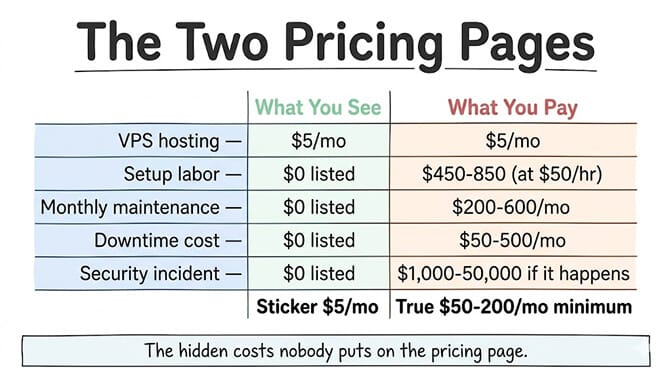
- Initial server setup (OS hardening, Docker, reverse proxy, SSL, firewall, DNS): 4-8 hours
- Agent framework installation and configuration: 2-4 hours
- Connecting integrations (OAuth flows, webhook configs, API key setup): 2-3 hours
- First debugging session when something inevitably doesn't work: 1-2 hours
Total month 1: 9-17 hours of setup labor
Monthly ongoing (months 2-12)
- Security patches and dependency updates: 2-3 hours/month
- Debugging crashes, webhook failures, SSL renewals, disk cleanup: 1-3 hours/month
- Monitoring (manual check-ins because you don't have automated monitoring): 1-2 hours/month
- Occasional "something broke and I don't know why" incidents: 0-4 hours/month
Total monthly ongoing: 4-12 hours/month
The 12-month math
- VPS hosting: $5 x 12 = $60/year
- Setup labor (once): 12 hours x $50 = $600
- Ongoing maintenance: 6 hours/month x 11 months x $50 = $3,300
- Total year 1: $3,960
That's $330/month when you include your time. On a $5 server.
And this assumes nothing goes seriously wrong. No security breach. No data loss. No extended downtime during a critical business period. Priced against that, a managed AI agent platform is buying back the hours the spreadsheet above does not show.
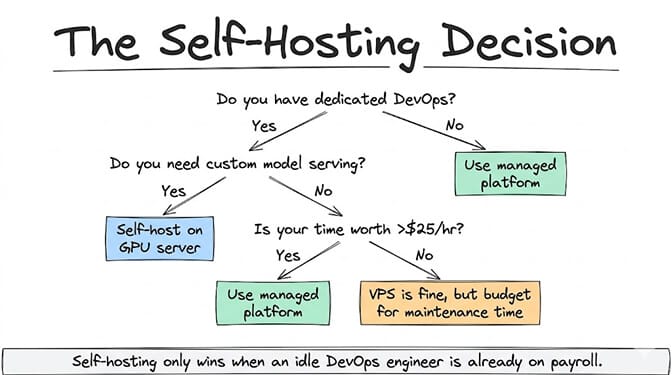
The managed vs self-hosting TCO comparison we published breaks this down across different team sizes. The short version: self-hosting only makes economic sense when you have a dedicated DevOps engineer who would be idle otherwise. For the OpenClaw-specific version of this decision, our self-hosting vs managed OpenClaw breakdown walks through ten scenarios where each one wins, and our OpenClaw hosting costs compared post puts side-by-side numbers on each provider.
The security gap that should keep you up at night
Here's the part that moves this from "inconvenient" to "genuinely dangerous."
In January 2026, the ClawHavoc campaign discovered 1,400+ malicious skills on ClawHub. These skills had names that looked legitimate. They worked as advertised. But they also exfiltrated SSH keys, API tokens, and browser cookies through reverse shells.
A Snyk audit found 13.4% of all skills had critical security issues.
On a $5 VPS, you're running these skills without a 4-layer security audit, without sandboxed execution, without credential isolation, and without secrets auto-purge. Your agent has the same access level as your SSH user. If a skill goes rogue, it can read your .env file, access every connected service, and exfiltrate data before you even know something happened.
This isn't hypothetical. Cisco documented a third-party skill performing data exfiltration without user awareness. It passed through the agent as a normal operation.
On a managed platform with proper security architecture, skills run in isolated Docker containers. Credentials are encrypted with AES-256 and purged from agent memory after 5 minutes. If a skill tries to access anything outside its sandbox, the request is blocked and flagged.
On your $5 VPS? The skill and your server are the same trust boundary. There is no sandbox. There is no purge. There is no flag.
The cheapest VPS in the world doesn't save you money if it costs you your customers' data.
When a $5 VPS actually makes sense (yes, there are cases)
I'm not going to pretend self-hosting is always wrong. There are legitimate reasons to run an agent on your own infrastructure:
Data sovereignty requirements. If your compliance framework requires data to stay on specific hardware in a specific jurisdiction, and no managed platform offers that, self-hosting is your only option.
Custom model serving. If you're running a fine-tuned open-weight model locally (like the upcoming MiniMax M3 open weights or a custom Llama variant), you need your own GPU server. A $5 VPS won't cut it for this anyway, but a proper GPU instance ($50-200/month) serves a different purpose.
Learning and experimentation. If you're a developer who wants to understand agent architecture from the ground up, running it yourself teaches you things a managed platform can't. Just don't run production workloads on your learning server.
You have dedicated DevOps. If your team includes someone whose job is infrastructure management, and they have capacity, the maintenance burden shifts from "founder's weekend" to "engineer's Tuesday afternoon." The economics change.
For everyone else, especially founders, solopreneurs, and small teams where the person setting up the VPS is the same person who should be closing deals, hiring, or building product... the math doesn't work.
This is exactly why we built BetterClaw the way we did. No VPS. No Docker. No SSH. No 3 AM debugging sessions. Sign up, connect your LLM API key, pick your integrations, and deploy in 60 seconds. Your agent runs in isolated containers with encrypted credentials and secrets auto-purge. Free plan with 1 agent and 500 credits a month. $49/month on Pro. You bring your own API keys with zero inference markup.
The $49/month sounds more expensive than $5. Until you factor in the 6+ hours per month you're not spending on maintenance.
The Anthropic ban changed the VPS math even further
Here's something most VPS guides don't mention.
On April 4, 2026, Anthropic banned Claude Pro and Max subscriptions from third-party tools including popular agent frameworks. Overnight, self-hosted users went from $20/month flat-rate Claude access to per-token API billing.
If your agent used Claude heavily, your monthly LLM cost jumped from $20 to potentially $100-500 depending on volume. That price increase hit self-hosted and managed users equally, but managed platforms adapted routing and offered BYOK options quickly. On your $5 VPS, you had to manually reconfigure your agent's model settings, update API keys, and figure out the new billing structure yourself.
The broader pattern: when a provider changes terms, breaks an API, or deprecates a model, managed platforms handle the migration. On a VPS, you handle it. DeepSeek is deprecating its legacy API aliases on July 24, 2026. If your agent uses deepseek-chat or deepseek-reasoner, those will stop working. On a managed platform, the routing layer updates automatically. On your VPS, you get a broken agent and a debugging session.
For a complete guide to choosing which LLM to use, including routing strategies that work across model changes, the framework is simpler than most people assume.
The real comparison: what $49 gets you vs what $5 gets you
Let me be direct. Here's BetterClaw's Pro plan at $49/month versus a $5 VPS.
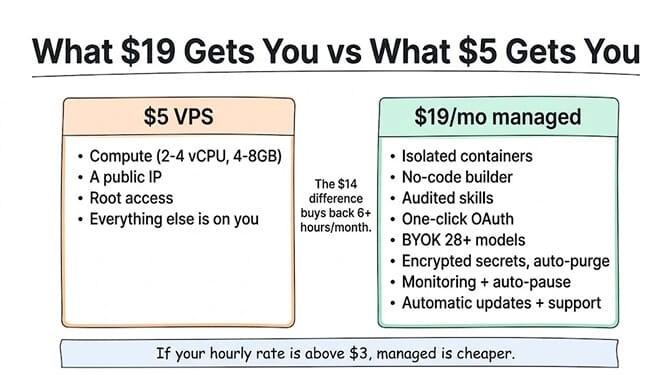
$5 VPS gives you:
- Compute (2-4 vCPUs, 4-8GB RAM)
- A public IP address
- Root access
- Everything else is your responsibility
$49/month managed gives you:
- 5 agents and 12,000 credits/month
- Compute (isolated Docker containers per agent)
- No-code visual builder
- 200+ verified skills with 4-layer security audit
- 25+ one-click OAuth integrations
- 28+ AI model providers (BYOK, zero markup)
- 15+ chat platform connections
- AES-256 encrypted credentials with 5-minute auto-purge
- Trust levels with action approval and kill switch
- Real-time health monitoring and auto-pause
- Persistent memory with hybrid search
- Smart context management
- Heartbeat scheduling with per-agent cost caps
- 24h email support
- Automatic updates and security patches
The $44/month difference buys you roughly 6+ hours of your time back every month. If your hourly rate is above $8, managed is cheaper.
The uncomfortable truth about DIY infrastructure
I'll end with this because it's what I wish someone had told me before I spun up that Hetzner box.
There's a certain satisfaction in running your own server. Knowing exactly where your data lives. Having root access. Feeling the technical competence of a clean Docker Compose file that just works.
But that satisfaction fades fast when the agent goes down on a Saturday morning and your partner is giving you that look as you pull out the laptop to SSH into a server in Germany.
The question isn't whether you can self-host an AI agent on a $5 VPS. Of course you can. The question is whether that's the best use of the most limited resource you have: your time.
For most people reading this, it isn't.
The agent framework you choose matters. The model you pick matters. The workflows you build matter. The server your agent runs on? That should be invisible. The best infrastructure is the kind you never think about.
If any of this resonated, give BetterClaw a look. Free plan with 1 agent and 500 credits a month. $49/month for Pro. Your first deploy takes about 60 seconds. We handle the servers, the security, and the 3 AM crashes. You handle building something that actually matters.
Frequently Asked Questions
What is cheap VPS AI agent hosting?
Cheap VPS AI agent hosting means running an autonomous AI agent on a low-cost virtual private server (typically $5-12/month from providers like DigitalOcean, Hetzner, or Contabo). You install Docker, pull an agent framework image, configure integrations, and manage the entire infrastructure yourself. The VPS provides raw compute. Everything else, security, monitoring, updates, debugging, is your responsibility.
How does a $5 VPS compare to a managed AI agent platform?
A $5 VPS provides raw server access and nothing else. A managed platform ($0-49/month) includes the server plus a visual builder, pre-built integrations, security (encrypted credentials, sandboxed execution), monitoring, automatic updates, and support. The VPS is cheaper on the invoice but typically costs $50-200/month in maintenance time. Managed platforms cost more per line item but less in total operational burden.
How long does it take to set up an AI agent on a VPS vs a managed platform?
VPS setup typically takes 4-8 hours for the initial configuration (OS hardening, Docker, reverse proxy, SSL, firewall, DNS, framework installation, integration setup). Ongoing maintenance adds 4-12 hours per month. A managed no-code platform like BetterClaw deploys a working agent in about 60 seconds. The difference is roughly 100x in initial setup time.
Is it worth paying $49/month for managed hosting when VPS costs $5?
If your time is worth more than $8/hour, yes. The $44/month difference buys back 6+ hours of maintenance time every month. Over 12 months, a $5 VPS costs roughly $3,960 in combined hosting and labor. A managed platform at $49/month costs $588/year ($468 billed annually) with zero maintenance time. The VPS is only cheaper if your time has no value or you have dedicated DevOps staff with spare capacity.
Is a $5 VPS secure enough for production AI agents?
Not with default configurations. A $5 VPS provides no credential isolation, no sandboxed execution, no secrets management, and no skill auditing. In January 2026, the ClawHavoc campaign found 1,400+ malicious skills that could exfiltrate credentials from unprotected agent instances. CrowdStrike and Cisco both published advisories about exposed agent infrastructure. Production agents need encrypted credentials, isolated containers, and audited skills, which require either significant manual security hardening or a managed platform that includes these by default.