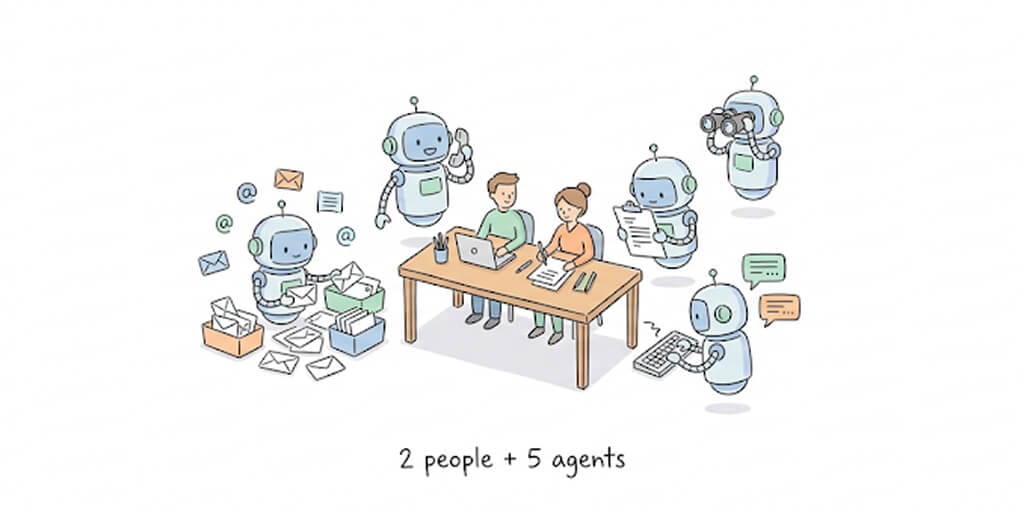
We're a 2-person team running 5 AI agents. They handle our support triage, lead qualification, morning briefings, competitor monitoring, and email follow-ups. That's 5 full-time roles covered for less than $150/month. Here's how.
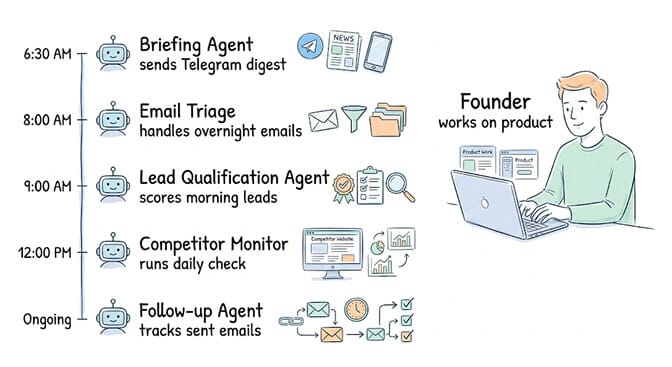
Last Tuesday at 7:15 AM, I opened Telegram and read my morning briefing. Three urgent support emails. Two qualified leads that came in overnight. A meeting at 10 AM with prep notes attached. One competitor had updated their pricing page.
I hadn't opened Gmail. Hadn't checked Slack. Hadn't looked at my calendar. An agent had already done all of that and summarized it for me.
By 7:20 AM, I knew exactly what my day looked like. Five minutes. Not forty-five.
We're a small team building BetterClaw. And we use AI agents for startups the same way we tell our users to: start with the task that eats the most time, automate it, then add the next one.
Every "AI agent" case study I find online is about IBM deploying agents across 10,000 employees. Or Walmart running supply chain agents at continental scale. That's great for IBM and Walmart. It's useless for a founder with 2 people and $3,000 in monthly burn.
This article is for founders like us. Small teams. Tight budgets. Not enough hours. Here's exactly what we run, what it costs, and how you can set up the same stack today.
Why startups need AI agents more than enterprises do
This might sound backwards. Enterprises have bigger budgets, more data, more processes to automate. Shouldn't they benefit more?
No. And here's why.
Enterprises have headcount. When an enterprise needs email triage, they hire a support coordinator. When they need lead qualification, they hire an SDR. When they need competitive intelligence, they assign it to a market research analyst.
You don't have that headcount. You're the support coordinator AND the SDR AND the market researcher AND the product manager AND the founder. Every hour you spend on admin is an hour you didn't spend on product, fundraising, or talking to customers.
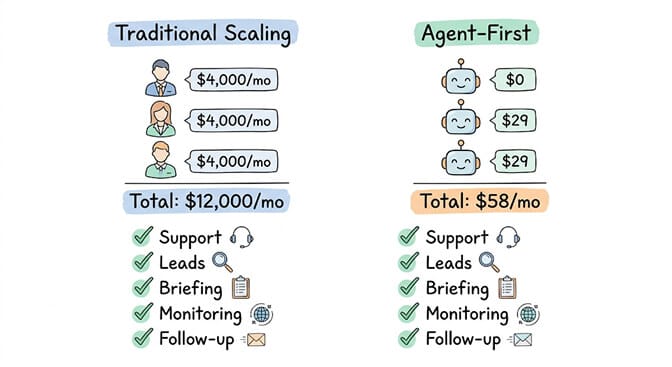
A junior hire costs $3,500-5,000 per month (salary + benefits + tools + management overhead). A BetterClaw Pro plan covers up to 5 agents for $49 per month. Even at 30% of human output on repetitive tasks, that's a 100x cost advantage.
At 50% of human output (realistic for email triage, lead qualification, and scheduling), it's 150x.
You're not replacing humans. You're delaying your first 3 hires while you figure out product-market fit. That's not a cost-cutting decision. It's a survival decision.
McKinsey estimates the addressable value of AI agents at $2.6 to $4.4 trillion. But they're thinking about enterprise deployments at scale. The real story is smaller: a founder getting 3 hours back every day because an agent handles the repetitive work that was drowning them.
The 5 agents a startup actually needs
Not 10. Not 20. Five. Each one solves a specific daily problem. Here's exactly what we run.
Agent 1: Email triage
What it does: Reads every inbound email. Classifies by urgency and type. Drafts responses for routine queries (order status, pricing questions, "how does it work" emails). Sends routine replies autonomously. Routes complex ones to Slack with context.
Setup time: 10 minutes. Connect Gmail, connect Slack, write classification rules in plain English, set trust level to Specialist.
Monthly cost: ~$10 in LLM usage, on top of the $49/month Pro plan that covers all five agents.
Time saved: 1-2 hours per day.
This is the agent I recommend building first if your inbox gets more than 15-20 emails a day. The full setup walkthrough for support triage agents covers the classification logic in detail.
Agent 2: Lead qualification
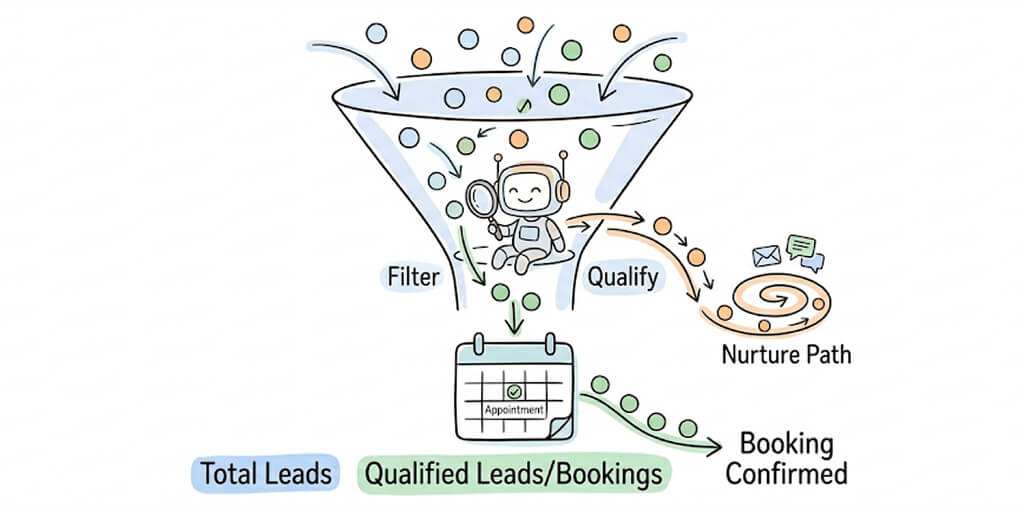
What it does: Reads inbound leads from the contact form. Scores against criteria you define (company size, industry, job title, budget language). Qualified leads get a personalized response with meeting time proposals from Google Calendar. Unqualified leads get a polite redirect to self-serve resources.
Setup time: 12 minutes. Connect Gmail, connect Google Calendar, write qualification criteria.
Monthly cost: ~$10 in LLM usage, on the same Pro plan.
Time saved: 1-2 hours per day.
Start this one at Intern trust level (you review every draft). After a week of validating accuracy, promote to Specialist. The AI sales agent guide covers the trust level progression.
Agent 3: Morning briefing
What it does: Scans Gmail, Google Calendar, and Slack at 6:30 AM. Summarizes everything into four buckets: urgent items, meetings today with context, emails needing response, and FYIs to skip. Delivers to Telegram.
Setup time: 6 minutes.
Monthly cost: $0 (free plan + Gemini free tier via BYOK).
Time saved: 30-45 minutes every morning.
This one runs on BetterClaw's free plan. Zero cost. It's the single best agent for proving the concept to yourself before investing in anything. You can deploy an AI agent on that plan without a card and keep it running indefinitely.
Agent 4: Competitor monitoring
What it does: Checks 5-8 competitor websites daily. Compares current content to the previous snapshot in memory. Reports significant changes (pricing updates, new features, positioning shifts) to Slack.
Setup time: 8 minutes. Connect Tavily Search, connect Slack, set daily cron.
Monthly cost: $0 in LLM usage (Gemini free tier), on the same Pro plan.
Time saved: 1 hour per week, plus catches things you'd miss entirely.
Agent 5: Email follow-up tracking
What it does: Monitors sent emails. Drafts follow-up if no reply after 3 days. Sends final follow-up after 7 days. Logs everything.
Setup time: 8 minutes.
Monthly cost: $0 in LLM usage, on the same Pro plan.
Time saved: Eliminates dropped leads entirely. Research shows 44% of salespeople give up after one email, but 80% of deals need 5+ touches.
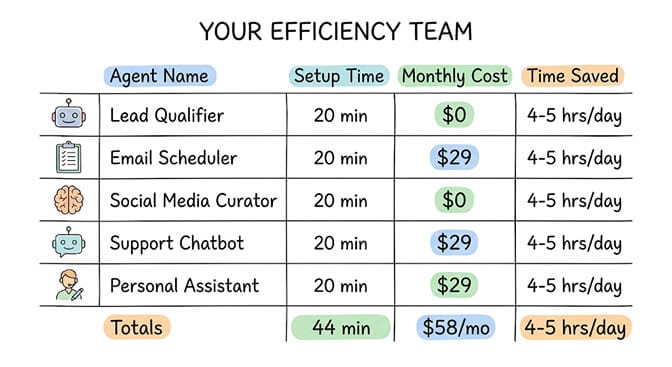
Five agents. Total setup time: 44 minutes. Total monthly cost: $49 for the Pro plan that covers all five, plus $20-30 in LLM usage. Total time saved: 4-5 hours per day.
The $0 startup stack (yes, actually zero)
If you're pre-revenue or just want to test the concept, here's the completely free version.
BetterClaw free plan: 1 agent, 100 credits/month, 3 connectors, basic skills, 7-day memory, BYOK required, no credit card.
Google Gemini free tier: Free API access for the LLM layer via BYOK.
Total cost: $0/month.
Run your most important agent. Probably the morning briefing (6 minutes to build, immediate daily value, read-only so zero risk). Or the competitor monitor if competitive intelligence matters more to your stage.
100 credits a month is enough to keep one agent running a daily briefing while you validate the concept. When you outgrow it, Pro is $49/month and includes 5 agents, which covers the entire stack above. $49 + roughly $20-30 in LLM costs = ~$69-79/month total for a 5-function operations team.
Compare that to any other path. n8n cloud starts at $24/month but gives you workflow automation, not autonomous agents (no memory, no trust levels, no judgment). CrewAI is free to run but requires Python and hosting ($50-200/month for infrastructure). Lindy focuses on outbound sales and starts at $49.99/month.
BetterClaw built this specifically because we needed it ourselves. We're a startup serving startups. We built the pricing model around the reality that most of our users start on free and some of them upgrade. Both paths are welcome. 80%+ of BetterClaw accounts are on the free plan and that's exactly how we designed it.
When NOT to use AI agents (honesty section)
Here's the part most AI agent companies won't tell you.
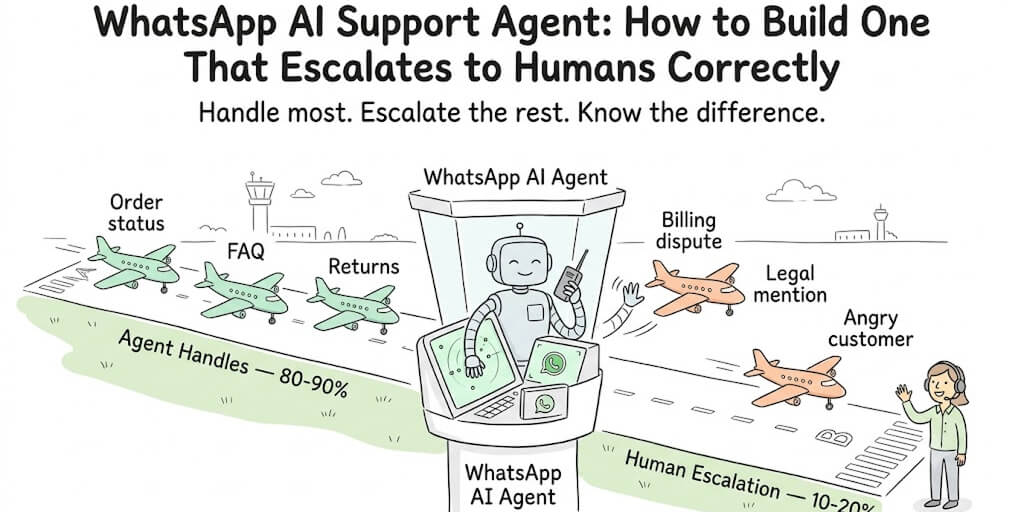
If your product requires constant human judgment calls, agents handle triage but not decisions. Legal advice, medical recommendations, financial counsel. An agent can sort and classify incoming requests. A human makes the actual call. Trust levels exist for exactly this reason: Intern mode means the agent drafts, you decide.
If you only get 5 emails a day, the setup time isn't worth it. The email triage agent saves time at scale. If your inbox is manageable, you don't need automation. Wait until volume makes manual handling painful.
If you're not willing to review the agent's work for the first week, don't deploy it autonomously. Every agent needs a calibration period. Start at Intern. Validate accuracy. Then promote. Skipping this step is how agents send wrong replies to customers.
AI agents are for volume and repetition. If you have neither, wait until you do. There's no shame in being too early. The AI agent workflow patterns guide covers when each pattern makes sense and when it doesn't.
The math: 1 agent = 1 FTE (sort of)
Let me be specific about this because "1 agent = 1 FTE" is a useful concept but it needs context.
A junior employee costs $3,500-5,000/month (salary + benefits + tools + management time). A BetterClaw Pro plan costs $49/month and covers up to 5 agents, plus LLM usage.
But an agent doesn't do 100% of what a human does. Here's a realistic breakdown:
Email triage and routine response: Agent handles 60-70% of volume. Human handles the rest. Agent output = ~0.6 FTE equivalent.
Lead qualification and initial response: Agent handles scoring and first contact for 80%+ of leads. Human reviews borderline cases and takes qualified meetings. Agent output = ~0.5 FTE equivalent.
Morning briefing and summarization: Agent handles 100% of the summarization work. This isn't an FTE comparison, it's a time savings: 45 minutes to 2 minutes every morning.
Competitor monitoring: Agent handles 100% of the monitoring. 1 hour per week saved. Not a full FTE, but work that simply doesn't get done manually at most startups.
Follow-up tracking: Agent handles 100% of follow-up scheduling. Work that most founders forget entirely.
You're not buying five employees for $69-79/month. You're buying back 4-5 hours of your day and ensuring work gets done that currently falls through the cracks. For a startup founder, that distinction matters more than the FTE math.
We built BetterClaw this way because we needed it
Here's the honest version of our story.
We're a small team. We didn't build BetterClaw because we saw a market opportunity in the AI agent space (though we did). We built it because we were drowning.
Support emails piling up. Leads going cold because we didn't follow up fast enough. Competitor moves we didn't notice until someone mentioned them in a meeting. Mornings wasted on context-switching between Gmail, Slack, and Calendar before making a single productive decision.
We started building agents for ourselves. The morning briefing was first. Then email triage. Then lead qualification. By the time we had three agents running, we realized: this is the product.
The agents we use internally are the same agents any BetterClaw user can build. Same platform. Same free plan. Same 60-second setup. We didn't build a separate tool for ourselves and a watered-down version for customers. That's the whole point.
Start with one, not five
I know I just listed five agents. Don't build all five today.
Pick the one that maps to your biggest daily pain point. If your inbox is killing you, build the email triage agent (10 minutes). If your mornings are chaos, build the briefing agent (6 minutes, free). If you're dropping leads, build the follow-up tracker (8 minutes, free).
Build one. Run it for a week. Adjust the instructions based on what it gets right and what it misses. Then add the second one.
The 5-agent stack took us about 3 weeks to build out fully. Not because any single agent is complex. Because each one benefits from a calibration week before you add the next.
Give BetterClaw a shot. Free plan with 1 agent and 100 credits a month. $49/month for Pro. We built it for teams like ours. Which means we built it for teams like yours. Start here.
Frequently Asked Questions
How can startups use AI agents?
Startups use AI agents to cover operational roles they can't afford to hire for. The five most common use cases are email triage (handling 60-70% of inbound email autonomously), lead qualification (scoring and responding to inbound leads), morning briefings (summarizing email, calendar, and Slack into a 2-minute digest), competitor monitoring (tracking competitor website changes daily), and follow-up tracking (ensuring no sent email goes without a follow-up). A 2-person startup can run all five for under $90/month.
How do AI agents for startups compare to hiring?
A junior hire costs $3,500-5,000/month including salary, benefits, tools, and management time. A BetterClaw Pro plan costs $49/month and covers up to 5 agents. At 50-60% of human output on repetitive tasks like email triage and lead qualification, that's roughly a 100-150x cost advantage. Agents don't replace strategic hires (product, engineering, sales leadership). They delay your first 3 operational hires while you figure out product-market fit.
What is the best first AI agent to build for a startup?
The morning briefing agent. It takes 6 minutes to set up, costs $0 (runs on BetterClaw's free plan with Gemini free tier), and you feel the value on day one. It scans your Gmail, Calendar, and Slack at 6:30 AM and sends a formatted summary to Telegram. Zero risk because it only reads and summarizes, never takes actions. Once you're comfortable with the concept, add email triage or follow-up tracking as your second agent.
How much does an AI agent cost for a small business?
On BetterClaw: $0 on the free plan, or $49/month for Pro. The free plan includes 1 agent, 100 credits/month, and 3 connectors (no credit card required). Pro is $49/month for 5 agents and 12,000 credits/month ($39/month on annual billing, $468/year). Pro plus LLM costs = roughly $69-79/month total for a five-agent stack. Compare to self-hosted frameworks (CrewAI, LangGraph) where hosting alone costs $50-200/month before development time, or enterprise platforms (Vertex AI, AWS Bedrock) with complex usage-based pricing.
Are AI agents reliable enough for a startup to depend on?
Yes, with proper setup. BetterClaw's trust levels let you control autonomy: start at Intern (human reviews every action), promote to Specialist after validating accuracy for a week, then Lead for fully autonomous operation. Every agent runs in an isolated Docker container with real-time health monitoring and auto-pause on anomalies. There's a one-click kill switch accessible to any team member. 50+ companies use BetterClaw in production. The key is the calibration week: don't deploy autonomously on day one. Validate first.