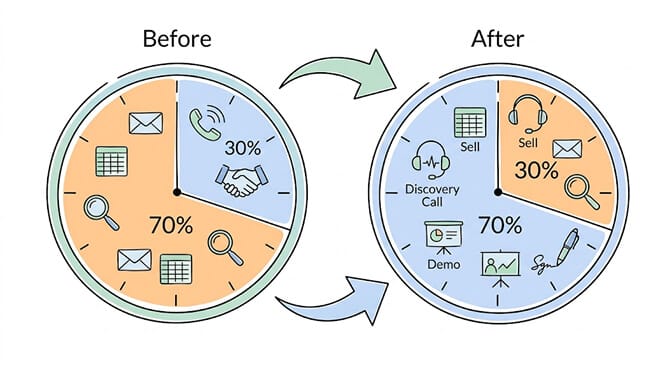
Your SDRs spend 70% of their time on admin. What if an AI agent handled the admin and your SDRs spent 70% of their time actually selling?
I watched a VP of Sales demo his team's workflow last quarter. Three SDRs. All smart. All motivated. And all of them spending the first four hours of every day reading inbound emails, checking LinkedIn profiles, Googling company sizes, and copy-pasting qualification criteria into spreadsheets.
By lunch, they'd qualified maybe 8 leads each. By 2 PM, they started the actual selling: personalized outreach, discovery calls, demo scheduling.
Seventy percent of the day was admin. Thirty percent was selling.
That ratio is backwards. And it's the default at almost every 10-100 person sales org I've talked to.
An AI sales agent flips it. Not by replacing your reps. By handling the qualification, research, and follow-up so your reps spend their time on the conversations that close deals.
Here's the thing nobody tells you about AI in sales: the fear isn't that it won't work. The fear is that it'll damage lead quality. That it'll send a tone-deaf email to a whale account. That it'll qualify someone who shouldn't be qualified and waste your closer's time.
Those fears are valid. And they're exactly why the trust level system matters.
What is an AI sales agent (and what it's not)
Let's kill the confusion first.
An AI sales agent is not a chatbot sitting on your pricing page. It's not a template-based email sequencer. It's not a Drift competitor.
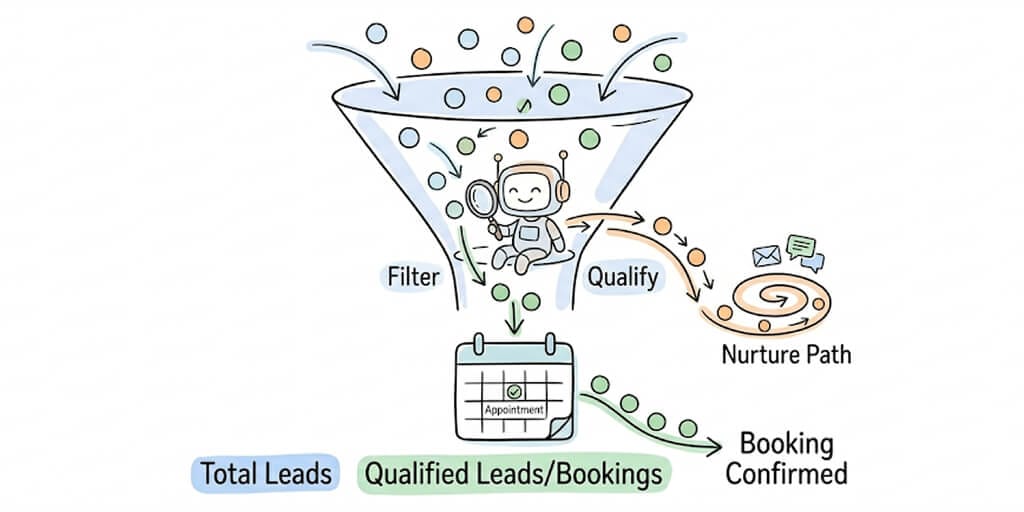
An AI sales agent is an autonomous agent that reads inbound leads, qualifies them against criteria you define, drafts personalized follow-ups referencing specific details about the prospect, and books meetings with qualified leads directly from your calendar. It works 24/7 across email and chat.
What it actually does:
- Reads inbound inquiries from email, forms, and chat
- Researches the prospect (company size, industry, job title, budget signals)
- Scores against your qualification criteria (BANT, MEDDIC, or custom)
- Drafts personalized responses referencing specific prospect details
- Proposes meeting times from your connected calendar
- Routes unqualified leads to nurture sequences or sends polite declines
- Follows up on no-replies at intervals you define
What it doesn't do:
- Run discovery calls
- Handle complex objections
- Build executive relationships
- Make judgment calls on enterprise deals
- Replace your closers
An AI sales agent handles the 70% that's admin so your SDRs can focus on the 30% that's actually selling.
Walmart gets this. They've deployed what they call "super agents" across their sales operations. The AI handles research, qualification, and initial outreach. The humans handle the conversations that require judgment. SaaStr reported one organization generating $4.8 million in additional pipeline from 20+ AI agents.
This isn't experimental anymore. It's operational.
The BetterClaw AI sales agent workflow (step by step)
Here's what the actual lead qualification flow looks like on BetterClaw.
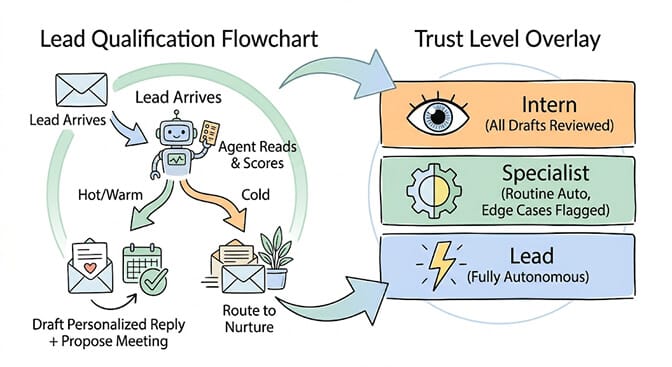
Step 1: Inbound lead arrives
Email comes in from a potential customer. Could be a form submission, a direct email, a LinkedIn message routed through your inbox. The agent reads it. To follow along, build an AI agent with Gmail connected and give it read access only for the first week.
Step 2: Agent researches and scores
Based on instructions you've written in plain English, the agent evaluates the lead against your criteria. Example instructions:
"Qualify leads based on: company size (50+ employees = qualified), industry (SaaS, fintech, ecommerce = qualified), job title (VP/Director/Head of = decision-maker, Manager = influencer), and budget signals (mentions pricing, asks about enterprise, references specific needs = high intent). Score as Hot, Warm, or Cold."
The agent checks the email content, any available company data, and scores accordingly.
Step 3: Qualified lead gets a personalized response
If the lead scores Hot or Warm, the agent drafts a personalized reply. Not a template. A response that references specific details from their inquiry, acknowledges their company and use case, and proposes meeting times pulled from your connected Google Calendar or Outlook.
If the lead scores Cold, the agent either sends a polite redirect (to self-serve resources, a different product line) or routes them to a nurture sequence.
Step 4: Trust level controls what happens next
This is where the "human touch" question gets answered.
In Intern mode, the agent drafts everything but sends nothing. You review every personalized reply before it goes out. The agent's suggestions sit in your approval queue.
In Specialist mode, the agent sends follow-ups to Warm and Hot leads autonomously. It handles the standard qualification patterns on its own. Edge cases (enterprise leads above a certain deal size, unusual requests, ambiguous signals) get flagged for human review.
In Lead mode, the agent manages the entire qualification pipeline. Books meetings. Sends follow-ups on no-replies. Routes leads. The one-click kill switch is always available.
Trust levels for sales (the "human touch" answer)
This is the part that addresses the fear head-on.
Every sales leader I've spoken to asks the same question: "What if the AI sends something embarrassing to a big prospect?"
Fair question. Here's the answer: it doesn't, because you control exactly how much autonomy the agent has.
Week 1: Intern mode (watch and learn)
Set the agent to Intern. Every drafted response, every qualification decision, every proposed meeting time sits in your approval queue. Nothing goes out without you clicking "approve."
This week, you're doing two things. First, you're validating the agent's judgment. Does it score leads correctly? Are the personalized responses good? Second, you're training yourself to trust the system.
Most teams find the agent gets qualification right 85-90% of the time on day one. By day five, after adjusting the instructions based on the misses, it's closer to 95%.
Week 2-3: Promote to Specialist
You've seen enough. The agent qualifies standard inbound leads correctly. Its follow-up emails are solid. Promote to Specialist.
Now the agent handles routine qualification autonomously. Warm and Hot leads get personalized responses immediately (24/7, including 2 AM and weekends). Cold leads get routed. Edge cases still come to you.
The result? Your lead response time drops from hours (waiting for an SDR to get to it) to minutes (agent responds immediately). Studies consistently show that responding to inbound leads within 5 minutes makes you 21x more likely to qualify them.
Month 2+: Selective Lead mode
Some teams promote to Lead mode for standard qualification (company size + industry + job title scoring). But they keep Intern mode for enterprise leads above a certain deal size ($50K+, $100K+, whatever your threshold is).
This is the smart play. Let the AI handle volume. Keep humans on the deals where a wrong note costs real money.
The assist-to-autonomous progression isn't just for support. It's the exact same pattern for sales. Start cautious. Build confidence. Increase autonomy where the data supports it.
If the idea of an AI qualifying your inbound leads while your SDRs focus on selling sounds like the right move, BetterClaw's free plan gives you 1 agent, 100 credits a month, trust levels, Gmail/Calendar OAuth, and 7-day memory to test the workflow. No credit card. $49/month for Pro when you're ready to scale. Bring your own API keys with zero inference markup.
The ROI math your CFO will actually care about
Let's be specific.
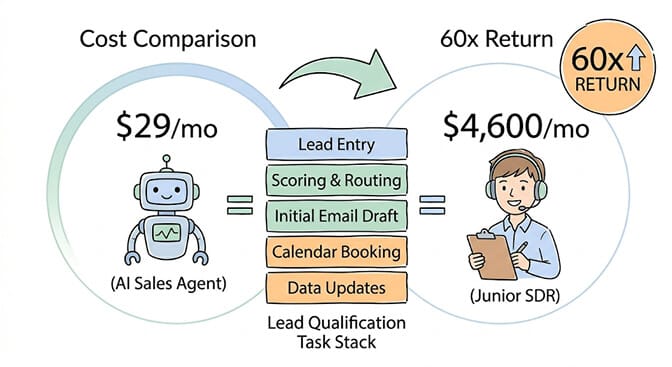
Cost of a BetterClaw AI sales agent:
- BetterClaw Pro: $49/month
- LLM inference (BYOK): ~$10-15/month at typical lead volumes
- Total: ~$59-64/month
Cost of a junior SDR (qualification-focused):
- Base salary: $4,000-6,000/month
- Tools (CRM seat, email tools, enrichment): $200-500/month
- Management overhead: 10-15% of salary
- Total: ~$4,600-7,200/month
Even at 30% of a human SDR's qualification output (which is conservative), an AI sales agent running on BetterClaw delivers roughly the same qualification throughput at 1/100th the cost.
Annual comparison: $708-768/year for the AI agent vs $55,000-86,000/year for the human SDR on qualification tasks. That's not a marginal improvement. That's a structural cost advantage.
And here's the compounding factor: the AI agent responds instantly. At 2 AM. On weekends. On holidays. Your competitors' leads sit in inboxes until Monday morning. Yours get a personalized response in minutes.
What AI sales agents can't do (yet)
Let me be straight about the limitations. Because the sales leaders who deploy AI agents successfully are the ones who understand where the boundary is.
Complex negotiations. An AI can draft a proposal. It can't read the room during a pricing conversation. It can't sense when a prospect is bluffing about a competitor's offer. That's human territory.
Executive relationship building. C-suite prospects need trust built over time. Personal connections. Industry credibility. An AI can research the prospect and draft the first outreach, but the relationship is yours to build.
Emotional intelligence in objection handling. "We're not ready yet" means different things from different people. Sometimes it means "convince me." Sometimes it means "not this quarter." Sometimes it means "never." Reading those signals is a skill AI doesn't have.
Strategic account planning. Which accounts to prioritize, how to position against a specific competitor in a specific deal, when to bring in executive sponsorship. These are judgment calls that need context an AI agent doesn't have.
AI handles volume. Humans handle judgment. The best sales teams use both.
The companies winning with AI agents in 2026 aren't the ones replacing their sales teams. They're the ones freeing their sales teams from the work that was never selling in the first place.
The agent your SDRs actually want
I've never met an SDR who said "I love spending four hours a day reading emails and updating CRM records." Not once.
Every SDR I've talked to wants to spend more time in conversations. More time on discovery calls. More time building relationships with prospects who actually have budget and need.
An AI sales agent gives them that. Not by taking their job. By taking the part of their job they never wanted.
Start at Intern. Let the agent draft and qualify for a week. Watch what it gets right. Correct what it doesn't. Promote to Specialist when you're confident. Keep humans on the big deals.
That's the playbook. It works for sales the same way it works for customer support. Start cautious. Scale with data. Keep humans where they matter.
If any of this sounds like the right approach for your sales operation, start free on BetterClaw. One agent. 100 credits a month. No credit card. $49/month for Pro when you're ready for 5 agents, 12,000 credits a month, all channels, and hourly scheduling. Your first sales agent takes about 10 minutes to build. The first qualified lead response goes out in seconds.
Frequently Asked Questions
What is an AI sales agent?
An AI sales agent is autonomous software that reads inbound leads, qualifies them against criteria you define (company size, industry, job title, budget signals), drafts personalized follow-up emails, and books meetings with qualified prospects via your calendar. It works 24/7 across email and chat. BetterClaw lets you build one in about 10 minutes with no code, starting at $0/month on the free plan.
How does an AI sales agent compare to a sales chatbot?
A chatbot follows scripted rules on your website. An AI sales agent reasons about each lead, pulls from your qualification criteria, drafts personalized responses referencing specific prospect details, and operates autonomously across email and messaging channels. Chatbots answer predefined questions. AI sales agents qualify, research, personalize, and book meetings. BetterClaw agents also include trust levels that let you control autonomy from fully assisted to fully autonomous.
How do I build an AI sales agent without coding?
With BetterClaw: sign up (free), connect your LLM API key, add Gmail and Google Calendar via OAuth, write plain English instructions describing your qualification criteria and response style, set the trust level to Intern (agent drafts, you review), and deploy. Total setup: about 10 minutes. No Python, no Docker, no YAML. Start at Intern and promote to Specialist after validating accuracy over 1-2 weeks.
How much does an AI sales agent cost compared to hiring an SDR?
BetterClaw AI sales agent: $0/month (free plan, 1 agent, 100 credits) or $49/month Pro plus ~$10-15/month LLM costs. Total: roughly $59-64/month. A junior SDR focused on qualification: $4,000-6,000/month salary plus tools and overhead ($4,600-7,200/month total). Even at 30% of human qualification output, the AI agent delivers a 30x cost advantage. The AI also responds 24/7, including nights and weekends.
Will an AI sales agent hurt my lead quality?
Not if you use trust levels correctly. BetterClaw's Intern mode means every outbound email is reviewed by a human before sending. No messages go out without approval. Specialist mode sends routine follow-ups autonomously but flags edge cases (large deal sizes, unusual requests) for human review. You control the dial. Most teams find agent qualification accuracy reaches 95%+ within the first week after minor instruction adjustments. The one-click kill switch provides an emergency stop if anything goes wrong.