A client in Munich asked us a question last month that stopped the conversation cold.
"If our AI agent reads customer emails and sends them to OpenAI's API for processing... does that count as transferring personal data to a US-based processor?"
The answer is yes. And it's the kind of question that most teams deploying AI agents never think to ask until a data protection officer shows up.
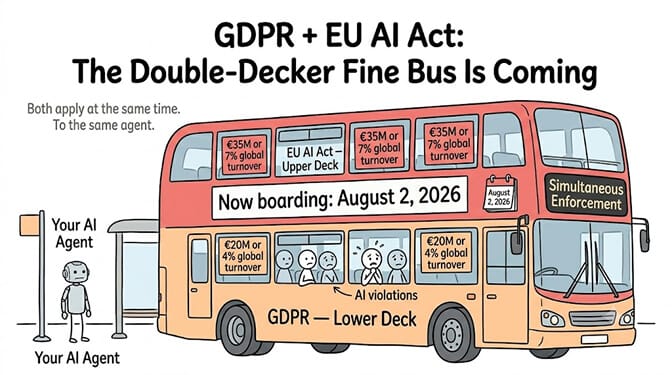
AI agent GDPR compliance isn't theoretical anymore. European data protection authorities have issued €6.11 billion in total GDPR fines as of March 2026, across 2,685 enforcement actions. Italy's Garante has already fined a company €5 million specifically for AI-related data processing violations. The EU AI Act adds a second enforcement layer with penalties up to €35 million or 7% of global turnover, with high-risk AI system obligations taking effect August 2, 2026.
If your AI agent processes personal data of anyone in the EU, you need to get this right. Here's what that actually means in practice.
The five GDPR obligations that apply to every AI agent
Most GDPR guides for AI are written for lawyers. This one is written for the person actually deploying the agent. Here's what you need to know, stripped of legal jargon.
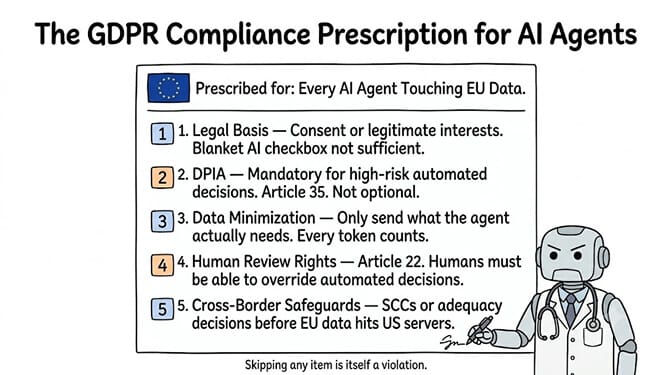
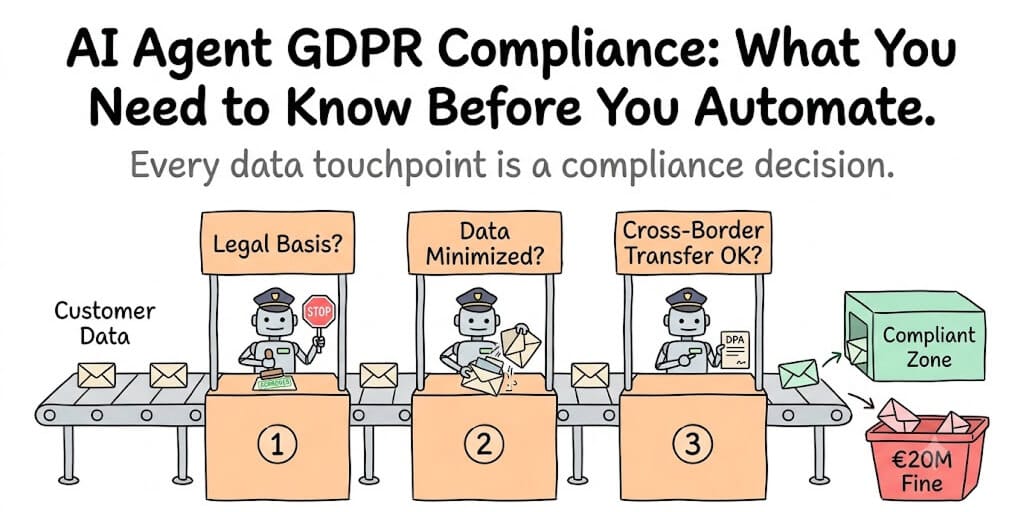
1. You need a legal basis for processing
Before your AI agent touches any personal data, you need a lawful reason. GDPR gives you six options, but for AI agents, two matter most: consent (the user explicitly agreed to AI processing of their data) or legitimate interests (you have a genuine business reason, you've assessed the privacy impact, and the individual's rights don't override your interests).
If your agent reads customer emails to classify support tickets, "legitimate interests" is the likely basis. If your agent profiles users to personalize marketing, you almost certainly need consent. And GDPR requires explicit, specific consent for each distinct AI function. A blanket "we use AI" checkbox doesn't cut it.
2. You must conduct a DPIA for high-risk processing
A Data Protection Impact Assessment is mandatory for AI processing likely to create high risks to individuals. If your agent makes automated decisions that produce significant effects (credit decisions, hiring recommendations, access to services), a DPIA is required before deployment.
This isn't optional. It's a specific legal requirement under GDPR Article 35. Skipping it is itself a violation.
3. Data minimization is not a suggestion
Your AI agent should only process the data it actually needs. If your email triage agent only needs the subject line and sender to classify urgency, sending the full email body (which might contain health information, financial details, or other sensitive data) to the LLM is processing more data than necessary.
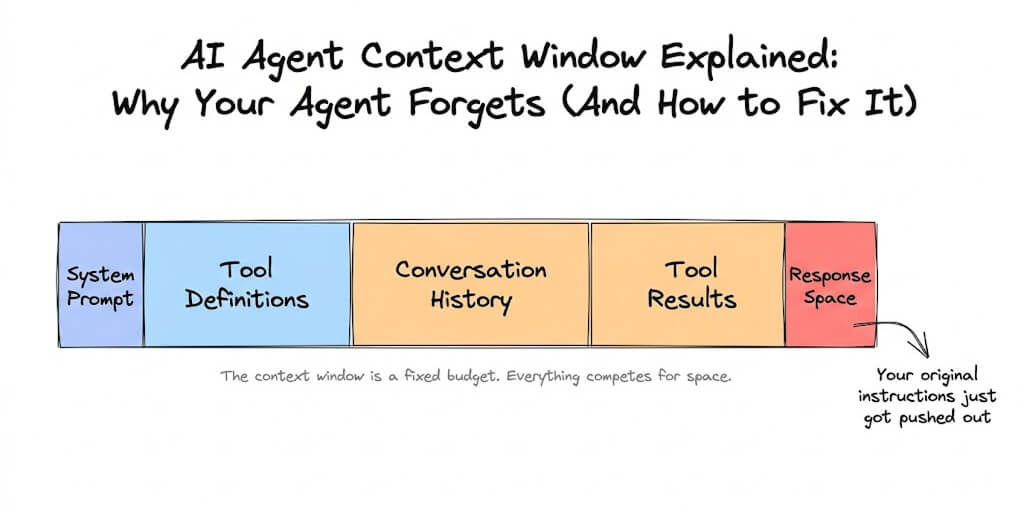
This is where context window management becomes a compliance issue, not just a performance one. Every token you send to the LLM is data you're processing. Reducing context bloat isn't just about speed and cost. It's about only sending what's necessary.
4. Users have the right to human review
GDPR Article 22 gives individuals the right not to be subject to decisions based solely on automated processing that produces legal or similarly significant effects. In practice, this means your agent needs a human-in-the-loop for decisions that matter.
An agent that automatically rejects a loan application? That needs human review. An agent that triages support tickets into priority buckets? Probably fine, since a human still handles the actual resolution.
5. Cross-border data transfers require safeguards
When your EU-based agent sends personal data to an LLM provider's US-based servers, that's a cross-border transfer under GDPR Chapter V. You need appropriate safeguards: Standard Contractual Clauses (SCCs), adequacy decisions, or binding corporate rules.
OpenAI, Anthropic, and Google all offer Data Processing Agreements and SCCs for their APIs. But it's your responsibility to verify this is in place before your agent starts processing.
The EU AI Act: the second compliance layer nobody's ready for
GDPR was just the beginning. The EU AI Act entered into force on August 1, 2024, and it applies on top of GDPR. Both regulations apply concurrently to AI systems processing personal data.
The enforcement timeline that matters for AI agent builders:
Prohibited AI practices have been banned since February 2, 2025 (social scoring, subliminal manipulation, certain emotion recognition). GPAI model obligations have been in effect since August 2, 2025 (applies to providers of models like GPT-4, Claude, and Gemini). High-risk AI system obligations take effect August 2, 2026.
The penalty structure makes GDPR look modest. EU AI Act fines reach up to €35 million or 7% of global annual turnover for prohibited practices, versus GDPR's ceiling of €20 million or 4%. For high-risk system violations, fines go up to €15 million or 3% of turnover.
If you're building an AI agent that handles HR screening, credit decisions, or access to essential services... you're likely operating a high-risk AI system. That means mandatory risk management, conformity assessments, logging requirements, and human oversight obligations starting August 2026. If screening is your use case, our AI HR screening agent page shows how screening, ranking and interview scheduling work, with the hiring decision left to a person.
GDPR fines total €6.11 billion across 2,685 cases. The EU AI Act's penalty ceiling is 75% higher. Both apply simultaneously to AI agents processing personal data of EU residents.
Where most AI agent setups go wrong on GDPR
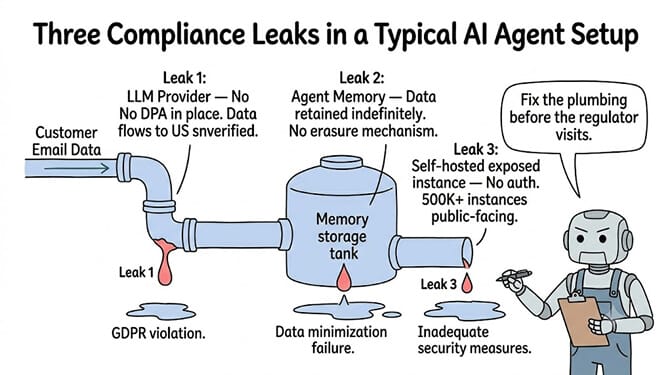
The compliance failures we see most often aren't malicious. They're architectural. People build agents without thinking about where data flows.
The LLM provider problem
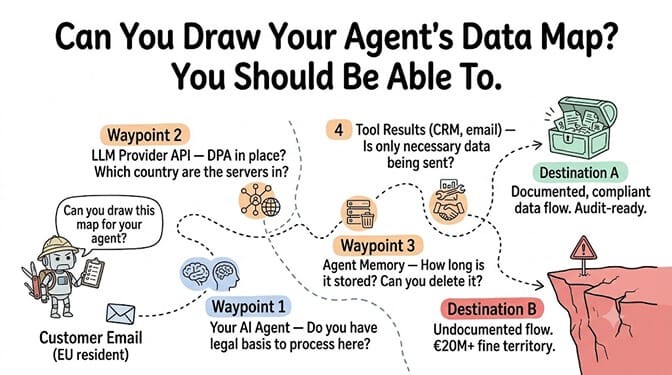
When your agent sends a customer email to Claude's API for classification, that email is being processed by Anthropic's servers. You need to know where those servers are, whether a Data Processing Agreement is in place, and whether the provider uses your data for model training.
Most major providers (OpenAI, Anthropic, Google) offer enterprise terms that include DPAs and commitments not to use API data for training. But the default terms for consumer-tier access often don't include these protections. BYOK (Bring Your Own Key) matters here. When you control which API key and which provider processes your data, you control the compliance chain.
The memory and logging problem
AI agents accumulate data. Conversation history. Tool results. Customer information. CRM lookups. If your agent stores this data indefinitely without a retention policy, you're violating data minimization principles.
Worse, if a customer exercises their right to erasure ("right to be forgotten"), you need to be able to delete all their personal data from your agent's memory. If that data is embedded in a vector database as part of the agent's long-term memory... deletion becomes technically complex.
The self-hosted exposure problem
Self-hosted AI agent frameworks give you data sovereignty in theory. In practice, CrowdStrike's security advisory documented that 500,000+ agent instances are running on the public internet without authentication. An exposed instance isn't just a security risk. It's a GDPR violation. Uncontrolled access to personal data being processed by the agent means your data protection measures are inadequate.
This is one of the areas where managed platforms have a structural advantage for GDPR compliance. On BetterClaw, every agent runs in an isolated Docker container. Credentials are encrypted with AES-256 and auto-purge from agent memory after 5 minutes. Trust levels (Intern, Specialist, Lead) enforce human approval before the agent takes sensitive actions. Enterprise tier includes audit logs for compliance documentation. You're not building compliance infrastructure from scratch. It's built in.
A practical GDPR compliance framework for AI agents
Here's the framework we recommend to teams deploying AI agents in GDPR-regulated environments.
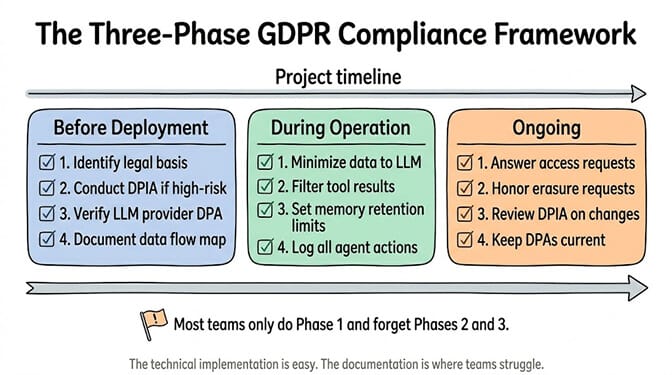
Before deployment: Identify your legal basis. Conduct a DPIA if processing is high-risk. Verify your LLM provider's DPA and data processing location. Document your agent's data flow (what data goes where, who processes it, how long it's retained).
During operation: Minimize data sent to the LLM. Filter tool results before they enter the agent's context. Set memory retention limits (don't store personal data indefinitely). Implement human approval for decisions with significant effects. Log all agent actions for audit purposes.
Ongoing: Respond to data subject access requests (individuals can ask what data your agent holds about them). Honor erasure requests. Review your DPIA when you change the agent's capabilities. Keep DPAs current when you switch LLM providers.
The hard truth: most of this work isn't about technology. It's about process and documentation. The technical implementation is relatively straightforward if you're on a platform that supports data minimization, retention controls, and audit logging natively. The documentation and governance is where teams struggle.
If your organization is exploring AI agents but compliance concerns are the blocker, we offer a free AI readiness audit. We identify where agents can add value for your specific operations, assess the compliance requirements for your use cases, and share a clear proposal. No commitment required.
The features that actually matter for GDPR compliance
Not every platform feature maps to GDPR. Here are the ones that do.
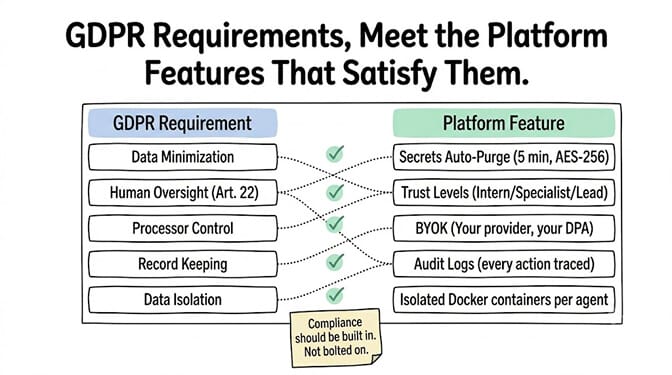
Secrets auto-purge satisfies data minimization. API keys, tokens, and credentials are encrypted with AES-256 and automatically removed from agent memory after 5 minutes. The agent can use them, but they don't persist in the context window or conversation history.
Trust levels satisfy human oversight requirements. An "Intern" level agent drafts actions but requires human approval before executing. A "Lead" level agent acts autonomously within defined boundaries. You control the level of autonomy per agent, which directly maps to GDPR Article 22 requirements.
BYOK (Bring Your Own Key) gives you control over the data processing chain. You choose which LLM provider processes your data. You verify their DPA. You maintain the contractual relationship. The platform doesn't add another data processor to your compliance chain.
Audit logs (Enterprise) provide the documentation GDPR requires. Every agent action is logged. Every tool call is recorded. Every decision the agent made is traceable. When a supervisor asks "why did the agent do that?", you have an answer.
Per-agent isolation means one agent's data doesn't leak into another agent's context. Isolated Docker containers per agent prevent cross-contamination, which matters when different agents handle data with different sensitivity levels.
Gartner projects 40% of enterprise applications will embed AI agents by end of 2026. The organizations that get compliance right early will move faster than those who retrofit it later.
The uncomfortable question nobody wants to answer
Can you use AI agents for GDPR-sensitive data? Yes. But only if you treat compliance as an architectural decision, not a checkbox.
The companies that get fined aren't the ones using AI agents. They're the ones using AI agents without thinking about where data flows, how long it persists, and who has access. (Our broader AI agent security guide covers the architecture side in depth.)
The EU AI Act's August 2026 deadline for high-risk AI systems is less than two months away. GDPR enforcement on AI is accelerating, not slowing down. The window for "we'll figure out compliance later" is closing.
Build it right from the start. Choose platforms and providers that make compliance the default, not an add-on. And when in doubt, ask the question the Munich client asked: "Where does this data actually go?"
If that question doesn't have a clear, documented answer, your agent isn't ready for production.
If your organization is exploring AI agents but compliance is the concern, we offer a free AI readiness audit. We identify the highest-impact use cases for your operations, assess compliance requirements, and share a proposal. If it makes sense, we implement it on the BetterClaw platform with built-in security and compliance features. No commitment required to get the audit.
Frequently Asked Questions
What is AI agent GDPR compliance?
AI agent GDPR compliance means ensuring your autonomous AI agent processes personal data of EU residents in accordance with the General Data Protection Regulation. This includes having a valid legal basis for processing, conducting Data Protection Impact Assessments for high-risk use cases, minimizing the data sent to LLM providers, providing human oversight for significant automated decisions, and ensuring cross-border data transfers have appropriate safeguards like Standard Contractual Clauses.
How does the EU AI Act affect AI agent deployments?
The EU AI Act applies alongside GDPR, creating dual compliance obligations. Prohibited AI practices have been banned since February 2025. High-risk AI system obligations take effect August 2, 2026, requiring risk management, conformity assessments, and human oversight. Fines reach up to €35 million or 7% of global turnover, which is 75% higher than GDPR's maximum. AI agents handling HR screening, credit decisions, or access to essential services are likely classified as high-risk.
How do I make my AI agent GDPR compliant?
Start with four steps: identify your legal basis for processing (consent or legitimate interests), conduct a DPIA if your agent makes automated decisions with significant effects, verify your LLM provider has a Data Processing Agreement in place, and implement data minimization by filtering what data enters the agent's context window. Use platforms with built-in compliance features like secrets auto-purge, trust levels for human oversight, BYOK for processor control, and audit logging.
How much do GDPR fines cost for AI-related violations?
GDPR fines reach up to €20 million or 4% of global annual turnover. As of March 2026, total GDPR fines have exceeded €6.11 billion across 2,685 cases. Italy's data protection authority has already issued a €5 million fine for AI-related processing violations. The EU AI Act adds additional penalties up to €35 million or 7% of turnover for AI-specific violations, meaning dual exposure for non-compliant AI agent deployments.
Is it safe to send personal data to LLM providers like OpenAI or Anthropic?
Yes, with appropriate safeguards. Major LLM providers offer enterprise-tier Data Processing Agreements, Standard Contractual Clauses for cross-border transfers, and commitments not to use API data for model training. However, these protections are typically not included in consumer-tier access. Verify your provider's DPA, confirm data processing locations, and use BYOK to maintain control over which provider processes your data. Using a managed agent platform with BYOK ensures the platform itself doesn't add another processor to your compliance chain.