Shenzhen, Wuxi, and Hefei are paying developers to build OpenClaw businesses. Here's what the policies say, what they fund, and what this means for the ecosystem.
A thousand people lined up outside Tencent's headquarters in Shenzhen last week. Not for a product launch. Not for a job fair. They were waiting for engineers to install OpenClaw on their laptops.
Children. Retirees. Developers. All standing in line for a free AI agent setup.
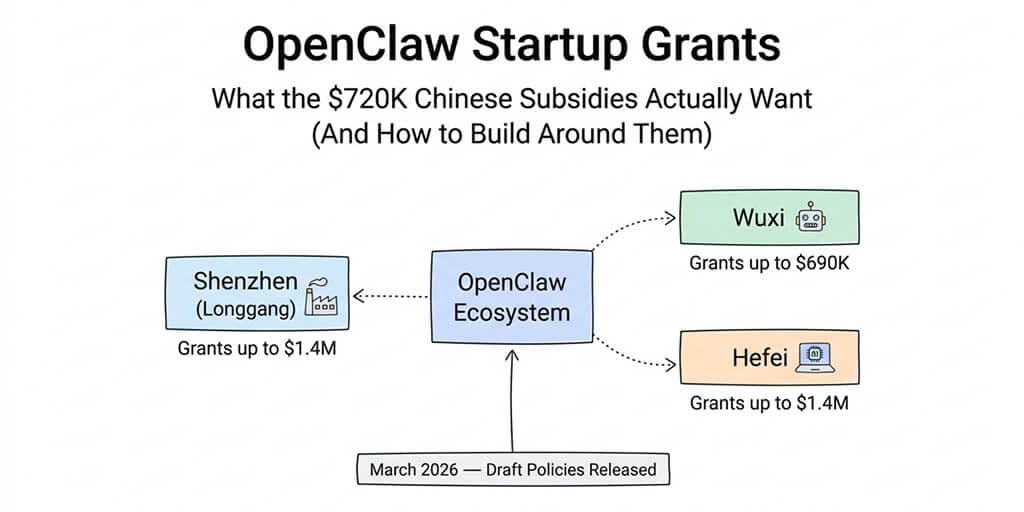
That same week, three different Chinese cities published draft policies offering millions of yuan to anyone building a business on top of OpenClaw. Shenzhen's Longgang district: up to 10 million yuan ($1.4 million) in combined subsidies and equity investment. Wuxi: up to 5 million yuan ($690,000) per project. Hefei's high-tech zone: matching Longgang's numbers.
This is not a hypothetical. Reuters, Bloomberg, CNBC, MIT Technology Review, and the South China Morning Post all covered it within the same week. The Chinese government is actively funding OpenClaw startups. Right now.
If you're a developer or founder thinking about building on OpenClaw, this is the most important ecosystem development since Peter Steinberger joined OpenAI. Here's what the grants actually cover, what kind of projects they're looking for, and what this means for anyone building in the OpenClaw space globally.
What the "Lobster Ten" policy actually funds
Shenzhen's Longgang district released the most detailed policy, nicknamed the "AI Lobster Ten" (a pun on the district's name and the lobster metaphor the Chinese OpenClaw community uses for the framework). Ten specific measures, each with defined funding:
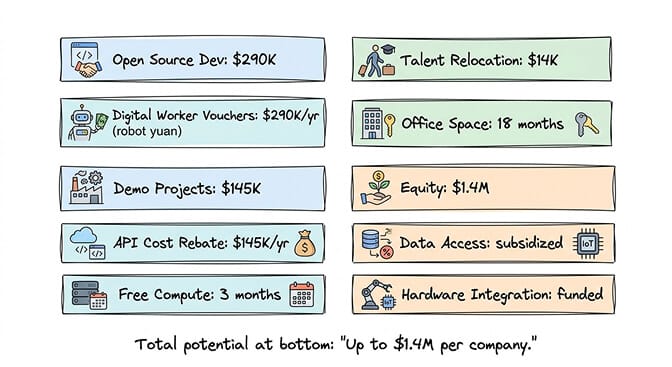
Free deployment and development support: Up to 2 million yuan ($290,000) for developers contributing code to open-source communities, building skill packages, or integrating OpenClaw with hardware like robots and IoT devices.
Digital Employee Vouchers: The "OpenClaw Digital Worker Voucher" reimburses 40% of investment for enterprises purchasing or building OpenClaw agent solutions. Capped at 2 million yuan per year.
Application demonstration awards: Innovative projects in manufacturing, governance, parks, and healthcare receive 30% of actual investment, up to 1 million yuan.
AIGC model access subsidies: 30% reimbursement for multimodal model API calls, up to 1 million yuan annually. This directly offsets the API costs that make OpenClaw expensive for heavy usage.
Computing power and scenarios: Three months of free computing resources for new "One-Person Company" (OPC) ventures. Demonstration projects funded up to 4 million yuan.
Talent and office space: Relocation bonuses up to 100,000 yuan by education level. Two months free accommodation for new arrivals. 18 months discounted office space.
Equity investment: Seed-stage OPC projects eligible for up to 10 million yuan ($1.4 million) in equity investment, with priority for youth-led ventures.
The policy has a three-year validity period and is open for public comment through April 6, 2026.
Wuxi's different angle: manufacturing and robots
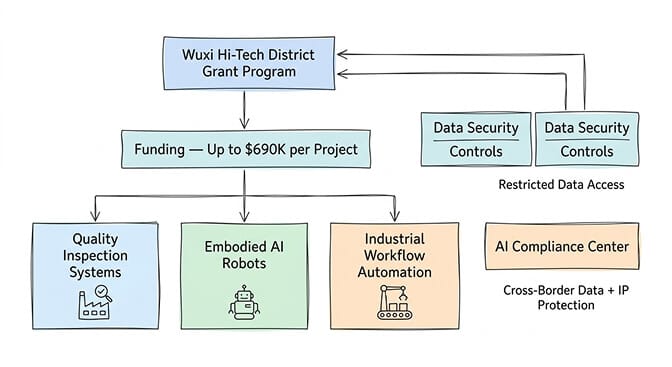
Wuxi's National Hi-Tech District took a more focused approach. Their draft policy offers up to 5 million yuan ($690,000) per project, but specifically targets manufacturing applications.
The sweet spot: projects applying OpenClaw to quality inspection, embodied intelligence robots, and automated industrial workflows. This isn't about personal productivity agents. It's about factory-floor automation powered by AI agents.
Wuxi's policy also includes something Longgang's doesn't: explicit security requirements. Cloud platforms providing OpenClaw must ban access to sensitive data directories. The district is exploring an AI compliance service center focused on cross-border data transfers and IP protection.
That's a signal. The Chinese government is simultaneously funding OpenClaw adoption and building the regulatory framework around it. If you're planning to operate in this space, compliance will matter as much as capability.
For context on the security challenges they're trying to address, our comprehensive guide to OpenClaw security risks covers every incident from CrowdStrike to the ClawHavoc campaign.
Why this is happening now (the "One-Person Company" thesis)
Here's what nobody tells you about these grants.
The funding isn't really about OpenClaw. It's about a broader Chinese government thesis called the "One-Person Company" (OPC) model: the idea that a single developer armed with AI agents can build and operate a competitive business.
This was highlighted at China's National People's Congress this month. Soochow University is running competitions to see which student can create the most effective one-person company using AI agents. The central government's latest report explicitly backs "future industries" including embodied intelligence and humanoid robots.
OpenClaw, with its 230,000+ GitHub stars and 1.27 million weekly npm downloads, became the most visible implementation of this thesis. It's the framework that made "one-person company" feel tangible rather than theoretical.
The Chinese tech ecosystem moved fast. ByteDance launched "ArkClaw" (a browser-based OpenClaw). Tencent dubbed their suite "lobster special forces." JD.com partnered with Lenovo to offer $58 remote installation services. Meituan did the same. One installation service operator reportedly earned 260,000 yuan ($37,000) in just a few days.
Chinese local governments aren't just subsidizing a tool. They're betting that AI agents will restructure how businesses form and operate. OpenClaw is the vehicle.
Watch: The OpenClaw Phenomenon in China and What It Means for Builders If you want to understand the scale of what's happening (including the Tencent installation events, the government policy context, and what Chinese tech companies are building on top of OpenClaw), this news coverage provides essential context for anyone considering building in this ecosystem. Watch on YouTube
What kind of OpenClaw startup actually qualifies
Based on the policy documents, here are the project types that best align with what the grants are designed to fund.
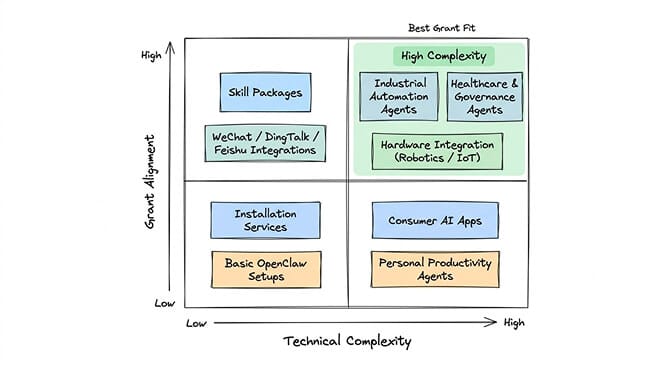
Industrial automation agents
Wuxi's policy explicitly targets manufacturing. An OpenClaw agent that monitors production quality, manages supply chain communications, or coordinates between IoT sensors and human operators fits perfectly. The grant covers up to $690,000 per project for these applications.
Healthcare and governance applications
Longgang's demonstration awards prioritize healthcare and urban governance. An agent that manages patient scheduling, triages incoming requests, or automates compliance reporting in a hospital setting would qualify for the 30% investment reimbursement.
Skill package development
Both policies fund developers who contribute to the OpenClaw ecosystem. Building and distributing vetted skill packages (especially ones relevant to Chinese business workflows like WeChat integration, DingTalk automation, or Feishu workflows) qualifies for the open-source development subsidy.
For a look at which OpenClaw skills are most in-demand and where the gaps in the ecosystem are, ourskills guide identifies the opportunities.
Hardware integration
Longgang specifically funds integration of OpenClaw with "embodied AI hardware." If you're building agents that control robots, IoT devices, or smart city infrastructure, the policy provides both development funding and demonstration project awards.
Managed hosting and deployment platforms
This is where it gets interesting for us. The "Digital Worker Voucher" reimburses enterprises for purchasing OpenClaw agent solutions. That includes managed deployment platforms. Companies building easier ways to deploy and manage OpenClaw agents are exactly what the policy wants to encourage.
If you're building on OpenClaw and want to focus on your product rather than infrastructure, BetterClaw handles the deployment layer at $49/month for Pro. Docker sandboxing, AES-256 encryption, 28+ model providers, 15+ chat platforms. BYOK. Zero config. That infrastructure foundation lets you focus on the application layer that grants actually fund.
The security elephant in the room
Here's the tension at the heart of this story.
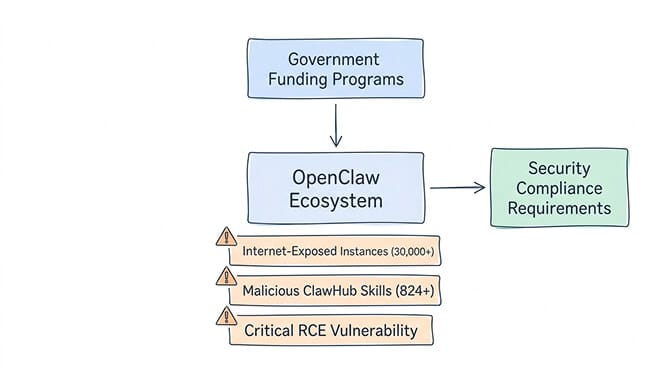
China's Ministry of Industry and Information Technology warned that OpenClaw could cause "information leaks or loss of system control." The National Vulnerability Database cautioned about improper configuration risks. And yet local governments are simultaneously funding mass adoption.
Wuxi acknowledged this directly by requiring cloud platforms to restrict access to sensitive directories. But the broader concern remains: 30,000+ internet-exposed instances without authentication, 824+ malicious skills discovered on ClawHub, a critical RCE vulnerability (CVE-2026-25253) that took weeks for some operators to patch.
If you're building an OpenClaw startup targeting these grants, security isn't optional. It's likely to become a qualifying criterion. The compliance center Wuxi is exploring will probably set standards that funded projects must meet.
For a practical security foundation, our OpenClaw security checklist covers the ten steps most deployments skip.
What this means if you're not in China
The grants are geographically targeted. Longgang requires physical presence in the district. Wuxi wants local operations. You can't apply from San Francisco.
But the signal matters globally.
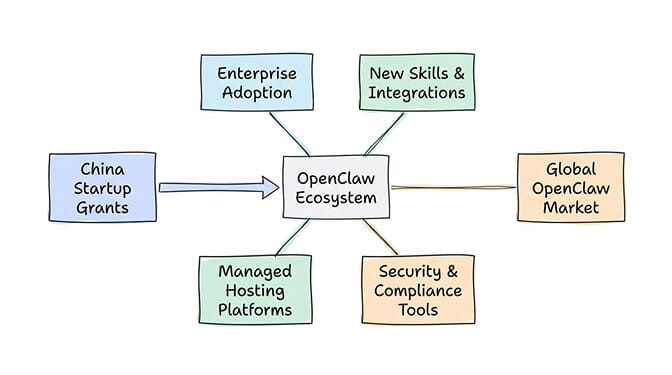
Government-backed funding for OpenClaw startups means the ecosystem is being taken seriously at the institutional level. That changes the calculus for investors, enterprise customers, and potential partners everywhere. It validates the "AI agent as business infrastructure" thesis in a way that GitHub stars alone don't.
It also means more skills, more integrations, more enterprise adoption, and more demand for managed deployment platforms. When factories in Wuxi run OpenClaw agents for quality inspection, they need reliable hosting, monitoring, and security. When hospitals in Longgang deploy patient management agents, they need the same.
The opportunity for OpenClaw-related businesses is expanding worldwide, even if the subsidies are local. Managed platforms, security tools, vertical skills, compliance layers: these are global markets with growing demand.
For anyone evaluating whether to build on OpenClaw or another framework, how the OpenClaw architecture actually works matters more than ever when enterprise and government contracts are on the table.
The gold rush parallel (and the honest caveat)
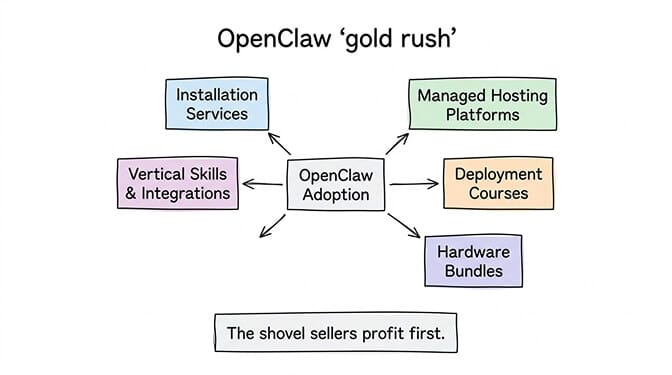
MIT Technology Review called it "China's OpenClaw gold rush." That framing is apt. Like every gold rush, the people making the most money right now aren't the miners. They're the people selling shovels.
Installation services charging $58-145 per setup. Pre-configured Mac Minis listed at premium prices on Chinese e-commerce sites. Paid courses teaching OpenClaw deployment. And managed hosting platforms (including ours) charging monthly subscriptions for zero-config deployment.
The honest caveat: some of this gold rush energy is hype. A 77-year-old man asking his son to install a "lobster" is heartwarming, but it doesn't mean OpenClaw is ready for mass consumer adoption. The security risks are real. The maintenance burden for self-hosted setups is significant. The project has 7,900+ open issues on GitHub.
The grants accelerate adoption. They don't solve the fundamental challenges of running autonomous AI agents safely and reliably.
The practical takeaway for builders
If you're a developer or founder thinking about the OpenClaw ecosystem:
The market is real. Government funding, enterprise adoption (Tencent, ByteDance, JD.com, Meituan), and 1.27 million weekly npm downloads confirm demand. This isn't a toy project.
The opportunity is in the application layer. The framework itself is open source. The value capture happens in vertical applications (healthcare, manufacturing, ecommerce), managed infrastructure, security tooling, and compliance solutions.
Security and compliance will become table stakes. Both Longgang and Wuxi policies signal that funded projects must meet security standards. Building with compliance in mind from day one gives you a competitive advantage.
The One-Person Company thesis changes the market sizing. If a single developer can run a viable business with AI agents, the total addressable market for agent infrastructure isn't "companies." It's "everyone with a business idea and a laptop."
The most interesting OpenClaw startups won't be the ones that deploy agents. They'll be the ones that make agent deployment safe, reliable, and accessible for the millions of people who want them but can't run a command line.
That's exactly why we built BetterClaw. If you're building an OpenClaw-based product and want to eliminate the infrastructure layer entirely, give it a try. $49/month for Pro, BYOK, Docker sandboxing, 15+ platforms, 28+ providers. Deploy in 60 seconds. Focus on your application. Let us handle the lobster infrastructure.
Frequently Asked Questions
What are the OpenClaw startup grants from China?
Multiple Chinese cities have released draft policies funding OpenClaw-based ventures. Shenzhen's Longgang district offers up to 10 million yuan ($1.4 million) in combined subsidies, equity investment, free compute, and office space. Wuxi offers up to 5 million yuan ($690,000) for manufacturing applications. Hefei matches Longgang's numbers. These policies target open-source development, industrial applications, healthcare, and the "One-Person Company" model. They're open for public comment through April 2026.
How do Chinese OpenClaw grants compare to typical startup funding?
The grants are non-dilutive (subsidies and vouchers, not equity rounds) except for the seed-stage equity investment option in Longgang (up to $1.4 million). They cover specific costs: 40% reimbursement on OpenClaw solutions, 30% on API costs, free computing for 3 months, and relocation support. Traditional VC funding provides more capital but takes equity. These grants are best used as a foundation alongside traditional funding.
How do I qualify for an OpenClaw startup grant in China?
Most programs require physical presence in the district. Longgang targets "One-Person Companies" and small teams building OpenClaw applications, skill packages, or hardware integrations. Wuxi focuses on manufacturing technology applications. You'll need to demonstrate a working project aligned with the policy priorities (industrial automation, healthcare, governance, or ecosystem development). Security compliance is increasingly expected.
How much does it cost to build an OpenClaw startup?
Minimal infrastructure: a VPS ($5-29/month), API costs ($15-200/month depending on model and usage), and your development time. Managed platforms like BetterClaw eliminate infrastructure costs at $49/month for Pro. The biggest expense is typically API costs for model access, which the Longgang policy's 30% API cost reimbursement directly addresses. Total early-stage monthly costs: $50-250 before the grants.
Is it safe to build a business on OpenClaw given the security concerns?
Yes, with proper security practices. CVE-2026-25253 was patched quickly. CrowdStrike and Microsoft have published detailed hardening guides. The Chinese policies themselves require security compliance, which is improving the ecosystem. Build on a managed platform with Docker sandboxing and encrypted credentials, vet all skills before installing, and stay current on patches. The security situation is improving, but it requires active attention.