$0.30/$1.20 per million tokens. 196K context. 97% skill compliance. Approaching Sonnet 4.6 on agent benchmarks. Here's when to use it and when not to.
A user in the OpenClaw Discord swapped Claude Sonnet for MiniMax M2.7 three weeks ago. His monthly API bill went from $22 to $1.80. Same agent. Same SOUL.md. Same tasks (email drafting, calendar management, web search, daily briefing).
His summary: "For everything I actually use my agent for, I can't tell the difference."
But then someone asked him about complex multi-step tasks. Specifically: "Can it plan a research project across five tools and synthesize the results?" His answer: "Haven't tried. My agent doesn't do that."
And that's the honest framing for MiniMax M2.7. For 80% of what people actually use OpenClaw agents for, it performs comparably to Claude at 10% of the cost. For the remaining 20% (complex multi-step reasoning, ambiguous instruction interpretation, nuanced creative work), Claude is still noticeably better.
Here's the complete breakdown.
The numbers that matter (verified April 2026)
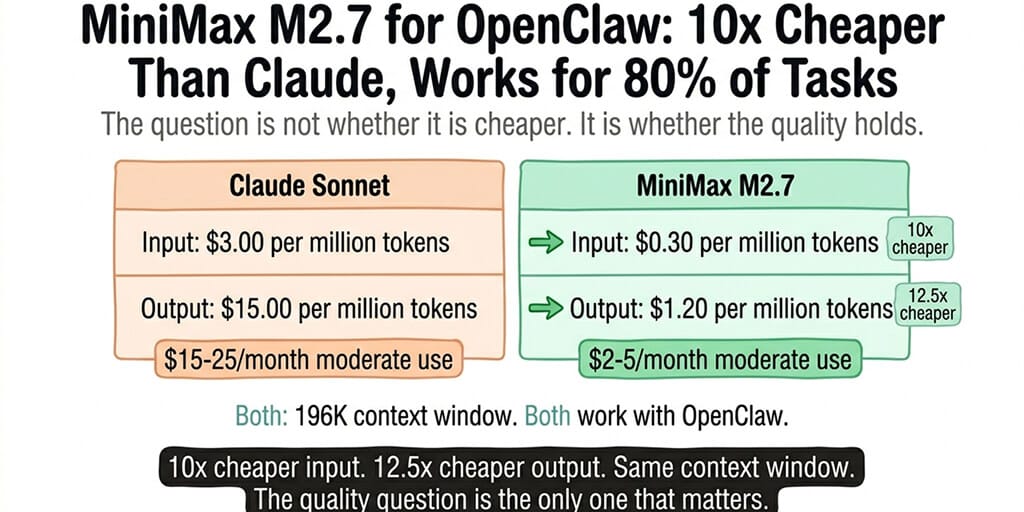
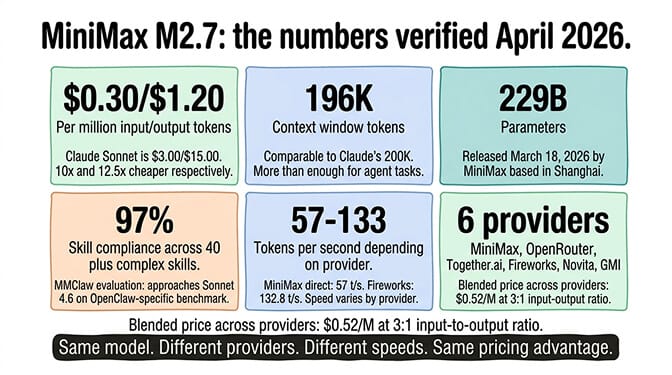
Pricing: $0.30 per million input tokens. $1.20 per million output tokens. Claude Sonnet is $3.00/$15.00. That's 10x cheaper on input, 12.5x cheaper on output.
Context window: 196,608 tokens. Comparable to Claude's 200K. For agent tasks, this is more than enough.
Parameters: 229 billion. Released March 18, 2026 by MiniMax (Chinese AI company, based in Shanghai).
Agent-specific benchmarks: 97% skill compliance across 40+ complex skills. On MMClaw evaluation (the OpenClaw-specific benchmark), M2.7 approaches Sonnet 4.6 performance. On SWE-Pro, scores 56.22% matching GPT-5.3-Codex.
Speed: 57 tokens per second on MiniMax's API. Fireworks delivers 132.8 tokens per second for the same model. Speed depends on your provider, not just the model.
Availability: MiniMax direct API, OpenRouter, Together.ai, Fireworks, Novita, GMI. Blended price across providers: $0.52 per million tokens (3:1 input-to-output ratio). For the newer generation, our MiniMax M3 vs Claude Sonnet 4.6 comparison shows how far the line has moved.
For the complete model comparison across providers, our comparison covers pricing, quality, and tool calling for every major model.
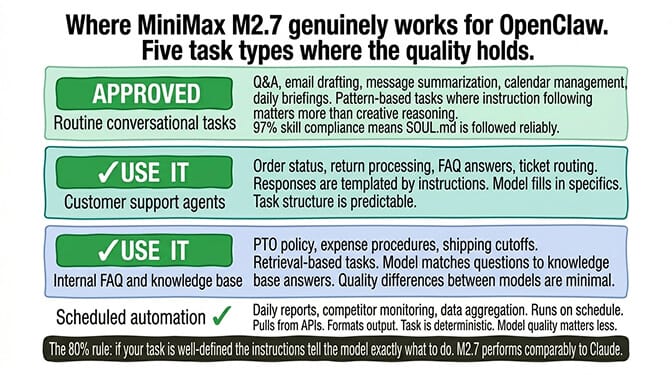
Where MiniMax M2.7 genuinely works for OpenClaw
Routine conversational tasks. Q&A, email drafting, message summarization, calendar management, daily briefings. These are pattern-based tasks where instruction following matters more than creative reasoning. M2.7's 97% skill compliance means it follows your SOUL.md instructions reliably.
Customer support agents. Order status, return processing, FAQ answers, ticket routing. The responses are templated by your instructions. The model fills in the specifics. M2.7 handles this well because the task structure is predictable.
Internal FAQ and knowledge base. "What's our PTO policy?" "How do I submit an expense report?" "What are the shipping cutoffs for next-day delivery?" These tasks are retrieval-based. The model matches questions to knowledge base answers. Quality differences between models are minimal here.
Scheduled automation. Daily report generation, competitor monitoring, data aggregation. Tasks that run on a schedule, pull data from APIs, and format output. The model quality matters less because the task is deterministic.
The 80% rule: If your agent task is well-defined (the instructions tell the model exactly what to do), MiniMax M2.7 performs comparably to Claude. If the task is open-ended (the model needs to figure out what to do), Claude is better.
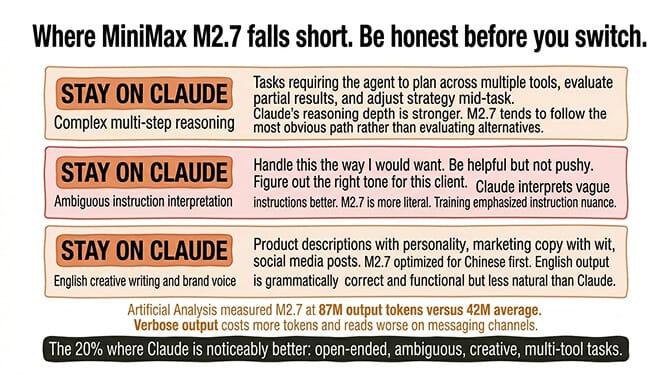
Where MiniMax M2.7 falls short (be honest before you switch)
Complex multi-step reasoning. Tasks that require the agent to plan across multiple tools, evaluate partial results, and adjust strategy mid-task. Claude's reasoning depth is stronger here. M2.7 tends to follow the most obvious path rather than evaluating alternatives.
Ambiguous instruction interpretation. "Handle this the way I'd want." "Be helpful but not pushy." "Figure out the right tone for this client." Claude interprets vague instructions better than M2.7 because its training emphasized instruction nuance. M2.7 is more literal.
English-language creative writing. Product descriptions with brand voice, marketing copy with personality, social media posts with wit. M2.7 was optimized for Chinese first (MiniMax is a Shanghai-based company). English output is grammatically correct and functional but less natural than Claude's.
Long-form document generation. M2.7 is noted for being "somewhat verbose" (Artificial Analysis measured 87M output tokens versus a 42M average on their Intelligence Index evaluation). For agent tasks where concise responses matter (messaging channels with limited screen space), verbose output costs more tokens and reads worse.
If model switching, cost optimization, and provider configuration across multiple models sounds like more infrastructure work than you want, BetterClaw supports MiniMax M2.7 along with 28+ other providers from a dropdown. Switch between Claude, M2.7, DeepSeek, and Gemini in 10 seconds. Smart context management reduces token costs on every model. Free tier with 1 agent and BYOK. $49/month for Pro (5 agents included). You choose the model. The platform handles the optimization.
The model routing strategy that makes this practical
Here's what nobody tells you about switching to M2.7.
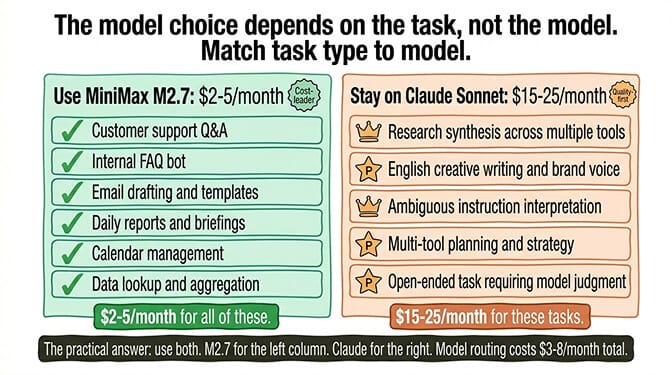
You don't have to choose one model for everything. The smartest configuration uses model routing: M2.7 for routine tasks and heartbeats. Claude Sonnet for complex tasks that require deeper reasoning.
Example routing setup:
Primary model: MiniMax M2.7 (handles all routine messages). Complex model: Claude Sonnet (triggered for tasks tagged as "research," "synthesis," or "creative"). Heartbeat model: MiniMax M2.7 (48 heartbeats/day at $0.30/M input instead of $3.00/M).
Monthly cost with routing: $3-8/month total. Compare to $15-25/month on Claude-only. The quality stays high where it matters (complex tasks still go to Claude) and the bill drops 60-80% on everything else.
For the cheapest provider configurations for OpenClaw, our provider guide covers the exact routing setup for each model combination.
The data privacy consideration (don't skip this)
MiniMax is a Chinese company based in Shanghai. Data processed through MiniMax's direct API is subject to Chinese data governance regulations. This matters for some users and organizations, and it doesn't matter for others. But you should know before you switch.
Alternatives that reduce the data concern:
Use M2.7 through Together.ai or Fireworks (US-based providers running the open-weight model on US infrastructure). Same model. Same pricing ($0.30/$1.20). US data processing. This eliminates the China data concern while keeping the cost advantage.
The bottom line (when to switch, when to stay)
Switch to M2.7 if: Your agent handles routine, well-defined tasks (support, FAQ, email, scheduling). You want to cut API costs by 80%+ without noticing a quality difference. You're comfortable using an open-weight model from a Chinese company (or routing through a US provider).
Stay on Claude if: Your agent handles open-ended, ambiguous tasks. English-language creative quality matters. You need the best possible instruction interpretation for vague prompts. Still weighing the options? Our guide on how to choose the right LLM for your task turns this into a four-question framework.
Use both if: You want Claude quality where it matters and M2.7 costs everywhere else. Model routing gives you both.
If you want to try M2.7 (or any of the 28+ providers) without configuring model routing in YAML files, give BetterClaw a try. Free tier with 1 agent and BYOK. $49/month for Pro (5 agents included). Switch models from a dropdown. Smart context management keeps costs low on every model. For the complete guide to free and budget models, our free model post covers five more options.
Frequently Asked Questions
What is MiniMax M2.7?
MiniMax M2.7 is a 229-billion parameter language model released in March 2026 by MiniMax (Shanghai). It costs $0.30/$1.20 per million tokens (10x cheaper than Claude Sonnet on input), has a 196K context window, and scores 97% on skill compliance across 40+ complex OpenClaw skills. Available via MiniMax API, OpenRouter, Together.ai, and Fireworks.
How does MiniMax M2.7 compare to Claude for OpenClaw?
For routine agent tasks (support, FAQ, email, scheduling), M2.7 performs comparably to Claude at 10% of the cost. For complex multi-step reasoning, ambiguous instruction interpretation, and English creative writing, Claude is noticeably better. On MMClaw evaluation (the OpenClaw-specific benchmark), M2.7 approaches but doesn't match Sonnet 4.6.
How do I set up MiniMax M2.7 with OpenClaw?
Get an API key from platform.minimax.io (or OpenRouter/Together.ai/Fireworks for US-hosted). Add the provider and API key to your OpenClaw config. Set the model to MiniMax-M2.7 (or the provider-specific model ID). Restart the gateway. On BetterClaw, select MiniMax M2.7 from the model dropdown. No config files needed.
How much does MiniMax M2.7 cost per month for OpenClaw?
$2-5/month for moderate use (50 messages/day). Compare to Claude Sonnet at $15-25/month for the same usage. With model routing (M2.7 for routine tasks, Claude for complex), total cost is $3-8/month. BetterClaw platform fee: $0 (free plan) or $49/month (Pro) on top of API costs. BYOK with zero inference markup.
Is MiniMax M2.7 safe for business use with OpenClaw?
The model itself is open-weight and available through US providers (Together.ai, Fireworks) if Chinese data governance is a concern. On self-hosted OpenClaw, standard security risks apply (540+ CVEs, credential exposure, skill supply chain). On BetterClaw, managed security includes Docker sandboxing, verified skills, and secrets auto-purge regardless of which model you use.