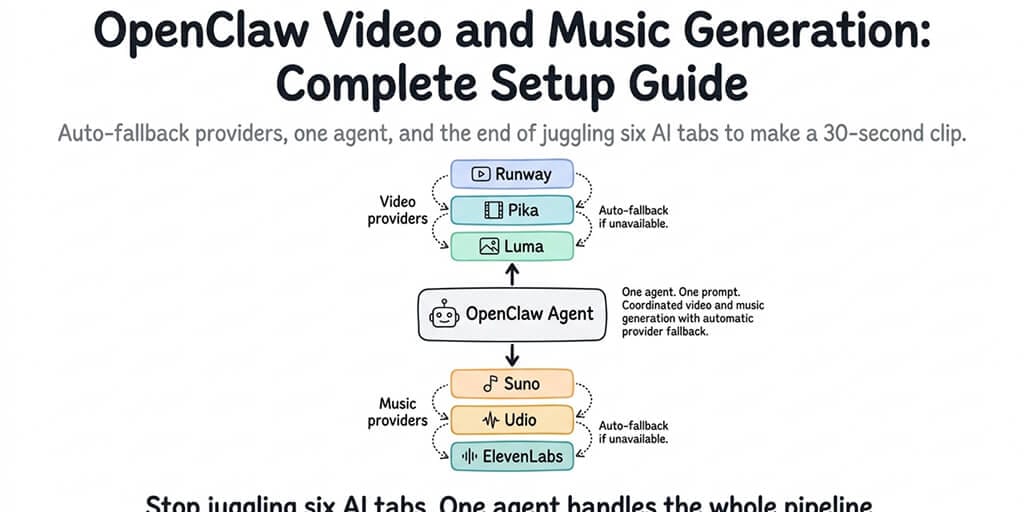
Auto-fallback providers, one agent, and the end of juggling six AI tabs to make a 30-second clip.
11:14 PM. Suno was down.
I had a video to ship in the morning, two competing music drafts I needed to hear before bed, and the Suno status page was politely telling me to come back later. I tabbed over to Udio. Tabbed back to my video tool. Realized I'd already paid for three different generation services this month and was now manually retrying each one like it was 2003 and my dial-up had dropped.
Then my agent finished the job. Tried Suno first. Failed. Fell back to Udio without telling me. Dropped two music drafts in Slack with the matching video clip already attached.
That's the moment OpenClaw video and music generation stopped being a novelty for me and started being how I actually ship media.
What "media generation with auto-fallback" actually means
Most people who try AI video or music generation hit the same wall. You sign up for one provider. It's great until it isn't. The model gets rate-limited during peak hours. The service goes down for maintenance. The new model release is amazing but your account is stuck on the old one. The cheaper plan throttles you to two clips a day.
So you sign up for a second provider. Then a third. Now you have three dashboards, three billing pages, three API keys, and you're picking between them manually based on which one is currently behaving.
OpenClaw video and music generation, with the auto-fallback pattern, collapses all of that into one agent.
You give the agent a creative brief. It picks the best provider for the job, tries that one first, and if anything goes wrong (rate limit, timeout, content filter, downtime), it quietly tries the next one in your fallback chain. You get the output. You don't get a notification that your favorite provider was acting weird tonight.
If you've already worked through smart model routing in OpenClaw for text models, this is the same idea applied to media. Different domain, same logic.
The point of an agent isn't to be one model. It's to know which model to use and what to do when that model fails.
Why this matters more for media than for text
Text generation is forgiving. If GPT is down, Claude is fine. If Claude is throttled, Gemini works. The outputs are roughly comparable for most tasks.
Media is not like that.
Suno and Udio sound different. Runway and Pika produce different motion characteristics. Luma's Dream Machine handles certain camera moves better than others. ElevenLabs music has a different texture than Stable Audio. Each provider has a personality.
Here's the weird part. That's actually why fallbacks work for media. You're not trying to get an identical result from your second-choice provider. You're trying to get a usable result when your first choice can't deliver one. For a marketing video, three different decent options beats waiting two hours for the perfect one from your favorite tool.
The four pieces of a media generation setup
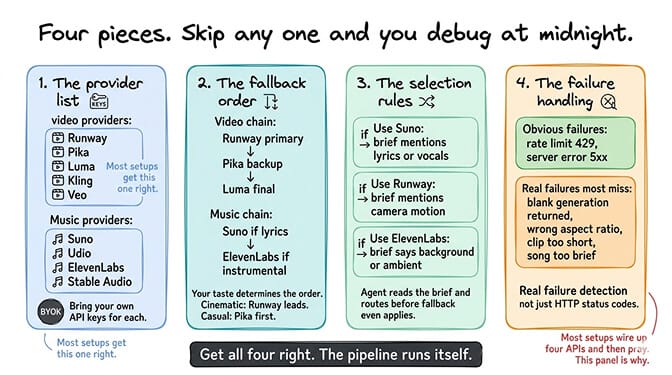
Every working OpenClaw video and music generation setup has four pieces. Skip any of them and you'll end up debugging at midnight.
The provider list. Which video and music services your agent has access to. For video, the usual suspects are Runway, Pika, Luma, Kling, and Veo. For music, Suno, Udio, ElevenLabs music, and Stable Audio. You bring your own API keys for each one you want to use.
The fallback order. What order the agent should try providers in. This is where your taste matters. For cinematic video, Runway might lead with Pika as backup. For casual social clips, Pika first, Luma second. For music, depends on whether you want vocals (Suno, Udio) or instrumental beds (ElevenLabs, Stable Audio).
The selection rules. When to pick which provider, even before fallback kicks in. "Use Suno for songs with lyrics. Use ElevenLabs for background music. Use Runway when the brief mentions camera motion." The agent reads the brief and routes accordingly.
The failure handling. What counts as "failure" worth falling back on. A 429 rate limit, obviously. A 5xx error, yes. But also: a generation that comes back blank, a clip that's clearly the wrong aspect ratio, a song that's too short. Real failure detection, not just HTTP status codes.
Most setups I see in the wild get the provider list right and the rest wrong. They wire up four APIs and then pray.
What the actual setup flow looks like
I'm going to walk through this at the conceptual level because the specific configuration syntax for OpenClaw media skills is moving fast and I don't want you copy-pasting something stale. Always check the current OpenClaw docs for exact field names.
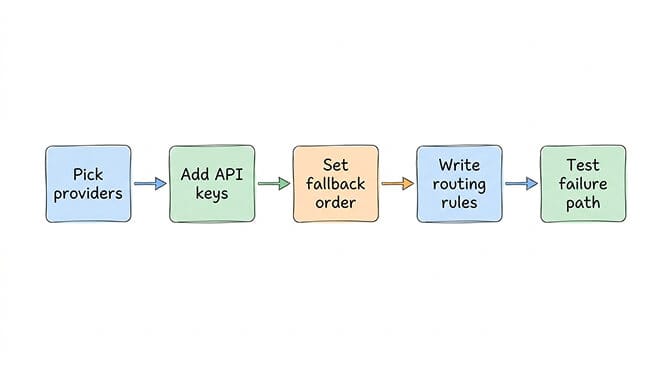
The flow has five steps.
Step 1: Pick your providers and get API keys. Sign up for whatever you actually plan to use. Don't add providers "just in case." Each one is a key to manage and a bill to track. Three is plenty to start.
Step 2: Add the credentials to your agent. This is where managed platforms diverge from self-hosted. On managed, you paste keys into a UI and they're encrypted at rest. On self-hosted, you're managing environment variables, secrets files, and probably a .env you have to remember not to commit.
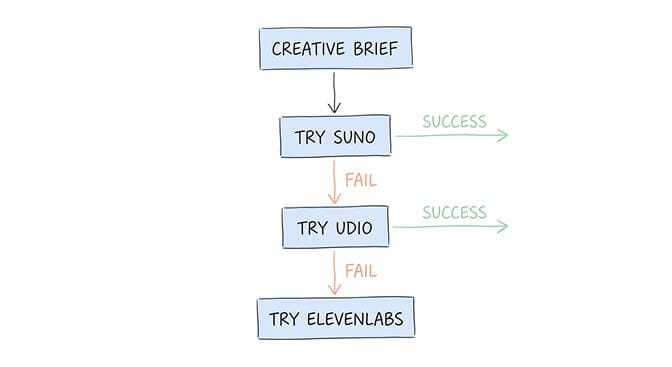
Step 3: Configure the fallback chain. Tell the agent the order to try providers in. Most setups support a primary and one or two backups per media type.
Step 4: Write the routing instructions. This is just natural-language guidance you give the agent. "If the user asks for a song with lyrics, try Suno first. If they ask for background music, try ElevenLabs first." The agent reads the brief and picks.
Step 5: Test the failure path. This is the step nobody does. Pull the API key for your primary provider and re-run a generation. Make sure the agent actually falls back instead of erroring out. If you don't test it, you'll find out it doesn't work the night you actually need it.
Real workflows people are running
Three patterns I've seen working in production.
Social content factory. A founder writes one brief in Slack ("30-second product teaser, upbeat, vertical"). The agent generates a video on Pika, music on Suno, mixes them, and drops a downloadable file in #marketing within two minutes. If Pika rate-limits, Luma. If Suno fails, Udio. The founder went from "we'll do video next quarter" to shipping three pieces a week.
Course and tutorial intros. An educator generates intro music for each new lesson, paired with a 5-second branded animation. Same agent. Same brief format. The cost per lesson dropped from $40 of freelance work to a few cents of API calls.
Podcast and ad jingles. A small agency generates custom audio stings for clients on demand. Three providers in the music fallback chain means they've never missed a deadline, even when one of the major music providers had downtime.
The thread connecting all three: none of them want to think about which provider is up today. They want the output.
If you're tired of juggling tabs and want a single agent handling video and music generation with auto-fallback baked in, Better Claw runs your OpenClaw agent without any of the API key, infrastructure, or fallback config headaches. $49/month for Pro, BYOK, encrypted credential storage included.
The part nobody tells you about self-hosting this
Self-hosting OpenClaw with media generation works. It's also the highest-friction setup in the OpenClaw ecosystem right now.
Why? Because media generation involves a lot of moving pieces that have nothing to do with the agent itself.
You're storing API keys for four to six providers in environment variables. You're handling large file outputs (a 1080p video clip is meaningfully heavy). You're dealing with provider SDKs that update on different cadences and occasionally break each other. You're maintaining the fallback logic when a provider changes their error response format. You're keeping the self-hosted OpenClaw instance updated without breaking anything that depends on the old version.
Plus the security stuff. Six API keys sitting in plaintext on a VPS is a target. The CrowdStrike security advisory on OpenClaw earlier this year was largely about exposed credentials and over-permissioned skills, and media generation setups tend to accumulate both.
Managed isn't always the right answer. But for media generation specifically, the math leans hard in its favor. See our self-hosting vs managed breakdown for the full tradeoff.
How to think about cost
This trips people up, so I'll be direct. Media generation is the most expensive thing your agent will do. A short video clip can cost $0.50 to $2 in API calls depending on provider and length. A song might cost $0.10 to $0.40. If your agent is generating a hundred pieces a week, that's real money.
The $49/month for the agent itself is rounding error compared to your provider bills.
What auto-fallback gives you on cost is option value. You can set your fallback chain to prefer the cheaper provider for casual content and the premium one for hero content. You can put a strict provider you've negotiated volume pricing with at the top. You decide.
Most of the cost-control tactics from the text-model side translate directly here. If you haven't read it yet, the breakdown of cheapest OpenClaw AI providers covers the same logic for picking which model to send which job to. Same principles apply when one of those jobs is generating a video.
What you stop doing is paying for sub-par output because your favorite provider was down and you needed something now.
One last thing
Media generation is going to keep splitting into more providers, not fewer. New video models drop monthly. Music generation is in the middle of the same explosion text was in two years ago. Every one of those providers will have a bad week, a maintenance window, a sudden pricing change, a new model that breaks the old API.
If your workflow depends on one tool, you're going to spend the next year context-switching every time something breaks. If your workflow depends on an agent that knows about all of them, you're going to ship through it.
If you've been juggling four media tools and want one agent doing the routing for you, give Better Claw a try. $49/month for Pro, BYOK, your API keys stay encrypted, and your first deploy takes about 60 seconds. We handle the credentials, the fallback plumbing, and the agent infrastructure. You handle the creative direction.
The right way to think about this stuff isn't "which AI video tool should I pick." It's "which agent should pick for me."
Frequently Asked Questions
What is OpenClaw video and music generation with auto-fallback?
It's a setup where a single OpenClaw agent can generate video and music using multiple AI providers, automatically falling back to a backup provider if the primary one fails or rate-limits. Instead of managing four separate dashboards, you give the agent one brief and it routes to the right service. Auto-fallback is a recent capability in OpenClaw and is one of the cleanest ways to handle the unreliability of fast-moving media APIs.
How does OpenClaw media generation compare to using Runway or Suno directly?
Direct usage is fine if you only need one provider and you're okay tab-switching. OpenClaw with auto-fallback gives you reliability across providers, a single brief format, and the ability to route between video and music in one workflow. The tradeoff is setup time. You're configuring an agent instead of just opening a web UI.
How do I set up auto-fallback providers for video and music generation?
At a high level: get API keys for two or three providers per media type, add them to your agent's credentials, configure the fallback order, write routing rules in plain language, and test the failure path by pulling your primary key. On a managed platform like BetterClaw, the credential storage and fallback wiring are handled for you. On self-hosted, you're managing environment variables and SDK updates yourself.
Is OpenClaw video and music generation worth it for solo creators?
If you ship media regularly, yes. The agent itself is $49/month for Pro on a managed platform. Your real cost is the provider API bills, which you'd be paying anyway. The benefit is one workflow instead of five, and reliability when individual providers have bad days. If you generate one video a month, just use the web UIs.
Are AI-generated videos and music safe to use commercially?
Each provider has its own commercial-use license. Runway, Pika, Suno, Udio, and ElevenLabs all have paid tiers that grant commercial rights for outputs, but the details vary by plan. Always check the current terms of service for the specific provider and tier you're using. Using BetterClaw as your OpenClaw deployment layer doesn't change your licensing, it just changes which provider produced the output.
Related Reading
- OpenClaw Model Routing — Same routing logic applied to text models
- Cheapest OpenClaw AI Providers — Picking the right model for the job on cost
- OpenClaw Self-Hosting vs Managed — Full tradeoff breakdown
- OpenClaw Security Risks — Why plaintext credentials are a real problem
- OpenClaw Webhook TaskFlows for Business Automation — Triggering media generation from real business events