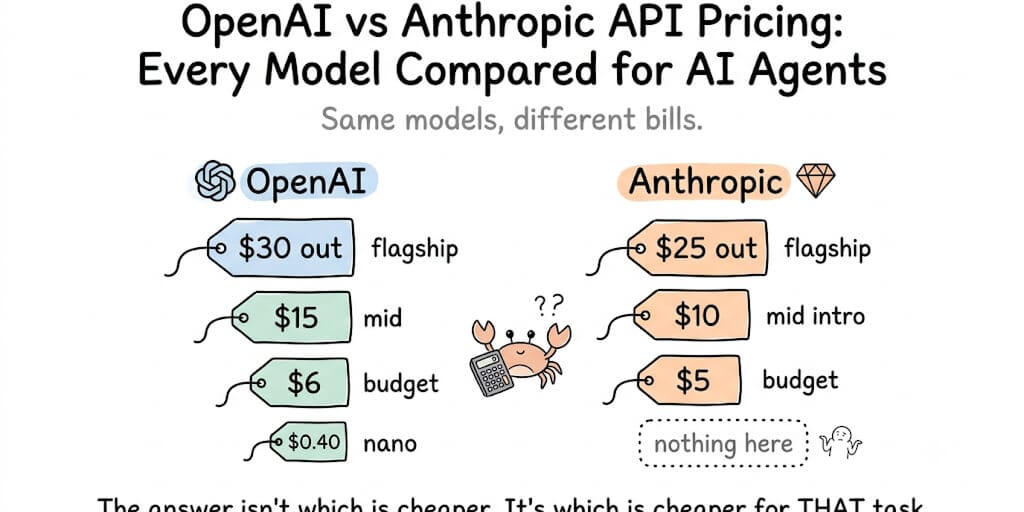
Same models, different bills. Here's the pricing math that actually decides which provider your agent should run on.
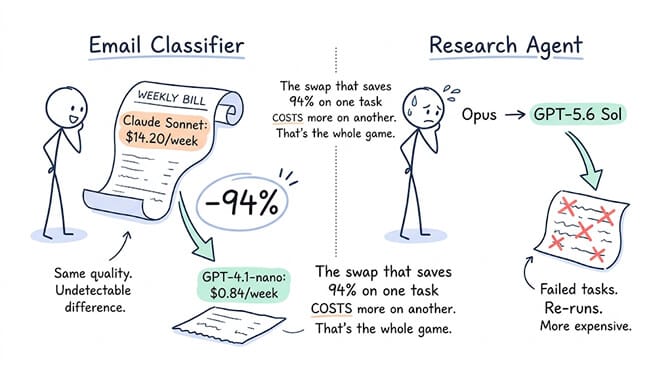
I switched an email triage agent from Claude Sonnet to GPT-4.1-nano on a Tuesday morning. Same workflow. Same prompt. Same 200 daily email classifications.
The weekly LLM bill dropped from $14.20 to $0.84. That's a 94% reduction for a task where the quality difference was literally undetectable in our evaluation.
Here's the part that took longer to figure out. When I tried the same swap on our research agent, switching from Opus to GPT-5.6 Sol, the output quality dropped noticeably on multi-step reasoning tasks. The cheaper model wasn't cheaper if it meant re-running failed tasks.
That's the whole game with OpenAI vs Anthropic API pricing in 2026. It's not about which provider is cheaper. It's about which provider is cheaper for the specific task your agent is doing, because the answer changes completely depending on what tier you need.
The complete pricing table (July 2026)
This is the table you'll come back to. All prices are per million tokens.
| Tier | OpenAI Model | Input | Output | Anthropic Model | Input | Output |
|---|---|---|---|---|---|---|
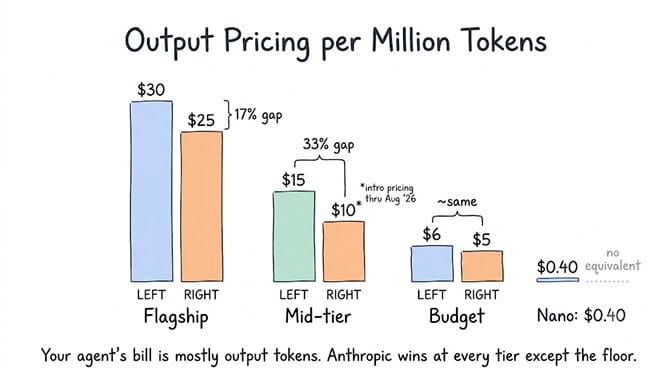
| Flagship | GPT-5.6 Sol | $5.00 | $30.00 | Claude Opus 4.8 | $5.00 | $25.00 |
| Mid-tier | GPT-5.6 Terra | $2.50 | $15.00 | Claude Sonnet 5 (intro) | $2.00 | $10.00 |
| Mid-tier (standard) | GPT-5.4 | $2.50 | $15.00 | Claude Sonnet 4.6 | $3.00 | $15.00 |
| Budget | GPT-5.6 Luna | $1.00 | $6.00 | Claude Haiku 4.5 | $1.00 | $5.00 |
| Ultra-budget | GPT-4.1-nano | $0.10 | $0.40 | (no equivalent) | — | — |
| Premium reasoning | GPT-5.5 Pro | $30.00 | $180.00 | Claude Fable 5 | $10.00 | $50.00 |
Notice the pattern. At the flagship tier, the two providers now mirror each other on input ($5 per million), but Anthropic is 17% cheaper on output ($25 versus $30). At the mid-tier, Sonnet 5's introductory pricing through August 31, 2026 ($2/$10) undercuts GPT-5.6 Terra ($2.50/$15) on both input and output. At the budget tier, they're virtually identical on input, with Anthropic slightly cheaper on output.
Where OpenAI wins on price: the ultra-budget floor. GPT-4.1-nano at $0.10/$0.40 has no Anthropic equivalent. For high-volume classification, formatting, and simple extraction where you need the absolute lowest per-token cost, OpenAI's bottom tier is 10x cheaper than anything Anthropic offers.
Where Anthropic wins on price: everything from mid-tier up. Anthropic's consistent 5x output-to-input ratio across all models makes budgeting predictable. OpenAI's ratio varies from 4x (GPT-4.1-nano) to 6x (GPT-5.6 Sol and GPT-5.5 Pro), which makes cost forecasting harder.
The context window pricing difference that actually matters for agents
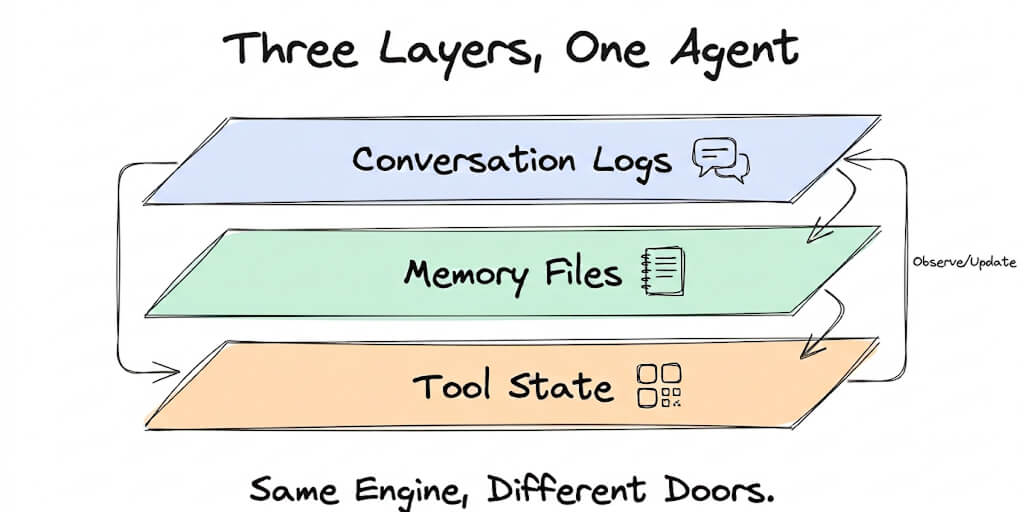
For AI agents, context window pricing is more important than it is for chatbots, because agents carry system prompts, memory files, conversation history, and tool outputs forward on every turn.
Anthropic offers flat pricing across the full 1 million token context window on Opus and Sonnet. No surcharges. Whether your agent's context is 10K or 500K tokens, you pay the same per-token rate.
OpenAI's GPT-5.6 family also supports 1M context at flat rates, which is a change from the earlier GPT-5.5 that charged surcharges above 272K tokens. If you're on the current generation, this difference has narrowed considerably.
Here's what this means for agents specifically: if your agent accumulates a large context over a long session (common for research agents, document analysis, or multi-step workflows), the per-token rate is now the primary cost factor on both providers, not the context window surcharge. That makes the output pricing gap the deciding factor: $25 versus $30 per million output tokens at the flagship tier means a 17% savings on every response, compounded across every turn in every session.
The caching and batch math that changes everything
Both providers offer the same two main discount levers:
Prompt caching: both cut cached input by up to 90%. Since your agent's system prompt, SOUL.md, and persistent context get re-sent identically on every turn, a high cache hit rate (60-80% is typical) dramatically reduces input costs on both platforms.
Batch API: both offer a flat 50% discount on all models for non-real-time workloads. If your agent processes a queue of tasks overnight rather than handling them in real time, batch pricing cuts the bill in half.
At the flagship tier with prompt caching enabled, effective input costs drop to roughly $0.50 per million tokens on both providers. The output price, where Anthropic is 17% cheaper, becomes the dominant cost factor.
The reasoning cost trap that catches agent builders
This is where most people get it wrong. Reasoning models generate hidden "thinking" tokens that are billed at the output rate but don't appear in the response. Your agent's visible 500-token reply might have consumed 2,000 or more tokens internally.
OpenAI's reasoning models (o3, o4-mini, GPT-5.5 Pro) bill internal thinking tokens at the output rate. A 500-token visible response may consume 2,000+ total tokens.
Anthropic's Opus 4.8 introduced adaptive thinking with effort controls (low, medium, high, xhigh, max), letting you dial how much reasoning the model spends per task. This gives you direct cost control over thinking tokens that OpenAI's reasoning models don't offer in the same way.
For agents that make dozens of calls per session, uncontrolled thinking tokens can be the largest hidden cost in the entire stack. If you're running our token cost optimization techniques, capping thinking tokens is one of the five fixes covered there.
Which provider for which agent task
Here's the decision framework that matters more than the raw pricing:
Classification, formatting, simple extraction: OpenAI wins. GPT-4.1-nano at $0.10/$0.40 is unbeatable for tasks where any capable model produces the same result. Route your email classifier, your tag extractor, and your format converter here.
General-purpose agent workflows (triage, summarization, drafting): Anthropic wins slightly. Sonnet 5 at introductory $2/$10 is cheaper than GPT-5.6 Terra at $2.50/$15 through August 2026. After that, they converge to near-parity.
Complex reasoning and multi-step tool calling: close to a tie on quality, Anthropic wins on cost. Opus 4.8 at $5/$25 versus GPT-5.6 Sol at $5/$30 means Anthropic is 17% cheaper per output token for the same tier of reasoning capability.
Ultra-high-volume, cost-is-everything workloads: OpenAI wins. Nothing in Anthropic's lineup matches the $0.10/$0.40 floor. If you're processing millions of simple requests, the 10x cost gap at the bottom tier is the only number that matters.
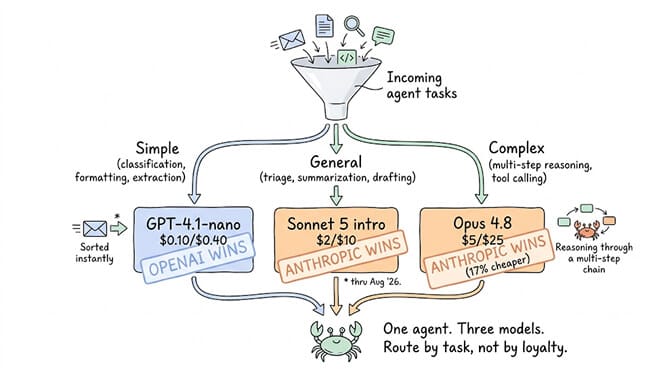
Both providers work on BetterClaw via BYOK with zero markup. You can switch between them in your agent settings without changing your workflow, which means the model routing pattern, where you send simple tasks to the cheapest model and complex tasks to the best one, works across providers in the same agent. Free plan, no credit card, 28+ model providers supported.
The real cost for a typical agent setup
Here's what a three-agent setup actually costs per month on each provider, assuming moderate volume (50 sessions a day, average 30 turns per session, 2,000 input tokens and 500 output tokens per turn):
All-OpenAI (GPT-5.6 Terra for everything): Input: ~90M tokens/mo x $2.50 = $225. Output: ~22.5M tokens/mo x $15.00 = $337.50. Total: ~$562/mo before caching. With 70% cache hit rate: ~$280/mo.
All-Anthropic (Sonnet 5 intro for everything): Input: ~90M tokens/mo x $2.00 = $180. Output: ~22.5M tokens/mo x $10.00 = $225. Total: ~$405/mo before caching. With 70% cache hit rate: ~$210/mo.
Mixed routing (budget tasks on GPT-4.1-nano, complex on Opus 4.8): 70% of tasks on nano: ~$15/mo. 30% of tasks on Opus: ~$180/mo. Total: ~$195/mo before caching. With caching: ~$120/mo.
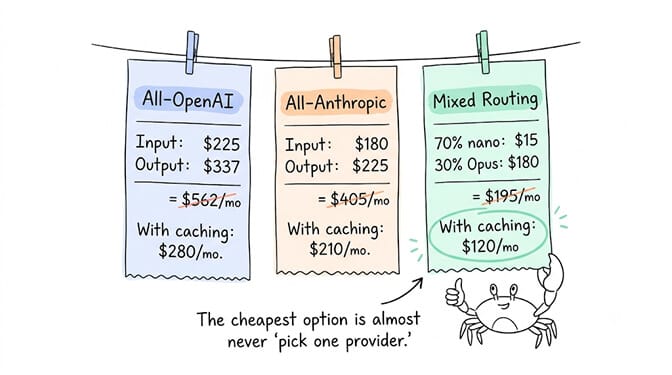
The cheapest option is almost never "pick one provider." It's route to the cheapest model that can handle each specific task, across both providers.
For more on how model routing, prompt caching, and context compression work together to reduce these numbers by 40 to 70 percent, our guide to cutting agent token costs covers all five techniques in detail.
The honest takeaway
OpenAI and Anthropic have converged on pricing more than they've diverged. The flagship tier is within 17% on output. The mid-tier is within a few dollars. The budget tier is where OpenAI's advantage is enormous and real.
The question isn't which provider is cheaper. It's which combination of models across both providers minimizes your bill while maintaining quality on the tasks that need it. Every dollar spent on a frontier model for a classification task is a dollar wasted. Every dollar saved by running a classification model on a reasoning task creates a failure you'll pay more to fix.
Route between both providers, no markup, no code changes
BetterClaw supports 28+ model providers with zero inference markup — switch models in settings, not in code. Start free → No credit card · One agent with every feature on the free plan · $19/mo per agent for Pro · Deploy in ~60 seconds
Frequently Asked Questions
What is the difference between OpenAI and Anthropic API pricing in 2026?
Both charge per million tokens with separate input and output rates. At the flagship tier, both charge $5 per million input tokens, but Anthropic is 17% cheaper on output ($25 versus $30). At the budget tier, OpenAI's GPT-4.1-nano ($0.10/$0.40) is roughly 10x cheaper than Anthropic's cheapest model, Haiku 4.5 ($1/$5). Both offer 50% Batch API discounts and 90% prompt caching discounts.
How does OpenAI GPT-5.6 Sol compare to Claude Opus 4.8 for agents?
Both are flagship-tier reasoning models at $5 per million input tokens. Opus 4.8 is cheaper on output ($25 versus $30 per million), includes adaptive thinking with effort controls for cost management, and offers flat 1M context pricing. GPT-5.6 Sol matches on context window size. For agent use cases involving complex multi-step reasoning, the 17% output savings on Anthropic compounds across every turn in every session.
Which API is cheaper for high-volume AI agent workloads?
For high-volume, simple tasks (classification, extraction, formatting), OpenAI is significantly cheaper thanks to GPT-4.1-nano at $0.10/$0.40 per million tokens. For mid-tier and flagship workloads, Anthropic is slightly cheaper, especially with Sonnet 5's introductory pricing at $2/$10 through August 2026. The cheapest overall approach is routing across both providers: budget tasks to OpenAI's nano models, complex tasks to Anthropic's Opus or Sonnet.
How much does it cost to run an AI agent on OpenAI or Anthropic per month?
A typical mid-tier agent setup (50 sessions/day, 30 turns per session) costs roughly $280 per month on OpenAI's GPT-5.6 Terra with caching, or roughly $210 per month on Anthropic's Sonnet 5 at introductory pricing with caching. Mixed routing across both providers can bring this down to roughly $120 per month by sending simple tasks to ultra-budget models and reserving frontier models for complex reasoning.
Can I use both OpenAI and Anthropic on the same AI agent?
Yes. On platforms that support BYOK (bring your own key) with multiple providers, you can route different task types to different models across both providers within the same agent workflow. BetterClaw supports 28+ model providers including both OpenAI and Anthropic, with zero markup on inference. You switch models in settings without changing the agent's workflow or configuration.