60,000+ GitHub stars in two months. A built-in learning loop that gets smarter over time. An OpenClaw migration tool that imports your settings in one command. Here's what Hermes actually is, what it does differently, and where it fits.
A Petronella Technology Group analysis put it clearly: "Hermes is more opinionated. It assumes the durable advantage will come from a runtime that remembers, structures, and improves its own procedures."
That's the difference in one sentence.
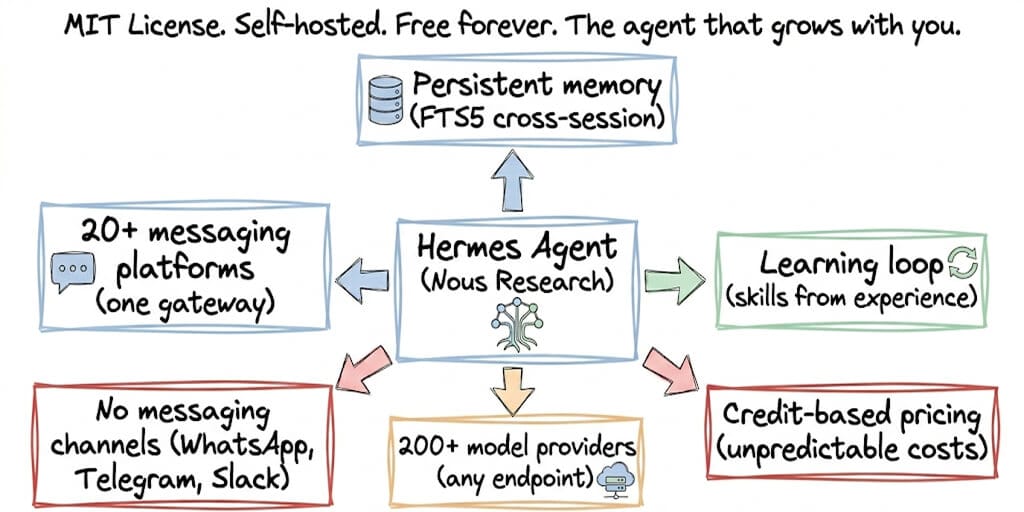
OpenClaw builds an ecosystem. 230K+ stars, 1,400+ skills on ClawHub, 50+ messaging channels. Breadth first. Hermes Agent builds depth. 60,000+ stars in two months. A self-improving learning loop. 20 messaging platforms from one gateway. It gets measurably smarter the longer it runs.
Both are open-source, self-hosted, MIT-licensed AI agent frameworks. Both connect to your messaging apps. Both support multiple AI models. They're competing for the same users. But they made fundamentally different bets about what matters.
Here's the complete overview.
What Hermes Agent actually is (the 60-second version)
Hermes Agent is an open-source autonomous AI agent built by Nous Research, released February 2026. It runs on your server (VPS, laptop, Docker container), connects to your messaging apps, and executes tasks autonomously. One command to install. One command to start.
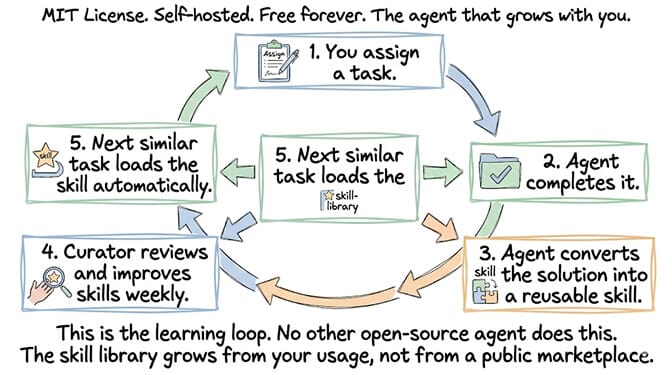
The key difference from everything else: Hermes has a built-in learning loop. When it completes a task, it can convert the solution into a reusable skill. Next time a similar task appears, it loads that skill instead of solving from scratch. The Curator (v0.12) reviews skills on a 7-day cycle: consolidating overlaps, archiving stale entries, and improving active ones.
The agent doesn't just do things. It learns how to do things better.
The numbers as of May 2026: 60,000+ GitHub stars (fastest-growing agent project in 2026). 295+ contributors. 20 messaging platforms. 200+ model providers via OpenRouter. MIT license. Free forever. For what people actually build with it, see our roundup of real Hermes Agent use cases.
The five things that make Hermes different
1. The learning loop (no other agent does this)
Other agents are stateless by design. They solve each task from scratch. Hermes converts completed tasks into skills. The Curator maintains the skill library. After three months of use, Hermes handles familiar task types significantly faster because it's loading proven solutions, not generating new ones.
Stanford HAI's AI Index 2026 confirms this matters: "AI agents moved from question answering toward task completion in 2025, but still fail roughly one in three attempts on structured benchmarks." The learning loop directly attacks that failure rate. Solved once, reused indefinitely.
2. Persistent memory that actually persists
Hermes stores memory in a local SQLite database with FTS5 full-text search. Two key files: USER.md (your preferences, style, things you don't want repeated) and MEMORY.md (projects, business context, environment). The agent searches its own past conversations for context.
Cross-platform continuity: A task started on Telegram can be continued on Discord. The memory system is unified across all platforms.
For the detailed comparison of how OpenClaw and Hermes handle memory differently, our security analysis covers how both frameworks manage persistent state.
3. 20 messaging platforms from one gateway
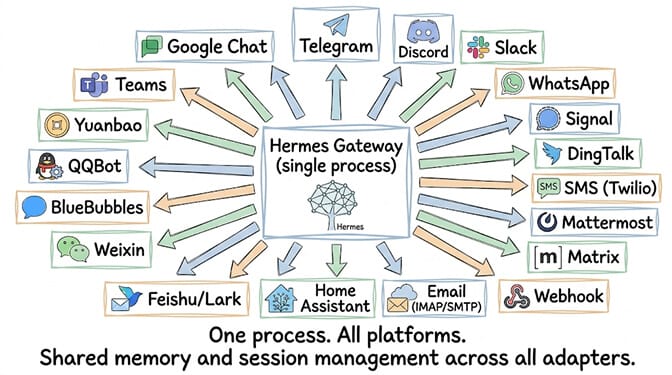
Telegram, Discord, Slack, WhatsApp, Signal, DingTalk, SMS (Twilio), Mattermost, Matrix, Webhook, Email (IMAP/SMTP), Home Assistant, Feishu/Lark, WeCom, Weixin, BlueBubbles (iMessage), QQBot, Yuanbao, Microsoft Teams, Google Chat. LINE support is on main.
All from one gateway process. Unified session management. Shared memory across adapters. OpenClaw claims 50+ channels, but many are community-contributed and inconsistently maintained.
4. Model freedom (200+ providers, no lock-in)
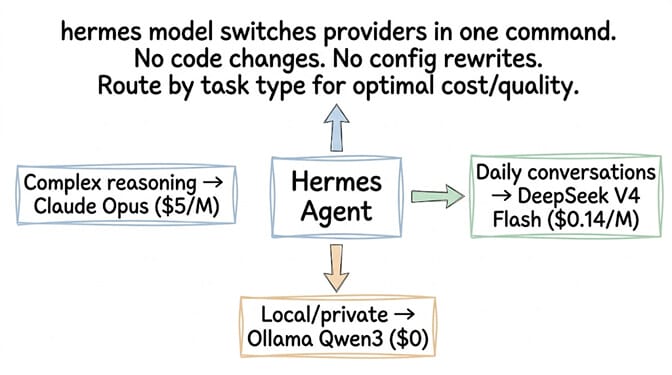
Nous Portal, OpenRouter (200+ models), OpenAI, Anthropic, DeepSeek, Kimi, xAI, Google, NVIDIA NIM, Hugging Face, or your own endpoint. Switch with hermes model. No code changes. No config rewrites.
Provider routing: Assign different models to different task types. Claude for complex reasoning. DeepSeek for daily conversations. Route by cost, quality, or latency.
5. Built-in OpenClaw migration
Here's what nobody tells you about switching.
Hermes automatically detects your OpenClaw installation during setup. The wizard offers to import your settings, memories, skills, and API keys. Or run it manually: hermes claw migrate. It supports dry-run previews, selective presets (user data without secrets), and conflict overwrite options.
If you want the capabilities of both ecosystems without managing either framework's infrastructure, security, and updates, BetterClaw handles the deployment and management layer. No Docker. No WSL2. No volume mounts. Free tier with 1 agent and BYOK. $49/month for Pro. 60-second deploy.
The honest assessment (strengths and weaknesses)
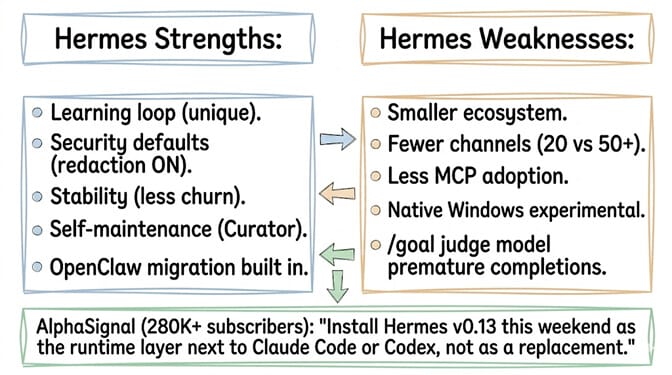
Where Hermes excels:
Learning loop. No other agent turns completed tasks into reusable skills automatically. This is genuinely unique.
Security defaults. Redaction on by default. Stranger rejection on messaging platforms. Pre-execution terminal command scanning. 8 P0 security fixes in v0.13 alone.
Stability. The i-scoop analysis noted: "Hermes keeps tighter boundaries around what the runtime does and how it executes skills." Compared to OpenClaw's 18-releases-in-18-days pace, Hermes releases are less frequent but less breaking.
Where Hermes falls short:
Ecosystem size. 60K stars versus OpenClaw's 230K. Fewer tutorials, fewer community guides, fewer third-party integrations.
MCP adoption. OpenClaw has 1,000+ MCP servers. Hermes supports MCP (and can act as an MCP server itself) but the ecosystem is younger.
Windows support. Native Windows is "early beta." WSL2 is the recommended path. OpenClaw runs natively on Windows (with known issues, but natively).
Velocity also means bugs. The flip side of fast releases is a steady stream of edge cases; our guide to troubleshooting Hermes Agent maps every reported error string to its fix, and when a request gets rejected outright, the Hermes Agent error 400 guide ranks every cause.
Where Hermes fits in the 2026 agent market
Here's the take.
Hermes and OpenClaw aren't interchangeable. They make different architectural bets. OpenClaw bets on ecosystem (more plugins, more channels, more community). Hermes bets on runtime depth (learning, memory, self-improvement). Both bets are valid. Both serve different priorities.
AlphaSignal's recommendation: "Install Hermes v0.13 this weekend as the runtime layer next to Claude Code or Codex, not as a replacement."
The community pattern: Many users run both. OpenClaw for its massive skill library and channel breadth. Hermes for its learning loop and task completion guarantees. The frameworks aren't mutually exclusive.
If you want the agent capabilities without choosing between frameworks, managing Docker, debugging WSL2, or maintaining self-hosted infrastructure, give BetterClaw a try. Free tier with 1 agent and BYOK. $49/month for Pro. 15+ messaging channels. Persistent memory. Smart context management. No infrastructure to manage. The agent runs. The framework choice is ours.
Frequently Asked Questions
What is Hermes Agent?
Hermes Agent is an open-source, MIT-licensed autonomous AI agent built by Nous Research, released February 2026. It runs on your own server, connects to 20+ messaging platforms, supports 200+ AI models, and features a built-in learning loop that converts completed tasks into reusable skills. The agent gets smarter the longer it runs. 60,000+ GitHub stars in two months.
How does Hermes Agent compare to OpenClaw?
Different architectural bets. OpenClaw prioritizes ecosystem breadth (230K+ stars, 50+ channels, 1,000+ MCP servers). Hermes prioritizes runtime depth (learning loop, Curator self-maintenance, persistent cross-session memory, security defaults). OpenClaw ships faster but with more breaking changes. Hermes ships less frequently but more stably. Many users run both.
How do I install Hermes Agent?
One command: curl -fsSL https://raw.githubusercontent.com/NousResearch/hermes-agent/main/scripts/install.sh | bash. It auto-detects your OS, installs dependencies, and runs the setup wizard. For Docker: docker run -it -v ~/.hermes:/opt/data nousresearch/hermes-agent setup. For Windows, WSL2 is recommended (native Windows is early beta). Total setup: 5-10 minutes.
How much does Hermes Agent cost?
Free. MIT license. No subscription. The only costs are your AI model API fees (varies by provider: DeepSeek V4 Flash at $0.14/M tokens, Opus at $5/M) and your VPS hosting ($5-10/month for a basic VPS). BetterClaw offers managed deployment at $0 (free tier with BYOK) or $49/month (Pro) with no self-hosting required.
Can I migrate from OpenClaw to Hermes Agent?
Yes. Hermes has built-in OpenClaw migration. During first-time setup, the wizard auto-detects ~/.openclaw and offers to import settings, memories, skills, and API keys. Run hermes claw migrate manually or use --dry-run to preview what would transfer. Selective presets let you migrate user data without secrets.