BetterClaw is a no-code AI agent platform. You build an agent in a visual builder, connect your tools and channels, and it runs. No Docker. No YAML. No server to manage.
If you ask me what BetterClaw is, the short answer is "a no-code AI agent platform." The longer answer is what makes it worth using: three layers that most AI agent setups don't have.
Running an agent is the easy part to describe. It's also the least interesting part. People stay on BetterClaw because their agents work better, cost less, and run safer. Not because of where the agent runs. Because of what the platform does around it.
This post explains what BetterClaw is, the three things that matter, and who it's for (and who it isn't for).
The three problems that shaped BetterClaw
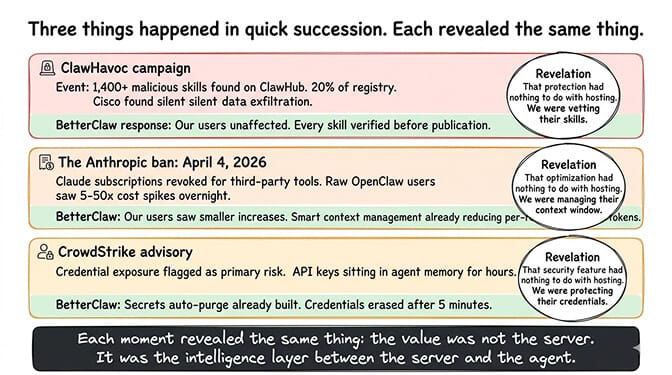
Three things happened in quick succession in 2026, and each one showed the same gap in how most people run AI agents.
The ClawHavoc campaign hit. Security researchers found 1,400+ malicious skills on ClawHub, roughly 20% of the registry. Cisco independently discovered a skill performing data exfiltration without user awareness. Our users weren't affected because every skill on our marketplace is tested before publication. That protection has nothing to do with servers. It comes from vetting skills.
The Anthropic ban landed. On April 4, 2026, Anthropic killed Claude Pro/Max subscriptions for third-party tools including OpenClaw (a ban it reversed on May 13). Users on raw OpenClaw saw their costs spike 5-50x overnight because they were sending full conversation context with every request. Our users saw smaller increases because smart context management was already reducing their per-request token volume. We were managing their context window.
CrowdStrike published their advisory. The enterprise security report flagged credential exposure as a primary risk. API keys sitting in agent memory for hours or days, accessible to any skill that could read the memory files. We'd already built secrets auto-purge: credentials erased from agent memory after 5 minutes. We were protecting their credentials.
Each of these moments pointed to the same thing. The value isn't where an agent runs. The value is the intelligence and security layer around the agent.
For the full comparison of what BetterClaw includes versus raw OpenClaw, our alternative page covers the complete feature breakdown.
What BetterClaw actually is (the three things that matter)
Here's the clearest way to explain it.
OpenClaw is an open-source agent framework. It made autonomous AI agents popular. But self-hosting it comes with three specific problems the framework itself doesn't solve: token waste, skill supply chain risk, and credential exposure.
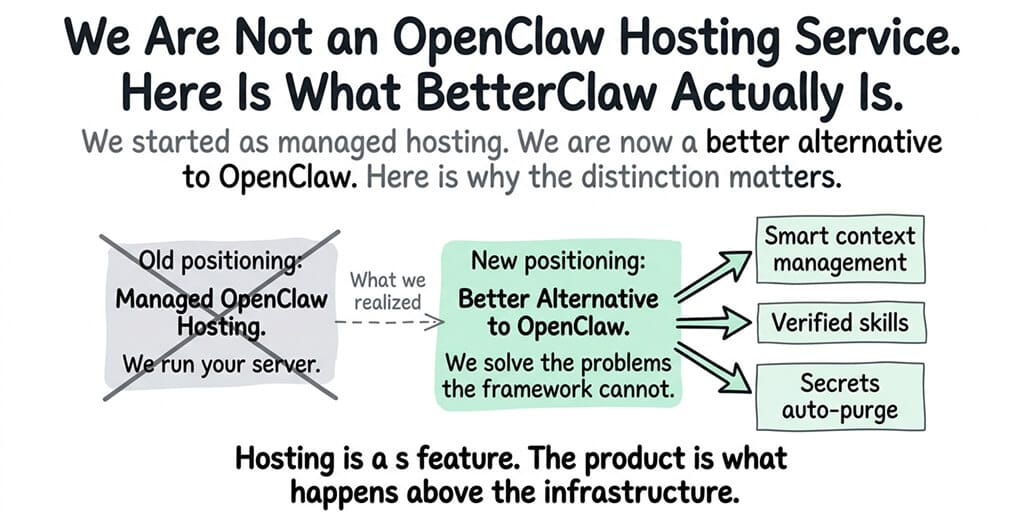
BetterClaw is a no-code AI agent platform built to avoid all three. It isn't a way to host OpenClaw. It's a separate platform with those layers built in.
Smart context management (the token problem)
OpenClaw sends the full conversation history, SOUL.md, tool results, and system prompts with every API request. By message 30, a single request can contain 25,000+ input tokens. Every heartbeat (48 per day) sends the same overhead. The viral "I Spent $178 on AI Agents in a Week" Medium post was the direct result of this default behavior.
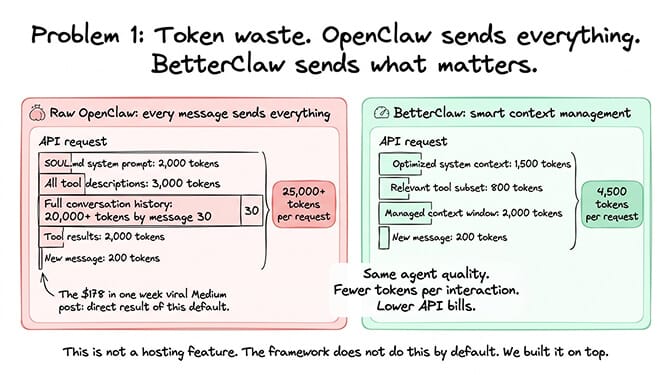
BetterClaw's smart context management prevents this. We optimize what gets sent with each request so you're not burning tokens on housekeeping. Same agent quality. Fewer tokens per interaction. Lower API bills.
Unlimited skills, verified curated set (the supply chain problem)
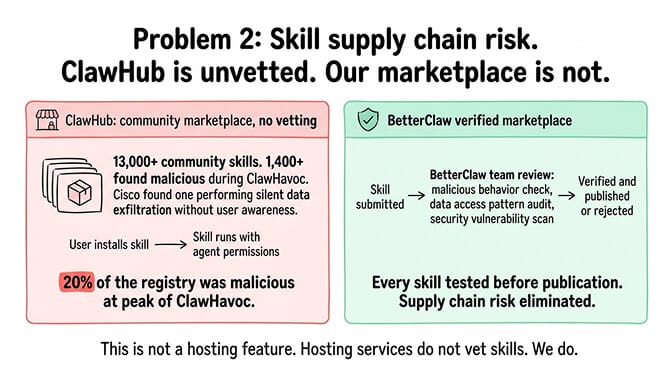
ClawHub has 13,000+ community skills. 1,400+ were found malicious during ClawHavoc. Cisco found one performing silent data exfiltration. The OpenClaw maintainer Shadow warned: "if you can't understand how to run a command line, this is far too dangerous of a project for you to use safely."
BetterClaw gives you unlimited skills, with a 4-layer security audit on our curated set in the verified marketplace: every curated skill is tested before publication. Our team reviews each skill for malicious behavior, data access patterns, and security vulnerabilities before it hits the marketplace. It's a curation layer that eliminates the supply chain risk.
For the full skill security vetting process, our security vetting page covers what we check and why.
Secrets auto-purge (the credential problem)
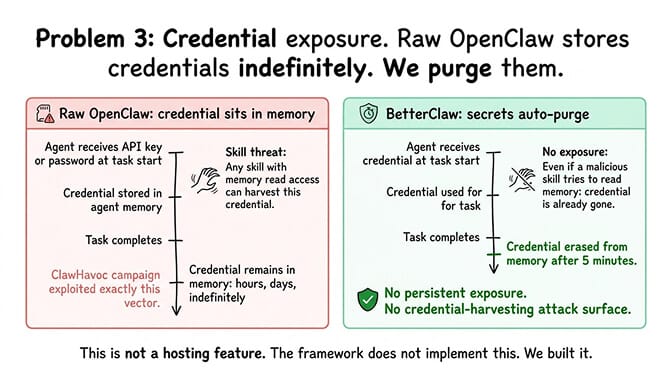
When you give a self-hosted OpenClaw agent an API key, a password, or a credential, it sits in the agent's memory indefinitely. Any skill that can read memory files can access those credentials. The ClawHavoc campaign exploited exactly this vector.
BetterClaw purges credentials from agent memory after 5 minutes. The agent uses the credential for the task, then it's erased. No persistent exposure. No credential-harvesting attack surface.
BetterClaw = a no-code AI agent platform with smart context management, unlimited skills, and secrets auto-purge built in. Infrastructure is included. But infrastructure isn't the product. Those three layers are.
Why BetterClaw isn't a hosting service
Here's where most people get it wrong.
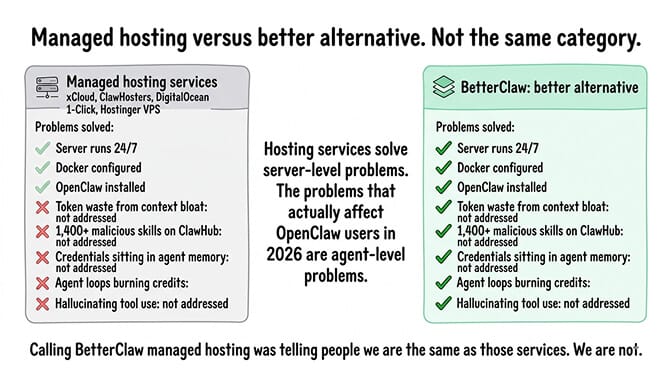
Hosting services like xCloud, ClawHosters, DigitalOcean 1-Click, and Hostinger VPS templates run OpenClaw on a server for you. That's a genuine, useful service. But they don't optimize your context window. They don't vet your skills. They don't purge your credentials.
BetterClaw isn't in that category. It's a no-code AI agent platform, so it solves problems hosting services don't address. Hosting services address server-level problems. BetterClaw addresses agent-level problems.
The problems that actually hurt people running AI agents in 2026 are agent-level problems: token costs spiraling from context bloat (that's us), malicious skills in the supply chain (that's us), credentials exposed in memory (that's us), agents stuck in loops burning credits (our health monitoring catches that), agents hallucinating tool use (our execution environment catches that).
A VPS doesn't catch any of these. A hosting service doesn't catch any of these. A platform built with those layers does.
Who BetterClaw is for
Here's the honest value proposition.
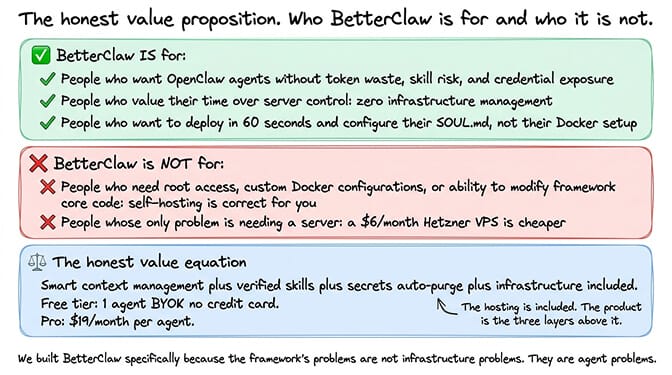
BetterClaw is for people who want AI agents without the three problems that make self-hosted OpenClaw painful. Token waste, skill risk, and credential exposure. We solve those. You also don't touch infrastructure (servers, Docker, updates), but that's table stakes, not the differentiator.
BetterClaw is not for people who want full server control. If you need root access, custom Docker configurations, or the ability to modify a framework's core code, self-hosting OpenClaw is the right choice. We don't pretend to serve that audience.
BetterClaw is not for people who only need a server. If your only problem is "I need somewhere to run OpenClaw," a $6/month Hetzner VPS is cheaper. For the complete self-hosting comparison, our comparison covers the ten scenarios where self-hosting makes sense.
We built BetterClaw because the hardest problems with AI agents aren't infrastructure problems. They're agent problems. And agent problems need agent-level solutions, not server-level solutions.
If you've been wondering whether BetterClaw is just another hosting service, now you know. It's not. It's a no-code AI agent platform that makes your agents work better, cost less, and run safer. Give it a try. Free tier with 1 agent and BYOK. $49/month for Pro. 60-second deploy. Smart context management, unlimited skills, secrets auto-purge.
Where this goes from here
Here's the honest take.
The AI agent space is splitting. OpenClaw (230,000+ stars, 1.27 million weekly npm downloads) is moving to an open-source foundation. The Anthropic ban forced everyone to rethink model economics. Hermes is emerging as a framework alternative with a genuinely different architecture. QClaw is localizing for China. The space is getting more complex, not less.
The constant across all of this: the people using AI agents don't want to manage infrastructure, vet skills, or worry about credential exposure. They want agents that work. Every framework, every fork, every platform eventually has to answer the same three questions: how do you manage token costs, how do you secure the supply chain, and how do you protect credentials?
Those are the questions we built BetterClaw to answer. Not "where does the Docker container run." That was never the interesting question.
If the interesting question for you is "how do I run an AI agent that doesn't waste money, doesn't install malicious code, and doesn't leak my API keys," BetterClaw is the answer. Free tier. $49/month Pro.
Frequently Asked Questions
What is BetterClaw?
BetterClaw is a no-code AI agent platform that solves three specific problems self-hosted agent frameworks don't: token waste (smart context management reduces per-request token volume), skill supply chain risk (unlimited skills, with every curated skill tested before publication), and credential exposure (secrets auto-purge erases credentials from agent memory after 5 minutes). Infrastructure is included but isn't the core product. Free tier available. $49/month for Pro.
Is BetterClaw built on OpenClaw?
No. BetterClaw is a no-code AI agent platform, not a hosted or modified version of OpenClaw. It's an alternative to self-hosting OpenClaw.
How is BetterClaw different from OpenClaw hosting services?
Hosting services (xCloud, ClawHosters, DigitalOcean 1-Click) run OpenClaw on a server for you. BetterClaw is a no-code AI agent platform with three layers built in: smart context management (prevents token bloat that causes costs to spiral), unlimited skills with a security-audited curated set (eliminates the 1,400+ malicious skill risk on ClawHub), and secrets auto-purge (closes the credential exposure vector exploited during ClawHavoc).
Can I move from OpenClaw to BetterClaw?
Yes. You can migrate from self-hosted OpenClaw to BetterClaw by importing your existing configuration. The platform adds optimization, security, and curation for your agents.
How much does BetterClaw cost?
Free tier: 1 agent, 100 credits/month, 3 connectors, basic skills, BYOK required, hosting included, no credit card. Pro: $49/month ($39/month billed annually), 5 agents, 12,000 credits/month, curated skill library, unlimited connectors, smart context management, 2 team seats. Business: $149/month, 25 agents, 40,000 credits/month, 5 seats, priority support. Enterprise: custom pricing. All plans use BYOK with zero inference markup. You pay model providers directly. See the full pricing page for details.