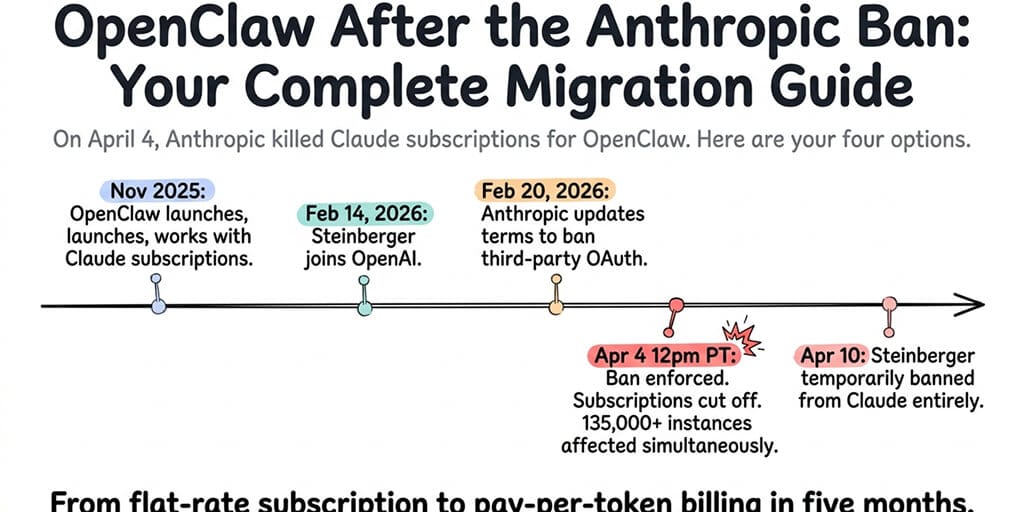
On April 4, Anthropic killed Claude subscriptions for OpenClaw. Here's exactly what changed, what your options are, and how to switch without losing your agent.
Update (September 14, 2026): The ban below didn't last. Anthropic reversed it on May 13, 2026, announcing that third-party agent use on subscriptions would come back through a separate monthly "Agent SDK credit" (non-rollover, billed at API rates) planned to start June 15. On June 15 it paused that change the day it was due: the Agent SDK,
claude -p, and third-party tools built on the Agent SDK continue drawing from normal Pro/Max/Team/Enterprise subscription limits, and Anthropic says it is reworking the plan and will give advance notice before a revised version takes effect. Whether a given tool like OpenClaw works on a subscription today isn't clear-cut, so the options below still apply, and an API key remains the most reliable choice for an always-on agent.
On Saturday, April 4, 2026, at 12pm PT, my OpenClaw agent stopped working mid-conversation. No error message. No warning. Just... silence. I checked the logs. Authentication failure. My Claude Pro subscription, which had been powering my agent for months at a flat $20/month, was no longer accepted.
Anthropic had flipped the switch. Claude Pro and Max subscriptions no longer covered third-party tools, including OpenClaw. Every user who had been running agents on their subscription was cut off simultaneously.
The r/openclaw subreddit exploded. 135,000+ instances affected. Users who were paying $20/month flat suddenly faced API billing at $3/$15 per million tokens for Sonnet. Some estimated their costs would increase 5-50x depending on usage.
Here's what actually changed, why it happened, and the four paths forward.
What Anthropic actually did (the technical change)
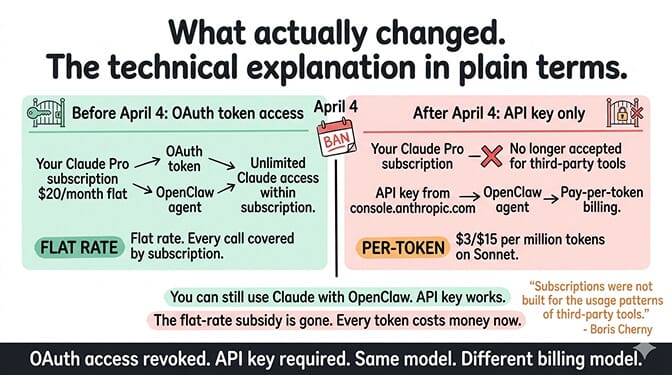
Before April 4, OpenClaw could authenticate with Claude using your subscription's OAuth token. This meant your $20/month Claude Pro plan covered all your agent's API calls. Flat rate. Unlimited within subscription limits.
Anthropic revoked OAuth authentication for all third-party tools. OpenClaw, NanoClaw, OpenCode, and every other external application that used Claude subscription credentials lost access. OAuth tokens were restricted to Anthropic's own products: Claude.ai, Claude Code, and Claude Cowork.
You could still use Claude models with OpenClaw. But you had to use a separate API key with pay-as-you-go billing. Every token cost money. The flat-rate subsidy was gone.
Boris Cherny, Head of Claude Code at Anthropic, explained the reasoning: subscriptions weren't built for the usage patterns of third-party tools. Anthropic was effectively subsidizing API-equivalent workloads at subscription prices, and the economics weren't sustainable.
Anthropic offered a $200 credit to affected users to soften the transition. It helps for about two months of moderate API usage. After that, you're on full per-token billing.
Why this happened (the part that matters)
Here's what nobody tells you about the Anthropic ban.
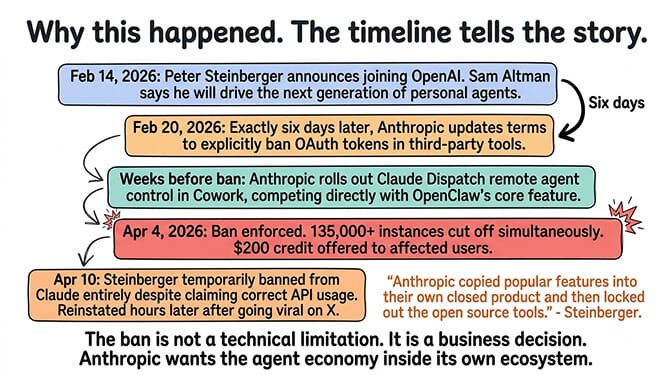
The timeline tells the story. Peter Steinberger announced he was joining OpenAI on February 14, 2026. Sam Altman publicly said Steinberger would "drive the next generation of personal agents" at OpenAI. Six days later, on February 20, Anthropic updated its terms to explicitly ban OAuth tokens in third-party tools. Enforcement followed on April 4.
Steinberger himself connected the dots publicly, saying Anthropic copied popular features into their own closed product and then locked out the open source tools. He was referring to Claude Dispatch (remote agent control) rolling out in Cowork just weeks before the ban.
Then on April 10, Steinberger was temporarily banned from Claude entirely, despite claiming he was using the API correctly. His account was reinstated hours later after the post went viral on X. When asked why he didn't just use OpenAI models, he said he only uses Claude for testing to ensure OpenClaw updates don't break things for Claude users. A TechCrunch report covered the incident in detail.
The Anthropic ban isn't a technical limitation. It's a business decision. Anthropic wants the revenue, the data, and the customer relationship that comes with owning the AI agent ecosystem through Cowork and Claude Code, not through third-party frameworks.
For the broader context of what's happening in the OpenClaw ecosystem, our comparison hub covers how the competitive dynamics are shifting.
Your four options right now
Option 1: Switch to Claude API billing (keep Claude, pay more)
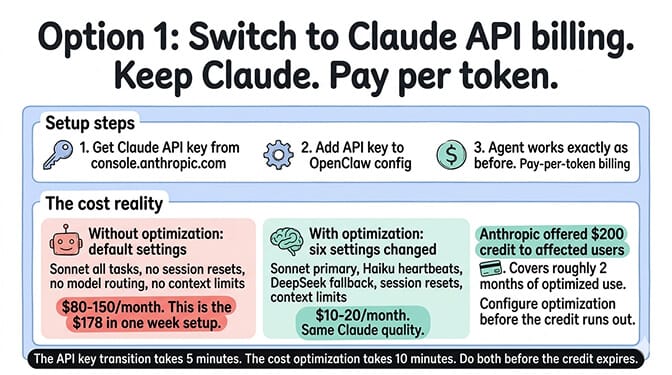
Get a Claude API key from console.anthropic.com. Add it to your OpenClaw config. Your agent works exactly as before but billed per token instead of flat rate.
Cost: Sonnet at $3/$15 per million tokens. With optimization (model routing, session hygiene, context limits), moderate use costs $10-20/month. Without optimization, $80-150/month. The "$178 in one week" viral Medium post was an unoptimized setup.
The $200 credit Anthropic offered covers roughly 2 months of optimized use. Use it while you set up a long-term solution.
For the complete cost optimization stack to keep Claude API bills under control, our eight-step guide covers each setting in priority order.
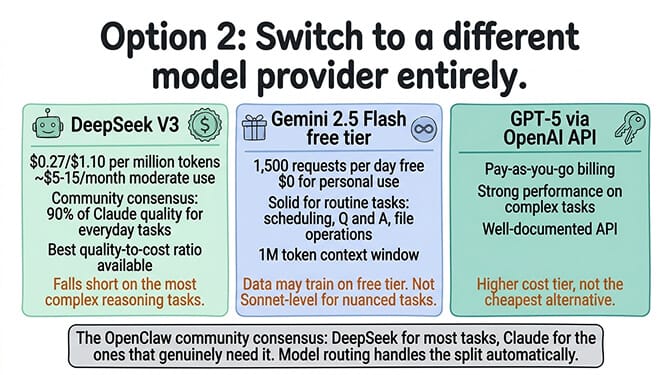
Option 2: Switch to a different model provider entirely
DeepSeek V3 at $0.27/$1.10 per million tokens delivers roughly 90% of Claude quality for everyday agent tasks. Gemini 2.5 Flash offers 1,500 free requests per day. GPT-5 works through OpenAI's API.
Cost: DeepSeek costs $5-15/month for moderate use. Gemini free tier costs $0 for personal use.
The trade-off: Quality varies by task. Claude remains the community's preferred model for complex reasoning and nuanced instruction-following. DeepSeek and Gemini are competitive for routine tasks but fall short on the complex ones.
For the ranked comparison of free and cheap model alternatives, our free model guide covers five options.
Option 3: Set up model routing (use Claude for some, cheap models for rest)
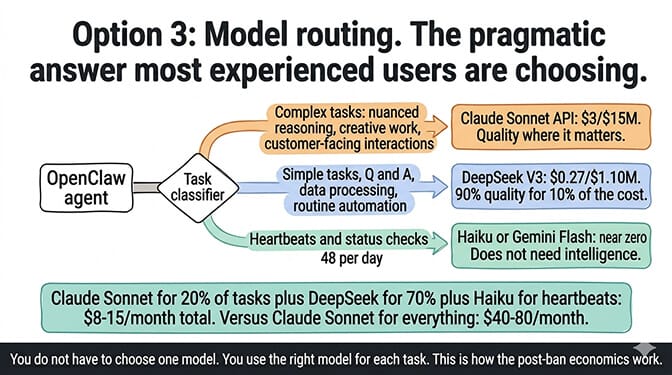
This is the pragmatic answer most experienced users are choosing. Route complex tasks to Claude Sonnet (API billing). Route simple tasks, heartbeats, and fallbacks to DeepSeek or Gemini Flash.
Cost: $8-15/month total. You get Claude quality where it matters and near-free models everywhere else.
This is the approach that makes the post-ban economics work. You don't have to choose one model. You use different models for different tasks.
Option 4: Move to a managed platform (separate the model from the infrastructure)
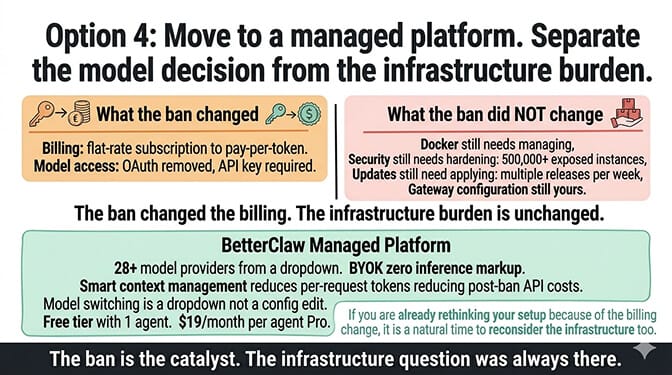
The Anthropic ban changed the billing. It didn't change the infrastructure burden. You still manage Docker, security, updates, and gateway configuration on self-hosted setups.
If you're already rethinking your setup because of the billing change, it's a natural time to reconsider the infrastructure too. BetterClaw supports 28+ model providers including Claude API, DeepSeek, Gemini, and OpenAI. BYOK with zero inference markup. Smart context management means you use fewer tokens per interaction, which directly reduces the post-ban API costs. Free tier with 1 agent and BYOK. $49/month for Pro (5 agents included).
What this means for the long term
Here's the honest take.
Anthropic made it clear in April that subscription pricing wasn't built for third-party frameworks. Then it reversed the ban on May 13, paused its replacement credit plan on June 15, and said a reworked plan is coming with advance notice. That churn is the real signal: subscription access for external tools is a moving target.
The OpenClaw community is adapting. Model routing is becoming standard practice. Multi-provider setups (Claude for complex tasks, DeepSeek for everything else) are the new default. Users who depended on a single provider's flat-rate pricing are diversifying.
The broader lesson: don't build critical infrastructure on a pricing model you don't control. A subscription is a gift until it's revoked. An API key with cost optimization is a contract.
If you want model routing, cost optimization, and multi-provider support handled by a platform instead of by your config files, give BetterClaw a try. Free tier with 1 agent and BYOK. $49/month for Pro (5 agents included). 28+ providers from a dropdown. Smart context management reduces your per-request token volume, which matters more than ever when every token costs money. 60-second deploy. The ban changed the billing. We handle the rest.
Frequently Asked Questions
What is the Anthropic OpenClaw ban?
On April 4, 2026, Anthropic revoked OAuth authentication for all third-party tools including OpenClaw, so Claude Pro ($20/month) and Max ($100-200/month) subscriptions stopped covering third-party agent usage and users moved to Claude API keys with pay-as-you-go billing ($3/$15 per million tokens for Sonnet). Anthropic cited unsustainable compute costs from subscription-priced agentic usage. It reversed the ban on May 13, 2026, and on June 15 paused the "Agent SDK credit" system it had announced as the replacement; Anthropic says it will give advance notice before a revised plan takes effect.
Can I still use Claude with OpenClaw after the ban?
Yes. The ban only affected subscription-based OAuth access, and Anthropic reversed it on May 13, 2026. The most reliable way is a separate API key (from console.anthropic.com) in your OpenClaw config, billed per token instead of flat-rate, with no weekly caps. Anthropic offered a $200 credit to affected users at the time. With cost optimization (model routing, session hygiene), moderate use costs $10-20/month on the API.
What's the cheapest alternative to Claude for OpenClaw?
DeepSeek V3 ($0.27/$1.10 per million tokens) at roughly $5-15/month for moderate use. Gemini 2.5 Flash with 1,500 free requests/day for zero cost. The recommended approach is model routing: Claude Sonnet for complex tasks, DeepSeek or Gemini for simple tasks and heartbeats. Total: $8-15/month instead of $80-150/month on Claude alone.
How much more does OpenClaw cost after the Anthropic ban?
Without optimization: 5-50x more, depending on usage. A heavy Claude Pro user paying $20/month flat could face $100-200/month on API billing. With optimization (model routing to cheaper models, session resets every 20-25 messages, context limits, heartbeat routing): $10-20/month on Claude API, or $5-15/month on DeepSeek/Gemini. The optimization determines the cost, not the ban itself.
Does BetterClaw help with the post-Anthropic ban migration?
BetterClaw supports 28+ model providers including Claude API, DeepSeek, Gemini, and OpenAI. BYOK with zero inference markup (you pay providers directly). Smart context management reduces token usage per interaction, which directly lowers post-ban API costs. Model switching is a dropdown, not a config file edit. Free tier with 1 agent and BYOK. $49/month for Pro (5 agents included).