

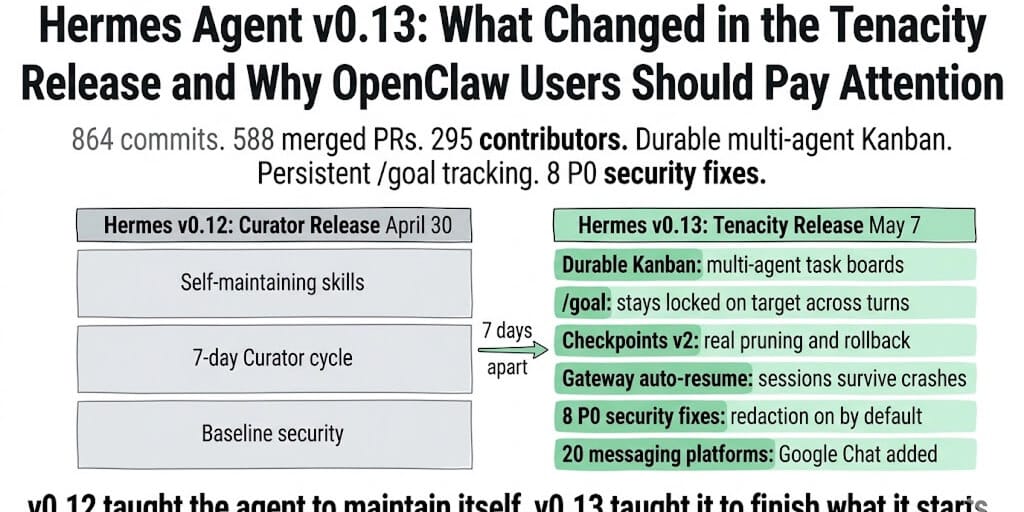
864 commits. 588 merged PRs. 295 contributors. Durable multi-agent Kanban. Persistent /goal tracking. 8 P0 security fixes. Hermes Agent v0.13 just shipped the features OpenClaw users have been requesting for months.
Hermes Agent v0.13 — codename "The Tenacity Release," from Nous Research, shipped May 7, 2026 — adds three flagship capabilities: durable multi-agent Kanban (task boards with heartbeats, zombie detection, retry budgets), persistent /goal tracking (the agent stays locked on a target across turns), and Checkpoints v2 (state persistence with real pruning and rollback). It also closes 8 P0 security issues in one release and grows native messaging channel support to 20. This post covers what shipped, the upgrade path, the known issues, and where it lands against OpenClaw.
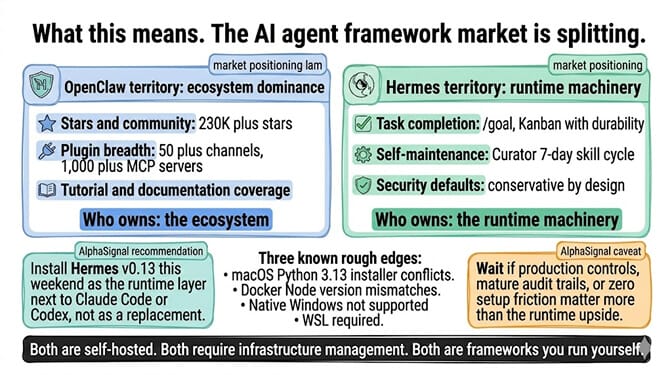
AlphaSignal — the developer newsletter with 200,000+ engineering subscribers — covered the release with a specific recommendation: "Install Hermes v0.13 this weekend as the runtime layer next to Claude Code or Codex, not as a replacement." Not "instead of OpenClaw." Next to it.
One week after v0.12 shipped the Curator (self-maintaining skills), v0.13 shipped Kanban (multi-agent task completion). Two releases in seven days that fundamentally changed what Hermes is. For a from-scratch primer on the project, see our overview of what Hermes Agent is.
What "The Tenacity Release" Actually Ships
The tagline says it all: "Hermes Agent now finishes what it starts."
Before v0.13, Hermes (like OpenClaw) had a completion problem. You'd ask the agent to do a multi-step task. It would start, hit a snag, and either loop, hallucinate a result, or silently abandon the work. The agent was smart. It just wasn't persistent.
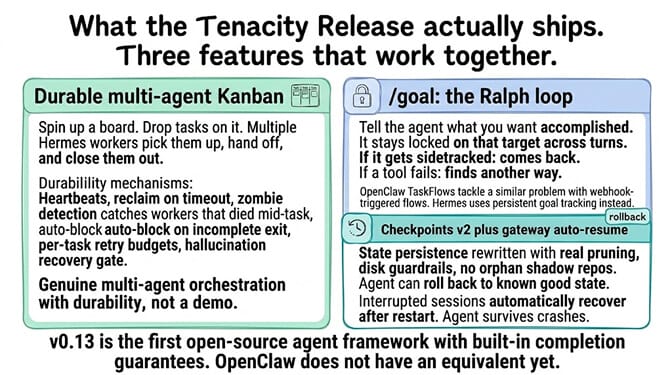
v0.13 attacks this with three features that work together:
Durable multi-agent Kanban
Spin up a board. Drop tasks on it. Multiple Hermes workers pick them up, hand off, and close them out. Heartbeats, reclaim on timeout, zombie detection (catches workers that died mid-task), auto-block on incomplete exit, per-task retry budgets, and a hallucination recovery gate. This is genuine multi-agent orchestration with durability, not a demo.
/goal (the Ralph loop)
Tell the agent what you want accomplished. It stays locked on that target across turns. If it gets sidetracked, it comes back. If a tool fails, it finds another way. The agent doesn't forget what you asked it to do. OpenClaw's TaskFlows (v2026.4.7) tackle a similar problem but with a different architecture: webhook-triggered flows versus persistent goal tracking.
Checkpoints v2
State persistence rewritten with real pruning, disk guardrails, and no orphan shadow repos. The agent can roll back to a known good state. Combined with gateway auto-resume (interrupted sessions automatically recover after restart), the agent survives crashes.
The shift: v0.12 taught Hermes to maintain itself (Curator — the self-maintaining skill library introduced in v0.12). v0.13 taught it to finish what it starts (Kanban + /goal + Checkpoints). Together, they make Hermes the first open-source agent framework with built-in completion guarantees. OpenClaw doesn't have an equivalent yet.
The Security Wave (8 P0 Closures in One Release)
Here's what nobody tells you about Hermes security.
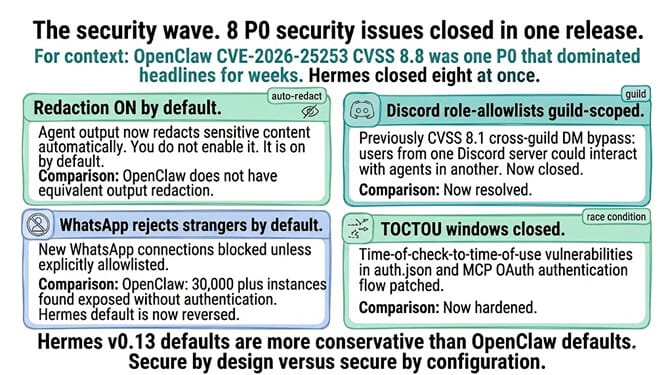
v0.13 closed 8 P0 security issues in a single release. For context, OpenClaw's CVE-2026-25253 (CVSS 8.8, one-click RCE) was one P0 that dominated headlines for weeks. Hermes closed eight at once.
Redaction ON by default
Agent output now redacts sensitive content automatically. You don't enable it. It's on. OpenClaw doesn't have equivalent output redaction.
Discord role-allowlists are now guild-scoped
Previously, a CVSS 8.1 cross-guild DM bypass let users from one Discord server interact with agents in another. Closed.
WhatsApp rejects strangers by default
New WhatsApp connections are blocked unless explicitly allowlisted. Compare to OpenClaw where Bitsight identified more than 30,000 instances exposed without authentication between January 27 and February 8, 2026 (with ~63% flagged vulnerable).
TOCTOU windows closed
Time-of-check-to-time-of-use vulnerabilities are patched across auth.json and MCP OAuth, eliminating the authentication-flow race conditions that previously allowed token theft.
For the OpenClaw security risks analysis, our security risks deep dive covers the broader attack surface that both frameworks share.
The Platform Count (20 and Growing)
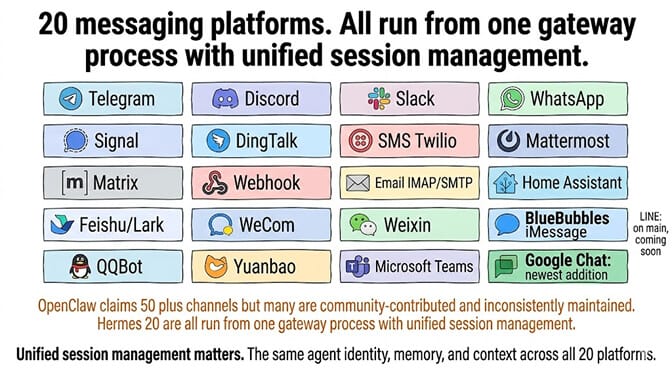
Hermes v0.13 added Google Chat as its 20th messaging platform. The full list: Telegram, Discord, Slack, WhatsApp, Signal, DingTalk, SMS (Twilio), Mattermost, Matrix, Webhook, Email (IMAP/SMTP), Home Assistant, Feishu/Lark, WeCom, Weixin, BlueBubbles (iMessage), QQBot, Yuanbao, Microsoft Teams, and Google Chat. LINE support is on main.
OpenClaw claims 50+ channels but many are community-contributed and inconsistently maintained. Hermes's 20 are all run from one gateway process with unified session management.
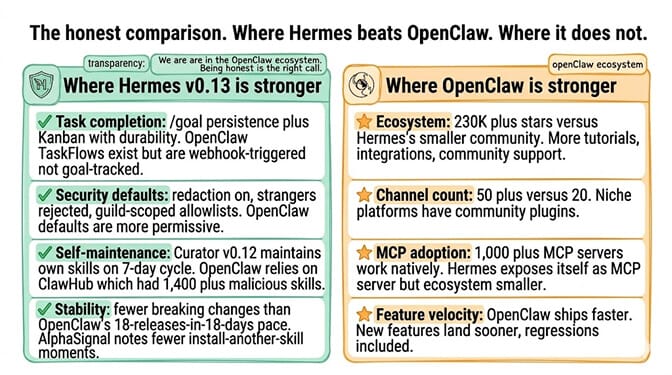
The Honest Comparison (Where Hermes Beats OpenClaw, Where It Doesn't)
| Dimension | Hermes v0.13 | OpenClaw |
|---|---|---|
| Task completion | Native /goal persistence + durable Kanban | TaskFlows (webhook-triggered, not goal-tracked) |
| Security defaults | Redaction on, strangers rejected, guild-scoped allowlists | More permissive defaults; gateway can bind to 0.0.0.0:18789 |
| Self-maintenance | Curator (v0.12): 7-day skill library upkeep | Relies on community-maintained ClawHub (security research has flagged 1,467 malicious skills since launch) |
| Stability | Less breaking-change churn | Faster release cadence; more regressions |
| Ecosystem size | Growing | 370K+ GitHub stars, larger community |
| Channel count | 20 official, unified gateway | 50+ (many community-contributed, varying quality) |
| MCP adoption | Exposes itself as MCP server; smaller ecosystem | 1,000+ MCP servers natively supported |
| Feature velocity | Two major releases in one week (v0.12 + v0.13) | Sometimes too fast — see update fatigue |
The short version: Hermes is winning on the runtime machinery (completion, security defaults, self-maintenance), OpenClaw is still ahead on the surrounding ecosystem (stars, channels, MCP servers, plugin count). Many users in the AlphaSignal threads are running both — Hermes as the runtime layer, OpenClaw for ecosystem breadth.
If you'd rather not pick a framework or operate one yourself, BetterClaw is a no-code AI agent platform with platform-level optimizations — smart context management, verified skills, secrets auto-purge, managed deployment. We track both ecosystems so you don't have to. Free plan with 1 agent + BYOK, $49/month for Pro.
How to upgrade from v0.12 to v0.13
If you're already on v0.12, the upgrade path is the standard Hermes installer flow. From a working install:
# Fetch the v0.13 release
curl -fsSL https://hermes-agent.nousresearch.com/install.sh | sh

# Or, if you installed via the binary path
hermes update
No config migration is required for the core gateway. New features (/goal, Kanban boards, Checkpoints v2) opt in per-session — your existing SOUL.md and skills continue to work unchanged. After the install, run hermes doctor to verify the v0.13 gateway is healthy.
Known issues and workarounds
A few sharp edges are worth knowing about before you upgrade. AlphaSignal's framing fits: this is "Tenacity, not Production."
- macOS + system Python 3.13: the installer's bundled venv pins Python 3.11, and detection of a system Python 3.13 currently misfires. Workaround: install Python 3.11 explicitly via
pyenv(or use the official binary installer path which manages its own venv). - Node version mismatches during install: if the installer reports a Node version conflict, delete
~/.hermes/, install Node 20+ viabreworapt, and rerun the installer. (Note: this isn't a Docker-specific bug — Docker is community-maintained, not the official path.) - Native Windows is early-beta; WSL2 is recommended. Native Windows installs run but are less battle-tested than Linux and macOS. Use WSL2 for production-leaning work.
/goaluses a judge model to decide when a goal is complete. Community reports note it can either declare success prematurely or hold a goal open longer than expected. Spot-check goal completions before treating them as authoritative.
If you hit something not listed here after upgrading, our roundup of Hermes Agent bugs and fixes tracks the ten most reported failures across recent releases and which version closed each one.
What this means for the AI agent space
Hermes v0.13 is the first time an OpenClaw competitor shipped features that OpenClaw users actively want and don't have: goal persistence, multi-agent Kanban with durability, default-on security redaction, and self-maintaining skills. The market is splitting — OpenClaw owns the ecosystem (370K+ stars, 1,000+ MCP servers, broader channel coverage), Hermes owns the runtime machinery (completion, self-maintenance, security defaults). Both are self-hosted. Both require infrastructure management. AlphaSignal's framing — install Hermes next to, not instead of — is the realistic posture for most teams right now.
For the side-by-side comparison of Hermes against BetterClaw, our BetterClaw vs Hermes post covers how the managed platform compares to the self-hosted framework.
If you'd rather skip both installer flows, start free on BetterClaw — 1 agent + BYOK, no credit card. Pro is $49/month. We track both ecosystems so you don't have to. Your agent runs. The framework operations are ours.
Frequently Asked Questions
What is Hermes Agent v0.13?
Hermes Agent v0.13, called "The Tenacity Release," shipped May 7, 2026 from Nous Research. It adds durable multi-agent Kanban (task boards with heartbeats, zombie detection, retry budgets), persistent /goal tracking (the agent stays locked on a target across turns), Checkpoints v2 (state persistence with real pruning and rollback), and 8 P0 security fixes. 864 commits, 588 merged PRs, 295 contributors.
How do I upgrade to Hermes v0.13?
From a working v0.12 install, rerun the official installer script (curl -fsSL https://hermes-agent.nousresearch.com/install.sh | sh) or run hermes update if you're on the binary path. No core config migration is required — /goal, Kanban, and Checkpoints v2 opt in per-session. After install, run hermes doctor to verify the gateway is healthy. See the Known Issues section above for macOS Python 3.13 and Node version gotchas.
What does the /goal syntax look like?
/goal is an in-session slash command. Set a goal with /goal <objective> (for example, /goal research the top 5 CRM tools and summarize their pricing). The agent stays locked on the objective across turns. Sub-commands include /goal status (current progress), /goal pause, /goal resume, and /goal clear. UX strings to watch for: "↻ Continuing toward goal," "✓ Goal achieved," "⏸ Goal paused."
How does Hermes v0.13 compare to OpenClaw?
Hermes v0.13 is stronger on task completion (/goal, Kanban), security defaults (redaction on, strangers rejected, guild-scoped allowlists), and self-maintenance (Curator). OpenClaw is stronger on ecosystem size (370K+ stars), channel count (50+ vs 20), MCP adoption (1,000+ servers), and feature velocity. Many users are starting to run both for different purposes.
Should I switch from OpenClaw to Hermes?
Not necessarily. AlphaSignal recommends installing Hermes "next to Claude Code or Codex, not as a replacement." The frameworks have different strengths. If task completion and security defaults matter most, Hermes v0.13 is compelling. If ecosystem breadth, channel support, and community resources matter most, OpenClaw is still ahead. BetterClaw lets you avoid the framework choice entirely with managed deployment.
Is Hermes v0.13 production-ready?
AlphaSignal's assessment: "Tenacity, not Production." Known issues: macOS + system Python 3.13 installer conflicts, Node version mismatches at install time, early-beta native Windows (WSL2 recommended), and a /goal judge model that can prematurely complete or keep goals open. Treat it as a serious test, not a production deployment. The security improvements are real. The stability improvements are real. The rough edges are also real.
Does BetterClaw support Hermes Agent?
BetterClaw is a no-code AI agent platform with platform-level optimizations (smart context management, verified skills, secrets auto-purge). It doesn't run Hermes directly — Hermes is a separate self-hosted runtime — but if what you want is the managed deployment, security, and monitoring layer that both OpenClaw and Hermes users end up needing, BetterClaw provides that. Free plan with 1 agent + BYOK, $49/month for Pro.