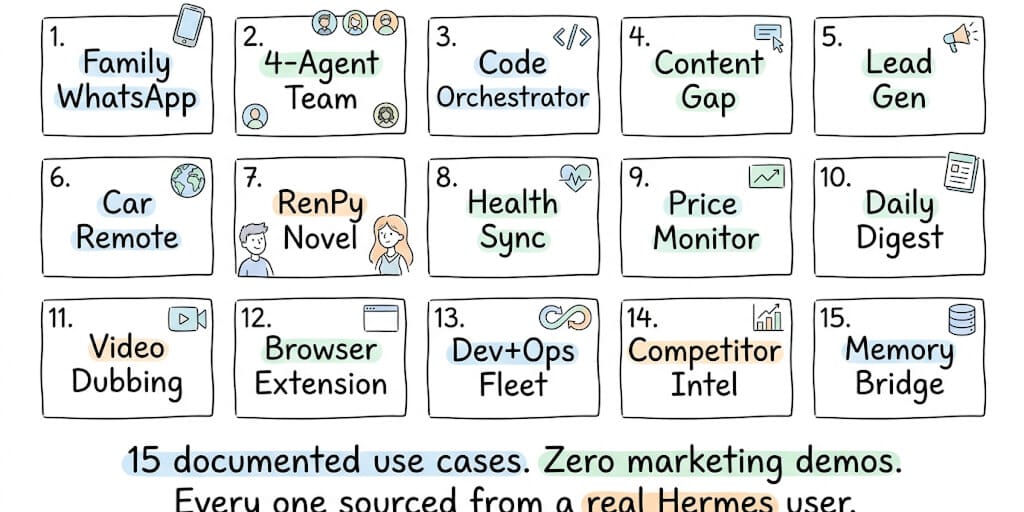
These aren't hypothetical. Every use case below comes from a real user running Hermes in production, documented on Twitter, GitHub, or community forums. Some of them are better served by Hermes. Some are better served by something else. Here's the honest list.
@EXM7777 posted this on April 30: "3 weeks ago I decided to setup a Hermes agent for my family (3 members), they all use it for different use cases, one $200 ChatGPT sub is more than enough. It opened a whole new world for them, just because it lives inside WhatsApp and has magic proactive behaviors."
A family of three sharing one AI agent on WhatsApp. Not a developer tool. Not an enterprise deployment. A family assistant. (If you're new to the framework, our overview of what Hermes Agent is explains the learning loop and memory that make these always-on deployments work.)
That's the use case nobody expected from Hermes. And it's one of fifteen real, documented deployments running right now. Here's the complete list, sourced from the Nous Research user stories page, community Twitter posts, and production deployment reports.
Updated September 28, 2026: Hermes has shipped eight feature releases since this list was written, from v0.14.0 in May to v0.21.0 on August 31, with patch releases up to v0.21.5 on September 24. We added six use cases those releases make possible. Unlike the first fifteen, those six are sourced from the official release notes and docs, not from user reports.
For developers (use cases 1-5)
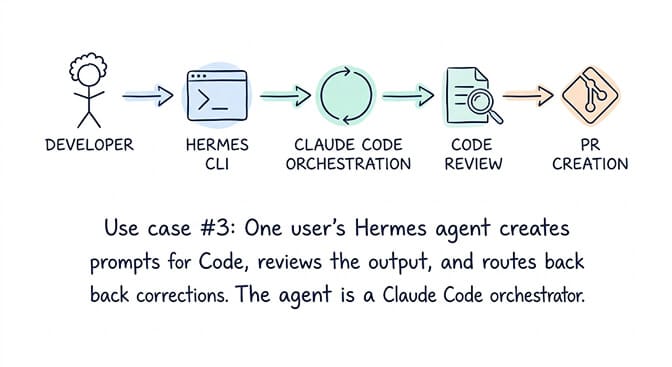
- Claude Code orchestrator and reviewer. @luminousix built a bridge where Hermes creates prompts for Claude Code via SSH, reviews the output, and routes corrections back. "My Hermes agent is a Claude Code orchestrator and reviewer." One agent managing another. The meta-agent pattern.
- Cross-agent memory bridge. @rohitg00 built a memory provider plugin connecting agent memory to Hermes. It covers cross-agent memory between Hermes, Claude Code, and Cursor with hybrid BM25 + vector + knowledge-graph search. Your coding agent and your messaging agent share the same knowledge base.
- Local model inference tuning. @alexcovo_eth used Hermes TurboQuant skills to optimize Qwen3.5-9B-MLX on Apple Silicon. The agent applied, tested, documented, and packaged the optimization path. A repeatable ML workflow managed by the agent itself. If running models locally is your goal, our pick for the best free OpenClaw model covers the trade-offs across local options.
- Content gap analysis (automated weekly). MindStudio documented this: Hermes scraped a YouTube channel, compared recent uploads to industry news, and identified five content gaps. Set as a cron job, it delivers a weekly competitive intelligence report to Telegram without manual intervention.
- Automated lead generation. Same MindStudio demo: "Scrape the internet for Northwest London plumbing businesses, find leads that don't have a website, return three qualified leads so I can pitch them an AI-built website." Hermes found the businesses, verified they lacked websites, and generated personalized pitch angles. Running on a $0.24/hour CPU instance.
For the comparison between Hermes and OpenClaw's approach to automation, our comparison page covers the architectural differences.
For sysadmins and ops (use cases 6-10)
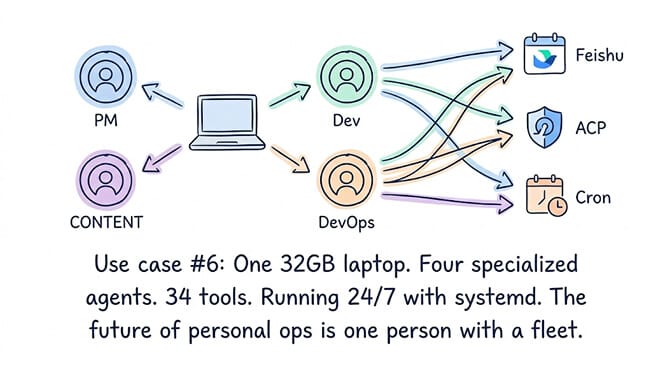
- 4-agent fleet on one laptop. @ones_07389 runs a 4-agent Hermes system 24/7 on a 32GB Ubuntu laptop managed by systemd + custom watchdog. Default agent (PM) on Feishu WebSocket. Dev agent, DevOps agent, and content agent delegated via ACP. 5 MCP servers. 34 tools. Self-learning distillation cron at 04:30 daily. This is a production multi-agent deployment on consumer hardware.
- Car remote start and EV monitoring. @gwyntel built a skill to remote start their car, check EV battery level, and monitor charging status from Hermes. "I noticed nobody else had made a skill for it, so here's mine." IoT meets AI agent.
- Health data sync. @wysie_ built a standalone tool designed to work with Hermes. Connect HC Webhook (a Play Store app) and sync Health Connect data locally. The agent processes health metrics without sending personal data to cloud APIs. Privacy-first health monitoring.
- Price monitoring with alerts. MindStudio tested this: Hermes monitored Autotrader listings and flagged mispriced supercars. Scheduled as a cron job, it delivers deal alerts to Telegram. The same pattern works for competitor pricing, stock alerts, or real estate listings.
- Daily inbox digest. Multiple users run this: Hermes summarizes email every morning, extracts action items, and delivers a clean briefing to WhatsApp or Telegram before you open your laptop. The most common Hermes cron job after heartbeat.
If the daily digest, inbox triage, and messaging automation use cases are what you need but setting up Hermes on your own hardware sounds like more infrastructure work than you want, BetterClaw handles always-on messaging agents with zero setup. Same WhatsApp/Telegram/Slack automation. No laptop running 24/7. No systemd. No custom watchdog. Free tier with 1 agent and BYOK. $49/month for Pro.
For founders and non-technical users (use cases 11-15)
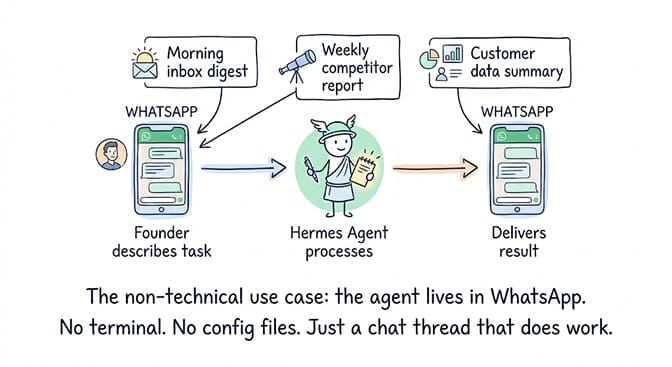
- Family WhatsApp assistant. @EXM7777's setup. Three family members sharing one Hermes agent on WhatsApp. The agent handles different use cases for each person and has "magic proactive behaviors" that surface relevant information before being asked. Cost: one ChatGPT subscription ($200/month for the model access). The agent lives inside WhatsApp, which is why non-technical family members actually use it.
- RenPy visual novel generator. @ExileAI_0: "It found ComfyUI, figured out how to generate images locally with LM Studio, then asked me to turn on the internet to install RenPy. About 10 minutes later there popped up a small but complete RenPy novel with 10 images and a little story." The agent autonomously discovered tools, installed software, generated assets, and assembled a complete creative project.
- Video production handoff. @vicky_dyor gave Hermes a screen recording and asked for a setup tutorial. The agent produced a HeyGen video with her avatar and kept preferences in memory for follow-up work. Creative production initiated from a prompt and delivered as a finished video.
- Browser translation extension. @misswuhanliang developed HermesAI Translator, an open-source browser extension for translation, reading assistance, text polishing, and summarization powered by the Hermes-4-70B model. A consumer product built on top of the Hermes ecosystem.
- Competitor intelligence (scheduled). Hermes scrapes competitor websites on a schedule and delivers a formatted report every Monday. MindStudio confirmed: "The difference between a task you run once and a task that runs every week without you touching it is the difference between a tool and a system."
Six new use cases unlocked by Hermes v0.14-v0.21
These come straight from the Hermes release notes and docs. Each one names the version it arrived in, so you can check your install with hermes --version.
- A team of named bots in one group chat. v0.21.0 ("Pantheon", August 31, 2026) built Bot Mode into the desktop app. Every agent profile gets a name and an avatar. You can create Discord-style group chats where several bots and you talk in one room, and @-mention any bot from the composer. The same release added
hermes peer, which lets one agent message another by handle across profiles and gateways. The release notes' example: ask your research bot to hand its findings to your coding bot and get the reply back where you can read it. It's the 4-agent fleet from use case 6, without the ACP plumbing. - Monitors that remember what they already told you. Also in v0.21.0, cron jobs load and update persistent memory like any other agent.
continuity=truefeeds each run its own previous output, so a price watcher (use case 9) or a news scout stops re-alerting on the same thing. Monitor-mode jobs skip the LLM entirely when nothing changed, and every job gets a durable notepad. From the CLI:hermes cron create "every 6h" "Scan for news" --continuity. In the release notes' words: "Your 9am briefing job now knows what it told you yesterday." - Parallel research you can steer mid-flight.
delegate_taskgrew in three steps. v0.17.0 added background subagents that don't block your chat. v0.18.0 added background fan-out, where several subagents' results come back as one consolidated turn ("research these five competitors in parallel"). v0.21.0 made them steerable while they run: list the children, send one a course correction, or stop it early and keep the partial result. Since v0.19.0, each child also writes a live transcript you cantail -f. Use cases 4 and 15 become one fan-out job. - A hands-free voice assistant. v0.20.0 (August 3, 2026) added streaming conversational voice with barge-in, so you can interrupt mid-sentence. It also added on-device wake words ("hey Hermes", or a phrase you choose), with no audio leaving your machine while it waits. You can send a voice note on WhatsApp, Feishu, DingTalk, LINE, QQ, Photon or Weixin and get a transcribed, spoken answer back. The family WhatsApp assistant (use case 11) no longer needs anyone to type.
- Errands that need a login, without handing over the password. v0.21.2 (September 11, 2026) added a password-blind credential vault. The agent can sign in, pay, and fill in addresses from 1Password, Bitwarden or the local Hermes vault without ever seeing the secret. Two-factor codes come from a saved authenticator key or are asked for in your UI. v0.19.0 had already let Hermes pull API keys from Bitwarden and 1Password instead of a plaintext
.env. Treat this as the riskiest item on the list: an agent that can pay can also pay for the wrong thing, so keep approvals on. - Meeting summaries posted into Microsoft Teams. v0.14.0 (May 16, 2026) shipped Teams end to end, including a meeting pipeline. It fetches transcripts through Microsoft Graph, summarizes them, and posts the summary into a Teams chat or channel. The catch is operational: Graph subscriptions expire within 72 hours, so you have to schedule
hermes teams-pipeline maintain-subscriptions. Our Hermes Teams setup guide walks through it.
One more that's easy to miss: since v0.20.0, Hermes can push signed events (session activity, turn completions, tool events) to any HTTP endpoint you register. That turns "the agent finished" into a trigger for your CI, dashboards or home automation.
The pattern across all 15 (what actually matters)
Here's what nobody tells you about these use cases.
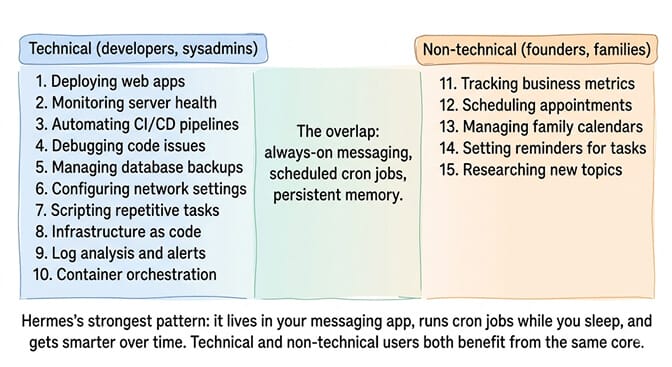
The common thread isn't AI capability. It's persistence. Every use case above works because Hermes runs continuously, remembers across sessions, and operates through messaging channels the user already uses. The AI model does the thinking. The infrastructure does the living. If you would rather not own that infrastructure, a hosted AI agent builder supplies the persistence layer for you.
Three patterns repeat across all 15:
Pattern 1: Lives in messaging. WhatsApp, Telegram, Discord, Feishu. The agent is where the user already is. Not a separate app. Not a browser tab. A chat thread.
Pattern 2: Runs on schedule. Cron jobs for daily digests, weekly reports, price monitoring, content analysis. The agent works while the user sleeps. Since v0.21.0, those jobs also remember their previous runs.
Pattern 3: Gets smarter over time. Persistent memory (MEMORY.md, USER.md) and self-created skills. The agent learns the user's preferences and builds reusable playbooks from experience.
These three patterns are exactly what BetterClaw provides as a managed platform. If you want the messaging integration, scheduled automation, and persistent memory without managing your own Hermes or OpenClaw infrastructure, give BetterClaw a try. Free tier with 1 agent and BYOK. $49/month for Pro with 5 agents. 15+ messaging channels. Persistent hybrid memory. Scheduled tasks. 60-second deploy. The patterns are the same. The infrastructure management is ours.
Frequently Asked Questions
What is Hermes Agent used for?
Hermes Agent is used for always-on AI automation across messaging platforms. The 15 most common use cases include daily inbox digests, multi-agent team coordination, code review orchestration, competitive intelligence, lead generation, price monitoring, and family WhatsApp assistants. It differentiates from chatbots through persistent memory, cron scheduling, and self-improving skills. Newer releases added bot group chats and bot-to-bot messaging (v0.21.0), cron jobs with memory (v0.21.0), steerable parallel subagents, voice with wake words (v0.20.0), and a password-blind credential vault (v0.21.2).
How does Hermes Agent compare to OpenClaw for these use cases?
Both handle similar automation patterns. Hermes has stronger goal persistence (/goal, Kanban), self-maintaining skills (Curator), and tighter security defaults (redaction on by default). OpenClaw has the larger ecosystem: roughly 390,000 GitHub stars to Hermes's roughly 250,000 as of September 2026. BetterClaw provides the same patterns as a managed platform without self-hosting either framework.
Can non-technical users set up Hermes Agent?
For basic use cases (WhatsApp assistant, daily digests), yes. The hermes setup wizard handles most configuration. For advanced use cases (multi-agent fleets, custom skills, MCP integration), technical knowledge is needed. BetterClaw offers a no-code alternative with similar always-on messaging capabilities. Free tier available.
How much does it cost to run Hermes Agent?
Hermes itself is free (open-source). Costs come from model API access (per-token prices vary widely by model) and infrastructure (your own hardware or a VPS at $5-10/month). One user runs a 4-agent fleet on a consumer laptop. Another runs on a $0.24/hour CPU instance. BetterClaw offers managed deployment at $0 (Free plan: 1 agent, 100 credits/month, BYOK) or $49/month (Pro, 5 agents).
Is Hermes Agent reliable enough for production use cases?
For the use cases documented here, yes. Multiple users report weeks of continuous uptime with systemd. However, releases move fast and each one brings fixes and regressions. v0.21.0 (August 31) shipped a session-store rewrite that corrupted state.db on some installs until v0.21.2 fixed it on September 11. Native Windows is now installable with a PowerShell one-liner, but WSL2 remains the most battle-tested path. Pin a release tag for anything you depend on, and back up with hermes update --backup before upgrading. When something does break, our roundup of Hermes Agent bugs and fixes covers the most reported failures on the current release. For production reliability without infrastructure management, BetterClaw offers managed deployment with health monitoring and auto-pause on anomalies.