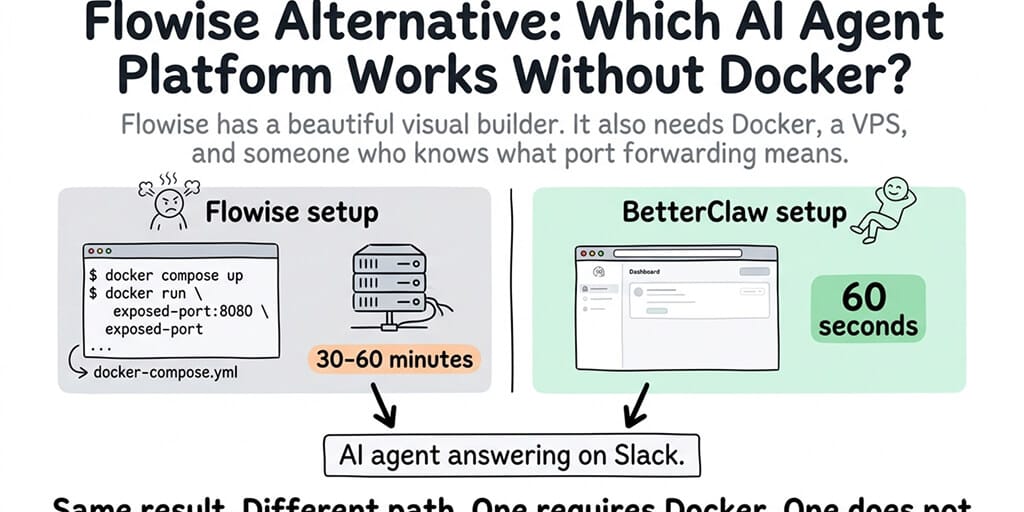
Flowise has a beautiful visual builder. It also needs Docker, a VPS, and someone who knows what port forwarding means. Here's the comparison for teams that don't have that person.
A founder in our community tried to set up Flowise to build a customer support chatbot for her Shopify store. She'd seen the demo video. Drag nodes. Connect them. AI chatbot in minutes.
Twenty minutes in, she was staring at a Docker Compose file trying to figure out why Chromium was failing to install inside the container. The visual builder was right there, behind one more infrastructure hurdle she didn't know how to clear.
I thought this was supposed to be no-code.
Flowise markets as a low-code/no-code AI builder. And the builder itself is genuinely no-code. Beautiful drag-and-drop canvas. Intuitive node connections. Clear visual logic. But getting to the builder requires Docker, Node.js, or a cloud VM. The building is no-code. The hosting is very much code.
This is the honest Flowise comparison for teams evaluating whether they need a visual pipeline builder or a managed conversational agent platform. Different tools, different strengths, different audiences.
Where Flowise genuinely wins (and it wins on several things)
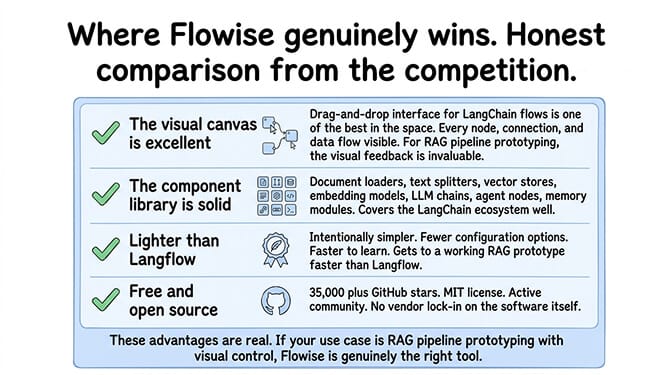
The visual canvas is excellent. Flowise's drag-and-drop interface for building LangChain flows is one of the best in the space. You see every node, every connection, every data flow. For teams prototyping RAG pipelines or complex retrieval chains, the visual feedback is invaluable.
The component library is solid. Document loaders, text splitters, vector stores, embedding models, LLM chains, agent nodes, memory modules. Flowise covers the LangChain ecosystem well. If your use case maps to a LangChain pattern, there's probably a Flowise component for it.
It's lighter than Langflow. Where Langflow has 150+ components and a heavier footprint, Flowise is intentionally simpler. Faster to learn. Fewer configuration options. For straightforward RAG chatbots and Q&A systems, Flowise gets you to a working prototype faster than Langflow. (If you're weighing the two visual builders directly, our Langflow alternative breakdown covers the migration story after DataStax shut down hosted Langflow, and if you're comparing code-first frameworks instead, our CrewAI alternative guide covers the no-code-versus-Python tradeoff.)
It's free and open source. 35,000+ GitHub stars. Active community. MIT license. No vendor lock-in on the software itself.
For the broader comparison of AI agent alternatives, our alternative page covers how different platforms address different use cases.
The infrastructure wall (the part the demo doesn't show)
Here's where most people get it wrong.
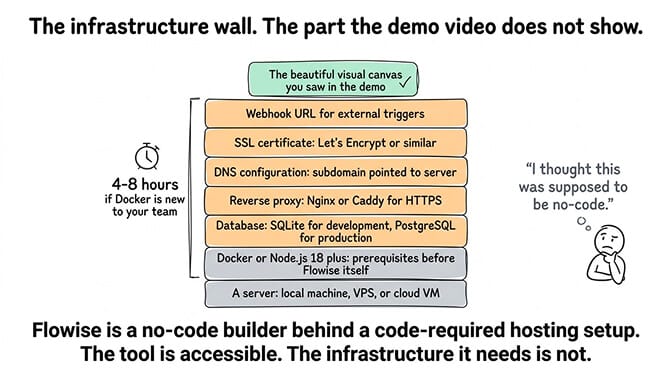
Flowise's demo videos show the canvas. They don't show the 30-60 minutes before the canvas: installing Docker, configuring environment variables, setting up a reverse proxy for HTTPS, configuring the database backend, and opening the right ports on your firewall.
Self-hosted Flowise requires:
A server (local machine, VPS, or cloud VM). Docker or Node.js 18+. A database (SQLite for development, PostgreSQL for production). Reverse proxy for HTTPS (Nginx, Caddy). DNS configuration if you want a custom domain. SSL certificate. Webhook URL for external triggers.
Flowise Cloud exists and eliminates the self-hosting. But at the time of writing, pricing and execution limits vary. Check flowise.ai for current cloud options.
The reality for non-technical teams: If nobody on your team has deployed a Docker container before, Flowise's self-hosted setup is a 4-8 hour learning project, not a 30-minute quick start. The visual builder is genuinely no-code. Everything before the visual builder is not. A hosted no-code AI agent builder removes the everything-before entirely, and the price you pay for that is giving up self-hosting control.
Flowise is a no-code builder behind a code-required hosting setup. The tool itself is accessible. The infrastructure it needs isn't.
The category question: pipeline builder versus conversational agent
Here's what nobody tells you about choosing between Flowise and a managed agent platform.
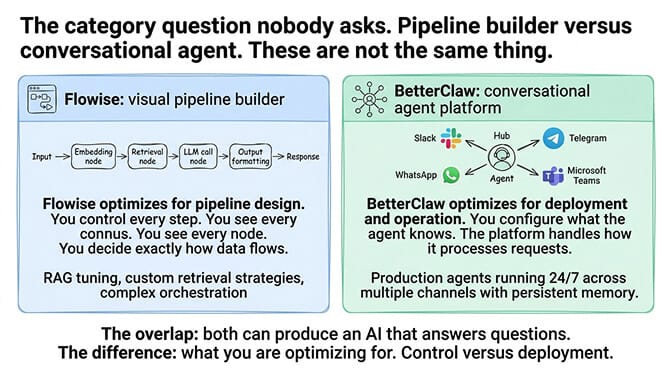
They're different categories. Flowise builds LangChain pipelines. You design a flow: input comes in, gets processed through nodes (embedding, retrieval, LLM call, output formatting), and produces a response. Each flow is a specific pipeline.
BetterClaw builds conversational agents. You configure a personality (SOUL.md), connect channels (Slack, WhatsApp, Telegram), add skills, and the agent handles conversations with persistent memory and multi-turn context.
The overlap is in the outcome: both can produce an AI that answers questions. The difference is in the architecture and what you're optimizing for.
Flowise optimizes for pipeline design. You control every step. You see every node. You decide exactly how data flows through the system. Great for RAG tuning, custom retrieval strategies, and complex orchestration.
BetterClaw optimizes for deployment and operation. You configure what the agent knows and how it behaves. The platform handles how it processes requests. Great for production agents that need to run 24/7 across multiple channels without monitoring.
When to choose Flowise (genuinely the right tool)
Choose Flowise when your team has someone comfortable with Docker and server management. When your use case is RAG pipeline building and you need to control every retrieval step. When you're prototyping and want to see the data flow visually. When you want full open-source self-hosting with no vendor dependency.
Flowise is excellent for developers building custom LangChain applications. The visual canvas accelerates what would otherwise be code-only pipeline design.
When to choose a managed agent platform instead
Choose a managed platform when nobody on your team wants to manage Docker, databases, or SSL certificates. When your use case is a conversational agent that handles messages on WhatsApp, Slack, or Telegram. When you need persistent memory across conversations. When you need the agent running 24/7 with health monitoring. When security matters (verified skills, secrets auto-purge, sandboxed execution).
If your Shopify founder friend just wants a support chatbot on WhatsApp that answers product questions and routes complex issues to her team, she doesn't need a visual pipeline builder. She needs a managed agent that deploys in 60 seconds and connects to WhatsApp natively. That's what BetterClaw is built for. Free tier with 1 agent and BYOK. $49/month for Pro. 15+ channels. 28+ model providers. Smart context management keeps token costs low. Verified skills eliminate supply chain risk.
The practical decision (30-second version)
Ask yourself one question: Am I building a pipeline or deploying an agent?
If you're building a pipeline (custom RAG, specific retrieval strategy, visual flow design), Flowise is the right tool. Accept the Docker setup. It's worth it for the visual control.
If you're deploying an agent (support bot, lead qualifier, team FAQ, task assistant on messaging channels), a managed agent platform is the right tool. Skip the Docker setup. For the ;specific agent workflows that work best, our best practices guide covers the configuration patterns.
Some teams use both. Flowise for prototyping and RAG experimentation. BetterClaw for production conversational agents. The tools complement each other because they solve different problems. For the full menu of options sorted by what each actually does, see our best OpenClaw alternatives guide.
The founder with the Shopify store? She ended up on BetterClaw's free tier. Had a WhatsApp support bot answering product questions within an hour. She never opened Docker.
If you're in the same situation, if you want a working agent without the infrastructure project, give BetterClaw a try. Free tier with 1 agent and BYOK. $49/month for Pro. 60-second deploy. The agent runs. The infrastructure is invisible. You handle the conversations, not the containers.
Frequently Asked Questions
What is the best Flowise alternative for non-technical teams?
For conversational agents (support bots, lead qualifiers, team Q&A), BetterClaw deploys in 60 seconds with no Docker or VPS required. For visual pipeline building specifically, Langflow OSS or Flowise Cloud (when available) eliminate self-hosting. The right alternative depends on whether you need a pipeline builder (Flowise category) or a conversational agent (different category entirely).
How does Flowise compare to BetterClaw?
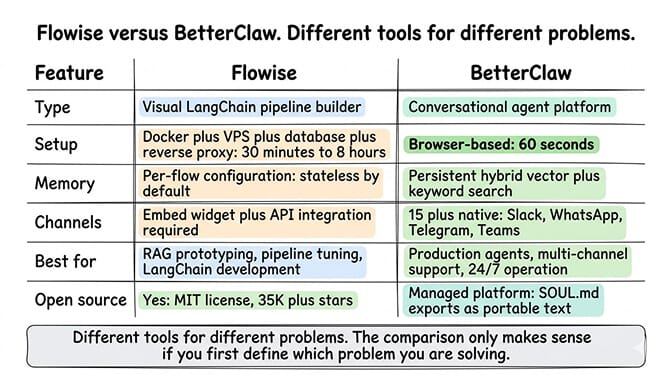
Flowise is a visual LangChain pipeline builder (drag-and-drop nodes, RAG tuning, flow design). BetterClaw is a conversational agent platform (SOUL.md configuration, 15+ messaging channels, persistent memory). Flowise requires Docker and a VPS. BetterClaw deploys from a browser in 60 seconds. They solve different problems: Flowise for pipeline design, BetterClaw for production conversational agents.
Can I use Flowise without Docker?
Yes, with Node.js 18+ installed directly (npx flowise start). But for production use, you still need a server, database backend, reverse proxy, and SSL. Flowise Cloud eliminates self-hosting entirely. Without Docker or Cloud, you're running Flowise locally, which works for development but not for production agents that need 24/7 uptime.
How much does Flowise cost compared to BetterClaw?
Flowise self-hosted: $0 software + $6-12/month VPS + your time. Flowise Cloud: varies (check flowise.ai). BetterClaw: $0 free tier (1 agent, BYOK) or $49/month for Pro. Both use BYOK for AI model costs. The pricing comparison matters less than the category comparison: they're different types of tools serving different use cases.
Is BetterClaw better than Flowise for chatbots?
For production chatbots on messaging platforms (WhatsApp, Slack, Telegram), yes. BetterClaw is purpose-built for conversational agents with persistent memory, multi-channel support, and health monitoring. Flowise can build chatbots through its visual pipeline, but deploying them to messaging channels requires additional integration work. For RAG prototyping and pipeline tuning, Flowise's visual canvas is better than any managed platform.