QClaw is Tencent's Chinese-market version of OpenClaw with native WeChat integration and Kimi models. Here's what it actually changes and who it's for.
Someone posted in r/openclaw last week asking whether QClaw was "the better version of OpenClaw." The top reply: "It's the Chinese version of OpenClaw. Whether that's better depends entirely on whether you live in China."
That reply is 90% correct. But there's more to QClaw than geography.
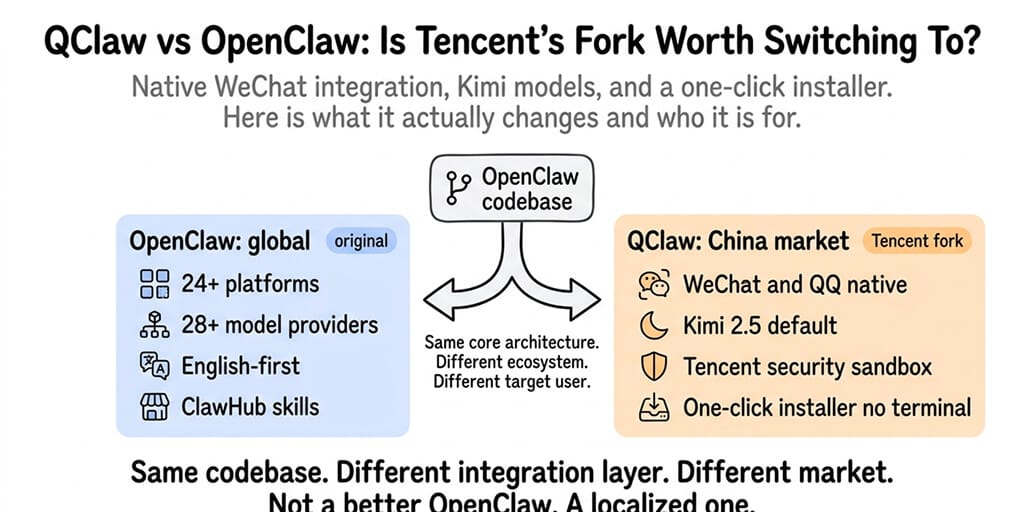
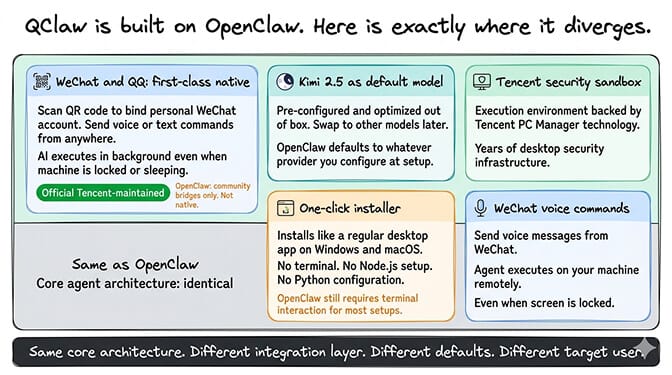
QClaw is a fork of OpenClaw built by the Tencent PC Manager team. It launched in early 2026 as a localized version that deeply integrates with China's messaging ecosystem (WeChat, QQ) and ships with Kimi 2.5 as its default model. It has roughly 2,400 GitHub stars and is currently in closed beta.
The question of QClaw vs OpenClaw isn't "which is better." It's "which ecosystem are you operating in."
Where QClaw falls short
Here's what nobody tells you about QClaw.
Windows and macOS only. No Linux support. A GitHub issue (#1) requests Linux, and the response was essentially "maybe later." For developers who deploy on VPS servers (which are overwhelmingly Linux), this is a fundamental limitation.
Closed beta. QClaw is not generally available. You need to get access during the beta subsidy period. This limits who can actually use it right now and introduces uncertainty about long-term pricing and availability.
Chinese ecosystem dependency. QClaw's advantages (WeChat, QQ, Kimi default) are specific to the Chinese internet ecosystem. If you operate outside China, these integrations aren't useful. WeChat's international version has different capabilities and restrictions. QQ is almost exclusively used in China.
Smaller community. 2,400 GitHub stars versus OpenClaw's 230,000+. The skill ecosystem, community support, and third-party resources are orders of magnitude smaller. ClawHub's 13,000+ skills (with all the security problems that entails) represent a massive catalog that QClaw's users can access but haven't built an equivalent alternative to.
Fork lag. As a fork, QClaw has to merge upstream OpenClaw changes. This means QClaw will always be behind OpenClaw's latest release by some amount of time. Features like memory-wiki (2026.4.7), TaskFlows, and Dreaming (2026.4.9) may take weeks or months to appear in QClaw after they land in the main project.
QClaw is OpenClaw optimized for China. If you operate in China and your communication happens on WeChat, QClaw is genuinely better than raw OpenClaw for your use case. If you operate outside China, QClaw has no advantage over OpenClaw and several disadvantages, and you're better served by one of the best OpenClaw alternatives, which compares NanoClaw, ZeroClaw, Hermes, n8n and five more.
The security question
Both OpenClaw and QClaw share the same core codebase, which means they share the same fundamental security surface. CVE-2026-25253 (CVSS 8.8), the ClawHavoc campaign (1,400+ malicious skills on ClawHub), and the 500,000+ exposed instances on the public internet are all OpenClaw ecosystem problems that affect QClaw too.
QClaw adds Tencent's security sandbox on top, which provides desktop-level isolation. But the underlying agent security model (gateway exposure, skill supply chain, credential storage) is inherited from OpenClaw.
For the detailed breakdown of OpenClaw security risks and mitigations, our security guide covers the attack vectors that affect both OpenClaw and its forks.
If you're evaluating whether to self-host OpenClaw, QClaw, or use a managed platform, the security calculus is the same: you're responsible for gateway security, skill vetting, credential protection, and update patching on any self-hosted fork. Managed platforms handle these protections by default.
If securing OpenClaw or QClaw yourself isn't how you want to spend your time, BetterClaw includes verified skills, secrets auto-purge, and Docker-sandboxed execution as part of the platform. Free tier with 1 agent and BYOK. $49/month for Pro. The security layer is built in, not bolted on.
Who should actually consider QClaw
The decision framework is straightforward.
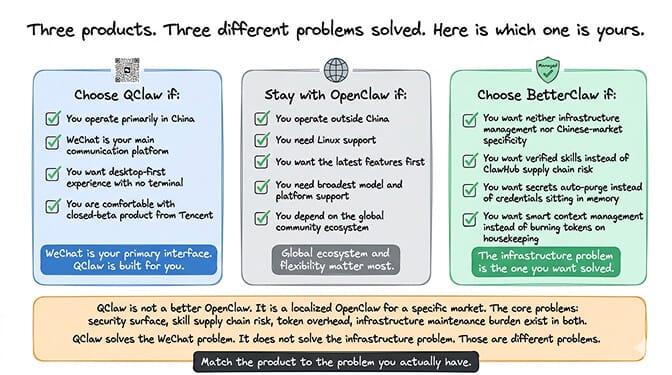
Choose QClaw if: You operate primarily in China, WeChat is your main communication platform, you want a desktop-first experience with no terminal, and you're comfortable with a closed-beta product from Tencent.
Stay with OpenClaw if: You operate outside China, need Linux support, want the latest features first, need the broadest model and platform support, or depend on the global community ecosystem.
Choose BetterClaw if: You want neither the infrastructure management of OpenClaw nor the Chinese-market specificity of QClaw. You want verified skills instead of ClawHub's supply chain risk. You want secrets auto-purge instead of credentials sitting in memory. And you want smart context management instead of burning tokens on housekeeping.
For the migration path from OpenClaw to a managed platform, our migration guide covers how to bring your SOUL.md, memory files, and configurations with you.
The honest take: QClaw isn't a "better OpenClaw." It's a localized OpenClaw for a specific market. The core problems (security surface, skill supply chain risk, token overhead from default context management, infrastructure maintenance burden) exist in both. QClaw solves the WeChat problem. It doesn't solve the infrastructure problem. Those are different problems.
If the infrastructure problem is the one you want solved, give BetterClaw a try. Free tier with 1 agent and BYOK. $49/month for Pro (5 agents included) with full skill access. 60-second deploy. Verified skills. Secrets auto-purge. Smart context management. The platform solves the problems that forks can't, because the problems aren't in the codebase. They're in the operational model.
Frequently Asked Questions
What is QClaw and how is it different from OpenClaw?
QClaw is a fork of OpenClaw built by the Tencent PC Manager team. It's a Chinese-market localization that adds native WeChat and QQ integration, ships with Kimi 2.5 as the default model, includes a one-click installer (no terminal needed), and runs inside Tencent's security sandbox. The core agent architecture is the same as OpenClaw. The differences are in the integration layer, default model, and target ecosystem. It currently has about 2,400 GitHub stars and is in closed beta.
Should I switch from OpenClaw to QClaw?
Only if you operate primarily in China and WeChat is your main communication platform. QClaw's advantages (native WeChat/QQ, Kimi default, Tencent sandbox) are specific to the Chinese internet ecosystem. Outside China, QClaw has no advantages over OpenClaw and several disadvantages: no Linux support, smaller community, closed beta access, and fork lag behind OpenClaw's latest features (memory-wiki, TaskFlows, Dreaming).
Does QClaw fix OpenClaw's security problems?
Partially. QClaw adds Tencent's desktop security sandbox, which provides execution isolation. But the underlying OpenClaw security surface (gateway exposure, ClawHub skill supply chain with 1,400+ malicious skills, credential storage) is inherited from the core codebase. CVE-2026-25253 and the ClawHavoc campaign affect both. QClaw doesn't add verified skills, secrets auto-purge, or managed security infrastructure. Those require a different approach.
How does QClaw compare to BetterClaw?
QClaw is a self-hosted fork for the Chinese market with WeChat integration. BetterClaw is a managed platform that works globally with Telegram, Slack, Discord and Gmail, plus webhooks and 120+ connectors. QClaw requires you to install, secure, and maintain the agent yourself. BetterClaw eliminates infrastructure management entirely. QClaw relies on ClawHub for skills (with its supply chain risks). BetterClaw offers a verified skills marketplace. Different products solving different problems.
Is QClaw free?
QClaw itself is open source and free. During the closed beta, Tencent is subsidizing usage, meaning you get access to Kimi 2.5 at reduced or no cost. After beta, pricing is unclear. You'll still need to pay for AI model API costs (BYOK) unless Tencent continues subsidizing. Running it requires your own Windows or macOS machine. There's no Linux support and no cloud hosting option.